

Start with a ready-made vacation rental script, brand it for your niche, connect payments and owner payouts, and bring in properties, so stays are booked on your own site instead of through a platform that takes a cut each time.
Vrbo’s Help Center now lists a 12% host commission, and industry reports date the change to October 29, 2026. A manager who books $400,000 a year there (an example figure) is looking at a $48,000 line item worth questioning.
The Zipprr vacation rental script is one way to bring that revenue home. This guide shows how the model works, what it costs, and how to decide if it fits you.
What is a vacation rental script?
A vacation rental script is ready-made software for running a rental booking website. It bundles property listings, availability calendars, guest checkout, owner dashboards, commissions, and payouts. You apply your brand and launch without writing a booking engine from scratch.
People also call it a Vrbo clone, a vacation rental clone, a property rental script, or a villa, condo or cabin rental script. The product is the same idea in different wording.
What does a Vrbo-style platform include?
A working platform has three sides: guests who search and book, owners or managers who list and get paid, and an admin who runs the business. Each side needs its own screens and rules.
- Guest side: location and filter search, map view, instant or request-to-book, wishlists, messaging, digital receipts, reviews, and multi-language, multi-currency display.
- Owner side: a multi-property dashboard, calendar sync, dynamic pricing, house rules, guest screening, and payout tracking.
- Admin side: listing moderation, commission settings, dispute handling, promo codes, featured listings, SEO controls, and reports.
Which business models fit property managers and rental-by-owner sites?
Two models dominate. A property manager runs a branded direct-booking site for a portfolio. A rental-by-owner site lets independent owners list homes and charges them to do so.
Both earn through some mix of the following:
- A commission on each confirmed booking.
- A monthly or yearly listing fee for owners.
- Paid featured placement on search pages.
- A guest service fee added at checkout.
- A management fee for homes you operate yourself.
Pick one lead model and add the rest later. Stacking five fees on day one scares off the owners you need first.
How do the Four Pipes decide if a script fits you?
The Four Pipes check is a simple way to test any rental platform before you buy. Every booking passes through four pipes, and a weak pipe leaks revenue.
Score each pipe from 1 to 5 for your plan. Anything below 3 is your first project, not a reason to skip the launch.
Key takeaway: a script solves the Inventory, Money and Trust pipes quickly. The Demand pipe is still your job.
How does calendar and availability sync work?
Each listing keeps a calendar of booked, blocked and open dates. When a guest books, the dates close automatically. Calendar sync shares those dates with other channels so the same night is not sold twice.
The Zipprr page lists calendar sync in the host app. If you need live two-way sync with other booking sites or a property management system, ask about it during your demo and test it before launch. Do not assume it.
The same availability logic powers other rental products. This explainer on how fleet booking software handles availability shows the pattern in a different industry.
How do owner payouts and commissions work?
The guest pays the platform. The platform keeps its commission, holds the rest, and releases the owner’s share on a set schedule, often after check-in. This protects guests and keeps owners paid on time.
A clean payout flow follows these steps:
Write the release rule into your owner agreement before launch. Vague payout terms cause more owner complaints than any missing feature.
Why does direct booking matter more now?
Platform fees are moving up, not down. Airbnb moved many software-connected hosts to a 15.5% host-only fee in October 2025, and Vrbo now lists 12% on the rental amount plus fees such as cleaning, with card processing included when it handles payments.
A direct site does not remove all costs. You still pay payment processing and marketing. But you keep the guest relationship, the data, and the repeat bookings.
If you want the launch playbook for a marketplace aimed at independent short-stay hosts, read our supply-first launch plan for short-stay marketplaces. This guide stays focused on managers and rental-by-owner sites.
What does it cost and how long does it take to launch?
Zipprr’s vacation rental script is a one-time purchase at $490 or $890, with 90 days of support and installation included. The live product page quotes a launch window of roughly 7 to 14 days, depending on how much you customize.
Native Android and iOS apps and app store submission come with the $890 plan. The $490 plan covers the website and admin source code. Hosting and domains are separate, so budget for them.
| Route | Upfront cost | Typical timeline | You own the code? |
|---|---|---|---|
| Ready-made script (Zipprr) | $490 or $890 one time | About 7 to 14 days | Yes, per the product page |
| Monthly software subscription | Low start, recurring fees | Days to weeks | No, you rent it |
| Custom build from zero | Quote-based, usually large | Months | Yes, if the contract says so |
The right row depends on how much you want to customize and how soon you need bookings. Subscriptions suit teams that never want to touch code. A script suits owners who want the source and no per-booking fee from the software vendor.
Want to see the live pricing and plan details? Compare both plans on the current plan and pricing section before you decide. Prices can change, so always confirm at checkout.
Want our free vacation rental launch checklist? Message us on WhatsApp or ask for it on your demo call.
Want to see the platform before you decide?
See the platform in action, ask about calendar sync and payouts, and get the free launch checklist.
What does a worked example look like?
Here is a hypothetical manager. These numbers are illustrations, not results or promises.
- 30 homes, 8 bookings per home per year, so 240 bookings.
- Average booking value of $1,800, so $432,000 in yearly bookings.
- Goal: move 25% of bookings (60 stays, $108,000) to the direct site.
On a 12% platform commission, that $108,000 would cost $12,960. On a direct site with an assumed 3% card processing cost, it costs $3,240. The difference is $9,720.
Now subtract year-one costs: $890 for the script, $600 for hosting, and $3,000 for marketing. That is $4,490 in total. The example nets about $5,230 in year one, and in later years only hosting and marketing repeat.
The weak spot is the 25% assumption. If only 10% shift, the saving falls to about $3,890 and year one lands slightly below break-even, at about minus $600. Test that number before you commit.
Should you buy a script or build custom?
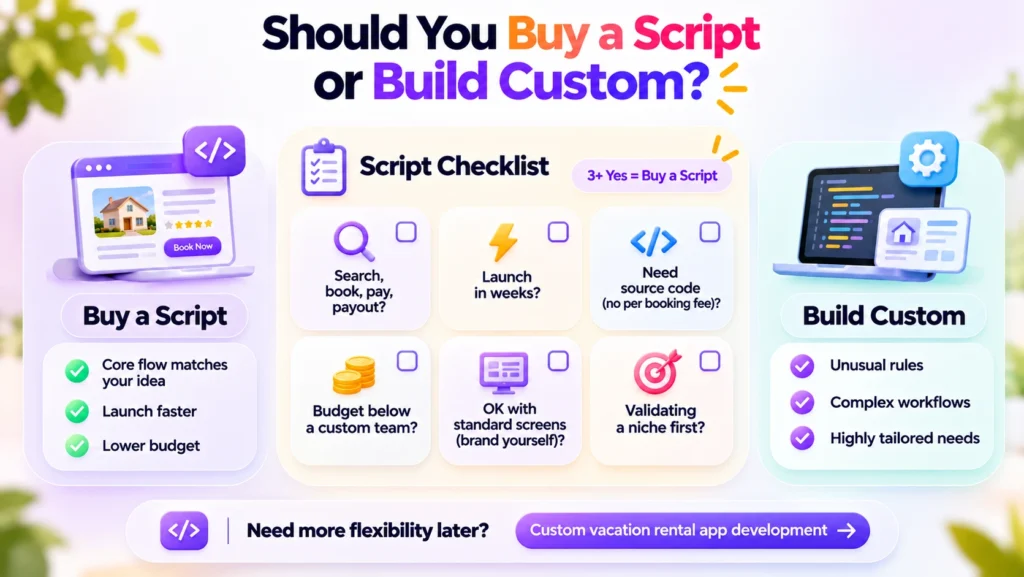
Buy a script when the core booking flow already matches your idea. Build custom when your rules are unusual enough that you would rewrite most of it anyway.
Use this checklist. Three or more “yes” answers point toward a script.
- Is your core flow search, book, pay, and pay out the owner?
- Do you need to launch in weeks, not quarters?
- Do you want the source code and no software fee per booking?
- Is your budget under the cost of a custom team?
- Can you live with standard screens and brand them yourself?
- Are you validating a niche before heavy investment?
If you do want tailored work later, our team also offers custom vacation rental app development on top of a script foundation.
What mistakes do buyers make?
- Recruiting guests before owners. Empty search pages kill trust. Start with supply.
- Launching everywhere at once. One region or one home type is easier to fill.
- Skipping payout rules. Owners ask about money first.
- Ignoring local rules. Short-term rental permits and lodging taxes vary by city. Check yours with a local professional.
- Copying a big brand’s fees. Charge what your first owners will accept.
- Treating launch as the finish line. Search traffic and repeat guests take months to build.
Filling an empty marketplace is the hardest part. The niche-first method for recruiting your first 25 providers works just as well for owners.
What red flags should you watch for in a vendor?
- No live demo you can click through yourself.
- Vague answers about who owns the source code.
- Pricing that changes between the page and the quote.
- No written support period or refund policy.
- Promises of rankings or guaranteed bookings.
- Features listed that the demo cannot show.
Ask for the demo first and the invoice second.
How do you launch in seven days?
Heavy customization stretches this plan, which is why the product page quotes up to 14 days.
How do you win direct bookings after launch?
Treat your site as the home base and the big platforms as advertising. Put a link to your direct site in every guest message and on every listing description where rules allow.
Build location pages for each destination, collect reviews on your own site, and email past guests before each season. Our complete SEO guide covers the page structure and content planning behind that.
If you plan to add flights, tours or other travel services to the same site, see how a travel booking platform is planned and priced.
Who should buy this and who should not?
Buy it if you manage a portfolio or want to run an owner marketplace, and you want to own your code and keep fees low. Talk to us if you need a custom workflow.
Skip it if you only have one or two homes. A simple website builder is cheaper for that. Also skip it if you cannot recruit owners or guests, because the software will not do that for you.
- “Is it expensive?” The price is one time, $490 or $890, with no per-booking fee from Zipprr.
- “Will it take months?” The product page quotes about 7 to 14 days.
- “What about support?” 90 days of support is included.
- “Do I own it?” The product page states 100% source code ownership.
- “What if it is wrong for me?” The page offers a 100% refund within 7 days.
Frequently Asked Questions
1. What is a vacation rental script?
A vacation rental script is ready-made software for running a rental booking site. It includes listings, calendars, guest checkout, owner dashboards, commissions and payouts. You brand it and launch without building a booking system from zero, then add your own owners and guests.
2. What is a Vrbo clone?
A Vrbo clone is a rental platform that offers a similar experience: whole-home listings, search, booking, reviews and owner payouts. It is independently built software, not a copy of any company’s code, and you run it under your own brand and rules.
3. What is a property rental script?
A property rental script is software that lets you list properties and take bookings online. It can cover vacation homes, apartments or villas. The main parts are listings, availability, payments, and a dashboard where owners manage their properties and see payouts.
4. Can I use a rental script for condos?
Yes. A condo rental script works like any vacation rental platform, with listings, a calendar, and payments. Add building rules, check-in details and local permit information to each listing, since many condo associations and cities set their own short-term rental rules.
5. Is there a vacation rental clone like HomeAway?
Yes. HomeAway became part of Vrbo, so a HomeAway-style site is the same whole-home rental model. A vacation rental clone gives you that structure under your own brand, with your own commission and owner terms.
6. What is a villa rental script?
A villa rental script is a rental booking platform tuned for villas and larger private homes. It usually adds longer stays, security deposits, seasonal pricing, and extra photos or amenities. The base software is the same as a general vacation rental script.
7. How much does a vacation rental script cost?
Zipprr’s vacation rental script is a one-time $490 or $890 purchase, with 90 days of support. Hosting, domain, payment processing and marketing are separate. Confirm current pricing on the product page before you buy, since prices can change.
8. How do I rank higher on Vrbo?
Keep your calendar accurate, answer inquiries fast, use many clear photos, and collect guest reviews. Price competitively and keep cancellation terms reasonable. These are common practices rather than guaranteed ranking rules, since the platform sets its own search order.
9. How do I get more bookings on Vrbo?
Improve your photos and description, respond quickly, and keep rates and availability current. Then give repeat guests a reason to book direct, such as a lower total price or a simple booking page on your own site.
10. Does a rental script handle owner payouts?
The Zipprr script lists automated host payouts and payout tracking, with commission set by the admin. Test the full payout flow with a small real booking before launch, and write your release timing into your owner agreement.
Ready to test your vacation rental idea?
See the platform in action, ask about calendar sync and payouts, and get the free launch checklist. You can also email us at [email protected].