

You launch by picking one narrow region, installing a ready-made script in days, and spending your real effort on hosts, payments, and trust. The software is the cheap part: in this guide, the script costs less than one month of a typical marketing budget.
An Airbnb clone script is ready-made, white-label source code for a booking marketplace where hosts list stays, guests search and pay, and you run the platform as admin. Zipprr’s white-label Airbnb clone runs on Laravel and MySQL and covers the guest, host and admin sides, so your first weeks go to supply and demand instead of code.
What does an Airbnb clone script actually include?
A good script covers the whole booking loop: listings, filtered and map-based search, an availability calendar, checkout, messaging, reviews, host payouts and an admin panel for commissions, verification and disputes. You then layer on your brand, your niche and your rules.
Zipprr’s live product page groups the tools by who uses them:
- For guests: filtered search, a map view, a protected checkout, messaging with hosts, saved favorites, trip tracking, notifications and reviews.
- For hosts: quick listing creation, flexible pricing controls, a live availability calendar, booking request handling, an earnings view and payouts.
- For you as admin: commission settings, identity and listing checks, payment gateway setup, coupons, a content manager, several currencies and languages, dispute handling and reports.
Every plan ships with 100% of the source code and website installation. Native Android and iOS apps, along with publishing to the App Store and Google Play, come only with the Pro plan. Startup gives you the website.
How does a short-stay marketplace make money?
Most short-stay marketplaces keep a percentage of each booking, taken from the guest, the host or both. Smaller income streams include featured listings, host subscriptions and add-on services. Commission stays the core because it grows only when your hosts get paid.
Each model behaves differently in practice:
- Host commission: easy to explain, and easy to waive for your earliest hosts.
- Guest service fee: hosts never see it, yet it raises the total price guests compare.
- Split fee: a smaller cut from each side, which many people find fairer.
- Featured placement: only worth selling once enough traffic makes visibility valuable.
- Subscriptions: suits professional hosts with several units, not weekend hosts.
For scale, Airbnb reported about $91.3 billion in gross booking value and $12.2 billion in revenue for 2025 (company results as reported by ShortTermRentalz, February 2026). Dividing one by the other gives a blended take of roughly 13 percent. That division is my own arithmetic, not a rate Airbnb publishes.
Key takeaway: A small marketplace does not need Airbnb’s scale. It needs a fee guests accept, hosts tolerate, and enough monthly bookings to cover your fixed costs.
How do you solve the cold start problem? The Pocket Ladder
Solve the cold start by building liquidity in one tiny area first. Recruit hosts before guests, send demand only where listings exist, and widen the map after repeat bookings appear. This order keeps every guest search from ending on an empty page.
I call this the Pocket Ladder. Each rung has a number you can check before you climb.
- Pick a pocket. One region plus one stay type, such as lake cabins within two hours of one metro. Pass test: you can name 200 likely hosts.
- Seed supply. Reach 40 to 60 live listings with real photos. Pass test: a guest can filter to any weekend and still see at least five choices.
- Prove the loop. Complete 10 stays with reviews. Pass test: at least 8 of 10 guests would book again.
- Buy demand. Only now spend on search, social and partnerships. Pass test: a booking costs you less than the net revenue it brings.
- Widen the map. Add the next pocket and repeat the playbook. Pass test: the first pocket keeps growing without your daily attention.
Most failed launches skip rungs one and two and start advertising to an empty catalog.
How do you get your first 50 hosts?
Go where hosts already gather and make saying yes cheap. Offer to build their listing, waive commission for the first 90 days, and give each host a few minutes of personal help. Early hosts care about bookings and ease, not your feature list.
- Owners listed elsewhere: pitch yourself as an extra booking channel, not a switch.
- Local communities: regional owner groups, cabin or boat clubs and small property managers inside your pocket.
- Do the typing for them: build the first listing from their photos and notes, then let them review and approve it.
- Early-member perks: give your first 50 hosts a badge and reduced fees, and ask each to request a review after every guest leaves.
- Better photos: share a simple shot list or arrange a free shoot, since strong photos lift bookings.
Hosts will also ask who deals with a problem guest. Write down your house rules and damage process before you recruit anyone.
How do payments, payouts and trust work in a US marketplace?
Guests pay you at checkout, you hold the money until check-in, and you pay the host minus your fee. Trust comes from verified identities, honest reviews, clear cancellation rules and a fast dispute process. Weak payment design is the most expensive mistake you can make.
Ask any vendor how its script handles four things:
- Split and held payments. Payment platforms built for marketplaces let you charge once and transfer money to hosts later. Stripe’s documentation on separate charges and transfers describes this pattern, and notes that it leaves refunds and chargebacks on your own balance.
- Host onboarding. Hosts must supply identity and bank details before they can be paid, so build that step into listing creation.
- Tax reporting. The IRS says a third-party payment organization files Form 1099-K when a payee has more than $20,000 and more than 200 transactions (IRS release, October 2025). Ask your accountant how this applies to your payment setup.
- Local rules. Some US cities require hosts to register. New York City, for example, requires short-term rental registration and expects booking platforms to confirm it (City Limits, 2026).
This is general information, not legal or tax advice. Book a short session with a local attorney before you open bookings.
What does it cost, and how long does it take to launch?
With a ready-made script, expect a few days to install and one to three weeks to brand it, according to Zipprr’s product page. A custom build usually takes months. The table below separates the software from the launch costs founders forget.
| Item | Script route (estimate) | Custom build route (estimate) |
|---|---|---|
| Software | $490 Startup or $890 Pro, one time | Often $50,000 and up, per marketplace vendors' 2025 and 2026 guides |
| Mobile apps | Pro plan only | Extra scope and cost |
| Hosting and tools | About $30 to $150 per month (my estimate) | Higher, depends on architecture |
| Legal and tax advice | $500 to $2,500 once (my estimate) | Same |
| Time to first listing | Days to 3 weeks | Typically 3 to 6 months |
| Early marketing | $2,000 to $6,000 over 90 days (my estimate) | Same |
The custom figures come from agency and marketplace-builder estimates, which are sales material, so treat them as ranges to challenge. Support after the 90-day period and any custom features are quoted separately.
Want the numbers for your niche?
If you are weighing a script against a custom quote, a short call can map your pocket, plan and budget. The contact options at the end of this guide go straight to the Zipprr team.
What does a realistic launch look like? A worked example
Everything below is a hypothetical illustration, not a real client or a promise of results. Imagine a founder launching a marketplace for mountain cabin stays in western North Carolina.
- Average stay: 3 nights at $195, so $585 per booking.
- Take rate: 12 percent in total, which is $70.20.
- Payment processing: assume about 3 percent of $585, or $17.55.
- Net revenue per booking: $52.65 before marketing and support.
- Fixed costs: $1,500 per month for hosting, tools and part-time support.
- Break-even: $1,500 divided by $52.65 is about 29 bookings per month.
Now the supply side. With 60 live listings and each one booked an average of 0.6 times per month, the marketplace reaches 36 bookings a month, or about $395 of monthly profit after fixed costs.
A plausible ramp: 6 bookings in month one, 19 in month two, 33 in month three and 42 in month four. That crosses 100 total bookings during month four.
The lesson is not the exact numbers. It is that 29 bookings a month is a supply problem (60 good listings), not a coding problem.
Should you buy a script or build from scratch? A decision checklist
Buy a script if speed to first booking matters more than owning a unique technical stack. Build custom if your product depends on something no script offers. Answer these ten questions honestly and count your yes answers.
- Is my main risk finding hosts and guests, not building technology?
- Does a standard search, book, pay and review flow fit my niche?
- Do I want live listings inside weeks instead of months?
- Is my launch budget under $50,000?
- Can I live with changing features after real bookings teach me what matters?
- Do I want full source code so a developer can edit it later?
- Is there a clear support period for installation and fixes?
- Can the script run on a server I choose?
- Are my payment methods supported by the script’s gateways?
- Would I be fine adding custom features only after I prove demand?
Seven or more yes answers point to a script. Four or fewer point to custom development. For a full cost comparison of both routes, read this script versus custom build decision guide. If your product really needs bespoke logic, Zipprr also offers custom vacation rental app development, built on Laravel engineering.
What red flags should you watch for when choosing a script vendor?
Walk away when a vendor cannot show a working demo, hides the license terms or promises results. A trustworthy vendor explains what is included, what costs extra and who answers when something breaks.
- Screenshots only, with no live demo of the admin panel.
- Vague license wording, so you cannot tell whether you may modify, host and deploy the code.
- No written support period, or “lifetime support” with no terms attached.
- Payment gateways named on the page but never shown working.
- Income promises such as “earn thousands in month one.”
- No refund window, or a refund policy you cannot find.
- A price that changes between the product page and checkout.
Ask for the refund and support terms in writing before paying.
What mistakes do first-time founders make?
The common mistakes are launching nationwide, ignoring local rules, skipping host support and measuring clicks instead of completed stays. Each one delays your first repeat booking, which is the signal you need.
- Opening in ten cities at once, which leaves supply thin everywhere.
- Copying a giant platform’s feature list instead of serving one niche better.
- Running ads before enough listings exist.
- Charging fees so high that hosts keep using their own booking sites.
- Waiting for the first dispute before writing a damage and cancellation policy.
- Never testing payouts with real money.
- Tracking visitors instead of completed stays and repeat bookings.
What if my niche is not a classic vacation home?
Short-stay is a broad pattern. If you rent a different kind of space or asset, a close sibling product may fit better than a general stay marketplace.
- Budget travelers and dorm beds: a hostel booking marketplace model handles shared rooms and private rooms.
- Gear, tools or other items rented peer to peer: a peer-to-peer rental script suits that pattern.
- Photo studios, event rooms and meeting spaces by the hour: an hourly venue booking platform fits better than nightly stays.
For a deeper feature-by-feature view of the nightly stay model, see this complete playbook on vacation rental marketplace features.
How do you launch in seven days?
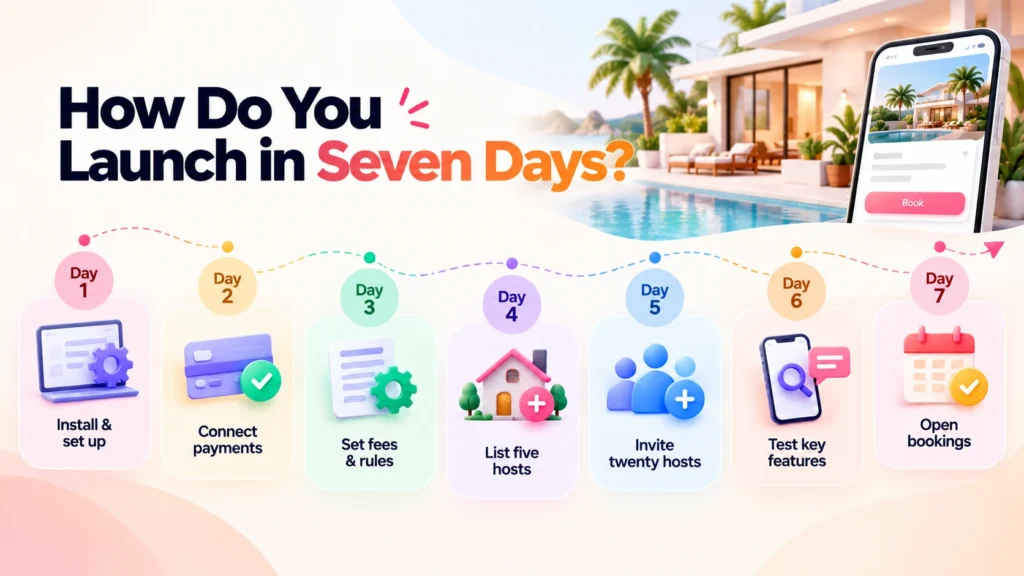
Use the first week to go from installed script to a live pocket with real listings. This plan assumes you already own the script and have a domain.
- Day 1: install the script, set your brand, currency and languages.
- Day 2: connect your payment gateway and run a small real-money test booking and refund.
- Day 3: set fees, cancellation rules, house rules and your terms pages.
- Day 4: list five founding hosts yourself, with real photos.
- Day 5: invite twenty more hosts from your pocket and send them the done-for-you listing offer.
- Day 6: test search, filters, messaging and notifications on a phone.
- Day 7: open bookings to a small invited group and watch every transaction by hand.
Want this plan as a printable one-page launch checklist? Ask for the free Short-Stay Launch Checklist through the contact options below.
Does the playbook change in the UAE or the UK?
The Pocket Ladder works anywhere, but rules and payments differ. Dubai runs a holiday home permit system and Scotland runs short-term let licensing, for example. Verify current local rules with a local adviser before you recruit hosts, and choose gateways that serve your country.
Who should buy this, and who should not?
Buy a script if you are a founder, agency or entrepreneur who wants to test a short-stay niche fast and has a plan for finding hosts. Do not buy one expecting bookings to appear on their own.
- Good fit: a founder with a niche, a region and the patience to recruit hosts personally.
- Not a fit: anyone who needs a unique algorithm or deep integrations on day one.
- Price worry: Zipprr lists $490 for Startup and $890 for Pro, one time. Confirm the current price at checkout.
- Timeline worry: a standard launch with few changes takes days, a fully branded platform one to three weeks.
- Support worry: 90 days of free technical support are included. Later support and custom work are quoted.
- Risk worry: there is a 7-day money-back guarantee, which excludes custom work, setup fees, hosting and domains.
Ready to test your short-stay idea?
See the platform in action, ask about your niche, or request the launch checklist.