

Peerspace Clone to Launch Your Own Hourly Venue Booking Marketplace
Peerspace Clone · Last Updated: October 2026
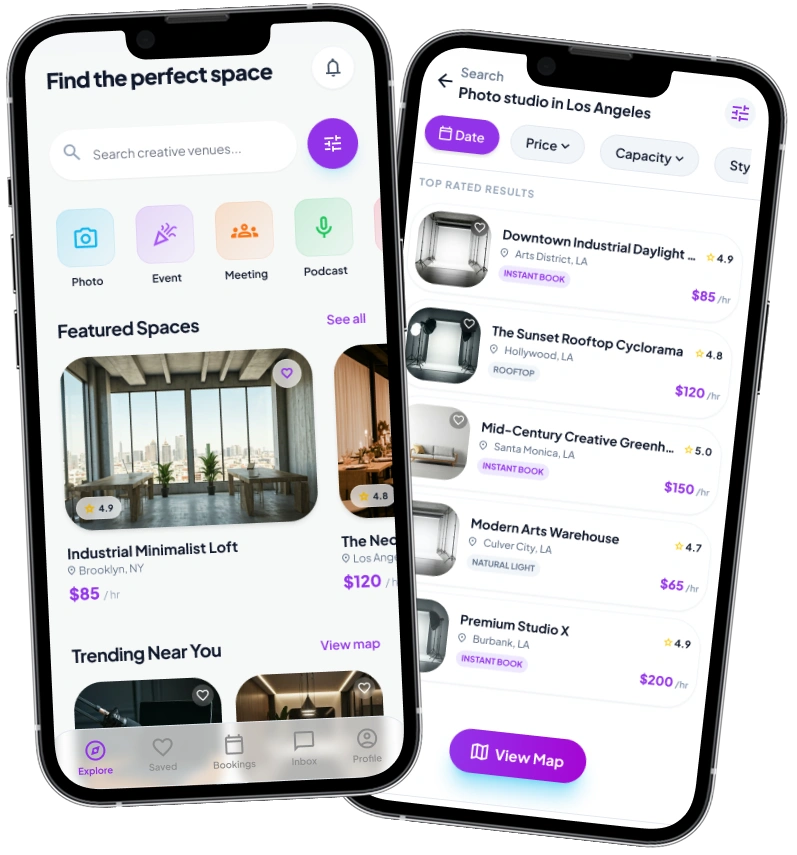
Give venue owners a place to list rooms by the hour and give locals a faster way to reserve them. With the Zipprr Peerspace clone, the web platform and admin engine arrive with full source code, and the Pro plan adds native iPhone and Android apps, ready to carry your name.
One-time payment from $490. Free live demo and 90 days of support.
Countries Served
0
+
Happy Clients
0
%
Years of Experience
0
+

App Submission on Pro
The Pro plan includes help with iOS and Android store submission.

Server Installation
Hassle‑free setup, we handle deployment for you.

Multi‑Language Support
Connect globally, serve users in their language.

Post‑launch Support
Get 90 days free expert technical assistance.

Transparent Pricing
Clear cost structure, no hidden surprise charges.
What Is a Peerspace Clone Script?
A Peerspace clone script is a ready-made venue booking marketplace software that lets you launch your own hourly space rental platform under your own brand. Owners list rooms, renters book them by the hour, and you earn a commission on every reservation.
The Zipprr Peerspace clone is a complete, white label space rental marketplace delivered with full source code and an admin panel, with native iOS and Android apps on the Pro plan. You set the commission, the categories, and the pricing.
It is the same commercial model as Peerspace, built independently by Zipprr. The Peerspace name is used only to describe the software category.
The unit of value is an hour, not a night, and the reason people book is an activity, not sleep. A photographer rents a studio for a shoot. A startup books a meeting room. A chef takes a kitchen for a pop-up dinner.
Your job is curation and growth, not property management. You do not sign leases, stock furniture, or hand over keys. Zipprr supplies the software layer that connects idle rooms to local demand.
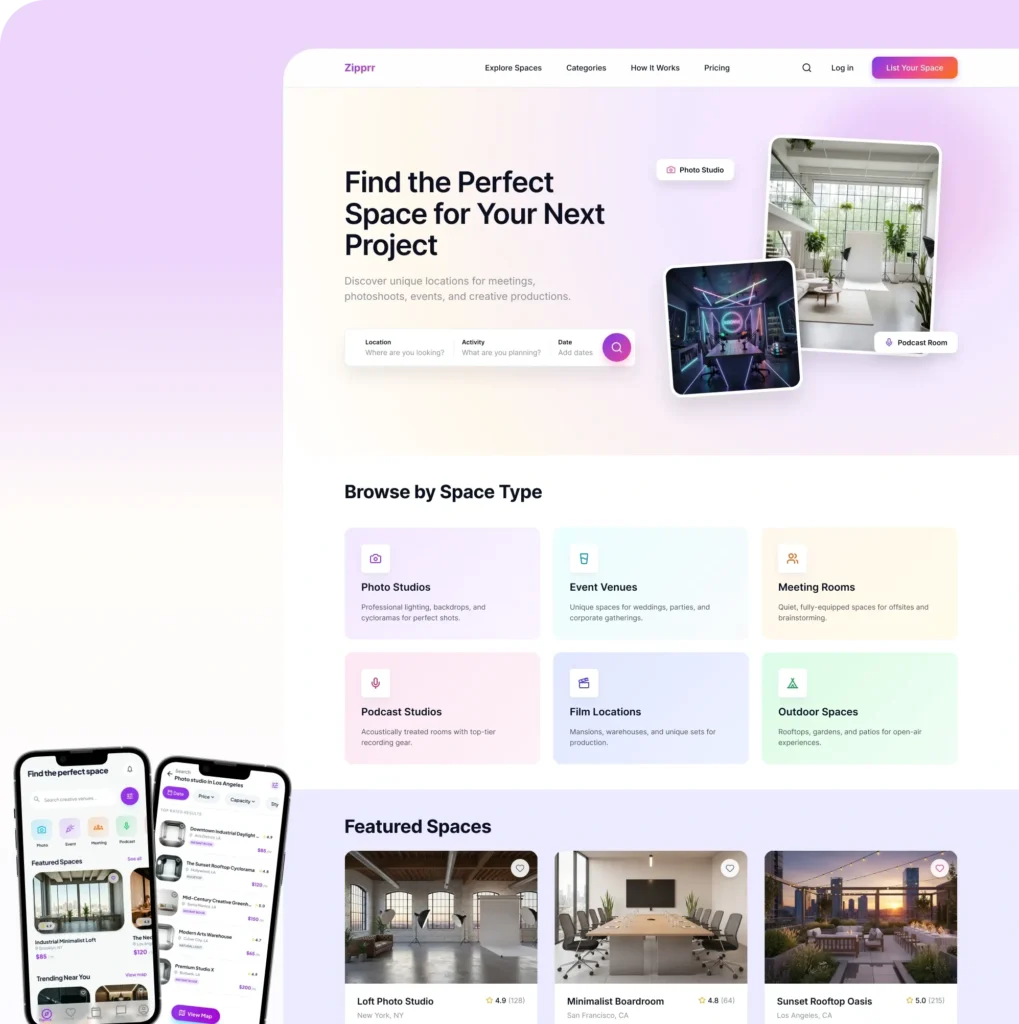
How the Venue Booking Marketplace Works
Every reservation follows the same quiet path. The renter never sees the machinery, the owner never has to chase a payment, and you collect your cut at exactly the right moment.
The renter goes looking
They open the app with a need in mind, a room for forty people on Saturday afternoon, and filter by area, date, capacity, budget, and what they plan to do there until a short list appears on the map.
They size up a space
A listing page answers the real questions: what the room looks like in daylight, what comes with it, what the house rules forbid, and which hours are still open on a calendar that updates itself.
They reserve the hours
Depending on how the owner set things up, the slot either locks instantly or goes through as a request, with a built-in chat so the owner can ask what the booking is for before agreeing.
The money is parked safely
The card is charged the moment the booking is made, but the funds rest inside the platform rather than landing in the owner’s account, which keeps both sides honest until the visit is done.
The slot is sealed
Both parties get a confirmation, the calendar marks the hours as taken so nobody double-books, and entry details such as the door code or contact point are shared.
The payout clears
After the session wraps, your commission is lifted off the top, the remainder is released to the owner, and each side is invited to rate the other so future renters know what to expect.
Why the Space Rental Business Model Works
Set the software aside for a moment. The reason this hourly rental business is worth starting comes down to how the economics behave once it is running.
You carry no rooms
The venues never appear on your books. You own the layer that introduces supply to demand and earns on the handshake, which keeps your costs light while the inventory does the heavy lifting.
Income that stacks
Each completed booking pays you a slice, and because rooms get rebooked and renters return, those slices accumulate rather than reset, so a quiet first month can become a busy quarter.
A loop that defends itself
More rooms attract more renters, and more renters attract more owners, so the early effort to build density turns into a barrier that latecomers struggle to climb.
More than one faucet
Commission is the spine, but featured placement, paid owner plans, checkout fees, and add-on margins all bolt onto the same platform without new infrastructure.
You can start narrow
Prove the loop in one neighborhood or one room type, learn what converts, then widen outward at your own pace instead of betting everything on a wide launch.
The work is repeatable
Once the first city hums, the playbook for the second one is mostly copy-paste, which is what makes expansion feel like growth rather than starting over.
Powerful Features of Peerspace Clone Platform
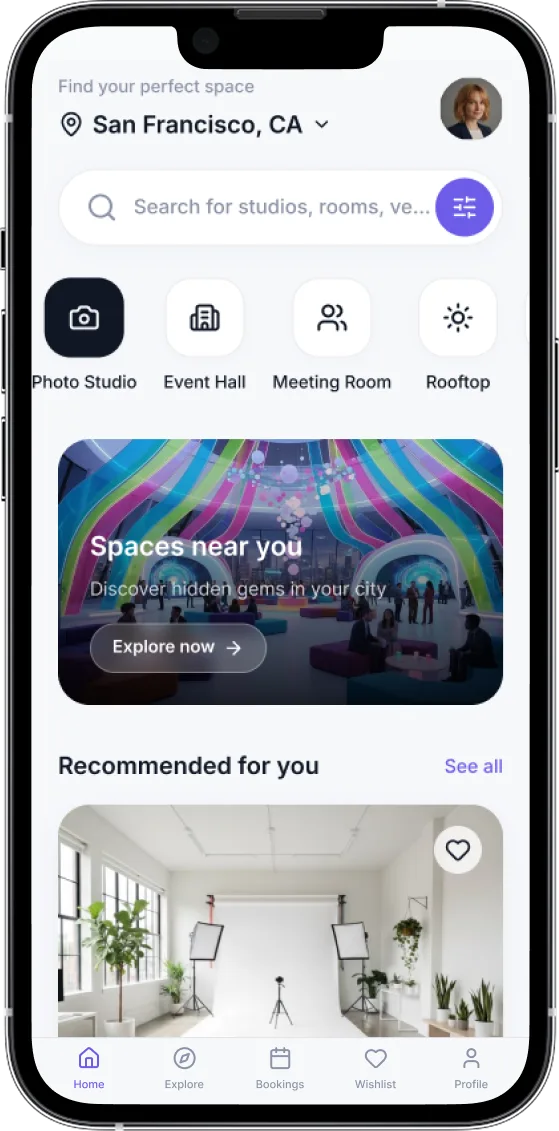
User Panel Features in Our Peerspace Clone
- Simple Social Logins : Sign up effortlessly using Google, Facebook, or Apple, so registration stays fast.
- Customizable Search Filters : Filter available spaces by location, type, price, size, and preferred activity, so you find what best suits your needs.
- Interactive Map View : Locate available spaces directly on Google Maps or OpenStreetMap, so you get a visual guide of venues nearby.
- Instant Bookings or Request: Secure a booking instantly or send a request to the host when you need confirmation first.
- Favorite Listings : Save your favorite spaces for future reference and easy access later.
- Real-Time Messaging: Connect instantly with hosts to clarify questions or details about a space before or during your booking.
- Flexible Payment Methods Enjoy multiple payment options, including Stripe, PayPal, or credit cards, so every transaction stays safe and seamless.
- View Past Bookings and Invoices Access all previous bookings and payment receipts, so you keep a complete history at your fingertips.
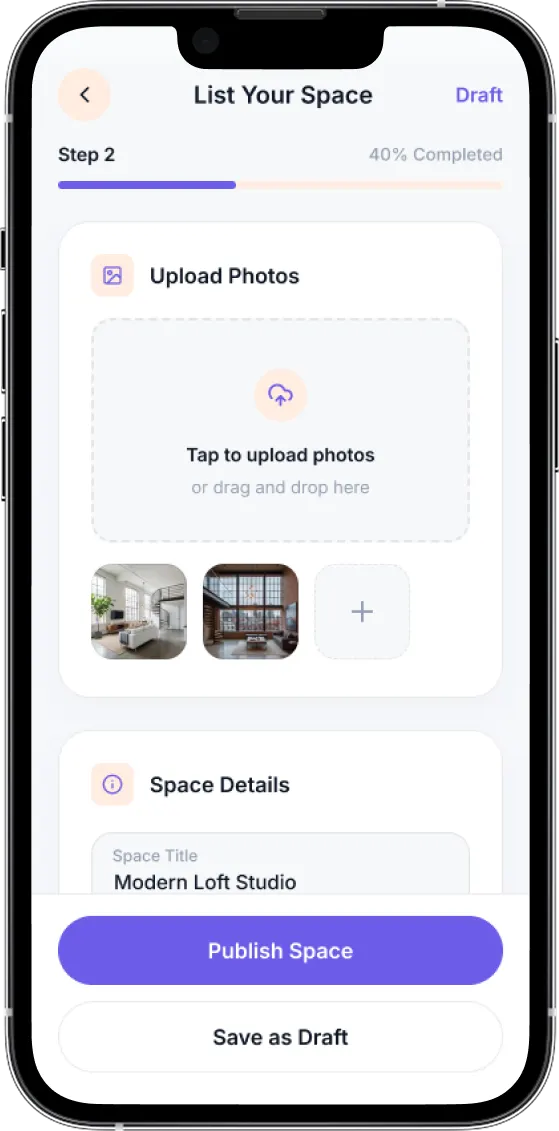
Seller Panel Features in Our Peerspace Clone
- Effortless Space Listings : Easily list your space with step-by-step guidance, then add high-quality images and descriptions.
- Booking Management Tools : View and manage booking requests, accept or decline, and keep track of upcoming reservations.
- Availability Sync : Sync your calendar with external systems, so double-booking never happens and availability stays easy to manage.
- Dynamic Pricing Set flexible pricing models based on hourly, daily, or weekend rates, and apply discounts for early or last-minute bookings.
- Earnings & Payout Management Track earnings, set your payout method (Bank Transfer, PayPal), and withdraw your earnings with ease.
- Host Profile Customization Personalize your profile with verified user IDs and detailed information, so guests see a trustworthy, professional host.
Admin Panel Features in Our Peerspace Clone
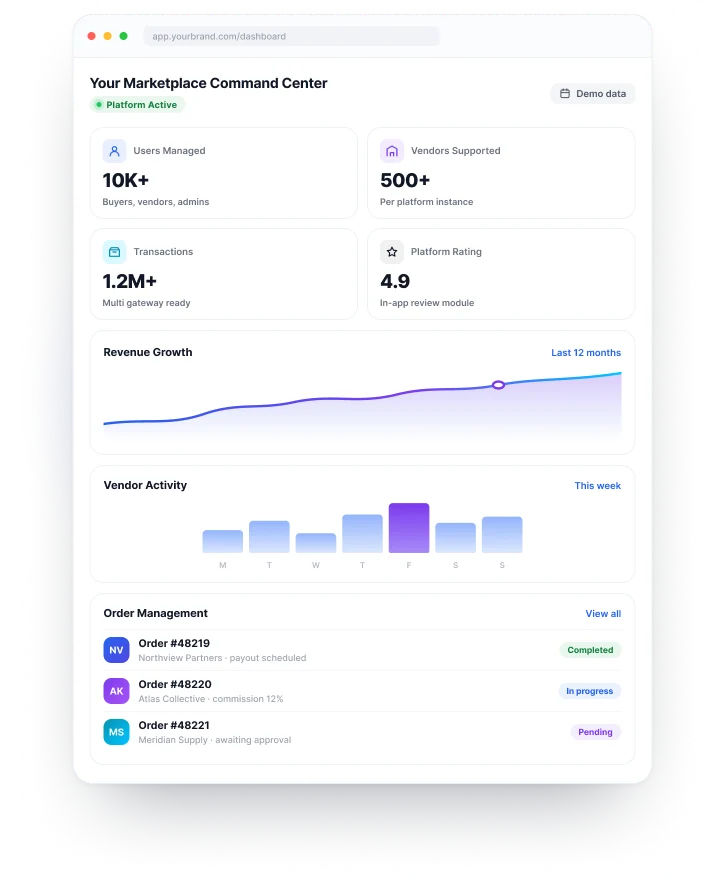
- Centralized Dashboard : Access a real-time overview of platform performance, including total revenue, active users, and booking trends.
- User Management : Admins can create, modify, or suspend user accounts, including both guests and hosts, to maintain platform integrity.
- Space Approval : Review, approve, or reject new venue listings to ensure the quality and accuracy of the spaces available.
- Revenue & Commission Management Set commission rates for hosts, manage payments, and track all transactions efficiently.
- Dispute Resolution & Cancellations : Handle disputes between hosts and guests, and manage platform cancellation policies with ease
- Content Management System : Admins can update static pages such as FAQs, Privacy Policies, and Terms & Conditions to keep users informed.
- Detailed Financial Reports : Generate reports on revenue, transactions, and commission details to monitor platform financials.
- Multi-Language & Currency Options Manage the platform in multiple languages and currencies to provide a global experience.
- Automated Notifications Set up email and SMS alerts for bookings, payments, and user activities to ensure timely communication.
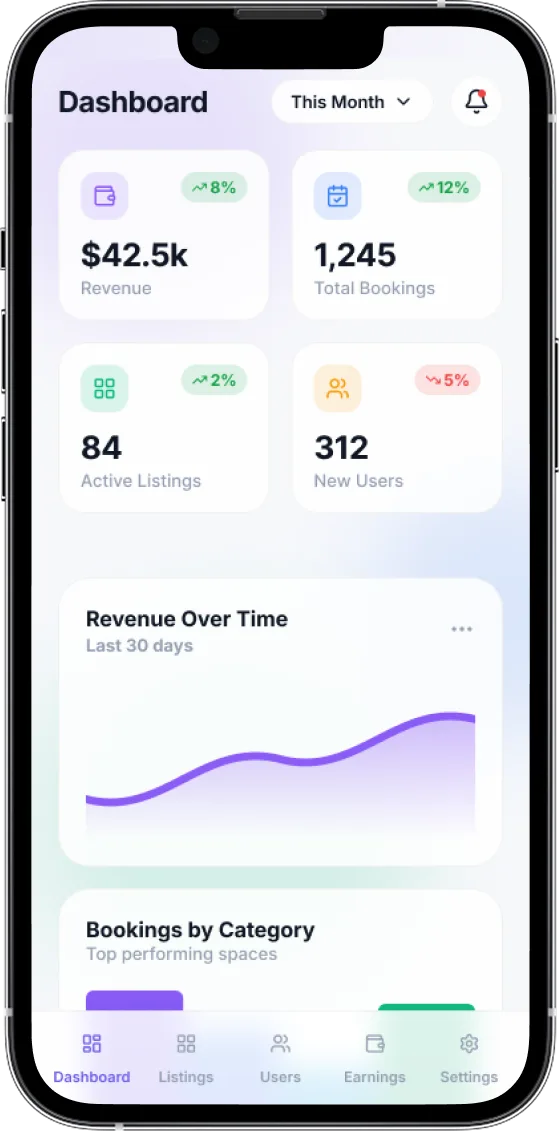
Core Features of the Peerspace Clone Software
The product splits cleanly into the place renters browse, the place owners manage, and the place you run the whole operation. Each one is finished, and all three talk to the same engine and the same data.
What renters get
A sign-up that takes one tap through Google, Apple, Facebook, or email, then a search that narrows by neighborhood, room type, headcount, price, amenities, and intended use. Also, results pin to a live map, listing pages carry full galleries and clear rules, and bookings go through instantly or as a request. A chat thread sits beside every space, favorites save for later, and checkout runs safely through card, Stripe, or PayPal with a receipt and a tidy booking history.
What owners get
A guided path to publishing a room, with prompts for photos, copy, and amenities so nothing important gets skipped. Also, a two-way calendar keeps outside bookings from clashing, rate cards bend to hourly, daily, weekend, peak, and last-minute pricing, and a single inbox handles every request. In addition, payouts land by bank transfer or PayPal, profiles carry verified badges earned through ID checks, and per-listing analytics show what is drawing views and what is converting.
What you get to run it
A control room that surfaces revenue, active users, and booking trends at a glance. From here you create, verify, or suspend accounts, push new rooms through a moderation queue, set commission, and schedule payouts. In addition, disputes and cancellations have proper tools behind them, static pages and FAQs have an editor, and multi-language plus multi-currency settings let the same platform serve more than one market.
The mobile apps, not an afterthought
On the Pro plan, both renters and owners get genuine native apps for iPhone and Android, ready for the stores rather than a web page squeezed onto a phone. Also, push notifications announce new requests, fresh messages, and cleared payouts the moment they happen, the whole operation can be run from a pocket, and location-aware search surfaces what is close by without anyone typing an address.
See it before you buy
Walk through the renter app, owner panel, and admin dashboard
Book a free demo and see how listings, bookings, payouts, and commission settings work for your own venue marketplace.
AI Features in the Space Booking Platform
The platform does more than display listings and move money. In fact, a set of smart features works in the background to lift bookings, guide pricing, and take routine chores off everyone’s plate.
✨
Suggestions that fit
By reading a renter’s past visits, recent searches, location, and the patterns of people who behave like them, the platform surfaces the spaces most likely to land, so the right room appears sooner and repeat bookings climb on their own.
📊
Pricing that reacts
Owners get rate guidance that responds to demand, the day of the week, nearby events, the season, and how far ahead the booking sits, which helps them fill more hours without sitting and adjusting numbers by hand.
🤖
Chores on autopilot
Check-in notes, reminders, and review prompts send themselves, suspect listings and messages get flagged by pattern, hot dates and underpriced rooms get surfaced, and a few owner inputs become a drafted listing with sensible tags.
See What Our Happy Clients Say
Benefits of the Venue Booking Platform
A space rental marketplace only works when all three groups feel they came out ahead. Here is the honest version of what each one gains.
If you are the founder
You reach a live product in weeks rather than burning a year on development, you pay once and own the source outright with no fee skimmed off every booking forever, and you begin from a model that has already been shown to work instead of guessing in the dark.
If you are an owner
Hours that earned nothing start earning, while you keep your hand on rates and availability. Also, new customers find you without you paying for ads, and the money arrives on its own through secure, scheduled payouts.
If you are a renter
You book precisely the space you need for precisely as long as you need it, with no lease and no commitment. You compare options out in the open with photos, prices, and honest ratings, and you pay safely while running the whole thing from your phone.
Peerspace Clone vs Custom Development
Commissioning a marketplace like this from scratch tends to cost between ten and fifty thousand dollars or more, and ties up half a year to a full year before anything goes live. Starting here changes the arithmetic completely.
What you are weighing
Starting with Zipprr
Building it yourself
Money up front
✓
From $490, paid once
✕
$10,000 to $50,000+
Time before launch
✓
Days to a few weeks
✕
Six months to a year
The mobile apps
✓
iOS and Android on the Pro plan
✕
Separate project & budget
The source code
✓
Yours, ready to run
✕
Yours eventually, but slow
The business model
✓
Blueprint proven to work
✕
An untested theory
What you keep paying
✓
One payment, lifetime updates
✕
Open-ended & hard to predict
Skip the custom build
Launch your Peerspace clone in weeks, not months
Compare the Basic and Pro plans, then book a free 30 minute walkthrough of the venue booking platform. Prefer a quick chat? Message us on WhatsApp.
Who Builds a Peerspace Clone Marketplace
A bookable-space marketplace is rarely a hobby project. Instead, the people who launch one usually already see idle inventory around them and want a cleaner way to turn it into money.
The events insider
Planners and hall operators tired of phone calls and spreadsheets, ready to let clients self-book and pay without the back-and-forth.
The regional first-mover
Someone who notices the big players never reached their city and wants to own the local market before anyone else bothers to show up.
The flexible-workspace brand
Coworking operators who want meeting rooms and quiet desks earning revenue in the gaps between members.
The studio owner
Photographers and producers whose lights and backdrops sit dark four days a week and could be paying their own rent.
The movement-space host
Yoga and dance studios renting their sprung floors to visiting instructors during the hours their own classes do not fill.
The community operator
Councils, libraries, and associations sitting on halls and rooms that the public would book if booking were not such a chore.
Choose the Best Pricing
Plan for Your Budget
Not happy with our product? No worries! Get a 100% refund within 7 days. Choose your plan with confidence—risk-free!
Basic
Get essential features, all in one place
$490
- Website Source Code
- Admin Source Code
- Website Installation
- 90 Days Support
- Life Time Updates
- One Time Payment
- Android App
- IOS
- App Submission
Pro
Popular
Launch your business app fast, with everything done-for-you
$890
- Website Source Code
- Admin Source Code
- Website Installation
- 90 Days Support
- Life Time Updates
- One Time Payment
- Android App
- IOS
- App Submission
Revenue Models for Your Venue Marketplace
Commission is where most operators begin, but it is far from the only lever. The table below lays out the options you can switch on as you grow, and most platforms end up running several at once.
01
Owner-side commission
Hold back a set portion, usually somewhere between a tenth and a fifth, from what each owner is paid out.
02
Renter service charge
Layer a small percentage on top of the cart at checkout so the renter shares the cost of running the platform.
03
Promoted listings
Let owners pay to ride at the top of search results and category pages when they want to fill a slow week.
04
Owner subscriptions
Offer monthly tiers that unlock more listings, lower fees, and richer analytics for owners who treat this as a real income stream.
05
Add-on margin
Earn a cut on cleaning, equipment hire, staffing, or short-term cover sold alongside the booking itself.
06
Local advertising
Sell visibility to nearby suppliers, the caterers, florists, and photographers who want to reach people already planning an event.
- Get Started
Launch Your Marketplace Business With Zipprr
Book a personalized demo and discover how Zipprr helps you launch a fully customizable marketplace solution built for growth.
Can we customize the platform?
Yes, every solution can be tailored to your business.
-
100% Source Code Ownership
Complete control from day one
-
Custom Branding
Your logo, colors and identity
-
Multi Vendor Ready
Manage sellers, roles and payouts
-
Built To Scale
Grow without limits
- 30 Minute Product Walkthrough
Request Your Free Demo
Book a personalized demo and discover how Zipprr helps you launch a fully customizable marketplace solution built for growth.
- 100% source code ownership
- Custom feature discussion
- Free product consultation
- 90 days launch support
Peerspace Clone Launch Timeline
The path from buying to going live breaks into three plain moves, and the table after them shows roughly how the weeks fall. However, exact timing shifts with how much you customize and how long the app stores take to review.
01
02
03
Choose a plan
Pick Basic for the web platform and admin source, or Pro to add the iOS and Android apps and app store submission.
Brand and configure
We install the server while you apply your identity, content, pricing, and policies.
Open the doors
Go live, bring on owners and renters, and grow through marketing and new categories.
Venue Categories and Use Cases
You can run a broad marketplace that takes anything bookable, or pick a single lane and own it. In short, the platform does not care which path you choose; the categories below are simply where demand already lives.
Gatherings and celebrations
Party and function halls, wedding venues, and open rooftops or gardens, the rooms people seek when an occasion needs a backdrop and enough space to breathe.
Work and meetings
Meeting rooms, hot desks, private offices, and conference spaces for the teams who need somewhere focused that is not a coffee shop or a cramped home corner.
Making and performing
Photography and film locations, podcast and recording booths, kitchens for culinary work, and fitness or yoga floors rented out by the hour to visiting talent.
Complete guide
How to Build a Venue Booking Marketplace Like Peerspace
Building a venue booking marketplace used to need a large team and a long budget. Today, however, a ready-made Peerspace clone gets you to launch much faster. Below are the short answers most founders look for first.
What is a space rental marketplace?
A space rental marketplace is an online platform where owners list rooms, studios, and venues, and renters book them by the hour or day. In short, the platform handles search, calendars, payments, and payouts, and it earns a commission on each booking.
How do venue rental marketplaces make money?
Mainly through commission on each booking, which commonly sits between ten and twenty percent. In addition, you can add renter service fees, promoted listings, owner subscriptions, add-on margins, and local advertising. As a result, most platforms end up running several revenue streams at once.
What features does an hourly space rental platform need?
First, renters need to find the right room quickly. Next, owners need simple tools to publish and manage it. Finally, you need control over money and moderation. At a minimum, plan for these features:
- Search filters for location, capacity, price, and activity
- A map view, so renters can see nearby spaces
- A live availability calendar for every listing
- Instant booking, or request-to-book when owners want to approve first
- In-platform chat, so renter and owner can clarify details before booking
- Secure checkout, so funds stay held until the session ends
- Ratings and reviews for both sides, because trust drives repeat bookings
- Admin tools, so you can manage commission, payouts, and moderation
Should you build from scratch or buy a Peerspace clone?
For most founders, buying is faster and cheaper. A ground-up build usually costs from $10,000 to $50,000 or more, and it takes six months to a year. By contrast, the Zipprr Peerspace clone starts at $490 and can go live in a few weeks.
Which Zipprr plan fits: Basic or Pro?
| Plan | Price | What you get |
|---|---|---|
| Basic | $490, one-time payment | Website source code, admin source code, installation, 90 days of support, and lifetime updates |
| Pro | $890, one-time payment | Everything in Basic, plus the Android app, the iOS app, and app store submission |
So, choose Basic if you want to launch on the web first. Choose Pro if you need native apps from day one. You can also compare the plans, book a free demo, or read the Peerspace clone complete guide for more detail.
Last updated October 2026. Zipprr builds this product independently, and it is not affiliated with Peerspace.
Peerspace Clone Guide and Related Marketplace Scripts
Want the full picture before you decide? Read the Peerspace clone guide for costs, features, and launch steps, explore our general space rental script, or see how the same booking model works in other categories.
- Peerspace clone complete guideCosts, features, and launch steps for an hourly venue booking marketplace.
- Airbnb cloneThe same marketplace model for overnight stays and vacation rentals.
- Turo clonePeer-to-peer car sharing with booking, payments, and apps.
- TaskRabbit cloneA service booking marketplace for local professionals.
Zipprr builds these products independently. They are not affiliated with or endorsed by Peerspace, Airbnb, Turo, or TaskRabbit.
Peerspace Clone FAQs
Get answers to frequently asked queries about our solution

What is a Peerspace clone script?
A Peerspace clone script is a ready-built marketplace for launching an hourly space-rental website like Peerspace. Owners list rooms such as studios, halls, and meeting spaces, renters book them by the hour or day, and you earn a commission on every booking. Both Zipprr plans include the website and admin source code, and the Pro plan adds native iOS and Android apps.
How does a Peerspace-style marketplace make money?
The backbone is commission on each booking, which you can charge to the owner, the renter, or split between them. On top of that you can run checkout service fees, paid featured placement, owner subscriptions, margins on add-ons, and local advertising as the platform grows.
How much does it cost to build a website like Peerspace?
A ground-up build usually runs from ten thousand to fifty thousand dollars or beyond, and takes six months to a year. However, starting here begins at a single payment of $490 for the website and admin source, or $890 for the Pro plan that adds the native iOS and Android apps, which is how you reach launch in weeks for a sliver of the cost.
How much does a Peerspace clone cost?
Zipprr’s Peerspace clone is a one-time purchase, not a subscription. For example, Basic costs $490 and Pro costs $890, with no recurring platform fees. Also, you own the source outright and receive updates for as long as the product exists.
What is included in the Peerspace clone script?
Both plans include the website source code, the admin source code, installation, 90 days of free support, and lifetime updates. The Pro plan ($890) also adds native Android and iOS apps and help with app store submission. Together, that is everything required to open a complete booking platform.
Can I customize the Peerspace clone with my own branding?
Yes. You can change the logo, colors, fonts, domain, wording, categories, prices, and commission setup. Because you receive the source code, a developer can also build features specific to your niche.
Do I own the source code of the Peerspace clone?
Yes. Zipprr sells the Peerspace clone with 100% source code ownership, so you receive the website and admin source code and pay no per-booking fees to Zipprr. You can customize and run the platform as your own business. For specific licence questions, such as reselling the script itself, confirm the terms with Zipprr before you buy.
Which payment methods does the Peerspace clone support?
Stripe, PayPal, and the major credit and debit cards all work from day one. Payment is captured at booking and released to the owner after the session ends, with your commission deducted automatically.
What commission should I charge on a Peerspace-style marketplace?
Most marketplaces charge a commission of ten to twenty percent of the booking value. The right figure balances keeping enough supply to attract owners against prices low enough that renters still convert.
What types of spaces can be listed on a Peerspace clone?
A Peerspace clone can list anything bookable: photo and film studios, party and function halls, wedding venues, rooftops, meeting and conference rooms, coworking desks, fitness and yoga floors, recording booths, kitchens, and more. You can run a general site or commit to a single niche.
Does the Peerspace clone include iOS and Android apps?
Only on the Pro plan ($890). Pro includes native iOS and Android apps for renters and owners, along with help getting them accepted through the app stores. However, the Basic plan ($490) covers the website and admin source without the apps.
How long does it take to launch a Peerspace clone?
A Peerspace clone usually launches within a few weeks. Installation takes a few days, then branding and content follow. On the Pro plan, app submission comes next, and store review is the part least within anyone’s control.
Do I need technical skills to run a Peerspace clone?
No. Zipprr handles the server installation, and the admin panel is designed so non-technical operators can manage accounts, listings, commission, and content. You only need a developer for custom features.
How does a Peerspace clone handle safety and trust?
A Peerspace clone handles safety through identity and listing checks, ratings tied to real bookings, messaging kept inside the platform, payments held until a session ends, and admin tools for moderation, disputes, and cancellations.
Does the Peerspace clone support multiple countries and currencies?
Yes. The admin supports multiple languages and currencies, so you can serve international markets and localize both prices and copy from a single back end.
What support do I get after buying the Peerspace clone?
Zipprr includes 90 days of free technical support after the platform is installed, plus lifetime updates for the product.
What hosting does a Peerspace clone need?
A Linux shared host or a VPS is enough to start a Peerspace clone, and you can upgrade as traffic grows. Zipprr can recommend hosting providers and take care of the installation.
Is the Zipprr Peerspace clone affiliated with Peerspace?
No. Zipprr is independent and unconnected to Peerspace. The phrase Peerspace clone only names the software category, while the source and design are built separately and owned by you.
Can I see a demo of the Peerspace clone before buying?
Yes. You can book a free live demo and explore the platform before you decide. Refund eligibility is set out in Zipprr’s Refund Policy, so read it before you order.
Is it better to buy a Peerspace clone or build a custom marketplace?
A clone hands you a proven, ready-to-brand marketplace you can launch immediately, while custom development starts from a blank page at a higher cost and over longer timelines. You can still bolt bespoke features onto the source later.
What is a Peerspace alternative for hosting my own venue marketplace?
A Peerspace alternative that you host yourself is your own independent hourly venue booking platform, built with a Peerspace clone script. You set the commission, categories, and pricing, and you build your own base of venue owners and renters. Zipprr’s Peerspace clone starts at $490 and includes the website and admin source code.
Start the Marketplace You Will Actually Own
Book a free demo, get your questions answered by someone who knows the product, and begin building an hourly-rental business that belongs to you. Also, plans start at $490 with the full source code, and the Pro plan at $890 adds the native apps.