

Hyperlocal Quick Commerce Software
Hyperlocal Quick Commerce Software: The AI-Powered Commerce OS You Own
Launch and scale your own hyperlocal quick commerce software. It connects customers, stores, delivery partners, inventory, payments and operations on one platform you own.
- Your brand
- Your stores
- Your riders
- Your cloud
- Your data
- Your source code
Live in 4 to 6 weeks
Single-city launch
Own your technology
100% source code
No commission sharing
0% royalty to Zipprr
Multi-city ready
Add stores and cities anytime
- Full source code, perpetual licence
- White label on your domain
- Your cloud: AWS, Azure or GCP
- Flutter, Next.js and Laravel
Step 1 of 7Customer places an order
Live city simulation with sample data- The category
What Is Hyperlocal Quick Commerce Software?
Hyperlocal quick commerce software is a ready-made platform that lets a business sell online and deliver from the store nearest each customer, often within 10 to 30 minutes.
Zipprr replaces the patchwork with one operating system. Customer apps, stores, inventory, delivery and administration share a single real-time core, delivered as a white label eCommerce solution with full source code on your own cloud. Starting with one vertical? See our grocery delivery script or food delivery app.
Customers order nearby
Customers order from the store or dark store nearest to them, often within 10 to 30 minutes.
Location decides fulfilment
The delivery location routes each order to the closest store that can fulfil it.
Stock belongs to a store
Inventory is tracked per store and reserved at checkout.
Orders are prepared locally
Store staff pick and pack the order in the merchant app.
Riders complete the last mile
The nearest delivery partner picks up and delivers, confirmed by OTP.
One system connects it all
Customer apps, stores, inventory, delivery and administration share a single real-time core.
- The platform
One Connected Hyperlocal Quick Commerce Ecosystem
Five systems, one real-time core. Every order flows through all of them in seconds.
Why it matters: When apps, stores, stock and riders share one core, orders stop falling between systems and every team works from the same live data.
01 of 05
Customer App
Where demand starts. A branded app and web store showing what the nearest store has in stock.
Android and iOS customer appsWeb and PWA storefront
- Product discovery and search
- Cart, wallet and payments
- Live order tracking
02 of 05
Store Network
Every store and dark store, each with its own hours, catalogue and order queue.
Merchant appStore console
- Multi-store and multi-vendor
- Store-level catalogue
- Order queue per store
03 of 05
Inventory Management
Stock counted per store, reserved at checkout and synced everywhere.
Store inventoryAdmin visibility
- Store-level stock
- Low-stock alerts
- Reservation at checkout
04 of 05
Delivery Operations
Riders, zones and routes run by the platform, not by phone calls.
Delivery partner appZone and pricing rules
- Automatic rider assignment
- Zones and distance pricing
- OTP proof of delivery
05 of 05
Admin Intelligence
One command layer for revenue, operations, payouts and people.
Admin control centerReports and analytics
- Live analytics
- Payouts and refunds
- Staff roles and permissions
- Why one system
Replace the Patchwork With One Hyperlocal Quick Commerce Software Platform
Customer apps, stores, inventory, delivery and administration share a single real-time core, so every team works from the same live data.
- Storefront, stores, inventory, delivery and admin on separate tools
- Stock that is not synced across stores
- Riders coordinated by phone calls
- No single view of revenue, orders and riders
- Aggregators that own the customer relationship
- Rented platforms that can change terms or switch you off
ZipprrOne real-time core
DisconnectedConnected
Storefront pluginCustomer apps and storefront
DisconnectedConnected
Stock spreadsheetStore-level inventory
DisconnectedConnected
Rider phone callsDelivery partner app
DisconnectedConnected
Aggregator listingYour branded app
DisconnectedConnected
End-of-day reportsAdmin intelligence
- Storefront pluginCustomer apps and storefrontDisconnectedConnected
- Stock spreadsheetStore-level inventoryDisconnectedConnected
- Rider phone callsDelivery partner appDisconnectedConnected
- Aggregator listingYour branded appDisconnectedConnected
- End-of-day reportsAdmin intelligenceDisconnectedConnected
One operating system: every order, store, rider and customer in one place.
- How it works
How Hyperlocal Quick Commerce Software Works
Follow one order. Five stages, about 15 minutes, zero manual hand-offs.
Why it matters: No manual hand-offs means fewer delays, fewer picking errors and a delivery promise you can keep.
- Step 1
Customer places an order
Discovers products in your app and checks out.
- Step 2
Nearby stores process it
The closest store with stock accepts and packs.
- Step 3
Inventory updates automatically
Stock is reserved and synced across every store.
- Step 4
The nearest rider picks up and delivers.
The nearest rider picks up and delivers.
- Step 5
Owners monitor everything
Revenue, orders and riders on one dashboard.
Step 1 of 10Customer location is detected
Sample dataStep by step, inside the platform
- Under the hood
How Does Quick Commerce Technology Work?
Quick commerce technology routes each order to the nearest store with stock, reserves the items, assigns the closest delivery partner and tracks the order live until the customer confirms it. On Zipprr, all eight steps run automatically on one platform you own.
01
Customers order
Customer app
The customer browses the nearest store’s live catalogue and checks out with wallet, card or cash on delivery.
02
Smart Store Selection
Order engine
The platform detects the delivery location and routes the order to the closest store or dark store that can fulfil it.
03
Inventory Validation
Inventory
Every item is checked against that store’s stock and reserved at checkout, which helps prevent the same stock being sold twice.
04
Store Fulfillment
Merchant app
Store staff accept the order, pick and pack it, and mark it ready for pickup in the merchant app.
05
Delivery Assignment
Delivery network
The nearest available delivery partner in the zone receives the job and accepts it with one tap.
06
Live Tracking
Customer and admin
Customers and admins follow the rider on a live map with an ETA that updates as the rider moves.
07
Successful Delivery
Delivery partner app
The rider confirms handover with the customer’s OTP, and cash on delivery is recorded when used.
08
AI Business Insights
Admin intelligence
The completed order feeds demand forecasting, reorder suggestions and revenue analytics for the next decision.
- Product experience
Four Apps in One Hyperlocal Quick Commerce Software Suite
The real product your customers, merchants, riders and managers use. Watch one order move through every screen.
Why it matters: Each role gets an app built for its job, and every app writes to the same order record.
Customer App
What your customers use: a fast, branded store that knows their nearest shop.
Business value
Repeat orders from a branded app you own, not an aggregator.
- Product discovery and search
- Cart, wallet and payments
- Live order tracking
YourBrandHome, 0.9 km
12 minSearch fruit, dairy, snacks
Delivery in 12 minFrom Store 04, open until midnight
Fruits
Dairy
Bakery
Snacks
Fresh apples1 kg
$3.40+
Oat milk1 L
$4.10+
SourdoughBakery
$5.40+
Greek yogurt500 g
$2.10+
Checkout
Fresh apples1 kg, qty 1
$3.40Oat milk1 L, qty 2
$8.20NowAbout 12 min
SchedulePick a slot
WalletCardCOD
Items$11.60
Delivery, Zone A$1.99
Total$13.59
Place order
Order #8943
Store 04, arriving in 12 min
- Order confirmed
- Packing at Store 04
- Rider on the way
- Delivered
Rider 118Live tracking
Share OTP4829Merchant App
What your store team uses: every order, every item, every shelf.
Business value
Stores handle more orders with fewer picking errors.
- Order queue with live status
- Store-level inventory
- Product and price control
Merchant app, Store 04Orders today 312
ORDER QUEUE
#8943Packing
3 items#8941Packing
4 items, $22.10#8939Handed over
3 items, $14.50#8936Handed over
6 items, $31.40PACKING, ORDER #8943
Fresh apples 1 kgx1
Oat milk 1 Lx2
Bag and seal
LIVE STOCK
Fresh apples 1 kg-164
Oat milk 1 L-222
Sourdough18
Store-level inventorySynced
Delivery Partner App
What your riders use: the next job, the route and the proof.
Business value
Faster deliveries and a lower cost per drop.
- One-tap job acceptance
- Navigation and live tracking
- OTP proof and earnings
Rider 118Online
New delivery request0:18
Pickup, Store 04Order packed
Drop, Home1.2 km
Earning$4.20
DeclineAccept
Return pickups arrive in the same queue
Head to customerRoute navigation
Live trackingOn
Distance1.2 km
Confirm handover
OTP proof of delivery
4829
Cash on delivery$13.59
Mark delivered
Admin Dashboard
What you see: the whole business, updating as it happens.
Business value
Decisions from live data, not end-of-day spreadsheets.
- Live analytics and reports
- Payouts, refunds and coupons
- Staff roles and permissions
admin.yourbrand.com, all zones
OverviewOrdersStoresCustomers
DeliveryRefundsCouponsWalletStaffReports
Orders today1,284
Revenue$38,420
Avg delivery11.8 min
Riders live88
Orders by hour
Stores
Store 02Open
Store 04Busy
Store 07Open
Store 09Closed
Operational alerts
Stock forecast, Store 04: Oat milk 1L out in 2h 10m
Evening peak predicted at 6:40 PM. Add 2 riders from 6 PM.
Cold brew 32 oz: reorder raised
Want to see it with your stores, your zones and your brand?
We walk through every app on a live call, configured for your city.
- Features
The Hyperlocal Quick Commerce Software Feature Engine
Marketplace, stores, orders, delivery, tracking, payments and analytics. One engine behind every order.
Why it matters: The rules that decide your margin, such as routing, delivery fees and payment splits, are yours to configure.
Multi-vendor marketplace
Many stores and brands on one app with one checkout.
Local store management
Hours, staff, catalogue and packing for each store.
Order management
Every order routed to the right store automatically.
Delivery operations
Zones, riders and distance-based pricing.
Real-time tracking
Live rider location and ETA for customers and admins.
Payments
Every order split between store, rider and platform.
Analytics
Revenue, orders and performance by store and zone.
Complete feature list
- Android and iOS customer apps
- Web and PWA storefront
- Product discovery
- Category navigation
- Product search
- Filters and sorting
- Product variants
- Product recommendations
- Cart and checkout
- Wishlist
- Multiple addresses
- Coupons and discounts
- Wallet and cashback
- Multiple payment methods
- Order tracking
- Live delivery tracking
- Ratings and reviews
- Multi-language support
- Multi-store management
- Store location management
- Store operating hours
- Store order management
- Multi-location fulfilment
- Centralized monitoring
- Store performance analytics
- Store inventory
- Store-specific product availability
- Inventory tracking
- Stock reservation at checkout
- Low stock alerts
- Delivery partner app
- Rider registration
- Delivery assignment
- Route navigation
- Real-time location tracking
- Geographic delivery zones
- Distance-based pricing
- Area-based pricing
- Surge delivery pricing
- OTP delivery verification
- COD collection and reconciliation
- Earnings management
- Return pickup workflow
- Product management
- Categories and attributes
- Discount management
- Customer reviews
- Returns and refunds
- Marketing campaigns
- Referral programs
- Customer retention tools
- Customer management
- Store management
- Order management
- Delivery management
- Refund management
- Coupon management
- Wallet management
- Staff permissions
- Analytics dashboard
- Reports
- AI product description generation
- AI SEO content creation
- AI blog content assistance
- AI multilingual content
- Demand forecasting
- Product recommendations
- Operational insights
- Payment gateway integrations
- Cash on delivery
- Split settlement
- Merchant payouts
- Store-level inventory
Hyperlocal Quick Commerce Software Inventory, Counted Per Store
Stock is tracked per store, customers only see what the fulfilling store has, and items are reserved at checkout, which helps prevent the same stock being sold twice.
| Product | Store 02 | Store 04 | Store 07 |
|---|---|---|---|
| Oat milk 1L | |||
| Fresh apples 1 kg | |||
| Greek yogurt | |||
| Sourdough | |||
| Avocados, 2 pack |
Customer is near Store 04. Availability follows that store.
What this customer sees
Store inventory
Store-specific product availability
Inventory tracking
Stock reservation at checkout
Low stock alerts
- Delivery operations
Hyperlocal Quick Commerce Software for Riders, Zones and Routes
Not by phone calls. You draw delivery zones and choose distance-based, area-based or surge pricing. Fees are calculated at checkout from the customer’s location and current demand.
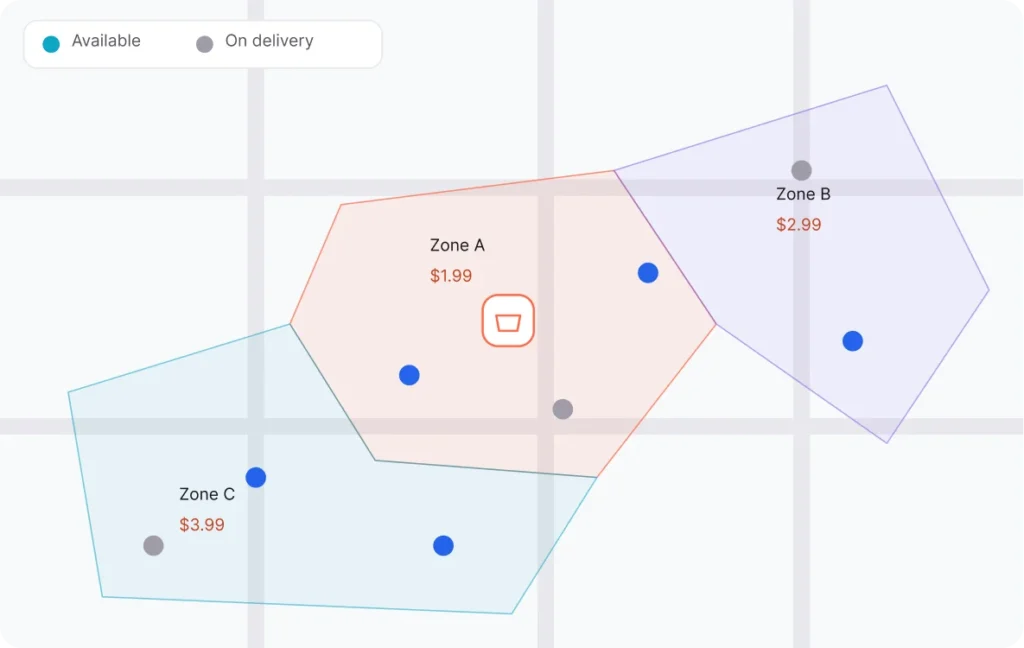
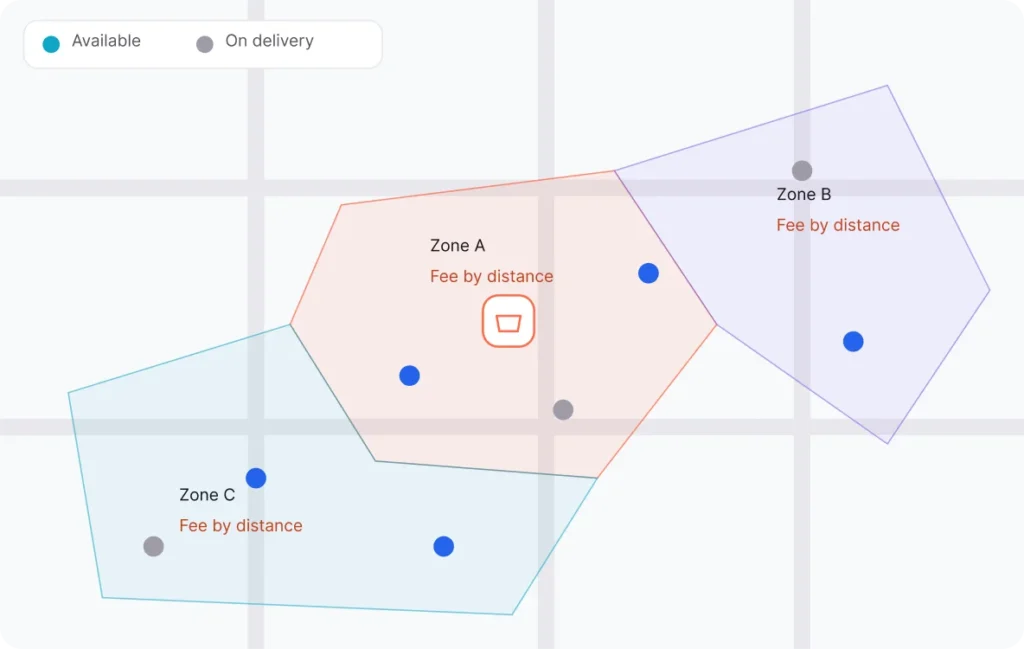
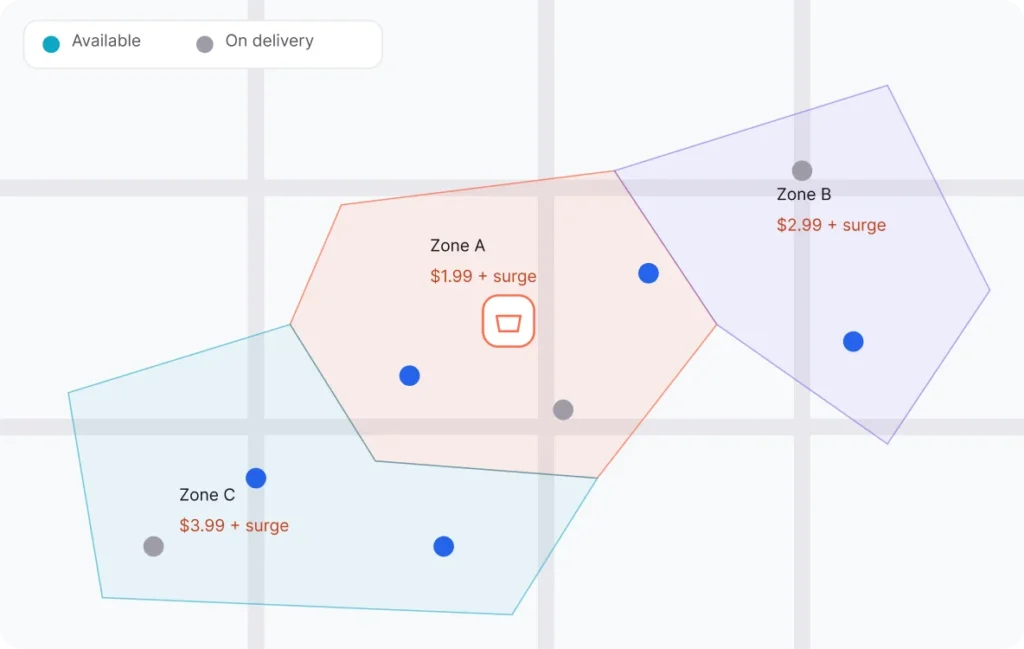
Store-specific product availability
Everything riders and dispatch need, from registration to verified handover.
- Delivery partner app
- Delivery assignment
- Real-time location tracking
- Distance-based pricing
- Surge delivery pricing
- COD collection and reconciliation
- Return pickup workflow
- Rider registration
- Route navigation
- Geographic delivery zones
- Area-based pricing
- OTP delivery verification
- Earnings management
- Operating model
Run a Multi-Vendor Marketplace
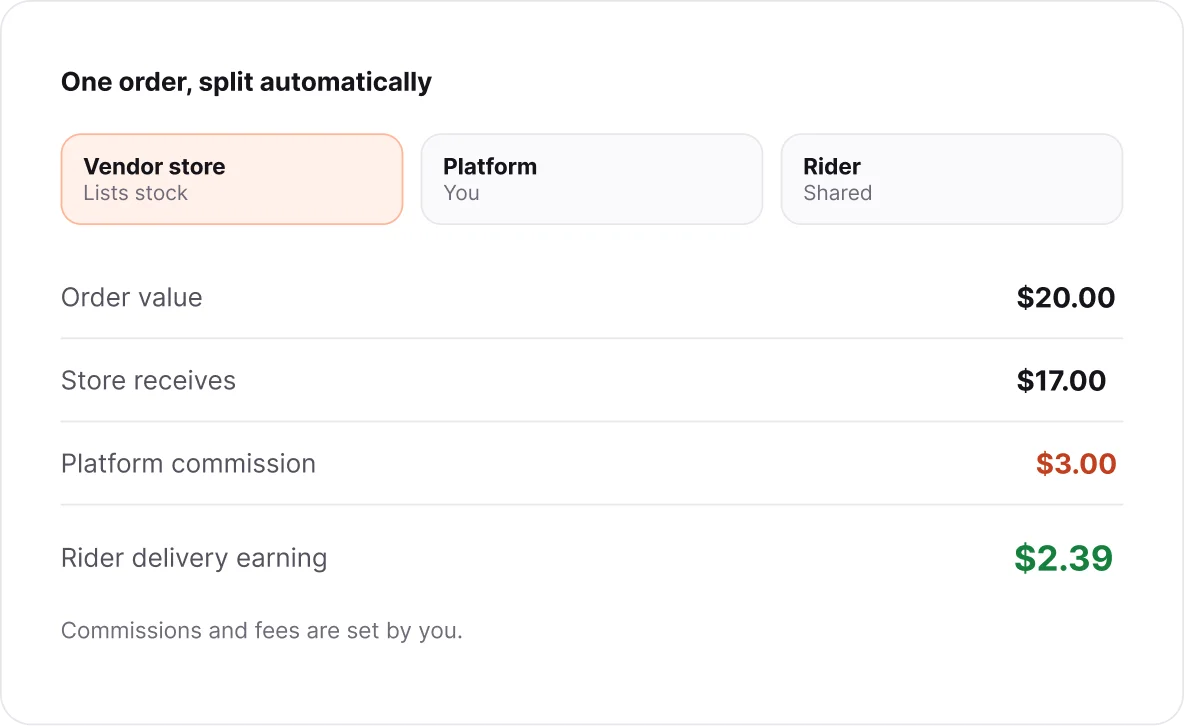
Sell from your own stores, or onboard independent stores and brands as vendors. Many stores and brands on one app with one checkout.
- Vendors onboarded with their own catalogue
- Vendor orders
- Merchant payouts and split settlement
- Vendor-level stock
- Commission applied automatically before payouts
- Shared riders across vendors
- Architecture
Complete Commerce Workflow
One order moves through seven connected systems. Each is a module of the same platform, sharing a single real-time data core, so there are no integrations to break between them.
- Customer
Android, iOS and web storefront where every order starts.
- Order Engine
Validates checkout, applies pricing and coupons, and routes each order.
- Store Operations
Merchant app for accepting, picking and packing orders.
- Inventory System
Store-level stock, reservation at checkout and low-stock alerts.
- Delivery Network
Rider app, delivery zones, distance-based pricing and live dispatch.
- Customer Confirmation
OTP proof of delivery, ratings, reviews and receipts.
- Analytics Intelligence
Revenue, operations and AI forecasting in the admin control center.
- Intelligence
AI Inside Hyperlocal Quick Commerce Software for Smarter Commerce
An intelligence layer on top of your operations, not a separate product. It reads orders, stock and routes, then recommends the next move.
Why it matters: Forecasts and alerts turn raw orders into decisions before problems reach your customers.
- Operational intelligence
Demand prediction
Staff and stock before the rush

Sample output: Evening peak predicted at 6:40 PM. Add 2 riders from 6 PM.
Inventory insights
Reorder before shelves run empty
Reorders suggested before shelves run empty, store by store.
Customer personalization
Bigger baskets from every visit
Every customer sees suggestions based on their own orders.
Route optimization
More drops per trip
Nearby drops batched into one route for one rider.
Business analytics
Know what is working, daily
New, repeat and at-risk customers, with win-back offers ready to send.
- Revenue models
What Revenue Models Work for Hyperlocal Quick Commerce Software?
Quick commerce platforms earn from six main streams: product margins, delivery fees, vendor commissions, memberships, brand advertising and expansion into new categories and cities. Because you own the platform, you configure every stream and keep the revenue.
- 0% royalty to Zipprr
- No per-order fees
- Commissions and fees set by you
01
Customers order
Sell groceries, meals and essentials directly from your own stores and dark stores, and keep the full product margin.
Sample basket
$20.00

- Per order
02
Delivery Charges
Charge distance-based, area-based or surge delivery fees, calculated at checkout from each customer’s zone.
Zone A to Zone C
$1.99 to $3.99

- Per zone
03
Vendor Commission
Onboard independent stores and brands as vendors, and take a commission automatically before each payout.
Platform share on a $20.00 order
$3.00

- Per vendor
04
Subscription Programs
Offer paid membership plans with delivery or pricing benefits you define, for recurring revenue from loyal customers.
Plan terms
Set by you

- Recurring
05
Brand Advertising
Sell promoted placements to brands through in-app banners and marketing campaigns.
Placement types
Banners, campaigns

- Per placement
06
Marketplace Expansion
Add vendors, categories and new cities on the same platform, so revenue grows without re-platforming.
Illustrative growth path
1 to 250+ stores

- Per city
- Scaling
Start Local. Scale Into A Commerce Network.
The platform you launch with one store is the same one that runs a network. Grow without ever re-platforming.
Why it matters: One codebase scales from a single store to a multi-city network, so growth never forces a rebuild.
1store online
- Ownership
Own Your Hyperlocal Quick Commerce Software With Full Source Code
A white label eCommerce solution delivered with full source code. Browse all Zipprr platforms to compare models.
Why it matters: A platform you own becomes a company asset, with no one able to change your terms or take a cut of each order.
100%
Own your platform
Full source code under a perpetual licence, deployed on your AWS, Azure or GCP.
Rented platforms can change terms or switch you off.
Your rules
Customize your business model
Set commissions, delivery fees, zones, subscriptions and workflows your way.
SaaS tools limit you to their settings.
No caps
Scale without platform limitations
No per-order fees or royalties. Add stores and cities when you are ready.
Per-order fees grow with every sale.
Asset
Build a long-term digital asset
Customer data, brand, app listings and code belong to your company.
On aggregators, the customer belongs to them.
- One-time licence
- Full source code
- Your AWS, Azure or GCP
- Business model set by you
- No per-order fees or royalties
| Area | Rented platforms and aggregators | Your Zipprr platform |
|---|---|---|
| Terms | Can change terms or switch you off | Full source code under a perpetual licence |
| Business rules | Limited to the vendor's settings | Commissions, delivery fees, zones, subscriptions and workflows set by you |
| Per-order cost | Per-order fees grow with every sale | No per-order fees or royalties |
| Customer relationship | On aggregators, the customer belongs to them | Customer data, brand, app listings and code belong to your company |
- Built on a modern, documented stack
Flutter apps
Customer app and delivery partner app for Android and iOS from one codebase.
Web platform
Storefront, PWA, store console and admin, server-rendered for speed and search.
Backend
Orders, catalogue, inventory, dispatch and payments on your AWS, Azure or GCP.
Cloud
Your infrastructure
Deployed on your own AWS, Azure or GCP account.
APIs
Integrations
Payment gateways, ERP, POS, maps, SMS and email.
AI
Automation
Recommendations, forecasting, insights and marketing triggers.
Ready to own your commerce platform?
Get a fixed quote for your cities, stores and modules after a 30-minute call.
- Industries
One Hyperlocal Quick Commerce Software Platform for Every Local Industry
Grocery
Grocery
Weight-based items, chilled and frozen handling, instant or scheduled slots.
3
storage zones: ambient, chilled, frozen
Order
Weigh and pack
Cold-chain delivery
Kitchen
Food Delivery
Menus, add-ons and riders dispatched the moment food is packed.
0%
royalty to Zipprr on orders
Order
Kitchen
Hot handoff
Pharmacy
Pharmacy
Prescription upload with pharmacist approval before picking, plus batch and expiry control.
Rx
upload and approval built in
Upload Rx
Pharmacist approves
Delivered
Retail
Retail
Fashion, electronics and beauty with variants, specs, verified handoffs and easy returns.
100%
OTP-verified handoffs
Order
Serial check
OTP handoff
Vendors
Local Marketplace
Onboard local shops as vendors with their own catalogue, stock and payouts.
Per vendor
commission applied before payout
Vendor joins
Lists stock
Shared riders
Quick
Quick Commerce
Dark stores, tight zones and a pack-and-dispatch flow built for minutes.
10 to 30
minute delivery windows
Order
Aisle pick
Rider in minutes
- Launch
How Can You Launch Hyperlocal Quick Commerce Software in 7 Days?
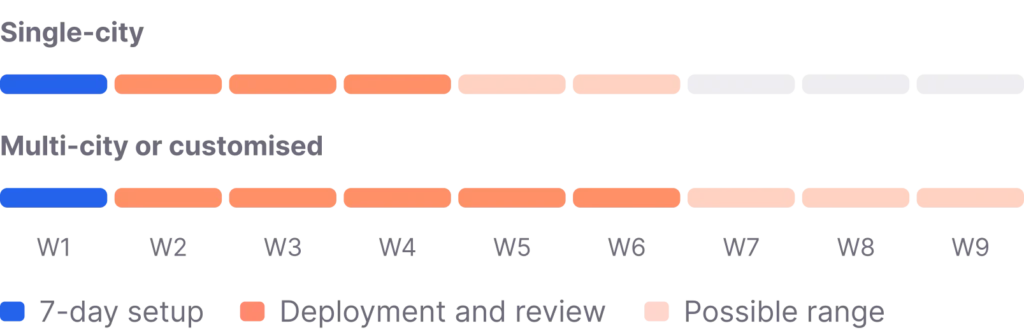
Choose a white label platform you can own, configure it for your brand, stores and delivery zones, test it with real orders, then go live in one zone and expand. Zipprr’s guided 7-day setup gets your platform launch-ready, and cloud deployment plus app store review complete a typical single-city go-live in 4 to 6 weeks.
Launch Your Platform in 7 Days
Logo, colors and domain
App names and store listings prepared
Cloud environment on AWS, Azure or GCP
Stores, locations and hours
Catalogue, categories and variants
Store-level stock
Home layout and banners
Payments, wallet and coupons
Languages and messaging
Zones and delivery pricing
Delivery partner onboarding
OTP and cash on delivery rules
Staff roles and permissions
Commissions and payouts
Reports and dashboards
End-to-end test orders
Payment and payout checks
Performance tuning
Go live in your first zone
Monitor live operations
Plan next stores and cities
Total go-live timeline
The 7-day setup makes your platform launch-ready. Timing covers branding, configuration, testing, cloud deployment and app store submission.
Typical single-city launch
Approximately
4 to 6 weeks
Multi-city or heavily customised projects
Approximately
6 to 9 weeks
- Pricing
How Much Does Hyperlocal Quick Commerce Software Cost?
Hyperlocal quick commerce software from Zipprr starts at $490 for Standard (full source code and website installation) and $890 for Pro (adds Android, iOS and app submission). Both are one-time payments. Multi-city or heavily customised builds get a fixed quote after a 30-minute scoping call.
Standard
Get essential features, all in one place
$490
- 100% Source Code
- Website Installation
- 90 Days Support
- Regular Updates
- One Time Payment
- Android App
- IOS
- App Submission
Most Popular
Pro
Launch your business app fast, with everything done-for-you
$890
- 100% Source Code
- Website Installation
- 90 Days Support
- Regular Updates
- One Time Payment
- Android App
- IOS
- App Submission
- FAQ
Hyperlocal Quick Commerce Software FAQs
Direct answers for founders and CTOs.
Hyperlocal Quick Commerce Software Basics and Profitability
What is the difference between quick commerce and same-day delivery?
Same-day delivery ships within hours from a regional warehouse, while quick commerce fulfills orders in 10 to 30 minutes from a nearby dark store. The difference comes down to proximity and catalog size: quick commerce keeps a smaller, curated stock of essentials close to customers instead of a broad inventory farther away.
Why is quick commerce growing so fast?
Quick commerce is growing because consumers now expect fast delivery, and groceries are a high-frequency purchase that rewards convenience. Lower technology barriers now allow more businesses to explore quick commerce models, while many mid-size cities remain underserved by large aggregator platforms.
Is a quick commerce business profitable?
Quick commerce can be profitable, though margins are tight due to running multiple dark stores and delivery fleets. Profitability depends on high order density per zone to keep delivery costs low, alongside revenue from fees, commissions, and advertising. Technology efficiency, inventory accuracy, and delivery automation, the kind built into platforms like Zipprr’s, play an important role in improving margins.
What is the difference between quick commerce and regular hyperlocal delivery?
Hyperlocal delivery covers any local service, including food and courier delivery. Quick commerce is a specific type focused on retail products, usually groceries, fulfilled from dedicated dark stores within a guaranteed short delivery window, often 10 to 30 minutes.
How Hyperlocal Quick Commerce Software Scales Across Cities
How do quick commerce businesses make money and which commission model works best?
Revenue comes mainly from delivery fees, commission on vendor orders, and membership plans offering discounted delivery. Featured listings and in-app ads add extra margin. Most platforms keep these models configurable from the admin dashboard, allowing businesses to adjust pricing strategies based on market conditions. With hyperlocal quick commerce software you own, every rate is a setting you control.
Can I launch a quick commerce business in multiple cities with one platform?
Yes, multi-city expansion works through zone configuration rather than a separate build per city. On Zipprr’s platform, for example, each city can have its own delivery zones, dark stores, pricing, and language settings, all managed from one admin panel. Zipprr’s hyperlocal quick commerce software supports this from one admin panel.
Is the software scalable for thousands of daily orders?
Yes, provided the hosting environment and database are configured correctly. The platform can be scaled by increasing infrastructure capacity, optimizing databases, and improving system performance as order volume grows. Businesses should plan resources based on expected traffic, users, and daily order volume.
How does inventory management work across multiple dark stores?
Each dark store keeps its own stock ledger, with low-stock alerts and reorder thresholds set per item. Zipprr’s platform, for instance, adds centralized reporting that shows which products move fastest at each location, helping operators decide what to restock where.
Hosting, Integrations and Technology Stack
Can I host the software on my own server?
Yes, self-hosting is standard for white-label software with source code included, such as Zipprr’s license. You can deploy on any VPS, dedicated server, or cloud provider instead of relying on the vendor’s infrastructure, though server maintenance becomes your responsibility. Zipprr’s hyperlocal quick commerce software deploys on your own AWS, Azure or GCP account.
Can the software integrate with an existing POS or ERP system?
Yes, most platforms use an API-driven architecture that supports POS or ERP integration for inventory and order sync. This matters for retail chains already running a POS system in-store. Integration effort depends on whether that system exposes a documented API.
What payment, logistics, and inventory integrations does the software support?
Payment gateway availability depends on region and provider, but most platforms support integration with popular payment solutions, COD options, wallets, and API-based payment services. Logistics can include third-party fleets, and inventory can sync with an existing POS system depending on integration availability.
What technology stack is the software typically built on?
Most platforms use a mainstream stack built on a scalable backend framework, mobile applications, database systems, and cloud infrastructure. This helps maintain predictable hosting requirements and allows businesses to work with widely available development resources. Confirm exact specs before purchase.
Security, Reporting and Ideal Customers
Is the software secure enough to handle customer payment data?
Security relies mainly on trusted payment gateways that follow industry security standards, which handle card data directly so the platform never stores raw numbers. It should also run over SSL with token-based authentication and admin activity logs.
What reporting and analytics does the software provide?
Standard reports cover revenue, commission, and delivery fee breakdowns, order volume and fulfillment time by dark store, and which products sell fastest where. Rider performance metrics like average delivery time are also tracked, helping flag issues before they hurt retention.
Who is the ideal customer for a quick commerce startup?
The ideal customer values speed over price for everyday essentials: urban households, busy professionals, and people needing last-minute items outside store hours. Order frequency matters more than order size, since repeat weekly buyers are more valuable than one-time bulk shoppers.
Buying Hyperlocal Quick Commerce Software: Source Code and Risks
Can I buy quick commerce software with source code?
Yes. Zipprr sells hyperlocal quick commerce software as a one-time licence with full source code. You deploy it on your own cloud, change any module and pay no per-order royalty to Zipprr. Standard starts at $490 and Pro at $890.
Can I buy a white label quick commerce app?
Yes. A white label quick commerce app carries your logo, colours, domain and store listings. Zipprr’s Pro plan includes Android and iOS apps with app store submission, so customers, riders and store staff use apps branded as your business.
Why do some quick commerce businesses fail?
Most fail on unit economics, not software. Low order density, high delivery cost per order and heavy discounting erode margin. Software helps by routing to the nearest store, batching drops and showing margin by zone, but a business still needs enough orders per dark store.
- Get Started
Launch Your Marketplace Business With Zipprr
Book a personalized demo and discover how Zipprr helps you launch a fully customizable marketplace solution built for growth.
Can we customize the platform?
Yes, every solution can be tailored to your business.
-
100% Source Code Ownership
Complete control from day one
-
Custom Branding
Your logo, colors and identity
-
Multi Vendor Ready
Manage sellers, roles and payouts
-
Built To Scale
Grow without limits
- 30 Minute Product Walkthrough
Request Your Free Demo
Book a personalized demo and discover how Zipprr helps you launch a fully customizable marketplace solution built for growth.
- 100% source code ownership
- Custom feature discussion
- Free product consultation
- 90 days launch support
Launch Your Hyperlocal Commerce Platform With Zipprr
Your brand, your stores, your riders and your data, on hyperlocal quick commerce software you own. Live in weeks.
- Your brand
- Your stores
- Your riders
- Your data
- Your source code