
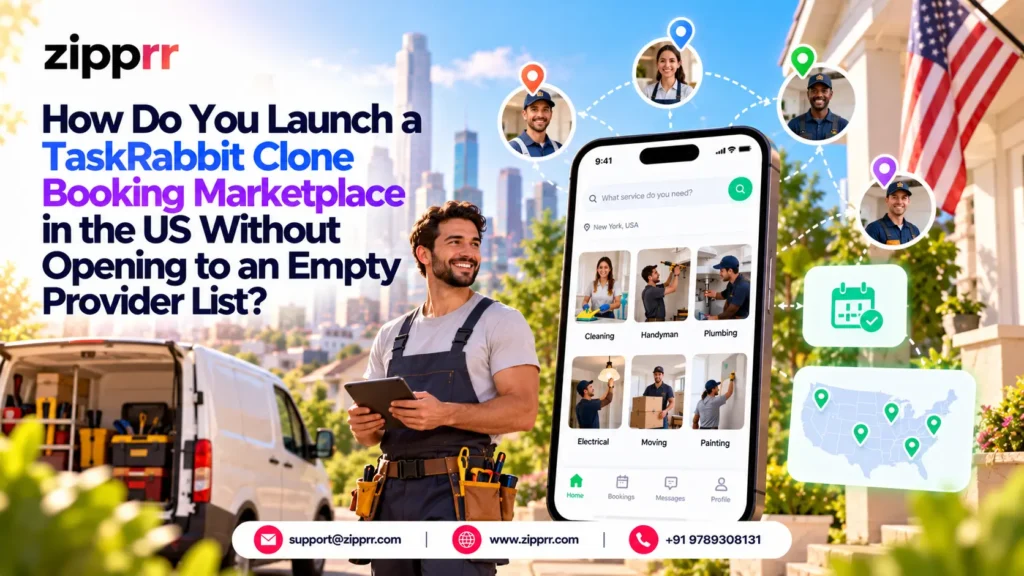
Launch it backwards: sign up your local providers first, then switch on customer bookings. A TaskRabbit clone script handles the technology in days, but a marketplace with no available providers sends customers away for good.
Picture a Saturday morning. A homeowner searches for a cleaner, finds one profile, and sees “unavailable”. She will not come back next week. Every early booking you lose this way costs more than the software did.
A TaskRabbit clone script is a pre-built website and app foundation for a local services marketplace. Customers find providers, view open time slots and book visits. You operate the business through an admin panel and own the code you receive.
Is a booking marketplace the same thing as a task-posting site?
No. On a booking marketplace the services already exist: each provider lists what they do, what it costs and when they are free, and the customer picks a slot. On a task-posting site the customer writes a request first and providers respond with offers.
Zipprr’s TaskRabbit Clone is built for the first style. Think of it like reserving a table at a restaurant, not like putting out a call for quotes.
This choice shapes your first month. A booking site lives or dies by how complete its provider catalog looks. A request-and-offer site needs a steady flow of customers posting jobs. Most new local brands find the catalog easier to build.
What does a customer actually do on the platform?
The journey is short, which is the whole point. Here is the path from search to review.
Behind the scenes you handle approvals, categories, plans, payments and complaints from one admin area.
Which home service should you start with?
Choose one service in one metro area. A tight start gives each provider more bookings, and it gives customers search results that look full instead of sparse.
The opportunity is real. Harvard’s Joint Center for Housing Studies projected that US homeowners would spend roughly $518 billion on remodeling by the end of 2026, according to its remodeling outlook (January 2026, revised April 2026). But a big market is not the same as a good first niche.
To compare options, score each one from 1 to 5 on four questions. We call the result the SLOT score.
- Slot-friendly: can the job be sold as a fixed block of time at a fixed price?
- Local pool: could you find 25 independent providers in your city without heroic effort?
- Often needed: will the same customer book again within a month or two?
- Trust-sensitive: does someone enter the customer’s home, so verified profiles and reviews genuinely matter?
Hypothetical scoring, for illustration only. Imagine you rate three ideas out of 20:
- Regular apartment cleaning: 5 + 4 + 5 + 4 = 18.
- Small handyman and assembly jobs: 4 + 4 + 3 + 4 = 15.
- Full kitchen remodeling: 1 + 3 + 1 + 5 = 10.
Cleaning leads because it fits a fixed slot and returns again and again. Remodeling trails because each project needs a custom estimate, which suits a quote request better than a calendar. Your own city will give different scores, so test with real local searches and phone calls.
How do you sign up your first 25 providers?
Start before you build anything public. Twenty-five verified providers in one niche is a practical target: it lets you show open slots on most weekdays and weekends without leaving gaps.
A realistic four-week rhythm looks like this.
Hypothetical funnel, not a forecast. Say you contact 150 people. About 60 answer, 36 apply, 28 clear your checks and 25 complete their profiles. Roughly one in six contacts becomes a live listing, which tells you how many conversations to schedule.
Early providers need a reason to trust a brand new platform. Offer a free listing for the first two months, a visible founding-member label, and an honest explanation of how you will bring them customers.
How can the platform earn money without taking a cut of every job?
Charge for access and visibility instead. The Zipprr product description mentions vendor subscriptions, featured listings, promotions and advertising as built-in ways to grow revenue.
- Monthly provider plans for listing and booking access.
- Featured placement that moves a provider higher in results for a set period.
- Sponsored spots sold to nearby businesses that want local attention.
Hypothetical money map, for illustration only. Let each provider pay $29 monthly, and let four of your 25 providers rent a $20 weekly featured spot. That brings in $725 plus $320, or $1,045 a month. Say your costs are $60 for hosting and map services, $600 for local advertising and $400 for a part-time coordinator, which comes to $1,060. At this size you are about even.
Grow to 60 providers with ten featured spots monthly. Revenue becomes $1,740 plus $800, or $2,540, against perhaps $1,500 of costs. The point is not the profit at 25 providers. The point is to prove each provider earns enough new work to feel $29 is cheap. If one extra $60 job lands every month, the plan pays for itself twice over.
What will it cost, and how soon can you go live?
The live Zipprr page showed $490 one-time for the Standard plan and $890 one-time for the Pro plan in October 2026. It outlines a seven-day path to launch, though your custom changes and how fast you supply content can stretch that.
| Piece | Details | Price or time |
|---|---|---|
| Standard | The complete code, installed on your site, with updates, three months of technical help and a phone-friendly web layout | $490, paid once |
| Pro | Everything above plus Android and iOS apps and help getting them into the app stores | $890, paid once |
| Customization | Twenty hours of changes are included; anything beyond that is estimated separately | Included, then quoted |
| Your own operating costs | Hosting, maps, domain, messaging, card-processing fees, provider checks and insurance | Depends on your quotes |
| Software go-live | Setup, branding, adjustments, testing, release | Seven-day path, scope permitting |
| Provider signup | The four-week rhythm above | About four weeks, alongside setup |
Only Pro includes the mobile apps and store submission. Many founders begin on Standard, prove that bookings repeat, and upgrade when native apps are worth it.
Which features can wait, and which cannot?
Ship a lean first version. These are the pieces you cannot skip:
- Search by service and place, with simple filters.
- Provider pages showing prices, services, ratings and reviews.
- A calendar-based booking flow, including rescheduling and cancellation.
- Card payments through a gateway you choose, with a cash option if your market wants it.
- Alerts for each booking step via WhatsApp, email and in-app notices.
- An admin area for approving providers, setting categories and managing plans.
- Earnings and payout screens so providers can see what they are owed.
Extras such as an online shop or ad programs can wait until you see steady bookings, around month three.
Who is this product for, and who should look elsewhere?
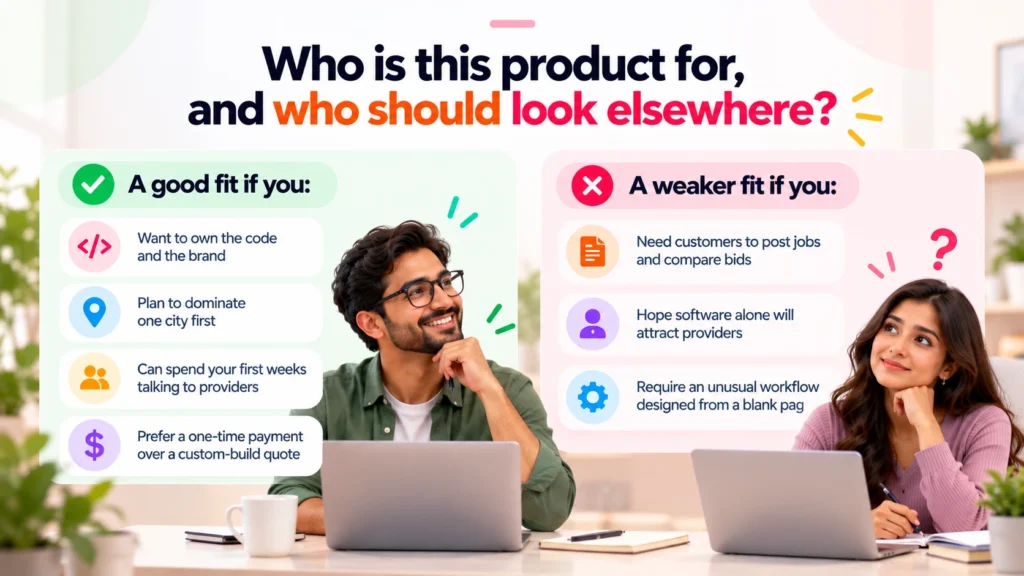
A good fit if you:
- Want to own the code and the brand instead of renting space on someone else’s platform.
- Plan to dominate one city before opening a second.
- Can spend your first weeks talking to providers, not just choosing colors.
- Prefer paying a few hundred dollars for software over a custom-build quote.
A weaker fit if you:
- Need customers to post jobs and compare bids. In that case Zipprr’s task-posting and bidding marketplace script matches the model better.
- Hope software alone will attract providers without any outreach.
- Require an unusual workflow designed from a blank page.
Common worries, answered plainly: the price is paid once, you receive the code, installation is part of the purchase, and support covers 90 days of technical help along with WhatsApp, email and chat contact. Timing depends on your changes, so request a scope before you pay.
Which mistakes sink new marketplaces?
- Too many categories. Ten half-empty shelves look worse than one full one.
- Ads first, providers later. Paying for visitors who find nobody is wasted money.
- Soft vetting. One poor visit to someone’s home can damage a young name.
- Fuzzy pricing. People book faster when the length and cost of a job are obvious.
- No cancellation policy. Write it before the first missed appointment.
- Counting only first bookings. Repeat customers prove the niche works.
- Believing the script is the business. The software is an empty shop until you stock it with people.
What warning signs should you notice when comparing script sellers?
- They will not let you click through a working demo.
- They are vague on what mobile apps and store listing cost.
- They avoid saying who owns the code or where you can host it.
- Support disappears right after delivery.
- They guarantee rankings or customers, which software cannot do.
- They push extra modules you will not need at launch.
If you want background on running a platform with many independent sellers, our multi-vendor marketplace platform guide goes deeper on vendor onboarding, payment splitting and revenue options.
What should your launch-week checklist include?
If your plan leans toward repair work, an on-demand handyman booking app script is a close relative of this product, and the piece on trends in on-demand handyman services shows where demand is moving. For a wider menu of local services, compare the UrbanClap-style local services marketplace. Once bookings are steady, read how AI tools for handyman businesses can take over scheduling and follow-ups.
Key takeaway: Providers are the product. Choose one niche with the SLOT score, sign about 25 checked providers, and open to customers only when the calendar looks full.
Frequently Asked Questions
1. How do I build a TaskRabbit clone?
Pick a niche and a city, install a clone script, adjust the branding and categories, then spend your time signing and checking providers. Test with friendly bookings and open to one neighborhood. The software part is quick; supply and testing take the weeks.
2. How much does it cost to build an app like TaskRabbit?
Through Zipprr the starting price is $490 once, or $890 once if you want Android and iOS apps and store submission. Hosting, maps, payment fees, provider checks and marketing are extra. Ask for written quotes before comparing a script with a custom build.
3. Which is the best TaskRabbit clone script I can choose?
Judge by what you can verify: a demo you can use, code ownership, a plain price list, support terms, and a model that matches your plan. If customers should book existing services, choose a booking script. If they should post jobs for bids, choose a task script.
4. How do I start a home services marketplace?
Choose one service in one city, score it for slot-friendliness, local supply, repeat demand and trust, and sign providers before inviting customers. Run it on a ready-made script, pilot with friendly bookings, and grow your area only after people book twice.
5. How do I get enough providers for a new home services platform?
Approach independents personally through community groups and trade forums, check them, help them finish their profiles, and offer early-member perks such as free listing months. Target about 25 checked providers before any customer advertising, and expect to speak with many more people than that.
6. How do home services apps make money?
Typical routes are provider plans, paid featured placement, sponsored spots and advertising. Zipprr’s product description lists subscriptions, featured listings, promotions and advertising. Start with one or two, and be sure providers receive enough bookings to feel the fee is fair.
7. How long does it take to build a home services marketplace?
Zipprr outlines a seven-day path from first setup to go-live, subject to your changes and content. Signing and checking providers usually takes longer, so budget around four weeks for supply to be ready by the time the software is.
8. Should the marketplace use fixed prices or provider quotes?
Fixed, visible prices suit a booking marketplace because customers can compare and reserve in one visit. Quotes make sense for large, variable work like remodeling, where a calendar slot is a poor fit and a request-and-offer model may work better.
9. Do I need a development team to set up a TaskRabbit clone script?
Not for a standard launch. Installation is handled as part of the purchase and twenty hours of changes are included. You would only need a developer for large custom features. What you do need is someone to manage provider signup and daily operations.
10. Does a TaskRabbit clone include mobile apps?
Only the $890 Pro plan includes Android and iOS apps and store submission. The $490 Standard plan gives you a phone-friendly website, so you can test demand there first and move up once bookings justify native apps.
About Zipprr
Zipprr has supplied white-label clone scripts and marketplace software to entrepreneurs since 2020. Its TaskRabbit Clone is a service booking marketplace covering search, availability, booking, live tracking, provider profiles, reviews, payments and admin controls. Zipprr’s products are independently developed clone and script solutions and are not affiliated with, endorsed by or sponsored by any brand mentioned in this guide.
Ready to launch your booking marketplace?
Book a free demo, message us on WhatsApp, or email [email protected].