

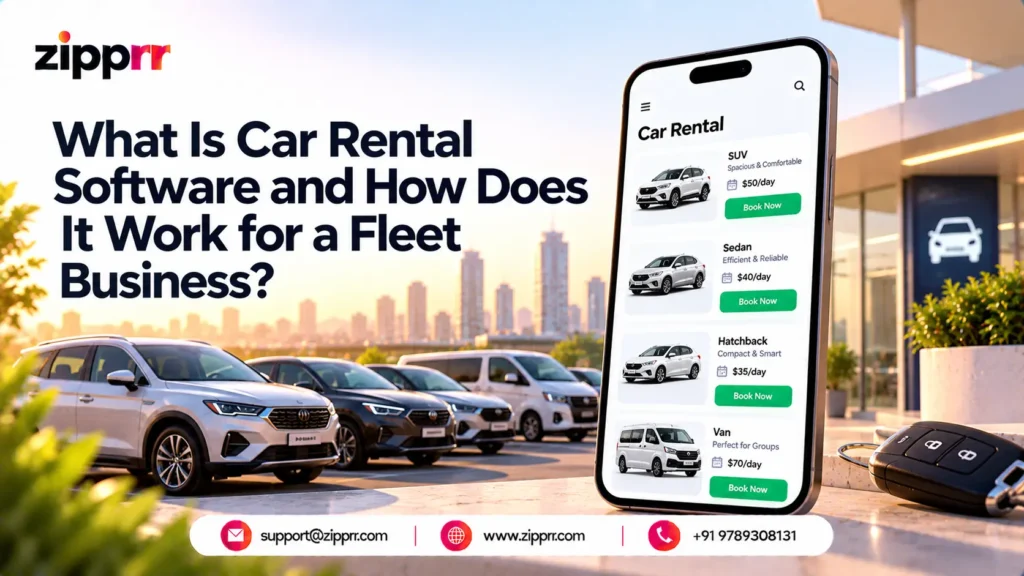
Picture a Friday morning at a twelve-car rental yard. The website says the white hatchback is free. The counter has just handed its keys to a walk-in. Meanwhile a customer is already driving across town for a car that is no longer there.
Car rental software exists to make that morning impossible. Below you will find what the category contains, which parts matter most to a fleet, and seven checks you can put to any vendor.
What is car rental software?
Car rental software is one system that holds a rental fleet’s vehicles, reservations, price rules, payments, contracts, and inspection records, and lets the website, the app, and the counter all read from it. The main reasons to use it are to keep two customers from booking the same car, to change prices with the calendar, to note each vehicle’s condition when keys change hands, and to find the cars that pay their way. You can subscribe to it, commission it, or purchase a ready-made script. Its real worth lies in that single record. When the website, the counter, and the accounts all read the same entry, nobody has to settle arguments between spreadsheets.
Which jobs in a rental fleet does it take over?
Most of the work falls into six jobs.
- Keeping the calendar honest: every car has one schedule, and a reservation made on the website appears at the counter instantly.
- Quoting prices: weekend, weekly and peak-season rates live in rules, with discount codes and extras such as child seats added automatically.
- Taking money: the deposit, balance, refund and invoice stay attached to the reservation that produced them.
- Recording condition: mileage, fuel or charge level and any marks on the body are noted when the car leaves and again when it returns.
- Sending cars to the garage: a service date makes the vehicle unbookable until the workshop releases it.
- Showing what earns: revenue and days on hire for each vehicle, so a weak performer shows up in numbers rather than hunches.
How big is the opportunity?
Grand View Research estimates that the Middle East and Africa car rental market earned USD 7,718.2 million in 2024. It projects USD 15,653.3 million in 2030, a 12.2% yearly growth rate across 2025 to 2030.
The estimate pools two regions, so it cannot tell you what Africa alone looks like, and a regional projection guarantees nothing for any single fleet. Treat it as a sign that online reservation is becoming normal behaviour, nothing more.
What is one extra day on hire worth to a ten-car fleet?
Utilisation means the percentage of vehicle-days that are on hire. The figures here are invented for illustration and are not industry benchmarks.
Put your own fleet size and day rate in. In practice the lost days hide in small habits: a car listed as free that is not, or a returned vehicle that sits for two days waiting for someone to sign off the inspection.
Seven checks to put to any vendor
Pick the problem that costs you most and ask the vendor to reproduce it live, using dummy data that mirrors your fleet. We drew up these seven checks for this article; no standards body publishes them.
| Pain point | Capability to look for | Live check |
|---|---|---|
| Two customers, one car | A single calendar fed by website, app and staff | Book a car through the public site, then have staff try to book the same car for overlapping days |
| Peak-season pricing | Rules by date window, length of hire and vehicle class | Create a festival-week rate plus a 7-day discount, then compare the quote with your own arithmetic |
| Second driver | Per-booking driver records, licence capture and liability terms | Add another driver and ask where the licence image and the responsibility clause are kept |
| Deposits and refunds | Deposit, balance and refund tracked on the reservation, through gateways your renters use | Take a deposit, cancel the reservation and trace the refund to the end |
| Damage arguments | An inspection record tied to the reservation | Record a dent on return and ask who can open that record next month |
| Garage time | Service windows that remove a car from search | Schedule a service and check the car disappears from the website for those dates |
| Weak vehicles | Revenue and days on hire per vehicle | Ask for the list that ranks cars by income last month |
With only an hour, test numbers 1, 4 and 6, which sit closest to cash.
The second-driver check deserves homework, because insurers and local rules differ. Zipprr’s admin guide to managing additional drivers on a car rental platform lists the settings to ask about.
What should you prepare before the call?
The vendor can only demonstrate what you describe, so gather this material first:
- Fleet sheet: how many cars sit in each class, and which are luxury or seasonal.
- Tariff: your current day and week rates, deposit amounts and optional extras.
- Ways of paying: how your renters actually settle bills, and which payment gateways operate where you do.
- Contract text: the rental agreement you use today, ideally checked by a local adviser.
- Insurer’s conditions: their requirements on extra drivers and damage claims.
- Brand kit: logo, colours and the domain renters will type.
- Hosting: the server that will run the software, and the person or team responsible for its upkeep.
Use these as your call agenda. When you want to see the checks run on a real product, you can schedule a demo with the Zipprr team, sending the fleet sheet and tariff ahead of time.
Subscription, custom build or script?
“Car rental software” names the category. “Script” names one way to obtain it.
- Subscription: you rent the software, the vendor runs the servers and ships the updates, and new features arrive on their schedule.
- Custom build: a development team codes to your brief, so you gain control but pay in time and money.
- Script: ready-made software delivered with its source code, which you rebrand and extend.
If you want the wider cost and launch comparison, Zipprr’s car rental script guide for founders covers it.
What does the Zipprr Car Rental Script list?
Everything below was read from the product page on 14 October 2026. It reflects the vendor’s own description, not independent testing.
- Price: the Zipprr Car Rental Script is shown at USD 490 (Basic) and USD 890 (Pro), each a single payment.
- Source and updates: website and admin source code with lifetime updates.
- Support: ninety days following launch.
- Renter features: car search with filters, availability, payments and notifications.
- Admin features: price and discount management, invoices, vehicle maintenance and availability, and reports.
Remember that the licence fee is one line of a launch budget. Hosting, payment gateway fees, app store accounts, insurance and advertising sit outside it.
Ask for written answers on three matters: which plan covers the mobile apps and store submission, who installs and hosts the system, and what the source code licence permits. Zipprr’s pages describe these slightly differently, and a written reply settles it.
Fleet or marketplace?
Fleet software suits the operator who owns or leases every car and sets prices, availability and terms personally.
A business that wants private owners to list their vehicles for a commission needs different machinery, namely owner payouts and listing approval. That points towards a peer-to-peer rental marketplace script.
Each model has a cost. A fleet gives control yet ties up capital in vehicles. A marketplace asks for less capital yet depends on attracting both owners and renters.
Where to go next
Once you hold a fleet sheet and a tariff, you can measure vendors against your actual operation. Bring your requirements, plan questions and hosting questions to the Zipprr team. You can chat with Zipprr on WhatsApp or email [email protected].
Frequently Asked Questions About Car Rental Software
1. What is car rental software?
A single system holding a rental business’s vehicles, reservations, rates, payments, contracts and inspection notes. Website, app and counter staff read identical information, so nobody keeps side spreadsheets, and the owner can check income per car. It can be subscribed to, custom built or purchased as a script.
2. How does car rental software work?
Renters choose dates and a car online. The software checks that vehicle’s schedule, applies the price rules, takes payment and locks the dates. At pickup and return, staff complete the inspection in the admin panel, and the finished rental flows into revenue and days-on-hire reports.
3. How much does car rental software cost?
Pricing follows the purchase route: subscriptions recur, custom builds are quoted project by project, and scripts are generally a one-off licence. Zipprr shows USD 490 and USD 890 for its Car Rental Script as of 14 October 2026. Hosting, gateway charges and tailoring are extra.
4. What is the best car rental software for a small business?
That depends on fleet size, countries served, payment methods and whether owning the code matters. Pick two or three candidates, hand each the same live checks, and judge them on double-booking prevention, deposit handling and garage scheduling instead of marketing claims.
5. What features should car rental software have?
Core items are a calendar per vehicle, price rules, deposit and refund handling, rental contracts, inspection records, service scheduling and reports. Optional ones such as extra languages, additional-driver controls or multiple branches depend on how you operate. Ask to watch each one work.
6. Is there free car rental software?
Free products exist, yet they commonly restrict vehicle counts, branding or data export. Because you will hold renters’ identity documents and payment records, find out what is restricted, where the data is stored and whether you can leave with it.
7. What is the difference between a car rental script and car rental software?
Software is the whole category; a script is one product format inside it. Scripts are completed programs sold with source code that you rebrand and configure. Subscription services are hosted by the vendor, and custom software is written to your brief.
8. How do I choose car rental software?
Begin with your most expensive problem, such as double bookings or hand-written quotes, and turn it into three live checks. Make each vendor perform them. Then compare total cost, hosting responsibility, source code terms, support period and payment options, not only the headline price.
9. Can car rental software include mobile apps?
Some products ship Android and iOS apps and others do not. Zipprr’s product page mentions both apps plus app submission, though its pages vary on plan details. Ask which plan includes them and who submits to the stores, and keep the reply in writing.
10. Do I get the source code with a car rental script?
Zipprr lists website and admin source code with its plans. Request the licence wording too, since receiving code is different from having the right to alter or resell it. Clarify what you may change, host and keep should the relationship with the vendor end.
Zipprr’s products are independently developed clone and script solutions. They are not affiliated with, endorsed by, or built using technology from any third-party rental brand mentioned or implied in this guide.