

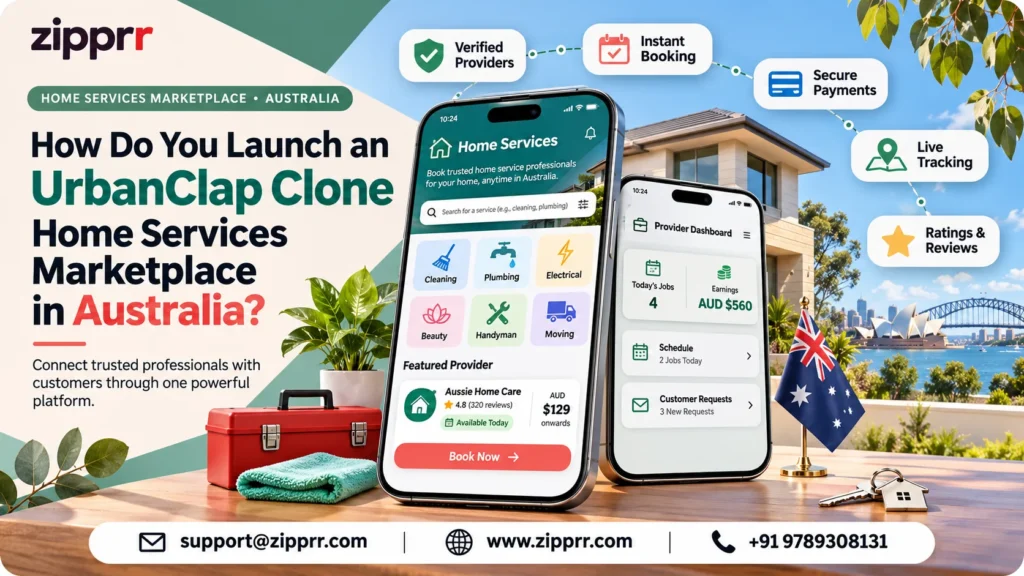
Launch a multi-service home services marketplace with one city, two categories and a 30-60-90 day roadmap.
You launch an UrbanClap clone in Australia by starting small: pick one city, open two service categories, onboard 25 to 40 verified providers, and expand only after bookings repeat. A ready-made platform such as the UrbanClap clone from Zipprr gives you the booking engine, provider app, payments and admin panel on day one, so your 90 days go into supply, trust and marketing rather than coding.
This guide gives you a 30-60-90 day roadmap built for Australian entrepreneurs. Each phase has a clear goal, a short task list and a sample target you can adapt. Everything here is written for first-time marketplace founders who want a practical plan.
Zipprr’s clone scripts are independently developed products. In addition, they are not affiliated with or endorsed by UrbanClap or Urban Company.
What Does an UrbanClap Clone Australia Marketplace Actually Do?
A multi-service marketplace lets customers book many kinds of home help in one place. Cleaning, handyman work, electrical jobs, pest control and appliance repair all sit under one brand, one app and one payment flow. Moreover, customers learn one habit, and providers fill their diaries from one source.
The model has three moving parts.
Zipprr’s product page lists the same structure: a customer app, a service provider app and an admin dashboard with provider approval, category management and payout control. That means one purchase covers all three sides of your marketplace.
Why Does Australia Suit a Multi-Service UrbanClap Clone?
Australia combines large metro areas with busy households and a strong habit of booking trades and cleaners online. Cities like Sydney, Melbourne, Brisbane and Perth each hold enough suburbs to give a new marketplace a dense, manageable launch zone. Similarly, you can win one postcode cluster before thinking about the next.
Several local needs also fit the multi-category model well.
The takeaway is simple. Furthermore, local, repeatable, high-trust jobs are the foundation of a healthy service marketplace, and Australian suburbs offer plenty of them. If you also want a task-style model, read our Airtasker clone task marketplace guide.
The Zipprr 30-60-90 Launch Ladder for an UrbanClap Clone in Australia
The Launch Ladder is a planning framework we use to keep new marketplace owners focused. It treats the first quarter as three rungs, and each rung has one job. Additionally, you only climb to the next rung when the current one holds your weight.
The table below shows sample targets for each rung. However, these numbers are hypothetical and labelled as a sample, so please replace them with your own market data.
| Rung | Goal | Sample target (hypothetical) | Key check |
|---|---|---|---|
| Days 1 to 30 | Launch two categories in one city | 30 verified providers, 15 test bookings | Every provider completes a profile and document check |
| Days 31 to 60 | Run first marketing | 120 bookings, 40 reviews | Average rating of 4.5 or higher |
| Days 61 to 90 | Expand categories | 2 new categories, 250 bookings in the month | Repeat booking rate rising week over week |
Sample figures like these are planning aids, not forecasts. Your own pilot weeks will tell you what is realistic for your suburbs and your categories.
Day 0 Setup Before You Launch an UrbanClap Clone in Australia
A short preparation week saves you from rework later. Therefore, treat it as Day 0 of your roadmap, and complete these steps before you invite a single provider.
- Choose your plan. Pick the Startup or Pro plan shown below.
- Pick your brand name and domain. Use a local, friendly name that works across all categories.
- Register your business details. Confirm your ABN and structure with your accountant before you take payments.
- Set up your payment gateway. The platform supports PayPal, Stripe and cash, so choose what your customers prefer.
- Draft your commission rule. Zipprr does not charge per-booking fees, so the commission you set is yours to keep.
Startup plan
$490Covers the web platform. Choose it if you want to validate demand on the web first.
Pro plan
$890Adds Android and iOS apps, free app submission and a multiple license. Choose it if your customers expect a mobile app from the first week.
Every Zipprr plan includes the following. Also, the page also states a 100% refund within 7 days for clone scripts, which gives you a low-risk way to confirm the platform fits your plan.
Want to see the platform before you plan your first 30 days?
Book a free walkthrough of the customer app, the provider app and the admin panel. Bring your city and your first two categories.
Days 1 to 30: Launch Your UrbanClap Clone Australia in One City
Your goal in the first month is a reliable, verified provider bench in a tightly defined area. Customers will judge your marketplace on the first job, so supply quality matters more than supply volume. In addition, think of this phase as building a small, trusted neighbourhood network.
Week 1: Pick Your City, Suburbs and Two Categories
Choose one metro area and two to four adjacent suburbs. Then choose two categories with frequent demand and low licensing complexity, such as house cleaning and handyman services. Starting with these keeps verification simple while you tune your workflow.
A good pairing has two traits. Moreover, the jobs are booked often, and the providers are easy to find locally. End-of-lease cleaning plus general handyman work fits both traits in most Australian cities. A handyman booking app shows how that second category can run, and this guide to building a handyman booking app covers the workflow.
Week 2: Configure the Platform
Set up your categories, service lists, pricing ranges and service areas in the admin panel. Write each service description in plain language, with what is included and the typical time needed. Similarly, clear descriptions lift booking confidence and cut support questions.
Then configure provider onboarding. Require a profile photo, ABN, insurance details where relevant and a short bio. Furthermore, the provider app includes registration with KYC, so every applicant follows the same path.
Weeks 3 and 4: Onboard Your First 25 to 40 Providers
Provider supply is the real launch task. Reach out to local cleaners, handymen and small trade businesses through community groups, neighbourhood pages and personal referrals. Offer each one a simple pitch: free listing, steady jobs and prompt payouts.
Our earlier guide on filling a new marketplace with its first 25 providers walks through the outreach steps in detail, and the same method works for any service category. Additionally, use this onboarding checklist for each provider.
- Complete the profile with photo, services offered and service suburbs.
- Upload ABN and relevant licence or insurance documents.
- Set weekly availability in the provider app.
- Complete one supervised test booking.
- Read and accept your marketplace conduct and cancellation rules.
By Day 30, aim for a bench that can cover your launch suburbs seven days a week. However, a small, dependable group beats a large, uneven one.
Days 31 to 60: Market Your UrbanClap Clone Australia Locally
With a verified bench in place, the second month is about proving demand. Your task is to reach homeowners and renters in your launch suburbs and turn the first bookings into reviews. Therefore, keep your marketing local, specific and measurable.
Build a Local Search Foundation
Create one landing page per category and suburb cluster, such as “house cleaning in [your suburb]”. Also, each page should describe the service, show pricing ranges, list your verified providers and include a booking button. This approach helps customers and search engines understand exactly what you offer.
Add a short FAQ to each page using the questions your first customers actually ask. In addition, real questions make your content more helpful and more likely to be quoted in AI-assisted search answers.
Use Community and Referral Channels
Local channels give young marketplaces the fastest trust. Suburb community groups, property managers and real estate agencies all talk to people who need a cleaner or handyman. Moreover, offer them a simple booking link and a clear service promise.
Prepare Your Electrical and Plumbing Categories
While your first two categories grow, plan your first licensed trade. Electrical and plumbing work require state or territory licences in Australia, so your verification step needs a licence check before approval. Reviewing a pilot page such as an on-demand electrician booking app helps you shape the provider fields, job types and emergency flows you will need. A page such as an on-demand plumber booking app does the same for plumbing.
Collect Reviews From the First Booking
Reviews are your most valuable early asset. Send a friendly review request right after each completed job, and thank every provider and customer who responds. Similarly, a rating of 4.5 or higher across your first 40 jobs gives you strong social proof for the next phase.
Send This WhatsApp Message to Start Your Launch
You can start the conversation with Zipprr in under a minute. Copy the message below, adjust the city if you like, and send it on WhatsApp.
You can also book a walkthrough and see the customer app, provider app and admin panel working together.
Days 61 to 90: Expand Your UrbanClap Clone Australia Categories
By now you should have real booking data, real reviews and a provider group that trusts your platform. Month three is where you add categories, but only where your numbers point the way. Growth based on evidence keeps quality high.
Read Your Own Data First
Review which category has the highest repeat rate and which suburbs book most often. Look at cancellation rates, average ratings and provider response times. Furthermore, these three signals tell you where your marketplace is strongest.
Then rank your next category candidates using this simple scoring list.
- How often do customers ask for it in support chats and search?
- Can you find at least 8 to 10 verified providers within two weeks?
- Does it share customers with a category you already run?
- Is the licence or insurance check clear and easy to manage?
Add Two New Categories
Good second-wave candidates include pest control, air conditioner servicing, gutter cleaning, appliance repair and lawn care. Add two of them and repeat your Day 1 to 30 playbook for each: onboard a small verified bench, run a short pilot and publish a dedicated landing page.
If you started with cleaning, a related page like an on-demand house cleaning booking app shows how a single service can grow into recurring weekly bookings. Additionally, recurring bookings are one of the strongest levers for stable revenue. If you want a task-based category too, explore the TaskRabbit clone.
Prepare Your Next City
When two or three suburbs run smoothly, document everything you learned. Capture your provider onboarding script, pricing ranges, support replies and marketing messages in a simple playbook. However, a written playbook lets you open a second city faster and with less effort. Our hyperlocal app development guide explains how to plan that expansion.
If your customers ask for a mobile app by this stage, the Pro plan adds Android and iOS apps with free app submission. Many founders start on the web plan and upgrade once their demand proves the case.
What Do the Economics of an UrbanClap Clone Australia Marketplace Look Like?
Marketplace owners earn mainly through commission on each completed booking, and some add featured listings or subscription tiers for providers. Therefore, because Zipprr charges no per-booking fees, your commission rate belongs to you. Also, the numbers below are a hypothetical sample, so please test your own pricing before you commit to them.
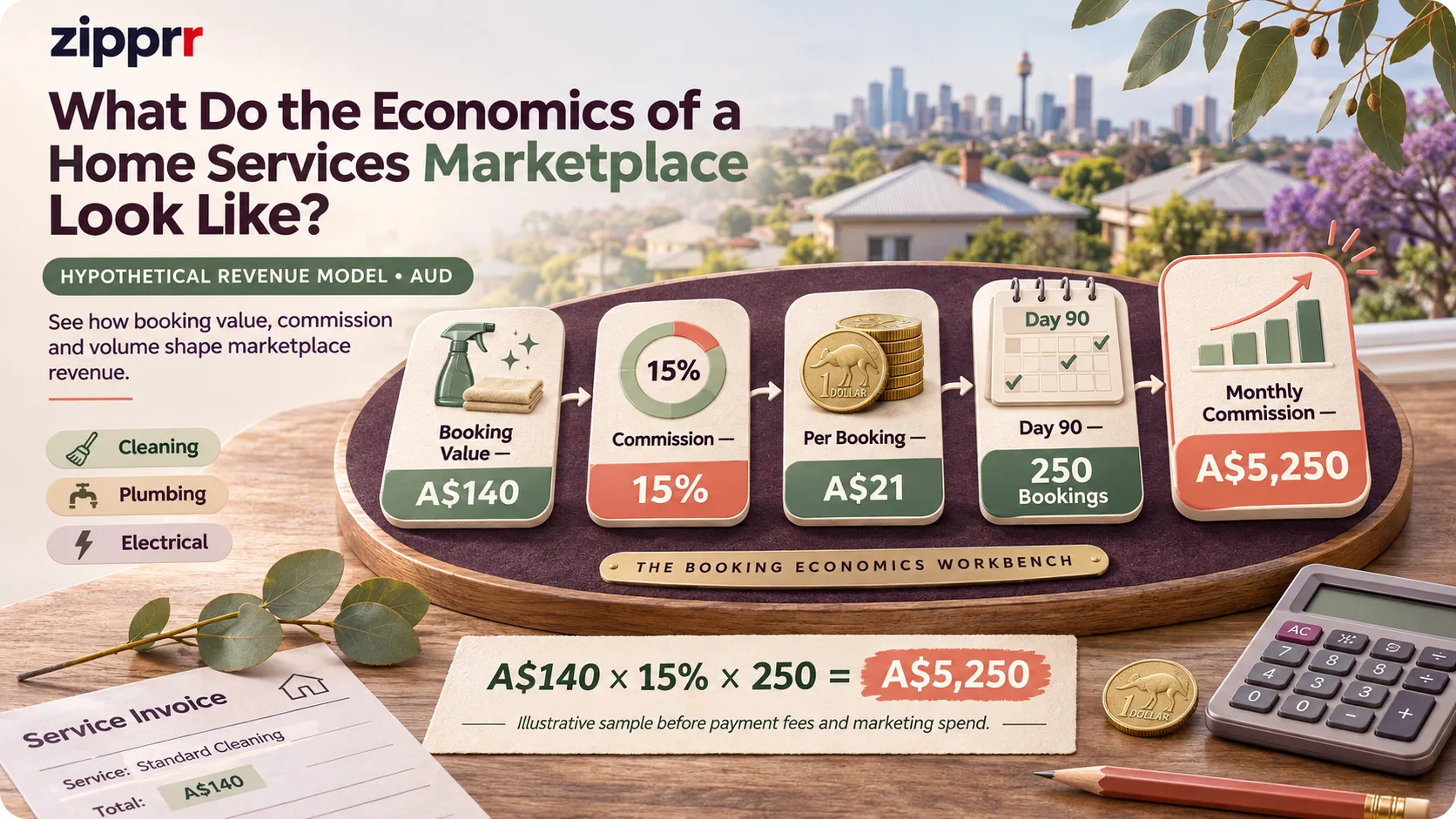
These figures show the shape of the model, not a promise of results. Your own average job value, commission and booking volume will vary by category and city. In addition, track them weekly from your admin dashboard so you can adjust early.
What Compliance Basics Should Australian Operators Review?
A short compliance review before launch builds trust with both customers and providers. Moreover, speak with your accountant and a legal adviser about your specific setup, since rules differ by state, territory and business structure. Here are the main areas to cover.
Habits That Keep Your First 90 Days on Track
Marketplace founders who reach month four in good shape tend to share a few habits. They are simple, and you can adopt every one of them from Day 1.
These habits cost almost nothing to start, and they compound quickly. By Day 90, they turn a new platform into a business with a clear, repeatable method.
Frequently Asked Questions
UrbanClap Clone Australia Cost and Revenue Questions
1. How much does it cost to build an app like Urban Company?
A custom build typically costs far more than a ready-made platform, since you pay for design, development and testing. With Zipprr, the UrbanClap clone starts at $490 for the web platform, and the Pro plan at $890 adds Android and iOS apps. Both plans include 100% source code and 90 days of support.
2. How do home services apps make money?
Most home services marketplaces earn a commission on each completed booking. Others add featured provider listings, subscription tiers or branded add-on products. Similarly, a sensible Australian launch starts with a simple commission and adds extra revenue streams once your booking volume is steady.
6. Should my app charge pros commission or per-lead fees?
Commission on completed bookings is the simplest model for a booking marketplace, because you earn when the job is done. Furthermore, it also aligns your income with provider success. Zipprr adds no per-booking fees, so you set and keep your commission.
Platform and Build Questions for an UrbanClap Clone Australia
3. How long does it take to build a home services marketplace?
A custom build can take many months. Additionally, a ready-made script shortens the technical work to installation and configuration, so your timeline is driven by provider onboarding. However, many founders aim to go live in one city within the first 30 days, as shown in the roadmap above.
4. How can I build an app like Urban Company that works in multiple service categories?
Choose a platform with customisable categories, then launch two categories first and add more as demand grows. Zipprr’s admin panel lets you create and manage categories, services and pricing. Therefore, a staged rollout keeps quality high while your Australian provider network grows.
5. How do I get enough pros for a new home services platform?
Start with one city and two categories, then recruit through local community groups, referrals and provider-to-provider invitations. Also, offer free listing and prompt payouts as your early benefits. Our guide on UrbanClap clone cost and revenue potential shows how provider supply connects to earnings.
9. Should I build a native or cross-platform app for home services?
For most new marketplaces, a web platform plus a cross-platform mobile app is the fastest, most budget-friendly path. Zipprr’s Startup plan covers the web platform, and the Pro plan adds Android and iOS apps with free app submission. In addition, you can begin on the web and upgrade as demand grows.
10. How to develop a home service app like Urban Company?
Define your niche, choose your categories, select a platform, configure providers and pricing, test with a pilot group and launch in one city. Using a ready-made script such as Zipprr’s removes most technical steps. Moreover, the 30-60-90 roadmap above gives you the full sequence.
Trust, Providers and Features Questions
7. How do I ensure quality and trust in a home service app?
Verify every provider with ID, ABN and any trade licence before approval. Add ratings and reviews after each job, and respond quickly to issues. In Australia, build state or territory licence checks into your electrical and plumbing categories.
8. What features must a home service app include to succeed?
You need search by category, instant and scheduled booking, secure payments, live job status, ratings and reviews, a provider app and an admin dashboard. Similarly, zipprr’s UrbanClap clone includes each of these. Notifications and multi-language support help you serve diverse Australian communities.
Ready to Launch Your UrbanClap Clone in Australia?
You now have a clear 90-day path: two categories in one city, first marketing in month two, and evidence-based expansion in month three. Furthermore, the next step is to see the platform working with your own categories in mind.
Your first 30 days can begin this week. Send the message, see the demo and start building your local provider bench.
Pick the route that suits you.
Tell us your city and the two categories you want to start with. We will take it from there.