

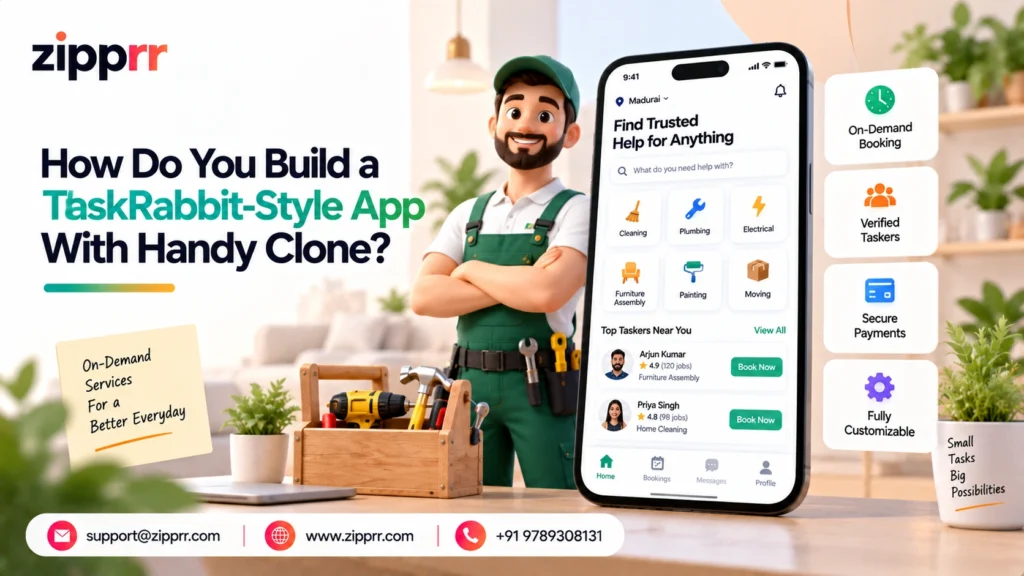
You build a TaskRabbit-style app with Handy Clone by purchasing Zipprr’s Handy Clone script, a one-time-purchase solution with full source code, a customer app, provider app, and admin panel. This gets most entrepreneurs live within days, versus custom development ($15,000 to $150,000+) or an ongoing SaaS subscription.
You build a TaskRabbit-style app with Handy Clone by buying Zipprr’s ready-made script, customizing the branding, and launching under your own name, since it already includes full source code for the customer app, provider app, and admin panel. The alternative paths are hiring a development team to code everything from scratch, or subscribing to a SaaS platform that charges ongoing fees instead of a one-time cost.
This kind of platform is a service marketplace where customers search for local handymen, check real-time availability, and book an appointment directly. It is different from a task-posting platform where a customer posts a job and waits for handymen to bid on it. Zipprr offers this same booking model under two names, Handy Clone and a TaskRabbit Clone, so you can pick whichever positioning fits your target market. That distinction matters because it shapes which features, pricing model, and go-to-market plan will actually work for your business.
What Is a Handyman Booking App and How Big Is the Market in 2026?
A handyman app like this connects homeowners with local, vetted handymen for jobs like repairs, installations, painting, furniture assembly, and small renovations. Customers browse services, see verified availability, and confirm a booking in a few taps, the same way they would book a ride or a hotel room.
This service-booking model is different from a bidding marketplace. There is no back-and-forth negotiation or open task board where anyone can place a bid. The customer picks a listed service, sees an upfront price range, chooses a time slot, and the assigned handyman accepts the confirmed job.
The opportunity behind this model is large and still growing. The global home services market is projected to grow by USD 6.54 trillion between 2023 and 2028, according to Technavio, as reported via PRNewswire. Within that broader category, the online on-demand segment specifically is forecast to grow by USD 15.11 trillion from 2024 to 2028, also per Technavio.
The handyman services segment on its own is expected to reach USD 1,579.14 million by 2033, growing at a 16.5% CAGR, according to Custom Market Insights. For entrepreneurs, this points to a category that keeps shifting away from phone calls and word-of-mouth referrals and toward app-based discovery and booking, in cities of every size, not just major metros.
Looking at the US market specifically, Mordor Intelligence sizes the United States home service market at USD 842.04 billion in 2026, growing to USD 989.22 billion by 2031 at a 3.27% CAGR. The same report notes that offline, traditional booking still accounts for 65.13% of the market, while online marketplaces and apps are the faster-growing channel, which is exactly the gap a well-run handyman booking app is built to close.
Why Entrepreneurs Are Investing in the Handyman Booking Model
Home repair demand never really slows down. Pipes leak, furniture needs assembly, and paint jobs get postponed until someone finally books a professional, which makes this a resilient, recurring category rather than a seasonal trend tied to one industry event.
Local service businesses are also historically fragmented and underserved by technology. Most handymen still rely on phone calls, referrals, and paper invoices, which leaves real room for a well-run app-based platform to organize supply that competitors haven’t captured yet in a given city.
Two-sided marketplaces like this also benefit from strong network effects. As more handymen join, customers get more choice and faster response times. As more customers book, handymen earn more and stay active on the platform, which reinforces growth on both sides at once.
Unlike ride-hailing or food delivery, handyman services carry a higher average order value per booking, since jobs like plumbing repairs or furniture assembly are priced well above a short ride or a meal delivery. That higher ticket size means fewer transactions are needed to reach meaningful commission revenue, which is one reason investors keep circling back to this category.
Many founders also enter this space because it’s easier to validate locally first. You don’t need national coverage to prove the model works. A single city with strong handyman supply and steady booking volume is enough to test the business before raising outside capital or expanding further.
The barrier to entry is also lower than it looks from the outside. You don’t need to be a developer, and you don’t need a large team to get a working platform live. What you need most in the early days is a handful of reliable handymen and a clear plan for how bookings, payments, and disputes will actually be handled day to day.
How a Handyman Booking Platform Works
At a basic level, three connected apps run the business: a customer app, a handyman (provider) app, and an admin panel that ties both sides together.
Customers open the app, choose a service category such as plumbing, electrical work, or furniture assembly, and view nearby handymen along with their ratings, pricing, and available time slots. They select a slot, confirm the booking, and pay securely inside the app rather than negotiating cash on arrival.
The assigned handyman receives the job details on their provider app, including the address, service description, and scheduled time. They accept the job, start navigation, mark the job as in progress, and close it out once the work is complete, with photo proof if required.
Behind the scenes, the admin panel manages handyman verification, service categories, pricing rules, commission tracking, and dispute resolution. This is where the business owner monitors performance, spots problem areas early, and keeps the marketplace running smoothly as booking volume grows.
Essential Features Every Handyman Booking App Needs
This kind of platform is only as good as the experience it gives to both sides of the marketplace. Missing the basics here is one of the fastest ways new platforms lose early users before word-of-mouth even gets a chance to build.
Customer App Features
- Service search by category and location
- Real-time handyman availability and instant booking
- Transparent, upfront pricing before confirming a job
- Secure in-app payments (card, wallet, and other local methods)
- Live job tracking and handyman arrival status
- Ratings, reviews, and easy rebooking of a preferred handyman
- In-app chat and customer support
Handyman (Provider) App Features
- Profile creation and skill/document verification
- Job requests with accept/decline controls
- Calendar and availability management
- Turn-by-turn navigation to the job location
- Earnings dashboard and payout history
- Job completion checklist with photo proof
Admin Panel Features
- Handyman onboarding and document verification workflow
- Service and category management
- Commission and payout configuration
- Booking oversight and dispute management
- Analytics on bookings, revenue, and retention
- Promotions, coupons, and referral program controls
Advanced Features That Set Winning Platforms Apart
Once the core marketplace works reliably, advanced features are what help a handyman booking app stand out from competitors and retain users over the long run.
AI-assisted dynamic pricing can adjust rates during high-demand periods, such as a post-storm spike in repair requests, without anyone manually resetting prices city by city.
Smart matching automatically assigns the best-fit handyman based on skill, distance, rating, and past job history, rather than leaving customers to scroll through a long list on their own.
Subscription or membership plans for repeat customers, such as a monthly home-maintenance package, help lock in recurring revenue instead of relying only on one-off bookings.
Multi-language and multi-currency support matter if you plan to expand beyond a single city or country. In-app video consultation also lets a handyman assess a job remotely before dispatch, which saves time and travel cost for both sides.
Revenue Models for a Handyman Booking Marketplace
Most successful platforms in this category combine more than one revenue stream rather than relying on a single source of income.
- Commission per booking, typically in the 10-25% range of job value
- Subscription plans for handymen who want priority visibility
- Featured listing fees for providers who want more exposure in search results
- Service call-out fees added to specific job categories
- Membership plans for customers, such as a recurring home-maintenance package
- In-app advertising from tool brands or hardware retailers
Choosing the right mix depends on your local market. Dense urban markets with high booking volume often do well on pure commission, while smaller or newer markets may need provider subscriptions or call-out fees to keep revenue steady in the first year.
For example, a platform charging a 15% commission on an average $120 booking earns $18 per job. At just 50 bookings a week, that’s roughly $900 a week in commission alone, before counting subscription or listing fee revenue from providers.
Technology Requirements to Launch in 2026
A modern handyman booking app needs native or cross-platform apps for Android and iOS, a secure backend for handling bookings, payments, and verification, and a web-based admin dashboard for the operations team.
Key technical must-haves include real-time GPS tracking, secure payment gateway integration, push notifications, an in-app chat system, and role-based access control for admin staff so not everyone sees every setting.
Scalability matters from day one. A platform built on a flexible, cloud-hosted architecture can handle growth from one city to multiple cities without a costly rebuild later, which is a common and expensive mistake with early custom builds.
This is exactly where the build-vs-buy decision becomes important, since technology choices made early directly affect how much you’ll spend fixing or rebuilding things later.
Hosting, server capacity, and third-party API costs (maps, SMS, payment processing) also add up over time regardless of which build path you choose. Budgeting for these as ongoing operating costs, separate from your upfront development spend, keeps your early financial projections realistic.
Data security and payment compliance also deserve attention early, not as an afterthought. Handling customer addresses, payment details, and handyman identity documents means your platform needs proper encryption and secure storage from launch, not bolted on after a scare.
Build vs Buy: Custom Development vs SaaS Subscription vs a Ready-Made Script
This is the decision every entrepreneur has to make before committing a budget. Each path has a different cost structure, timeline, and ownership outcome, and getting this choice wrong is one of the most expensive mistakes founders make in this category.
| Factor | Custom Development | SaaS Subscription | Zipprr Handy Clone Ready-Made Script |
|---|---|---|---|
| Upfront cost | $15,000 to $150,000+ | Low to none upfront | $490 (Standard) or $890 (Pro), one-time payment |
| Ongoing cost | Developer and maintenance fees indefinitely | Monthly or annual subscription, forever | 90 days free support included, no recurring license fee |
| Time to launch | 3 to 7+ months | Days to a few weeks | Days |
| Source code ownership | Yes, full ownership | No, the vendor owns the platform | Yes, 100% source code included |
| Customization depth | Fully custom, but expensive and slow | Limited to the platform's built-in settings | Full customization since you own the code |
| Android + iOS apps | Built separately, added cost and time | Sometimes included, varies by plan | App source code included on both plans; free app store submission included only on the Pro ($890) plan |
| Best for | Well-funded teams with truly unique requirements | Testing an idea with minimal upfront spend | Entrepreneurs who want to own their platform and launch fast without ongoing license fees |
Custom development gives full control but stretches timelines to months and keeps stacking up developer costs long after launch. A SaaS subscription lowers the upfront cost but locks you into recurring fees indefinitely and caps how far you can customize the platform.
A ready-made script like Zipprr’s Handy Clone sits between the two. You get full source code ownership and both Android and iOS apps for a one-time cost, without the multi-month build cycle that custom development requires.
What to Check Before You Buy a Handyman Clone Script
Before paying for any ready-made script, confirm these details directly with the vendor, since pricing pages and inclusions can change and marketing claims vary between providers.
- Confirm whether Android and iOS apps are included in your specific plan, and whether app store submission is handled for you or left to you.
- Ask exactly what the included support period covers: bug fixes only, or also configuration help and minor customization.
- Verify you receive full, unencrypted source code, not just admin panel access, so you actually own the platform long-term.
- Check the refund policy in writing before purchasing, not only as a marketing claim on the landing page.
- Ask whether future updates and new feature releases are free or charged separately once the support window ends.
- Request a live walkthrough of the actual admin panel and both apps, not just screenshots, before you pay.
Business Benefits of Launching a Ready-Made Handyman Booking Script
Speed to market is the biggest benefit. Launching in days instead of months means you can start collecting real bookings, real feedback, and real revenue while competitors are still stuck in development.
Lower financial risk follows naturally from lower upfront cost. Testing your local market with a few hundred dollars is a very different risk profile than committing tens of thousands of dollars to a custom build before you know whether local demand is even there.
Full source code ownership means you’re not renting your business. You can rebrand, adjust workflows, add new service categories, and expand to new cities without asking a SaaS vendor’s permission or paying them a growing monthly fee as you scale.
Included support also gives new founders a safety net while they learn how to operate the platform, onboard handymen, and fix early issues without hiring an in-house developer on day one.
Customer trust builds faster too, since a clean, professional booking experience signals reliability the same way an established brand would, even for a business that launched only weeks earlier. Verified ratings and transparent pricing do a lot of that trust-building work automatically once the platform is live.
Common Challenges and How to Solve Them
Every handyman marketplace faces the same early hurdles. Recognizing them ahead of time saves both money and momentum later, and most of these problems are solvable with process, not more code.
- Chicken-and-egg problem (no handymen, no customers): Solve by manually onboarding a small group of vetted handymen in one neighborhood before opening customer bookings broadly.
- Trust and safety concerns: Solve with ID verification, background-check partnerships, and visible ratings and reviews for every handyman on the platform.
- Inconsistent service quality: Solve with a structured rating system, mandatory job checklists, and a clear dispute-resolution process inside the admin panel.
- Handyman churn: Solve with fast payouts, a transparent commission structure, and incentives for consistently high-performing providers.
- Local competition from classified listings or word-of-mouth: Solve by making booking faster and more trustworthy than a phone call, with visible pricing and verified reviews upfront.
Future Growth Opportunities in the Handyman Services Space
AI-assisted job estimation, where the app predicts a price range from a photo and a short description, is becoming a realistic near-term feature rather than a distant concept.
Expansion into adjacent categories such as house cleaning, plumbing services, appliance repair, and moving help lets a handyman platform grow into a broader home-services marketplace instead of staying limited to one niche. Many successful operators start with handyman jobs and add these categories only once the core business is running smoothly.
Corporate and property-management partnerships, where landlords or facility managers use the platform for recurring maintenance contracts, open a B2B revenue channel alongside individual consumer bookings.
International expansion is realistic too, since demand for reliable handyman services is not unique to any one country. Structuring your content and FAQs around clear, direct answers also makes your brand more likely to surface in AI-generated answers on tools like Google AI Overviews, ChatGPT, and Perplexity as more buyers research this category through conversational search.
How to Launch Your Handyman Booking App Successfully
Launching successfully has less to do with having every possible feature on day one and more to do with sequencing the right steps in the right order.
- Validate demand in one city or neighborhood before expanding further.
- Choose your platform path (custom, SaaS, or ready-made script) based on your actual budget and timeline.
- Onboard an initial group of vetted, reliable handymen before marketing heavily to customers.
- Set clear, transparent pricing and a fair commission structure from day one.
- Launch with a simple, working feature set, then add advanced features based on real usage data.
- Invest in local marketing, such as your Google Business Profile and local SEO, rather than only paid ads.
- Track retention and repeat bookings as your core success metric, not just download numbers.
Most failed launches in this category don’t fail because of missing features. They fail because founders market to customers before there is enough reliable handyman supply to actually serve them.
If you’d rather see this working before committing a budget, book a free live demo of Zipprr’s Handy Clone, message our team on WhatsApp at wa.me/919789308131, or email [email protected]. Most founders go from that first conversation to a live, branded platform in days.
Key Takeaways
- A handyman booking app is a service-booking marketplace, not a task-bidding platform. Customers pick a listed service and time slot directly.
- The global home services market is projected to grow by USD 6.54 trillion between 2023 and 2028 (Technavio, via PRNewswire), with the online on-demand segment forecast to grow by USD 15.11 trillion in the same window.
- Custom development costs $15,000 to $150,000+ and takes 3-7 months. A SaaS subscription lowers upfront cost but adds recurring fees indefinitely. A ready-made script like Zipprr’s Handy Clone costs a one-time $490 or $890, with full source code and both Android and iOS apps included.
- Commission per booking, combined with provider subscriptions and featured listings, is the most resilient revenue mix for this model.
- Solving the chicken-and-egg supply problem before marketing to customers is the single most important early execution step.
Ready to launch your own handyman booking app without the months-long wait or the six-figure development bill?
Zipprr’s Handy Clone gives you a fully working customer app, handyman app, and admin panel with 100% source code, so you own your platform outright from day one. See it running before you commit: book a free live demo at zipprr.com/schedule-free-demo/, message our team on WhatsApp at wa.me/919789308131, or email [email protected] with your questions. Most founders go from first conversation to a live platform in days, not months.