

Booking a plumber, a salon visit, or a deep-clean through an app has stopped feeling novel and started feeling normal. That shift is why so many founders keep circling back to one question: can the model behind Urban Company, the platform many still call by its old name UrbanClap, be rebuilt for a different city, country, or service category? This guide answers that head-on. You will get the realistic price of building such a platform in 2026, an honest read on what it can earn, the features that actually carry weight, and a clear way to choose between coding it yourself and buying something ready to go.
If it helps to picture the result while you read, this UrbanClap clone solution demonstrates the typical setup in a working environment.
What an UrbanClap clone actually is
Strip away the jargon, and it is straightforward. An UrbanClap clone is packaged software that lets you launch your own version of a home services platform: customers find and book a service, a checked professional turns up to do the work, and you, the owner, handle the matchmaking, the calendar, the payment, and the standards in between.
Here is a naming point worth settling early, since it trips so many people up. The labels UrbanClap and Urban Company belong to a single business, not two rivals. The firm dropped its first name and adopted the Urban Company identity in 2020, roughly six years on from when it began trading. There is no separate product called UrbanClap waiting to be cloned, then. The term is just convenient shorthand for recreating how the platform functions, and it has nothing to do with its name or look.
Think of it as a marketplace with two customer groups and one referee. People who need a job done sit on one side. Trained workers who can do that job sit on the other side. You sit in the middle, deciding the rules, holding the money until the work is finished, and taking a slice to make the whole exchange safe and easy. Notice what does the real work there: not the app, but the confidence both sides have that a booking will go smoothly. Software is replaceable. That confidence is not, which is why operators win or lose on execution.
How the original turns a profit
You cannot copy a business sensibly until you know how it pays for itself, so the money is where we will begin.
Urban Company keeps a tight grip on quality. Workers are interviewed, trained, and held to standards. Customers pay a rate the platform sets, not one negotiated on the spot. After each visit, the two sides score one another. The income, though, leans heavily on a single mechanism: the platform pockets a cut of every job that gets completed. By published accounts, that cut is the source of the large majority of company income, and it tends to land in the region of a quarter to just under a third of the job value, often around the high-twenties in percentage terms. Two side earners round things out. The company sells branded kits and refills to the workers who use its platform, and it offers customers a paid membership that comes with perks like cheaper visits and earlier slots.
The reason investors and copycats pay attention is the direction of travel. In its most recently reported financial year, the company cleared roughly a sixth of a billion dollars in revenue, grew that figure by well over a third compared with the prior year, and finally finished a year in the black after a long stretch of red ink. Forecasts that model the company out to the end of this decade have its revenue landing near three times where it is now. User numbers point the same way, with the count of people actually transacting expected to push past eight million within a year or two, up from under five million a couple of years earlier. None of this is unique to one country, either. The same upward pull is visible in home-service apps around the world.
Is the 2026 opportunity genuine?
It is, for two reasons that survive scrutiny. The category is enormous and still mostly offline, and the biggest player has barely scratched the global surface. Different research houses size the market differently depending on what they count, but the numbers below give a fair spread of what was published for 2026.
| What is measured | 2026 estimate | Where it heads | Pace |
|---|---|---|---|
| Home services overall | about USD 464 billion | roughly USD 653 billion by 2030 | high single digits |
| Online, on-demand slice (one report) | about USD 6.8 billion | close to USD 11.8 billion by 2030 | mid-teens |
| Online, on-demand slice (broader read) | up to about USD 13 billion | steady mid-teens climb | mid-teens |
| Leading platform's active users | past eight million | still rising | upward |
What does building one cost in 2026
There is no single sticker price, and anyone quoting one is guessing. What you spend hinges on three things: the path you take, how deep the feature set runs, and where in the world your developers sit. The table groups the realistic options.
| Approach | Ballpark spend | How long | Who it suits |
|---|---|---|---|
| Lean MVP, one city, core booking | USD 30,000 to 70,000 | roughly 3 to 5 months | testing a single niche |
| Mid-weight build, tracking and matching, two apps | USD 70,000 to 150,000 | roughly 5 to 8 months | growing inside a region |
| Full custom, multi-city, smart matching | USD 150,000 to 300,000+ | roughly 8 to 12 months | funded, multi-market plans |
| Ready-made clone, branded and configured | low four figures and up | days to a few weeks | fast, budget-aware launch |
Pre-packaged clone bundles are advertised from the high-two-thousands in dollars and can be live within days, which is the main reason many first-timers choose that lane in any region. Keep in mind that local pay rates swing these figures: the identical build is cheaper through teams in lower-cost markets and pricier in North America or Western Europe, so treat the ranges as a worldwide middle, not a fixed invoice.
The big cost levers are how many separate apps you need (one for customers, one for workers, one for you to run the show), how clever the scheduling and matching have to be, whether you want live tracking, how payments and worker payouts are handled, how many service types you list, and how polished the design is. A proven home services clone script wipes out most of those line items, because the core pieces already exist and only need configuring and branding.
Then come the expenses that rarely make it onto the first quote, and they bite. Budget around a fifth of your build cost every year just to maintain it. Every transaction carries a gateway fee. Vetting and background-checking each worker costs money. Messaging and alerts add up once volume grows. Hosting bills rise with traffic. Support needs real people. And looming over all of it is the spend on winning both customers and workers, which in a two-sided business is usually the single fattest recurring cost.
What it can realistically earn
| Income thread | Mechanism | Worth knowing |
|---|---|---|
| Job commission | a percentage of each finished booking | Industry norm runs roughly a tenth to a third |
| Worker subscription | a recurring fee for priority or a lower cut | steadier, more predictable cash |
| Lead charges | pay-per-qualified-lead in scattered trades | A benchmark elsewhere is tens of dollars per lead |
| Promoted placement and ads | paid visibility for workers | high margin once you have scale |
| Urgency or convenience fees | extra for same-day or rush jobs | lifts the margin at peak demand |
| Selling supplies | kits and consumables sold to workers | echoes what the market leader does |
The commission should anchor everything, with the other threads added later, once you have volume. Pile too many fees onto workers early, and they walk. The platforms that endure typically end up running several of these at once.
To make it tangible, the table below runs a commission-only model. Assume an average job worth USD 50 and a one-fifth cut, which leaves you USD 10 per completed booking. These are illustrations to show the shape of the curve, not guarantees, and they move with local pricing.
| Where you are | Jobs per day | Commission per month | Commission per year |
|---|---|---|---|
| One area, proving the idea | 40 | about USD 12,000 | about USD 146,000 |
| A city in full swing | 400 | about USD 120,000 | about USD 1.44 million |
| Several cities, real brand | 2,000 | about USD 600,000 | about USD 7.2 million |
Three numbers steer the outcome. The first is your cut of each job, which the market leader is expected to widen over time, and that widening alone explains a big chunk of its projected growth. The second is the size of an average booking, since that sets what each commission is worth. The third is what it costs you to bring in customers and workers, because that decides how much margin actually survives. The smart sequence is to open with a modest cut so workers flock in, then nudge it up as your platform becomes their dependable source of jobs. Switching on extra income threads is simple once you are ready, and the monetization options inside an UrbanClap clone are built to turn them on as the business matures.
The features that actually carry weight
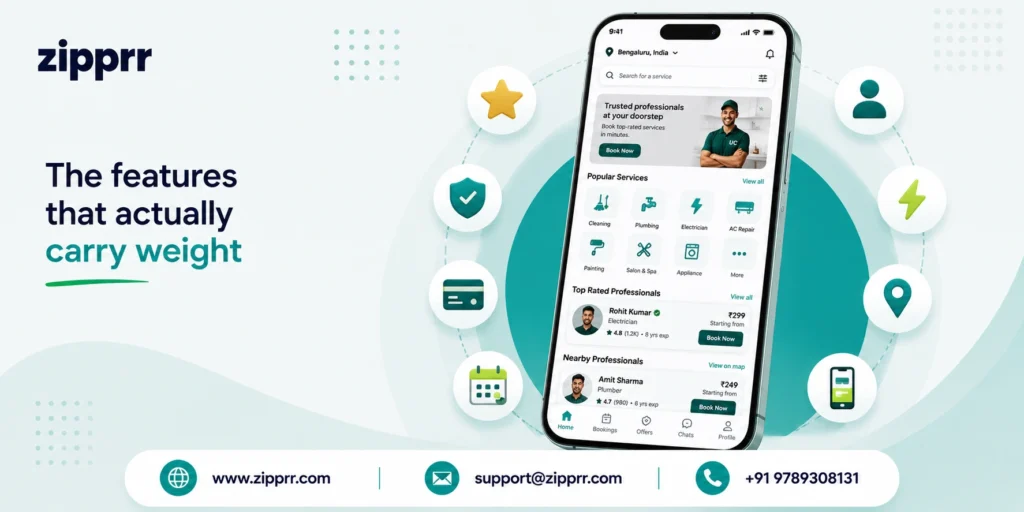
| App | Need it on day one | Add once you have momentum |
|---|---|---|
| For customers | browse and search services, book and schedule, pay securely, leave ratings, get alerts | live tracking, messaging, wallet, rewards, and memberships |
| For workers | receive and accept jobs, see the schedule, track earnings and payouts, manage profile and documents | turn-by-turn routing, analytics, training content |
| For you (admin) | set categories and prices, manage people, control commission, settle disputes, pull reports | smart matching, flexible pricing, multi-city, multiple languages |
The rule of thumb is to launch with the first column and resist the rest. New platforms die for lack of liquidity, rarely for lack of a fancy feature, so put your money into filling both sides of the market instead of polishing extras. A standard UrbanClap clone feature set already ships with that launch column across all three apps.
A sensible technology stack
Pick familiar, well-supported tools over clever ones, because familiar is cheaper to hire for and to keep running. The table sketches a reasonable 2026 setup.
| Layer | Reasonable pick | Why |
|---|---|---|
| Mobile apps | Flutter or React Native | one codebase for both platforms, often trimming build cost by about a third |
| Server | Node.js with Express | battle-tested and easy to staff |
| Data store | MongoDB or PostgreSQL | flexible or structured, your call |
| Web and admin | React | mature and well-documented |
| Sign-in | token-based auth | standard and secure |
| Payments | an established gateway | reliable splits and payouts |
| Location | a mapping service | needed for live tracking |
| Hosting | scalable cloud | expands with demand |
Coding it yourself versus buying it ready
| Consideration | Code from scratch | Ready-made clone |
|---|---|---|
| Money up front | USD 30,000 to 300,000+ | much less |
| Time to go live | several months to a year | days to a few weeks |
| How customizable | endless | solid base, then tailored |
| Build risk | higher | lower, the code is proven |
| Who it fits | novel idea, own engineers, funding | first launch, testing demand, tight budget |
For most people launching their first platform, buying and tailoring a clone is the wiser bet: it keeps your cash for marketing and gets you to liquidity sooner, and liquidity is the genuine choke point. Building everything yourself only pays off when the difference you are selling lies in the technology, and you have the money and patience to back that. If you want to test the two routes against your own market, you can walk through the platform on a free product walkthrough before spending anything, or look over a customizable UrbanClap clone to see how much is already handled for you.
A practical launch sequence
- Pick one service and one small area to begin with.
- Decide your route, clone or custom, based on money and timeline.
- Set up your categories, prices, commission, and payout rules.
- Sign up and vet a starter group of workers before spending a cent on customer ads.
- Open quietly to a small group of customers and listen hard.
- Get quality and reviews steadily in that first patch.
- Layer in extra income threads once your job volume is dependable.
- Only then push into the next service or the next neighborhood.
Where new operators face friction
The model works, but it carries specific operating risks that are smarter to plan for than to discover. The table pairs each common headache with a way to soften it.
| Headache | Why does it show up | What helps |
|---|---|---|
| Demand and supply are out of sync | peaks and seasons spike demand while worker availability stays flat | predict demand, reward off-peak supply, cap bookings when short |
| Workers leaving | independents drift to direct bookings or rivals | keep the early cut low, feed steady jobs, pay fast |
| Uneven quality | The work is done by third parties | standardize training, enforce ratings, drop weak performers |
| Skinny early margins | discounts and acquisition outrun commission | Concentrate spending in one area, and raise the cut only after liquidity |
| Rules and licensing | worker-classification and local permits vary widely | clarify contractor status, hold the right licenses, plan for tax |
| Trust and safety | Strangers entering homes worries people | background-check workers, verify identity, add support, and tracking |
The thread running through every one of these is that your value is operational, not technical. The software moves the booking along; reliability, safety, and keeping workers happy are what keep both sides showing up. Funding support, vetting, and quality control from the start matter as much as the build.
Choosing a niche and competing
Trying to be everything to everyone across every service is how a newcomer burns cash with nothing to show. The opposite works: go narrow and dig in. Lock onto one hungry slice in one defined area, whether that is at-home salon work in well-off neighborhoods, appliance and air-conditioning repair in cities the big names ignore, eldercare visits, pet grooming, or move-out cleans. Owning that slice cold gets you reviews, repeat customers, and word of mouth quickly, none of which a sprawling rival can easily replicate in your backyard. Widen out only after that first foothold is unshakable.
The bottom line
An UrbanClap clone is a credible business in 2026 for anyone who plans it with eyes open. The market is huge, and the online slice is growing fast. The money model is well proven and rests on commission backed by extra threads, and the cost of entry stretches from a few thousand dollars for a ready clone to several hundred thousand for a bespoke build. What you earn rides on booking volume and your cut, which means local liquidity, not software, decides your fate. For most newcomers, the sane path is the same: start small, launch quickly on a proven base, earn trust in one place, and switch on more revenue as the volume builds.
Ready to launch?
Frequently Asked Questions
Is UrbanClap the same as Urban Company?
They are the same company, not two. UrbanClap was simply the brand’s first name when it opened in 2014, and it became Urban Company in 2020. So an “UrbanClap clone” means software that copies how the platform works for home services, not its name, logo, or trademark in any way.
How does Urban Company actually make money?
Its income leans mostly on a cut taken from every job booked through the platform, which makes up the bulk of what it earns and tends to sit around the high-twenties in percentage terms. It also sells supplies to its workers and runs a paid customer membership offering discounts and faster booking.
How much does it cost to build an UrbanClap clone in 2026?
A lean single-area app generally lands somewhere between roughly USD 30,000 and USD 70,000, while a full multi-city custom platform can run from about USD 150,000 to USD 300,000 or beyond. A ready-made clone costs far less and can be live in days rather than the months a scratch build needs.
How long does it take to develop an Urban CCompany-style home services app?
A scratch build of an Urban Company-style platform usually runs somewhere between four months and a year, with the exact span driven by feature depth, design, testing, and app-store review. Picking a ready clone collapses that to days or a couple of weeks, since the booking, payment, and admin pieces already exist.
How much can a home services marketplace earn?
Most of the income comes from a cut on each booking, commonly between a tenth and a third of the order, topped up by subscriptions, lead charges, and promoted listings. A city doing four hundred jobs daily at a fifth cut on a fifty-dollar order brings in roughly USD 120,000 monthly, climbing steeply with volume.
What features does an UrbanClap clone need?
At minimum, it needs a browsable service catalog, booking and scheduling, secure payments with worker payouts, ratings, alerts, a worker app for managing jobs, and an admin console for prices and commission. Extras like live tracking, smart matching, chat, and memberships are best added once the marketplace has genuine traction.
Should you build an UrbanClap clone from scratch or buy a clone script?
For most first-time founders, buying and tailoring a clone wins, because it launches fast, costs far less, and frees cash for marketing. Building from scratch is justified only with a truly original idea, in-house engineers, and funding, since reaching liquidity usually counts for more than owning custom code.
What technology stack suits a home services app in 2026?
A practical setup pairs a cross-platform mobile framework such as Flutter or React Native, which can trim build cost by around a third, with a Node.js and Express server, a MongoDB or PostgreSQL store, React for web and admin, token-based sign-in, a payment gateway, and a mapping service. Familiar tools are easiest to hire for.
Is running an on-demand home services business legal?Is running an on-demand home services business legal?
It is legal in most places, but you must handle worker classification, background checks, local trade permits, tax collection, and data privacy rules. Requirements shift from country to country, especially around gig-worker status and benefits, so review local labor and consumer law before you open the doors.
What is the best niche for a new home services marketplace?
The strongest play is a narrow, high-demand slice in one defined area, such as at-home salon work in affluent neighborhoods, appliance repair in cities the big names overlook, eldercare, or pet grooming. Concentrating on a single service and place builds liquidity far faster than scattering across many.