
Somewhere between a customer’s abandoned cart and their next purchase sits a message they will actually open. WhatsApp now carries that conversation for more businesses than any other channel, and a growing number of entrepreneurs are building software companies around exactly that fact.
Not by inventing a new app, but by making the WhatsApp Business API usable for teams that do not have engineers on staff. This guide walks through what a WhatsApp automation software business actually does, who pays for it, what it actually costs, how much it takes to build, and where the real risks sit, all grounded in current pricing and market data rather than guesswork.
What WhatsApp Automation Software Actually Does
At its core, WhatsApp automation software sits between a business and Meta’s WhatsApp Business API, also called the Cloud API. Meta does not let just anyone plug in. A business either applies directly through Meta or works through an approved Business Solution Provider, verifies its number, and only then gets access to send template messages, run chatbots, and message customers at scale.
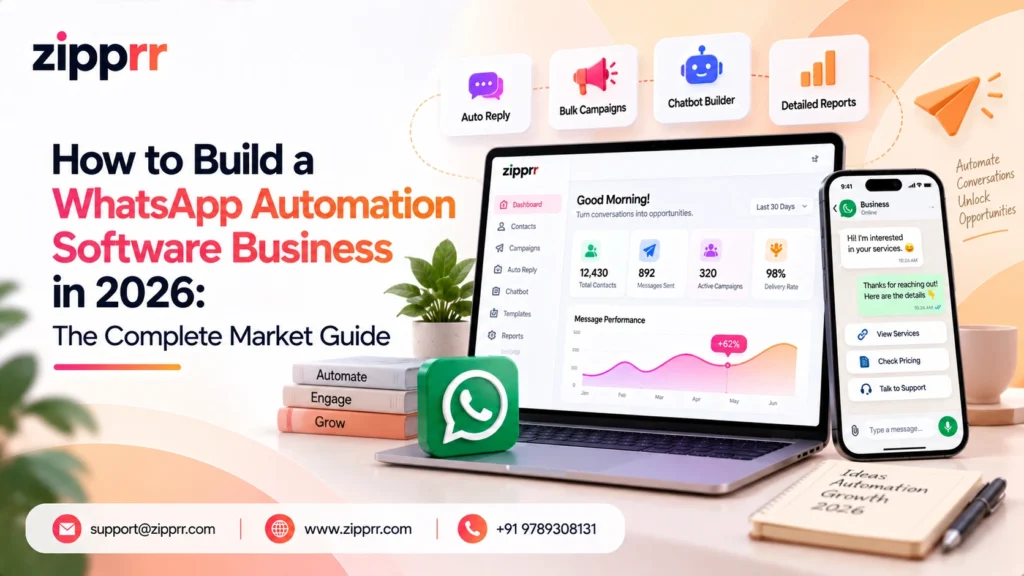
The software layer is what makes that raw API usable day to day: a shared inbox so more than one support agent can answer from a single number, a chatbot builder for automated replies, a broadcast tool for approved marketing or utility templates, and reporting on delivery and read rates. One thing worth knowing before you build anything: Meta changed the economics of this space on January 1, 2026, moving from bundled conversation-based pricing to per-template-message billing, with free-form service replies inside the 24-hour customer window still free. Any serious product today has to be priced around that shift. For the fuller technical walkthrough, Zipprr’s complete guide to WhatsApp automation software covers the Cloud API setup process in more depth.
Who Actually Buys This Kind of Software
- D2C and e-commerce brands: They use it for cart recovery, order confirmations, and cash-on-delivery verification, since WhatsApp’s open rates comfortably beat email
- Real estate and rental agencies: They use it to qualify leads the moment they arrive and send listing updates instantly, since a slow reply on a property enquiry usually means a lost lead
- Clinics, salons, and appointment-based businesses: They use it for booking confirmations and reminders that cut no-shows and protect revenue on a fixed daily schedule
- Coaching and education businesses: They use it for nurture sequences and cohort reminders that keep enrollment numbers up
- Marketing and CRM agencies: They buy or license the software once and resell it under their own brand to dozens of small-business clients, effectively becoming their own regional WhatsApp software provider for a specific city or niche
Demand skews heavily toward India, Southeast Asia, Latin America, and the Middle East, where WhatsApp is the default messaging app rather than one option among several, though enterprise adoption is now rising quickly in North America and Europe too. Lead qualification is one of the biggest draws for agencies specifically; Zipprr’s own playbook on WhatsApp automation for lead generation breaks that use case down in more detail.
What This Looks Like in Practice
Picture a mid-sized online fashion brand that switches from email-only reminders to WhatsApp for order confirmations and abandoned-cart nudges. Because WhatsApp messages tend to get opened far more reliably than email, those nudges get seen within minutes rather than sitting unread for days, and a meaningful share of abandoned checkouts get completed simply because the reminder showed up somewhere the customer was already paying attention.
For the software vendor selling that brand the tool, the economics work in reverse: a modest one-time software cost, plus a small markup on Meta’s per-message fees, adds up quickly across a client base of even fifty small businesses. That is the entire business model in miniature, and it is exactly why agencies increasingly prefer buying or licensing a ready-made platform rather than building their own from zero.
Core Features Every WhatsApp Automation Platform Needs
- Official WhatsApp Business API connection, including number verification and the Meta approval flow, ideally routed through a registered Business Solution Provider
- A shared team inbox with conversation assignment, tags, and searchable chat history
- A flow-based chatbot builder for FAQs, lead capture, and simple order-status lookups
- Broadcast and bulk campaign sending against pre-approved templates, with opt-in and opt-out tracking built in from day one
- Contact management with CSV import and export and basic list segmentation
- A template library that shows each message’s Meta approval status
- Core analytics covering delivery rate, read rate, and average response time
- Role-based logins for multiple support agents
- Webhooks and a documented API so the tool can be wired into whatever else the customer already runs
These are not optional extras. A product missing any one of these will struggle against established players who already offer all nine as standard, and customers evaluating a new tool notice the gap within the first week of a trial.
Advanced Features That Create a Real Competitive Advantage
Once the basics are covered, these are the features that actually win a deal against an established provider. Many teams also pair their WhatsApp bot with a separate AI chat assistant for the website, so a visitor who starts on the site and moves to WhatsApp never has to repeat themselves:
- Native CRM and e-commerce integrations with Shopify, WooCommerce, HubSpot, Zoho, and Salesforce, for cart-recovery and order-status flows that update automatically
- AI-assisted replies, where a language model drafts a response for a human agent to approve rather than sending it unsupervised
- Branching bot flows that can make live API calls mid-conversation, such as pulling a real order status or a CRM record
- Click-to-WhatsApp ad tracking that ties an incoming chat back to the exact Facebook or Instagram ad that triggered it
- In-chat payments where WhatsApp Pay or a checkout link is supported in the target market
- Multi-number, multi-brand dashboards for agencies managing several clients from one login
- Usage-based billing controls that let a reseller set their own margin on top of Meta’s per-message rates
- White-label branding, so an agency can resell the tool entirely under its own name and logo
What This Actually Costs: A One-Time Pricing Model
Most platforms in this space run on recurring monthly subscriptions, typically priced by the number of agents, contacts, or messages sent, layered on top of Meta’s own per-message charges. That adds up fast for a growing business, and it is exactly the model Zipprr built its own WhatsApp automation software to avoid. Here is what the one-time pricing actually looks like:
| Plan | Price | What's Included |
|---|---|---|
| Standard | $490 (one-time) | Full source code, website installation, 90 days of support, regular updates, no monthly fees |
| Pro Most Popular | $890 (one-time) | Everything in Standard, plus native Android and iOS apps with app store submission |
Both plans include a 7-day money-back guarantee, and because it is a one-time purchase, there is no recurring subscription fee, no per-agent billing, and no renewal deadline to track. Meta’s own per-message charges are billed separately and paid directly to Meta, since no software vendor, including Zipprr, can waive those. For a founder or agency planning to resell this to multiple clients, that fixed, predictable cost structure is usually the deciding factor over an ongoing subscription model.
Development Complexity, Honestly
Building this from zero involves three separate layers of work, and founders routinely underestimate the first one. Getting official API access, whether directly from Meta or through a Business Solution Provider, involves business verification and a review process that can take anywhere from a few days to several weeks, entirely outside your control.
Only after that is settled does the actual software layer become the real engineering project: the inbox, the bot builder, the broadcast engine, and the billing system. A small team building it properly, including template compliance handling and the new per-message billing logic, is realistically looking at three to four months before there is a usable, sellable product. The third layer, ongoing compliance with Meta’s shifting rules, never really ends, and it is the layer that quietly eats the most founder time after launch.
For founders who would rather skip the first two layers entirely, a pre-built option like Zipprr’s WhatsApp automation software already handles the Meta integration, chatbot builder, and broadcast tooling out of the box, turning a multi-month build into a matter of days.
Monetization Models Worth Considering
Most incumbents run recurring subscription tiers priced by seats, contacts, or message volume, because it matches how customers already think about SaaS spending. A second, increasingly common model is usage-based billing with a margin stacked on top of Meta’s per-message rate, which suits customers who send unpredictable volumes.
A third, less crowded model is a one-time license or white-label sale, similar to how Zipprr prices its own broader catalogue of business software as a single purchase rather than a subscription. That appeals directly to agencies and resellers who want to own the tool outright and layer their own recurring pricing on top for their own clients. Add-on services such as managed campaign setup or compliance consulting are a reasonable way to increase revenue per account without adding more subscription tiers.
Many successful vendors actually blend two of these models rather than picking just one: a low-cost or free base subscription to remove friction at signup, combined with usage-based charges for messages sent above a fair-use threshold. That hybrid approach tends to convert better than a single high-commitment plan, since it lets a nervous first-time buyer start small and grow their spend only as they see real results.
Market Demand: Is There Still Room in 2026
The underlying numbers are hard to argue with. Industry trackers put the number of businesses actively using the WhatsApp Business app at around 200 million globally, with more than 5 million businesses now on the API specifically for engagement at scale, and roughly 15 million of those in India alone. Analysts expect roughly 80 percent of large enterprises to have integrated the WhatsApp Business API by the end of 2026.
On the customer side, close to 40 percent of consumers now say WhatsApp is their preferred support channel, and a majority of companies running chatbots on WhatsApp report measurably higher customer satisfaction as a result. None of that guarantees a new entrant succeeds, but it does mean the demand is structural rather than a passing trend.
Risks and Challenges to Plan Around
- Platform dependency: You are building a business on rules you do not control. Meta’s January 2026 pricing overhaul proves policy can change with real financial consequences for every vendor
- Approval and account risk: Template rejections or account restrictions can happen with limited warning and little recourse
- Regulatory pressure: Rules around unsolicited messaging are tightening in most markets, so opt-in and consent handling cannot be an afterthought
- Margin compression: As the core feature set commoditizes, price competition against free or near-free tiers from well-funded players squeezes margins
- Support overhead: A large share of customers are non-technical small businesses, so support costs per account run higher than a typical developer-facing SaaS product and need to be priced in from day one
- Currency and localization complexity: Per-message rates, tax treatment, and preferred payment methods vary by country, which adds real overhead for founders selling across multiple regions from day one
Recommended Tech Stack
- Backend: Node.js with NestJS, or Python with Django, for the API and core business logic
- Database: PostgreSQL for structured data, Redis for caching and message queueing
- Message queue: RabbitMQ or Kafka to pace bulk broadcasts and avoid hitting Meta’s rate limits
- WhatsApp connectivity: Meta’s Cloud API directly, or through a Business Solution Provider for faster onboarding
- Frontend: React or Next.js for the agent dashboard and admin panel
- Bot flow engine: a custom flow builder, or an adapted open-source base such as Botpress
- AI layer: an LLM API such as OpenAI or Anthropic for AI-assisted reply drafting
- Infrastructure: AWS or GCP with autoscaling to absorb sudden broadcast spikes
- Mobile: React Native or Flutter, only once a dedicated agent mobile app becomes a real priority
Which Platform Type Actually Fits
For this category, a multi-tenant web-based SaaS platform is the right shape, not a mobile app and not a marketplace. The buyers, whether business owners, support managers, or agency operators, work from a desktop dashboard managing campaigns and conversations, and a browser-based product lowers the barrier for non-technical customers far more than a native app ever would.
Agencies in particular need a multi-client admin view that a mobile-first product struggles to deliver well. A companion mobile app for agents to reply on the move is a reasonable later addition, but never the primary interface, and a marketplace model does not fit here at all since this is a straightforward B2B tool sale rather than a two-sided network.
If mobile matters to your specific buyers, the smarter sequencing is almost always web-first, mobile-second: launch the full dashboard on the browser, prove the core workflows earn their keep with real paying customers, and only then invest in a native app once agents are actively asking for one.
How to Validate the Idea Before You Build Anything
Before committing months of development time, talk to fifteen or twenty prospective customers in whichever vertical you are targeting and ask specifically how they currently handle WhatsApp conversations at volume, not whether they like the idea in the abstract. A faster and cheaper way to test real demand is to run a concierge version first: sign up for an existing subscription-based WhatsApp automation tool, manually deliver the workflow your target customers need, and charge for it before writing a single line of your own code.
Watch what those early customers complain about in the tools they already use; a recurring complaint across ten conversations is a far stronger signal than any amount of market-size research. It is also worth checking review sites and community forums for existing platforms in this space, since public complaints about pricing, support, or missing integrations point directly at where a new entrant can win.
Common Mistakes First-Time Founders Make in This Space
- Building before securing API access: The entire product gets built before founders discover verification is stuck or a display name has been rejected
- Copying competitors line by line: Instead of picking a specific niche where the product can genuinely be the best option, which leads to a forgettable me-too tool competing purely on price
- Treating compliance as a later problem: Opt-in consent and spam regulations only get taken seriously after a customer complaint or account suspension forces the issue
- Pricing too aggressively low: Trying to undercut existing subscription-based providers on cost alone compresses margin without building real differentiation, and it is hard to raise prices later
- Underestimating support costs: Non-technical small-business customers need more hand-holding than a typical developer tool’s customers, and unplanned support costs quietly erode profitability
- Neglecting distribution: Treating the whole venture as purely an engineering project and only thinking about marketing after launch, when acquiring the first paying customers turns out to be the hardest part
Ready to Launch Your Own WhatsApp Automation Business?
If everything above has you leaning toward buying rather than building from scratch, Zipprr’s WhatsApp automation software is available as a one-time purchase: $490 for the Standard plan, or $890 for the Pro plan with Android and iOS apps included, full source code, and 90 days of support, all backed by a 7-day money-back guarantee. Book a free demo to see the eight modules running on real data, or chat with the team directly on WhatsApp if you have questions before you buy.
Is a WhatsApp automation software business actually profitable in 2026?
How much does it cost to build WhatsApp automation software from scratch?
Do I need Meta's approval before I can start selling this kind of software?
What is the difference between the WhatsApp Business app and the WhatsApp Business API?
Can I white-label an existing WhatsApp automation script instead of building one myself?
Yes, and it is a common path for agencies and resellers. A pre-built script already includes the Meta integration, chatbot builder, and broadcast tooling. The same buy-once, own-the-source-code approach shows up across other AI-powered verticals too, such as an AI-native legal practice management platform, so it is worth comparing a few ready-made options before deciding whether to build from zero.
How do most WhatsApp automation platforms make money?
What is the fastest way to start earning from this idea?
Bringing It All Together
WhatsApp automation software is not an undiscovered market, but it is far from a closed one either. The demand is structural, the monetization paths are already proven across the existing market, and the biggest open opportunity is not another generic inbox-plus-chatbot tool but a sharper focus on one vertical, one region’s compliance needs, or a pricing model that does not simply pass Meta’s per-message costs straight to the customer.
Whether you spend the next few months building from scratch or start from a ready-made base and put that time into distribution instead, the underlying fundamentals of the opportunity hold either way. Companies such as Zipprr have built their business around exactly this kind of ready-to-launch software, and if you want to see how the WhatsApp automation product actually works before deciding how to build your own, it is worth booking a free demo consultation or browsing the Zipprr blog for more breakdowns of what it takes to launch and price a niche software business.