

Did you know most car rental businesses launching today aren’t custom-built at all?
They’re running on a ready-made car rental script, and the founders behind them are booking their first customers in weeks, not waiting a year for developers to finish an app.
A car rental script is pre-built, ready-to-deploy software, typically including a customer-facing website, mobile apps, and an admin/fleet-management dashboard, that lets an entrepreneur launch a fully functioning car rental or car-sharing business without writing the underlying platform from scratch.
Here’s the question every founder eventually asks: “Do I really need to spend six figures and a year of runway just to get a car rental app live?” That’s no longer necessary in 2026. The car rental script category has matured to the point where the entire technology bet is already solved and ready for licensing.
This guide is built for the person making that decision right now: the first-time founder launching a local car rental brand, the existing rental agency owner trying to stop taking bookings over the phone, the agency reselling a white-labeled platform to clients, and the investor trying to understand what they’re actually being pitched when a founder says “we run on a car rental script.” Feel free to jump straight to whichever part below is most relevant to you; each one covers its topic fully on its own.
Quick summary, if you only read one box on this page:
A car rental script gives you a working booking platform, mobile apps, and fleet-management dashboard in weeks instead of months, for a fraction of custom-development cost. It’s the right default for almost every founder in this category. The exceptions are well-funded teams building a genuinely novel business model. Read the “Decision Matrix” section below to see which category you fall into.
❝ The businesses that win in commodity-infrastructure categories are seldom the ones with the best-engineered booking calendar. They’re the ones who spent that engineering time on the one thing a script can’t buy them: customer trust.” A pattern worth internalizing before you evaluate a single vendor ❝
The Problem: Why Launching a Car Rental Business Is Harder Than It Looks
On paper, car rental is a simple business: you own or list vehicles, someone books one, they pay, they drive, they return it, you get paid again. In practice, every one of those steps hides operational complexity that kills unprepared launches:
- Booking logic is deceptively hard. Preventing double-bookings across multiple vehicles, locations, and time zones, handling last-minute cancellations, and managing overlapping reservation windows requires real engineering, not a spreadsheet, and not a generic booking plugin.
- Trust has to be engineered, not assumed. Renters won’t hand over a card number to book a stranger’s car without visible verification, reviews, and secure payment handling. Owners won’t list a $30,000 asset without deposit protection and damage documentation tools.
- Money movement is regulated. Card payments, security deposits, refunds, and payouts to fleet owners all touch financial compliance (PCI-DSS for card data, KYC/AML in many jurisdictions) that a homegrown solution will almost always get wrong the first time.
- Mobile is not optional. A meaningful share of rental bookings now originate on mobile, and Apple App Store and Google Play submission alone can stall an underprepared team for weeks.
- The fleet side is its own product. Maintenance scheduling, vehicle availability calendars, damage and mileage tracking, and payout accounting form a second application hiding inside the one everyone thinks about, the customer-facing booking site.
Expert note: The founders who get this wrong don’t usually fail because the idea was bad.
They fail because they spend their first six to twelve months, and most of their budget, rebuilding commodity infrastructure such as login systems, booking calendars, and payment processing, none of which was ever going to be their competitive advantage.
The Solution: What a Car Rental Script Actually Does
A car rental script solves the problem above by treating the entire technology layer, booking engine, payments, fleet management, customer app, owner app, and admin dashboard, as a solved, licensable product. You’re not buying “a website.” You’re buying the accumulated engineering of a company that has already built, tested, and iterated this exact system across hundreds of live rental businesses, and you’re customizing the branding, business rules, and market fit on top of it. Solutions in this category from providers such as Zipprr’s Car Rental Script are typically delivered as source code you own outright, deployed to your own hosting or a managed environment, with the vendor handling installation, initial branding (“white-labeling”), and a defined support window.
The Three Main Categories of Car Rental Script
| Model | How it Works | Best For |
|---|---|---|
| Fleet-owned model | You own the vehicles; the software manages your own inventory, bookings, and payments. | Traditional rental agencies, airport counters, local operators digitizing an existing fleet. |
| Peer-to-peer (marketplace) model | Independent car owners list their vehicles; the platform takes a commission per booking (the "Turo model"). | Founders launching a new marketplace brand without owning any vehicles themselves. |
| Hybrid model | The operator owns a core fleet and also onboards third-party owners to expand inventory without capital outlay. | Growth-stage operators scaling beyond what their own fleet capital allows. |
Choosing between these isn’t cosmetic. It changes your legal structure (are you a rental company or a marketplace facilitator?), your insurance requirements, your payout logic, and your entire go-to-market message. Get this decision right before you touch a single feature checklist. Nearly every established vendor, Zipprr’s Car Rental Script platform included, supports all three models right out of the box. That makes this a configuration choice, not a reason to eliminate a vendor from consideration.
Core Features That Actually Matter
In this space, feature lists often turn into an endless row of checkboxes that all start to look the same. Here’s the version organized by who actually uses each piece, and why it matters commercially rather than just technically.
Renter-facing features
- Advanced search and filtering: by location, vehicle type, price, availability window, and transmission or fuel type. This is your conversion engine; weak search directly costs bookings.
- Secure, frictionless payments: card, wallet, and increasingly local payment methods depending on your market, with deposit hold-and-release logic.
- Real-time booking status and notifications: email and SMS confirmations, pickup reminders, return alerts.
- Reviews and ratings: the single biggest trust lever in any peer-to-peer or unfamiliar-brand rental transaction.
- Multi-language and multi-currency support: table stakes the moment you serve more than one market.
Owner and host-facing features (marketplace and hybrid models)
- Listing management: photos, pricing, availability calendar, instant-book vs. request-to-book toggles.
- Payout and earnings dashboard: transparent commission breakdowns build owner trust and retention.
- Dynamic and surge pricing tools: letting owners, or the platform automatically, adjust pricing for weekends, holidays, and high-demand periods.
Admin and operator features
- Centralized dashboard and analytics: revenue, booking volume, fleet utilization, and churn in one view.
- Fleet and maintenance management: service scheduling, mileage tracking, damage documentation.
- Dispute and refund management: the unglamorous feature that determines whether your support team drowns or scales.
- Commission and fee configuration: the actual revenue engine of a marketplace model.
Callout, the feature that gets underrated: Damage and dispute documentation tooling (photo timestamps, digital sign-off at pickup and return) is rarely the headline feature in a sales demo, but it is very often the difference between a rental business that scales smoothly past its first hundred bookings and one that drowns in disputes. Ask about this specifically during any product demo.
Real-World Context and Industry Examples
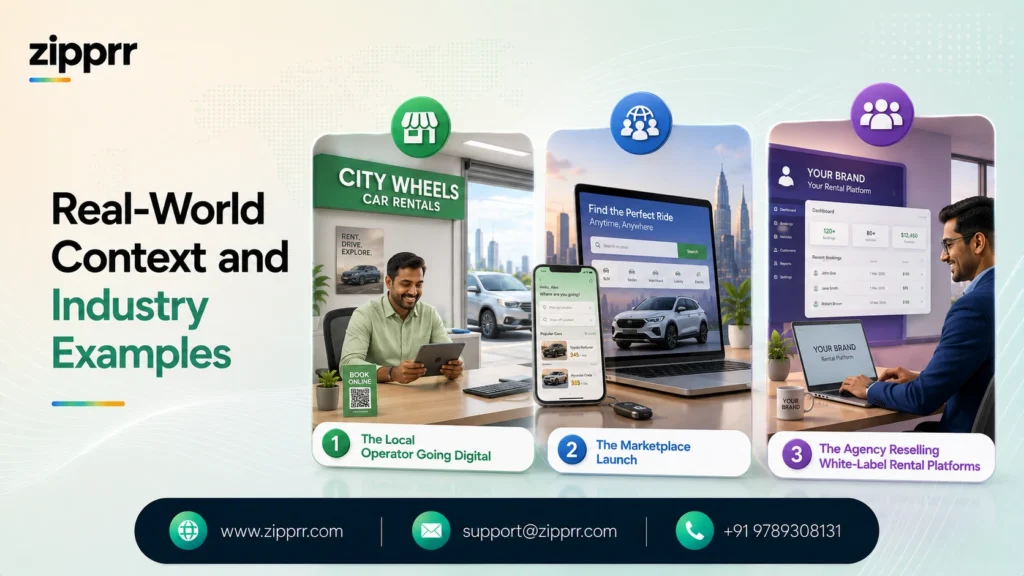
The car rental and car-sharing category has matured publicly enough that its shape is well understood: large fleet-owned incumbents (the traditional airport-counter brands), asset-light peer-to-peer marketplaces that connect private car owners to renters, and a growing wave of regional and niche operators, including luxury car rental, EV-only rental, and long-term subscription rental, built on exactly this kind of white-labeled software rather than custom-built platforms. The pattern across nearly all of the fast-moving entrants in the last five years is the same: they didn’t out-build the incumbents on engineering, they out-executed them on niche focus, local market knowledge, and speed to launch, all of which a car rental script is specifically designed to enable.
Hypothetical Scenario 1: The Local Operator Going Digital
Picture a family-owned rental counter with 40 vehicles, still taking bookings by phone and managing availability on a whiteboard. A car rental script lets them stand up a booking website and mobile app in weeks rather than months, digitize their existing fleet into the admin dashboard, and immediately reduce double-booking errors and no-show losses, all without hiring a single engineer.
Hypothetical Scenario 2: The Marketplace Launch
Picture two co-founders with no engineering background who want to launch a peer-to-peer car-sharing brand in a mid-sized city that no major platform has entered yet. A marketplace-model car rental script gives them owner onboarding, commission logic, and payment splitting on day one, letting their limited runway go toward local marketing and owner acquisition instead of platform engineering.
Hypothetical Scenario 3: The Agency Reselling White-Label Rental Platforms
Picture a digital agency that has built one successful car rental platform for a client and now wants to resell the same white-labeled foundation to five more regional operators. A script with clean multi-tenant licensing turns a one-off project into a repeatable, higher-margin product line for the agency.
Build vs. Buy: The Real Cost Comparison
This is the calculation most vendor pages never show plainly. Independent software-development cost research on building a car-rental or car-sharing app from scratch (comparable to a Turo-style platform) puts custom development in roughly the following bands, depending on feature complexity. These are third-party estimates, not figures unique to any one vendor, and actual costs vary significantly by region, team, and scope:
| Approach | Estimated Cost Range | Estimated Time to Launch | What You're Actually Paying For |
|---|---|---|---|
| Custom-built app (simple) | Roughly $20,000 to $50,000 (estimate) | 4 to 8 months (estimate) | A minimum viable version of features a script already includes. |
| Custom-built app (mid-complexity) | Roughly $50,000 to $100,000 (estimate) | 6 to 12 months (estimate) | Custom UX and business logic, most of it duplicating solved problems. |
| Custom-built app (advanced/enterprise) | Roughly $100,000 to $200,000+ (estimate) | 9 to 18 months (estimate) | Deep customization and scale, justified only at real enterprise scope. |
| Ready-made car rental script | Typically a few hundred to a few thousand dollars, plan-dependent (verify current pricing directly with the vendor) | Days to a few weeks, typical for standard branding and customization | The same core engineering, already built and proven, plus your customization and go-to-market time. |
Expert tip: The right lens isn’t “script vs. custom” in the abstract. It’s “what, specifically, would custom development buy me that a script doesn’t?” If the honest answer is “nothing our customers would notice or pay more for,” that’s your build-vs-buy decision made. Reserve custom engineering budget for the 10 to 20 percent of your product that is genuinely your differentiation, not the booking calendar.
A Simple ROI Illustration
Say a custom mid-complexity build runs an estimated $75,000 and takes an estimated nine months. Over that same nine months, a founder who launched on a ready-made script instead could realistically be several months into live bookings, meaning the script path isn’t just cheaper on paper, it’s also collecting real revenue and real customer data during the entire stretch the custom-build founder is still watching a project-management board. If that script-based launch reaches even a modest volume of monthly bookings during those nine months, the founder has effectively used the custom-development company’s own build timeline to fund part of their marketing budget instead. That compounding time advantage, not just the sticker-price difference, is usually the more decisive number in this calculation.
Pricing Considerations and What to Actually Budget For
Sticker price is the least useful number when evaluating a car rental script. Budget for the full stack:
- License or software cost: the script itself, one-time or subscription.
- Hosting and infrastructure: self-hosted vs. managed hosting changes both cost and your ongoing maintenance burden.
- Customization and branding: even “white-label ready” platforms need real design and configuration time.
- Mobile app store fees and submission: Apple and Google developer accounts, plus review-cycle time.
- Payment gateway fees: ongoing transaction costs, separate from the platform license.
- Support and updates after the included window: nearly every vendor’s free support period expires; budget for what comes after.
Explore current car rental script plans and pricing tiers directly with the vendor before comparing sticker prices across providers. The headline number rarely reflects the full first-year cost once hosting, support, and add-ons are included.
Benefits, Honestly
| Benefit | Why It Matters |
|---|---|
| Speed to market | Weeks instead of months or years, in a market where a competitor moving faster can lock in owner and renter supply first. |
| Lower upfront capital risk | A five- or six-figure engineering bet is replaced with a fraction of that cost, preserving runway for marketing and operations. |
| Proven, battle-tested logic | Booking conflicts, payment edge cases, and fraud patterns have already been discovered and fixed across many prior deployments. |
| Source-code ownership (with most vendors) | You're not locked into a SaaS subscription forever; you typically own and can self-host the code. |
| Focus where it counts | Your time goes to fleet acquisition, local marketing, and customer experience, the parts of the business a script cannot do for you. |
Limitations: What a Script Won't Solve For You
- It won’t create product-market fit. The software runs your business; it doesn’t decide your pricing strategy, your target city, or your brand positioning.
- Deep customization has a ceiling. If your business model is genuinely novel, not fleet-owned, not marketplace, not hybrid, something structurally different, a script built for the standard model will fight you.
- You still own operations. Fleet maintenance, customer support, insurance, and legal compliance are business responsibilities no software purchase removes.
- Vendor dependency for updates. Even with source-code ownership, staying current with security patches and new features typically means staying in some relationship with the vendor or budgeting your own dev resource.
Comparison Matrix: Script vs. Custom Development vs. No-Code Builders vs. Franchise
| Criteria | Car Rental Script | Custom Development | No-Code Builder | Franchise Model |
|---|---|---|---|---|
| Upfront cost | Low to Medium | High to Very High | Low | Very High (franchise fee) |
| Time to launch | Days to Weeks | Months to Years | Days | Months (approval and setup) |
| Source-code ownership | Usually yes | Yes | Rarely | No |
| Scalability for complex fleets | High | Highest (if well-built) | Low | Depends on franchisor |
| Brand independence | Full | Full | Full | None; you operate under their brand |
| Best for | Most founders and agencies | Well-funded, highly differentiated products | Pure MVP testing, pre-revenue validation | Risk-averse operators wanting a proven playbook |
The Buyer's Checklist
- Before signing with any car rental script vendor, verify each of the following:
- Is pricing fully transparent, including hosting, support renewal, and add-on costs?
- Do you receive full source code, or is this a locked SaaS subscription?
- Is mobile app store submission included, and who owns the developer accounts?
- What payment gateways are natively supported in your target market?
- How long is free support, and what does renewal cost afterward?
- Can you see a live, working demo, not just screenshots?
- Are there verifiable client references or reviews, not just testimonial quotes?
- Is multi-language and multi-currency support native or a costly add-on?
- How are security updates and vulnerability patches handled post-launch?
- What is the actual customization process, and is there a cost ceiling disclosed upfront?
Implementation Roadmap
| Phase | Typical Duration | What Happens |
|---|---|---|
| 1. Business model decision | Week 1 | Choose fleet-owned, marketplace, or hybrid model; define target market and pricing strategy. |
| 2. Vendor selection and demo review | Week 1 to 2 | Compare vendors against the buyer's checklist above; request live demos. |
| 3. Licensing, branding, and configuration | Week 2 to 3 | Purchase license, apply branding, configure payment gateways, set commission and pricing rules. |
| 4. Fleet and inventory onboarding | Week 3 to 4 | Load vehicle data, photos, pricing, and availability; onboard initial owners if marketplace model. |
| 5. Testing and QA | Week 4 | End-to-end booking, payment, and refund testing across devices. |
| 6. Mobile app submission | Week 4 to 5 (parallel) | Submit to Apple App Store and Google Play; budget review-cycle time. |
| 7. Soft launch | Week 5 to 6 | Limited local marketing push, monitor bookings and support load. |
| 8. Full launch and scale | Week 6+ | Broader marketing, fleet expansion, iteration based on real usage data. |
These are typical, plan-dependent timeframes based on standard implementation scope. Highly customized builds will run longer.
Best Practices and Expert Tips
- Start narrower than feels comfortable. One city, one vehicle category, one clear customer promise. Expansion is easy once the core loop works; fixing a diluted launch is not.
- Price the deposit and cancellation policy before you price the rental itself. These two policies generate more support tickets and disputes than any other part of the business; get them right on day one.
- Instrument analytics before you need them. Booking funnel drop-off, search-to-book conversion, and repeat-rental rate are the numbers that tell you what to fix first; most founders only start tracking these after a problem is already visible.
- Treat your first ten support tickets as market research. They will tell you more about real user friction than any amount of pre-launch planning.
- Negotiate support renewal terms before you buy, not after your free window expires. Vendors have far less incentive to negotiate once you’re already dependent on the platform.
Common Myths and Mistakes
| Myth / Mistake | Reality |
|---|---|
| "A script means I don't need any technical help." | You'll still want at least a technically literate operator or freelancer for configuration, updates, and troubleshooting. The script removes the need to build from zero, not the need for any technical involvement at all. |
| "Cheapest license equals best deal." | Support quality, update cadence, and hidden renewal costs usually matter more to total cost of ownership than the sticker price. |
| "I should customize everything before launch." | Over-customizing pre-launch delays your first real market feedback, the most valuable input you can get. Launch closer to standard, then customize based on real usage. |
| "AI features are just marketing buzzwords in this category." | Where genuinely implemented, AI-driven dynamic pricing, fraud detection, and demand forecasting produce measurable operational gains, but verify with a live demo and don't take the label at face value. |
| "Source code ownership doesn't matter if the vendor is reliable." | Even reliable vendors get acquired, pivot, or sunset products. Owning your source code is the insurance policy against exactly that scenario. |
Legal and Compliance Considerations
This is not legal advice, and requirements vary significantly by jurisdiction. Always confirm specifics with a qualified local attorney and accountant before launch. That said, founders in this category should be actively researching: local transportation and rental-business licensing requirements, insurance obligations for both fleet-owned and marketplace models (liability differs meaningfully between the two), payment-card data handling standards (PCI-DSS) if you process card payments directly rather than through a compliant third-party processor, driver’s license and identity verification requirements for renters, and data privacy obligations for any personal or financial data your platform stores.
The Future: AI, Automation, and Where This Category Is Headed
The next wave of differentiation in this category is unlikely to be about who has a booking calendar; that’s now table stakes. It’s shifting toward AI-assisted dynamic pricing that adjusts rates in real time based on demand, weather, and local events; automated fraud and identity-verification checks that reduce manual review overhead; predictive fleet maintenance driven by telematics data; conversational AI support handling routine booking questions instead of human agents; and increasingly, generative-AI-assisted listing creation for marketplace owners, auto-writing descriptions, suggesting pricing, and flagging photo quality issues. Platforms that ship these capabilities natively, rather than bolting them on as an afterthought, will set the pace for the category over the next several years.
Decision Matrix: Which Path Fits You?
| Your Situation | Recommended Path |
|---|---|
| First-time founder, limited capital, want to launch fast | Ready-made car rental script, fleet-owned or marketplace model matched to your capital position. |
| Existing rental agency going digital | Fleet-owned script with strong admin and fleet-management tooling; prioritize migration support in vendor selection. |
| Two or more co-founders building a new marketplace brand | Marketplace-model script with strong owner onboarding and commission configuration. |
| Agency building for multiple future clients | Script with clean multi-tenant and white-label licensing terms. |
| Well-funded team with a genuinely novel business model | Custom development, but validate the model with a script-based MVP first if possible. |
| Pre-revenue, just validating demand | No-code MVP or a low-tier script plan, then upgrade once demand is proven. |
Whichever path fits, the single highest-leverage next step is the same: go look at a live product demo before you evaluate anything else on paper. You can request a demo of Zipprr’s Car Rental Script and see the actual booking flow, admin dashboard, and mobile experience firsthand. Screenshots and feature lists on any vendor’s site are never a substitute for that.
Conclusion
The founders who win in the car rental and car-sharing category over the next few years won’t be the ones who spent the longest building their own booking engine. They’ll be the ones who spent that time instead on fleet quality, local trust, pricing intelligence, and customer experience, while running on infrastructure that was already solved. A car rental script isn’t a shortcut that cuts corners; it’s a reallocation of your scarcest resources, time and capital, toward the parts of the business that will actually determine whether you win.
If you’re at the point of comparing vendors, use the buyer’s checklist and decision matrix above as your evaluation framework, and don’t skip the live demo step. When you’re ready to see what a modern, AI-assisted car rental script actually looks like in practice, explore Zipprr’s Car Rental Script here and request a walkthrough tailored to your specific business model.