
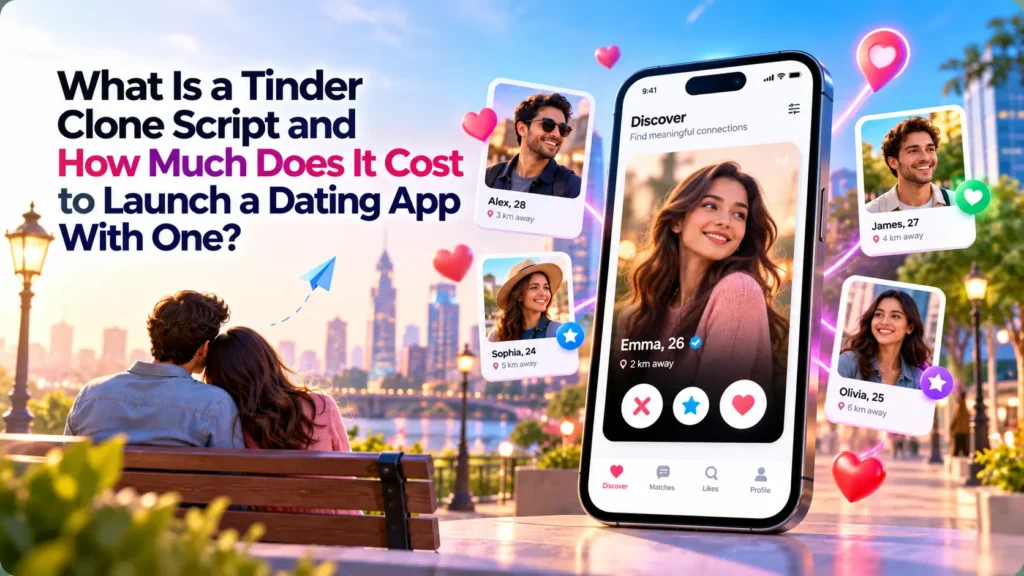
In plain terms, it is pre-built software that copies the swipe-to-match experience: member profiles, a swipe deck, match alerts, in-app chat and an admin panel to run it all. You add your brand, your niche and your pricing, then host it and open the doors.
Picture a founder in Austin who wants a dating app only for local trail runners. The code is no longer the hard part; finding the first 500 members is. A script solves the first problem in days and leaves you holding the second, so this guide spends as much time on launching as on software.
Last updated: October 2026
How does a Tinder clone script work?
A Tinder clone script runs a simple loop: a member signs up, builds a profile, sees a stack of nearby profiles, swipes, and gets a chat window only when both people swipe right. The admin panel sits behind the scenes, where you manage members, reports and subscriptions.
Here is the member journey from the inside:
That “match first, chat second” rule is the product’s real engine. It keeps conversations wanted on both sides, which is also why safety tools matter so much later in this guide.
Should you build a dating app at all? The Density, Dependability, Dollars test
Before comparing scripts, run your idea through three questions. I call it the 3D test, and it has saved more founders from a bad launch than any feature list.
- Density: Can you gather enough people in one small place, such as one city, campus, faith community or hobby group, that a new member sees real matches on day one? A thin deck of profiles feels like an empty restaurant, and people leave.
- Dependability: Can you prove members are real and keep bad actors out? Trust is the product. If you cannot afford moderation and verification, you are not ready.
- Dollars: Can you name who pays, how much, and for what? Dating apps earn mostly from a minority of payers, so you need a plan for turning free members into paying ones.
Score each from 1 to 5. A total below 9 means fix the weakest area before spending anything. A total of 12 or more means a script is a sensible shortcut.
Is it legal to launch an app that looks like Tinder?
Using a script is common, but copying another company’s name, logo, wording or protected designs is where trouble starts. Pick your own brand name and visual identity, avoid any wording that suggests a link to a known dating brand, and ask a lawyer in your country to review trademark and privacy points. This is general information, not legal advice.
What features should a Tinder clone script include?
At minimum, a dating script needs profiles, swiping, match notifications, real-time chat, profile verification, premium subscriptions and an admin panel. Without the last two, you cannot protect members or earn money, and those are the pieces buyers most often forget to check.
Zipprr’s live product page lists these as part of the Tinder clone script:
- User profiles, swiping and match notifications
- In-app chat between matched members
- Profile verification
- Premium subscription options
- Multi-language support with a language drop-down
- Encryption, secure authentication and regular audits for user data
- Branding changes to color, logo, font, icons and images
- An admin panel to manage profiles and track matches
Beyond that, ask for each of these in writing before you pay, and treat anything missing as a paid add-on conversation: reporting and blocking, photo moderation, age gating, push notifications, and account deletion inside the app. Apple’s App Review Guidelines expect apps with user content to offer ways to report content and block abusive users, and apps that create accounts must let people delete them in the app.
Trust tools matter in every two-sided app. For a different example, see how a resale marketplace handles payments and buyer protection.
Do AI matching and photo verification matter in 2026?
Photo verification matters a lot, and AI is worth adding carefully. Verification directly answers the biggest worry among online daters: fake people. AI helps with bios, prompts and match suggestions, but it cannot fix an empty network or hide weak safety.
Start with the evidence on trust. In its 2022 survey, published in 2023, Pew Research Center found 52 percent of online dating users believed they had met someone they suspected was trying to scam them. Reporting on Federal Trade Commission Consumer Sentinel data, published in February 2026, said consumers reported losing $1.16 billion to romance scams in the first nine months of 2025.
The biggest brand in the category has reacted. In an October 2025 announcement, Tinder said its Face Check feature uses a short video selfie to confirm a person is real and matches their photos, and reported a drop of more than 60 percent in exposure to potential bad actors and more than 40 percent in reports, alongside other safety work. Those results come from the company itself and are not independent.
For a new niche app, a practical order is:
The Zipprr page lists profile verification but does not list AI matching, so ask about AI as a custom or add-on topic, not as something included.
How do dating apps make money?
Most dating apps earn from premium subscriptions, then from one-time purchases such as profile boosts and extra likes, and sometimes from ads or paid events. A small share of members pays, so growth in sign-ups matters more than squeezing each payer.
For scale, Match Group said Tinder had 8.5 million payers in the second quarter of 2026, down 5 percent from a year earlier, with revenue of $17.90 per payer, up 4 percent. A newcomer will not match those numbers. They do show that subscriptions, not ads, carry the category.
Common models for a new app:
- Freemium subscription: free swiping with daily limits, paid plans for unlimited swipes and filters.
- Consumable credits: boosts, super likes or message credits bought one at a time.
- Niche memberships: a paid community, such as a professionals-only or faith-based circle, with higher prices and fewer members.
One caution: if you sell digital features inside an iPhone or Android app, Apple and Google generally take a cut. Apple’s Small Business Program lowers its rate to 15 percent for developers under its revenue threshold, so check current terms before pricing.
How much does a Tinder clone script cost to launch?
The script itself is the smallest line on the bill. Zipprr lists the Tinder clone script at a one-time $490 for the first plan and $890 for the Pro plan, with 90 days of support, lifetime updates and free installation support. The rest of the launch budget goes to hosting, verification, store fees and finding members.
The $890 Pro plan is the one that includes mobile apps with app store submission. Plan details change, so check the plan comparison on the live product page before you buy.
Here is a planning view of a first-year launch. Zipprr’s prices come from its product page; every other number is a labelled planning estimate for illustration, not a quote.
| Cost item | Planning range (USD) | When you pay | Notes |
|---|---|---|---|
| Zipprr Tinder clone script | $490 or $890 one-time | Day 0 | Live page price; $890 Pro includes mobile apps and app store submission |
| Apple Developer Program | $99 per year | Before iOS submission | Apple's published annual fee |
| Google Play developer account | $25 one-time | Before Android submission | Google's published registration fee |
| Cloud hosting | $50 to $300 per month (estimate) | Monthly | Grows with active members and photo storage |
| Selfie or ID verification provider | Per-check fee (estimate; get a quote) | Per signup | Optional at launch, valuable soon after |
| Legal review (terms, privacy, age rules) | $500 to $2,000 (estimate) | Before launch | Varies by country and counsel |
| Member acquisition | $1,000 to $5,000 (estimate) | Launch month | Often the largest line |
A worked example with hypothetical numbers
These numbers are invented to show the math. Your results will differ.
Say a niche app reaches 12,000 registered members, and 3,600 are active in a month. If 5 percent of active members pay $14.99 per month, that is 180 payers and $2,698.20 in monthly gross revenue.
Take a 15 percent store fee of $404.73 and you keep $2,293.47. Subtract $600 for hosting, verification and tools, and monthly profit is about $1,693.
If you spent $890 on the script and $1,500 on legal and launch work, your up-front total is $2,390. At that run rate, you recover it in roughly 1.4 months. The catch is the first line: reaching 12,000 registered members is the real job, and that is where your budget and time will go.
Ready to see the product before you decide?
If the numbers look workable, the next move is to watch the script run. Book a short demo below and bring your niche, your city and your questions. Ask to see the admin panel and the verification flow. Want the free launch checklist? Email [email protected] and we will send it to you.
How long does it take to build a dating app with a script?
With a ready-made script, planning for a few weeks from purchase to a first public launch is realistic, and most of that time goes to branding, content, legal review and app store approval, not coding. Building from zero commonly takes several months. Zipprr’s page does not state a fixed delivery time, so ask for one in writing.
A typical sequence:
Opening one zone at a time is the same logic behind launching your first hyperlocal zone: dense beats wide.
How hard is it to make an app like Tinder from scratch?
Making the swipe screen is easy. Making a dependable dating product is hard. You need recommendation logic, real-time messaging, photo handling, push notifications, payments, moderation tools and an admin system, all working together at scale. A script gives you these pieces already connected, so your effort moves to people and rules.
There is also a store question. Apple’s App Review Guidelines treat dating as a crowded category and expect new apps to bring something meaningfully different. That makes a clear niche more than a marketing choice; it helps your submission story too.
What is your seven-day launch-week plan?
Your launch week should be about people, not code. A tight plan beats a big one.
- Day 1: Invite a waiting list of at least 100 names you collected before launch.
- Day 2: Seed each profile pool so no new member sees an empty deck. Real members only; never fake profiles.
- Days 3 and 4: Watch reports, respond within hours, read every support message and fix the top three confusions.
- Day 5: Add a simple support helper, such as a self-hosted website chat assistant that answers sign-up and billing questions from your own content.
- Day 6: Run a local event or partner post to bring in the next 100 members.
- Day 7: Review match rate, chat-start rate and report rate, then decide what to change.
Who should buy a Tinder clone script, and who should not?
Buy one if you have a defined niche, a way to reach your first members, and a budget for trust and marketing. Skip it if you want a quick passive income or have no audience plan. Software alone never fills a dating app.
A script fits you if:
- You run or belong to a community that already wants to meet each other.
- You want to test a niche idea for a few thousand dollars, not tens of thousands.
A script does not fit you if:
- You need a brand-new matching algorithm or unusual features nobody sells.
- You expect downloads without spending time or money on promotion.
Common objections:
- “Is $490 too cheap to be real?” The price covers the software, not your launch. Use the cost table above to budget the rest.
- “What if I get stuck?” Zipprr’s page lists 90 days of support and a typical response within 24 hours.
- “Who owns the code?” The product page mentions source code ownership, but the plan table does not list source code. Ask for the license terms in writing before paying.
- “How long until I launch?” No fixed delivery time is published, so ask for a schedule and compare it to the steps above.
What mistakes do first-time buyers make?
What are the red flags when choosing a dating script vendor?
Walk away from any vendor that hides pricing, refuses a live demo, will not put the feature list in writing or promises guaranteed downloads and revenue. Compare what each vendor states about installation, updates, support length and license terms. For a general method, use this vendor checklist for clone script buyers.
Specific warning signs:
- No visible price, or a price that changes after you ask for the demo.
- A demo that shows screenshots only and never the admin panel.
- No mention of safety tools, reporting or blocking.
Dating is only one place where a messaging layer helps. If you later plan member reminders over WhatsApp, a self-hosted WhatsApp automation platform can sit alongside the app, though Meta’s message fees apply separately.
What is your decision checklist before you buy?
- I can name my first 500 members and where they gather.
- I scored 12 or more on the 3D test.
- I have a written feature list, price and support period from the vendor.
- I know which plan includes mobile apps and app store submission.
- I have budget for legal review, hosting and member acquisition.
- I have a launch zone and a brand name that are fully my own.
Want the free launch checklist that goes with this list? Email [email protected] and we will send it, no sales call required.
Plan your dating app launch with Zipprr
Book a short demo and bring your niche, your city and your questions. You can also email [email protected].
Frequently Asked Questions
1. How much does it cost to build an app like Tinder?
With Zipprr, the script is a one-time $490 or $890, and the Pro plan includes mobile apps with app store submission. Budget extra for hosting, store fees, legal review and member acquisition. A custom build from scratch costs far more in developer time, which is why many niche founders start with a script.
2. How to build an app like Tinder?
Pick a niche and a launch city, choose a script or a custom build, brand the app, set safety rules, configure subscriptions, test with real people, and submit to the app stores. Open one zone first. The software is the shorter part of the work; building the first member community takes longer.
3. How do dating apps make money?
Mainly through premium subscriptions, then one-time purchases such as boosts and extra likes, and sometimes ads or paid events. Only a minority of members pays, so steady sign-ups matter. Match Group reported 8.5 million Tinder payers in the second quarter of 2026, which shows how large the paying base can become.
4. How long does it take to build a dating app?
A ready-made script can shorten the build from months to roughly weeks, with branding, legal work and store review taking most of the time. Zipprr’s page does not publish a fixed delivery time, so ask for a written schedule. A custom build from zero commonly takes several months.
5. How hard is it to make an app like Tinder?
Building the swipe screen is simple, but a full dating product is hard because it needs matching, real-time chat, photo handling, payments, moderation and an admin system. A script supplies those pieces already connected, so your work shifts to safety rules, branding and finding your first members.
6. How to create a dating app from scratch?
You would design the data model, build the swipe and matching logic, add real-time chat, photo storage, push notifications, payments and moderation, then test and publish to stores. It works, but takes a skilled team and months. Many founders choose a script to reach the market sooner.
7. How to create a dating app with AI?
Start with a working dating app, then add AI where it helps, such as profile bio suggestions or conversation prompts. Match Group said Tinder is testing AI profile building. Keep safety first: AI does not replace photo verification, moderation or a report-and-block flow.
8. Is a Tinder clone on GitHub enough to launch a dating app?
Rarely. Public repositories help you learn, but they often lack an admin panel, subscription billing, moderation tools, installation help and support. Running a dating business needs those, plus app store submission and updates. A commercial script costs money but saves weeks of fixing gaps.
9. What is a dating app clone script?
It is ready-made software that reproduces a known dating app’s core experience, such as swipe matching, chat and subscriptions, so you can launch your own branded version faster. You customize the name, design and rules, and you remain responsible for hosting, legal compliance and member safety.
10. Dating script for sale: what should I check before buying?
Check the visible price, what each plan includes, support length, update terms, license and source code terms, and whether mobile apps and store submission are covered. Ask for a live demo of the admin panel and the verification flow. Get every promise in writing before you pay.
About Zipprr
Zipprr has sold white-label clone scripts since 2020, helping founders launch marketplaces, service apps and community platforms with ready-made software.
Zipprr’s Tinder clone script is an independent clone and script solution. Zipprr is not affiliated with, endorsed by or connected to Tinder or any other brand referenced in this article.