
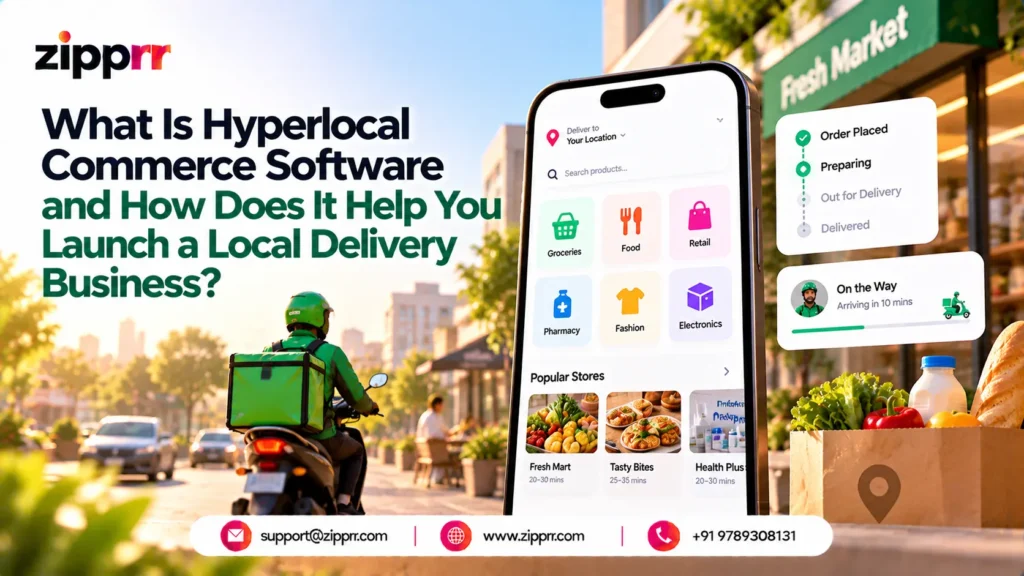
Corner shops, grocers, pharmacies and bakeries already have loyal customers on their own street. What many lack is a way to take orders, track stock and organise deliveries without hiring a software team.
That gap is what hyperlocal commerce software fills. This guide explains how it works, what it contains, how it earns, what it costs and how to launch your first zone.
How does hyperlocal commerce software work?
An order passes through six steps:
Everything runs on one set of records, so the buyer, the shopkeeper, the rider and the operator all see the same order status.
Which business models can it support?
The same software can run several kinds of local business:
- Multi-shop marketplace: many independent shops sell through your platform, and you earn a share of each order.
- Dark-store model: you stock a small warehouse yourself and promise very fast delivery from it.
- Single-brand chain: a supermarket, pharmacy or restaurant group runs its own ordering app across its branches.
- Mixed model: partner shops supply the wide range, while you hold stock of a few fast-selling items.
The stock-ownership question matters most when choosing between these. Zipprr’s grocery delivery guide compares marketplace, aggregator and dark-store models in more detail.
What features does a hyperlocal platform include?
Zipprr’s product page groups features by the person who uses them.
Customer app and storefront
- Android and iOS apps and a web storefront.
- Search, cart, wallet and online payment.
- Live order tracking.
Store and inventory tools
- Multi-store and multi-vendor support.
- A separate catalogue and order queue for each store.
- Stock per store, low-stock alerts and stock reserved at checkout.
Rider and delivery tools
- A rider app with automatic job assignment.
- Delivery zones with distance, area and surge pricing.
- OTP (one-time password) proof of delivery.
- Cash on delivery reconciliation and return pickups.
Admin control
- Live analytics, payouts and refunds.
- Coupons, wallet and staff roles.
- Multi-language, multi-currency and tax settings for multi-city use.
AI tools
- Demand prediction and reorder suggestions.
- Personalised product suggestions.
- Route batching and business analytics.
Each of these is described on the product page. Confirm in a demo how each one behaves with your own products and zones.
How does a hyperlocal business earn money?
Most operators combine several income lines. Zipprr’s page lists six:
- Product margin on goods you sell yourself.
- Delivery fees charged per order.
- Vendor commissions from partner shops.
- Membership plans that give buyers perks such as free delivery.
- Brand advertising from shops and suppliers who want more visibility.
- Expansion into more shops, categories and cities.
If you plan to recruit many shops, Zipprr’s guide to building a multi-vendor marketplace platform explains vendor onboarding, split payments and commission models.
Want to see these features working? You can request a free demo from Zipprr and ask to watch the order flow above from the buyer, shop and rider sides.
Ready-made, custom or hosted: which route suits you?
This table gives general guidance. Exact terms differ by vendor, so confirm each point in writing.
| Question | Ready-made source code | Custom build | Hosted subscription |
|---|---|---|---|
| Who owns the code? | You, if the licence includes source code | You, if the contract says so | The provider |
| How fast can you launch? | Usually faster, since the product exists | Slowest, since everything is designed first | Fast |
| How much can you change? | Moderate to high, with extra work | Unlimited | Limited to the provider's options |
| Who looks after hosting? | You, on your own cloud account | You or the developer | The provider |
| How is it paid for? | Licence plus extras | Project fee plus upkeep | Recurring monthly or yearly fee |
A ready-made base suits owners who want to test a market and keep the code. A hosted plan suits those who want the least technical work. Custom development suits businesses whose order flow is genuinely unlike the standard one.
For a single grocery brand rather than a network of shops, Zipprr’s grocery delivery script may be a closer match.
How much does hyperlocal commerce software cost?
Zipprr’s product page lists a Standard plan at $490 and a Pro plan at $890. These are one-time prices in US dollars, with source code included, as read on 15 October 2026.
The same page says the final cost depends on the number of cities, stores and modules, and that a fixed quote follows a 30-minute scoping call.
A software price is only part of a launch budget. Plan separately for:
- Custom changes to the standard product.
- Cloud hosting, maps, text messages and payment charges.
- Support after the listed 90 days.
- Rider pay, shop sign-ups, dark-store rent and marketing.
Ask in writing which plan includes the Android and iOS apps and app-store submission.
Why do owners choose Zipprr's hyperlocal platform?
Based on its product page, the main points are:
- Full source code, so you own what you launch.
- Deployment on your own AWS, Azure or GCP account.
- A Flutter, Next.js and Laravel technology stack.
- No per-order royalty to Zipprr, according to the page.
- 90 days of support on the listed plans.
Zipprr’s products are independently developed clone and script solutions. They are not affiliated with, endorsed by, or built using technology from any third-party brand or marketplace referenced in this category.
How do you launch your first hyperlocal zone?
Plan your hyperlocal launch
Before you talk to any vendor, note how many cities you plan to open, how many shops you expect to sign and which modules you need. Zipprr’s product page says a fixed quote follows a 30-minute scoping call, and that note is what the call will run on.
You can reach the team on WhatsApp at +91 97893 08131 or by email at [email protected].
Frequently Asked Questions
1. What is a hyperlocal delivery app and how does it work?
It sells from shops within a short distance of the buyer and delivers quickly, often on the same day. The buyer’s location decides which shops appear, a shop with stock packs the order, a nearby rider collects it, and the buyer follows progress on a map. The operator sets zones, fees and payouts in an admin panel.
2. Can inventory be tracked in real time across stores?
Many platforms keep a separate count for each store, and some hold units while a buyer pays. How fresh the counts are depends on the update method: typed by the shop, uploaded in bulk, or synced from a till or ERP (enterprise resource planning) system. Ask the vendor to change stock in one shop and time how soon a shopper sees it.
3. How do you manage inventory sync across multiple stores in a delivery app?
Give each store its own count, set units aside once a buyer starts paying, and release them if payment fails. Decide beforehand what happens when a shop reports an item missing after payment, such as a swap or part refund. Then have the vendor demonstrate all three before you sign.
4. Can orders be assigned automatically to the nearest delivery partner?
Many hyperlocal platforms can, and Zipprr’s page lists automatic assignment. The useful questions are what the system does after a refusal, how long it waits before offering the job elsewhere, and whether an admin can reassign by hand when demand spikes.
5. Can a hyperlocal platform manage delivery zones and time slots?
Zone-based areas and fees are common, and Zipprr’s page lists distance, area and surge pricing. Scheduled slots vary by product, so ask to watch one being created for a single store, including its cut-off and what a shopper sees when it fills. Check that editing a zone leaves open orders alone.
6. How is hyperlocal delivery different from last-mile delivery?
Last-mile delivery means the final leg of any parcel journey, from a depot to a doorstep, over whatever distance a carrier covers. Hyperlocal delivery is a selling model in which nearby shops serve nearby buyers within a small radius. So hyperlocal software must handle shop stock and shop orders, not just the courier’s route.
7. What is the difference between hyperlocal commerce and quick commerce?
Hyperlocal commerce is the broad idea of selling from nearby shops to buyers in a small area. Quick commerce narrows it to delivery in minutes, usually from compact warehouses called dark stores that the operator stocks. A marketplace of independent shops can be hyperlocal without being quick commerce.
8. How much does it cost to launch a hyperlocal delivery app?
The licence is one line in a longer budget. Zipprr’s page shows $490 for Standard and $890 for Pro as one-time plans (US dollars, read 15 October 2026) and says the final cost follows cities, stores and modules. Add customisation, hosting, maps, text messages, payment fees, riders, shop sign-ups and marketing, and ask for a quote that prices each line separately.
9. How long does it take to launch a hyperlocal commerce platform?
It moves with how far you depart from the standard product, how many cities and shops you open with, and how long app-store review takes. Be wary of any date not tied to a written scope. Ask the vendor to list each launch task, name its owner, and say what could hold it up.
10. Should you buy hyperlocal commerce software or build custom?
Buy if your flow resembles the usual buyer, shop and rider loop and you want to test a market sooner while owning the code. Build custom only if your order flow is truly unusual and you can pay for it and maintain it. Either way, settle code ownership, hosting and data terms in writing.