

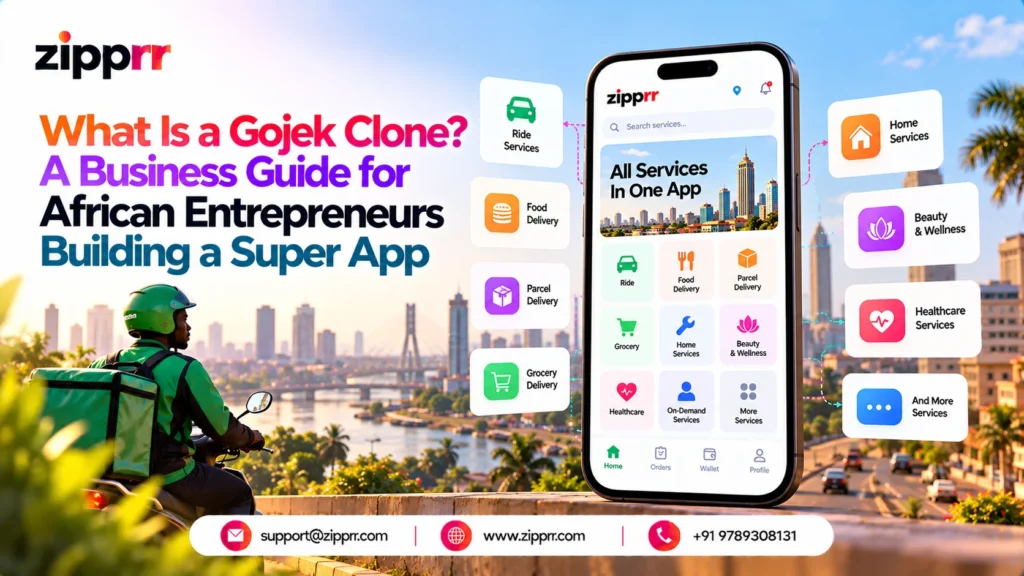
For an African founder, the better question is not how the app looks. It is what business you can build on top of it, and in which order. This guide answers that in plain language: the problems it solves, what is inside the package, how it compares with other routes, how you can earn from it, what to check in your own city, and why founders put Zipprr on their shortlist.
Why founders reach for a Gojek clone
Building software from scratch is slow and expensive, so many founders look for a shortcut. Here is where a ready-made package helps, and where the work stays with you.
- Waiting months for a first booking. Working apps exist from day one, so your time goes into winning drivers and customers. Any custom change still costs extra time and money.
- Three services, three separate tools. One customer app, one driver app and one dashboard cover rides, food and parcels. You still need people who understand each service.
- Customers who do not trust a new brand yet. The listed safeguards include one-time trip codes, live trip sharing, an SOS button and driver verification. Real screening and a support desk that answers quickly are your job.
- Guesswork on pricing. Fare rules, regional pricing and surge settings are listed. Choosing numbers that actually work is up to you.
- Fear of being locked in. Zipprr states that source code is included. What you may edit, reuse or hand to other developers depends on the wording of the written licence, so read it before you sign.
- A product that does not fit your city. Multi-city setup and several currencies and languages are listed. Local payment methods and legal rules remain yours to sort out.
What comes inside a Gojek clone
This list follows the description on Zipprr’s Gojek clone page. After each item you will see what you still have to bring yourself.
- Ride booking. Instant, pre-booked and city-to-city trips, fare previews, a choice of vehicle, and fares that you set or drivers bid. You bring: drivers, vehicles, permits and a pricing policy.
- Food ordering. Restaurant menu management, an order flow and grouped deliveries. You bring: restaurant partners and delivery riders.
- Parcel jobs. Pickup requests, driver assignment and live tracking. You bring: courier capacity and handling rules.
- Apps and dashboards. Customer app for Android and iOS, driver app, restaurant app, admin dashboard, support dashboard, public website and a browser-based installer. You bring: hosting, a domain, store accounts and a support team.
- Safety and oversight. One-time trip codes, live trip sharing, SOS, driver and vehicle verification and dispatcher tools. You bring: your own vetting and emergency procedures.
- Scale settings. Several cities, region-based pricing, multiple currencies and languages, including right-to-left scripts. You bring: written confirmation of the exact currencies and languages you need.
- Extra service lines. Extensions such as groceries, medicine delivery, at-home services, vehicle hire, laundry collection and B2B couriering, each priced as a separate quote. You bring: a scope and a budget for every extension.
Notice the pattern. The software hands you the tools. The riders, drivers, kitchens and licences are things no download can supply, so you will have to gather them in your own city.
Gojek clone, super app, custom build or single-service app
A super app tries to let customers handle rides, food, payments and other errands without leaving one app. Zipprr sells a Super App Platform that covers taxi, food and parcel services under one brand, with a shared wallet, a pooled driver network and commission settings per service and city. It overlaps with the Gojek clone page, so ask in a demo exactly where the two packages differ. For a wider view of features and income ideas in a mature multi-service app, read Zipprr’s article on multi-service app features.
| Route | Best suited to | Strengths | Limits | Launch effort (my judgement, not Zipprr data) |
|---|---|---|---|---|
| Gojek clone | Testing rides, food and parcels in one city | Three services pre-assembled, with shared users and drivers | Shaped by the package; changes are quoted | Medium |
| Super app platform | Planning many services around one wallet from the start | Shared wallet and per-service commissions described | Easy to over-scope; the same local checks apply | Medium to high |
| Custom build | A new workflow or payment model is your edge | Complete design freedom | Longest timeline, highest cost and risk | High |
| Single-service app | One narrow niche, such as food only | Easier to scope and run | Adding services later may mean new software | Low to medium |
A simple rule of thumb: start with a Gojek clone if you want to prove demand in one city, lean towards a super app if wallet-led growth is the plan from day one, and go custom only when your edge cannot be built any other way.
Business models you can run on a Gojek clone
- Open marketplace. Independent drivers and restaurants join your app and you keep a share of each job. A fit if you want supply to grow fast without owning vehicles. Watch out for weaker control over service quality.
- Managed fleet. You own or lease vehicles and take on drivers directly. A fit if you want tight quality control in a small area. Watch out for heavy fixed costs and labour obligations.
- Hybrid. A small core fleet plus independent drivers for busy periods. A fit if you need dependable coverage with flexible capacity. Watch out for two sets of rules and incentives to manage.
- Niche specialist. One service for one audience, such as parcels for small shops. A fit if you understand a segment better than general apps do. Watch out for a smaller market.
- City-by-city operator. The same brand rolled out one city at a time, each with local pricing. A fit if you have local partners and capital. Watch out for new permits and costs in every city.
Ways a Gojek clone makes money
- Ride commission. A cut of every fare. Set it too high and drivers leave.
- Restaurant commission. A cut of every food order. Thin kitchen margins limit how much you can charge.
- Delivery and service fees. A charge added to the customer’s bill. Customers compare final totals, so keep it fair.
- Surge pricing. Higher fares at busy moments. Explain it clearly or trust suffers.
- Parcel charges. A fee per pickup and drop-off, often by size or distance. Handling and liability rules apply.
- Extra service lines. New income from added modules. Each line needs its own supply and compliance.
Zipprr’s pages mention fare rules and surge pricing, and the Super App Platform page mentions commission settings per service and city. Neither publishes a standard commission rate, so any rate you pick is your own decision. Confirm which settings you can configure per service and per city.
A worked example (hypothetical numbers)
These figures are invented to show the arithmetic in a neutral currency unit. They are not Zipprr data, benchmarks or a promise of results. Take a single food order:
| Line item | Amount |
|---|---|
| Food value, paid to the restaurant side | 100 |
| Your commission from the restaurant (assumed 20%) | +20 |
| Delivery fee charged to the customer (assumed) | +10 |
| Driver payout (assumed) | -8 |
| Payment processing (assumed 2% of 110) | -2.2 |
| Left before servers, support, marketing and refunds | 19.8 |
The lesson: the margin on one order is thin once everything around it is deducted. The real question is how many orders a day you need to cover your fixed costs.
Four checks to run in your own city
Africa has 54 countries, so none of this applies everywhere. Test each point in the place where you plan to launch.
- Payments. Mobile wallets are a major force in many African markets. GSMA’s 2026 mobile money industry report, released on 24 March 2026, put global wallet volume above $2 trillion for 2025 across 2.3 billion registered accounts, and found roughly three accounts in four idle in a typical month. A customer who owns a wallet is not yet a customer who pays you with it. Zipprr’s pages name no mobile money connection, so scope, price and confirm one.
- Phones and data. GSMA’s October 2024 connectivity findings counted about six in ten people inside Sub-Saharan Africa’s mobile broadband coverage as not using mobile internet. Expect modest handsets and careful data spending, and ask to see the apps on a budget phone over a slow connection.
- Permits. Passenger transport, food handling and courier work are licensed differently by country and often by city, and driver screening, tax and data-protection duties vary too. Zipprr’s guide to launching a ride-hailing app with a Bolt clone discusses legality and local adaptation in general terms. Treat it as background and pay for local legal advice.
- Languages and currency. The product page promises several of each but does not list them, so get your exact set confirmed in writing.
Launch readiness checklist for your first city
Before you commit, make sure you can answer each of these. The second half of each line is what to ask the provider.
- How will customers pay on day one? Ask which methods work today, which need integration, and who pays for it.
- Will the apps run on budget phones and slow data? Ask for a live test on a low-cost handset and the supported Android versions.
- Which vehicles and parcel types will you run? Ask which vehicle types the dashboard can be set up for.
- Which languages and currencies do you need? Ask for the precise list available today.
- Which permits apply? This is not a software question. Get local legal advice first.
- Can you recruit drivers and restaurants? An app with no drivers or kitchens is just an empty app. Ask how onboarding and document checks work in the dashboard.
- What help follows launch? Launch week is when unexpected problems tend to surface. Ask for support length, start date and contact route, in writing.
- What does the quote leave out? Ask for a written list of exclusions.
Want to test this list against a live build? Book a free Zipprr demo and bring your city, payment routes, vehicle types and languages. Ask to watch one ride, one food order and one parcel from request to completion.
Why founders put Zipprr on their shortlist
These reasons come only from what Zipprr’s pages state. They are not customer testimonials or independent test results, so each one comes with something to verify.
- Three services in one package. Rides, food and parcels with customer, driver and restaurant apps plus admin and support dashboards. Verify: a live demo of each service end to end.
- Source code included. Code for the apps, backend and dashboards is stated as included. Verify: the written licence, covering what you may modify, reuse or hand to developers.
- Branding handled. Name, logo and colour setup is included. Verify: how much of the look and flow you can change.
- Help reaching the app stores. Zipprr submits the apps using your developer accounts, and the stores decide approval. Verify: what Zipprr needs from you and the steps involved.
- Room to expand. Multi-city setup, several currencies and languages, and optional modules quoted separately. Verify: which currencies, languages and modules apply to your country.
- Support after the sale. 90 days of support. Verify: when the 90 days begin and what is covered.
- A look before you buy. A free demo is offered, with a 30-minute walkthrough listed. Verify: the demo format and what you can test live.
- Mainstream technology. Flutter for the mobile apps and Laravel for the backend. Verify: whether your developers know these tools (my inference, not a Zipprr claim).
Zipprr also states it has no affiliation with Gojek. Its pages show inconsistent prices and mixed wording on code ownership, so get the price for your scope and the licence in writing before committing.
Growing in four stages
This is a planning aid, not a forecast. Move on only when the current stage runs smoothly.
Where the money goes
| Cost area | What it covers | Who sets it |
|---|---|---|
| Software | The package itself. Get the price for your scope in writing. | The provider |
| Customisation | New modules, integrations, workflow or design changes. Quoted after scoping. | The provider |
| Hosting | Server, domain and backups. | The hosting company and you |
| Third-party services | Maps, messaging and payment fees. | Those providers |
| Store accounts | Apple and Google developer accounts. | Apple and Google |
| Business operations | Legal advice, recruiting, marketing and support staff. | You |
When another route makes more sense
If your whole idea is one narrow service in one town, a lighter tool or a hand-run pilot may teach you more for less. If your edge is a payment or logistics model that off-the-shelf software cannot bend to, custom development may be the honest route. And if you cannot answer the readiness checklist yet, finish that homework before shopping for software.
Next step
Write down your first city, your first service, how customers will pay and which rules apply. Then take those answers into a conversation with your software provider, ask for the licence and exclusions in writing, and decide whether a Gojek clone is the right first product for your plan. A clear first launch scope is worth more than a long feature list.
To talk it through with Zipprr, you can schedule a free demo, message Zipprr on WhatsApp, or email [email protected].
Gojek clone FAQs for founders
1. What is the difference between a Gojek clone and a super app?
A Gojek clone packs a few services, usually rides, food and parcels, into one ready-made app. A super app is the bigger ambition: many services behind one login and wallet. Most founders start with the first and grow toward the second. Providers sometimes sell both with similar features, so ask what differs.
2. Can I launch a Gojek clone app in Africa?
The software can be configured for different cities, currencies and languages. Whether you may operate it, and whether it pays, depends on your country and city. Settle transport, food, courier and data rules, payment options and driver supply first.
3. What is the business model of a Gojek clone?
Most operators run a marketplace: independent drivers and restaurants use your app and you earn a share of each job. Others run their own fleet or a mix of both. The right model depends on how much control, capital and local supply you have.
4. How does a Gojek clone make money?
Income typically comes from commissions on rides and food orders, delivery or service fees, parcel charges and sometimes surge pricing, plus any extension modules. Confirm which commission and fee settings the software lets you configure per service and city.
5. How much does it cost to start a Gojek clone business?
The software is one cost among several. Add customisation, hosting, maps and messaging, payment fees, developer accounts, legal advice, recruiting, marketing and support. Ask for a written list of what the quote omits, and be wary of any single headline price.
6. Is a Gojek clone legal in Africa?
Running ready-made software under your own brand is different from copying another company’s name, logo or code. Licensing for passenger transport, food and couriers differs by country and sometimes by city, so take local legal advice. This is general information, not legal advice.
7. Does a Gojek clone work with mobile money?
Not automatically. Wallets are widely used in parts of Africa, but support depends on the specific provider connections available where you operate. Zipprr’s pages name none, so ask what exists now and what would have to be built and quoted.
8. Do I get the source code, and do I own it?
Zipprr says source code is included, and also notes that receiving code is not automatically the same as holding every right to it. Ask for the written licence in your demo, including whether you may modify the code and hire your own developers.
9. Will it run on cheap phones and weak internet?
Possibly, but prove it yourself. With about six in ten people inside mobile broadband coverage in Sub-Saharan Africa still offline (GSMA, October 2024), budget handsets and cautious data use are common. Ask for a live test on a low-cost phone with a poor connection, plus the list of supported Android versions.
10. How long does it take to launch?
Zipprr’s product page gives no timeline, so request a written estimate. Your own dependencies usually decide the date: store accounts and app review, server setup, payment integration, legal clearance and signing your first drivers and partners.