

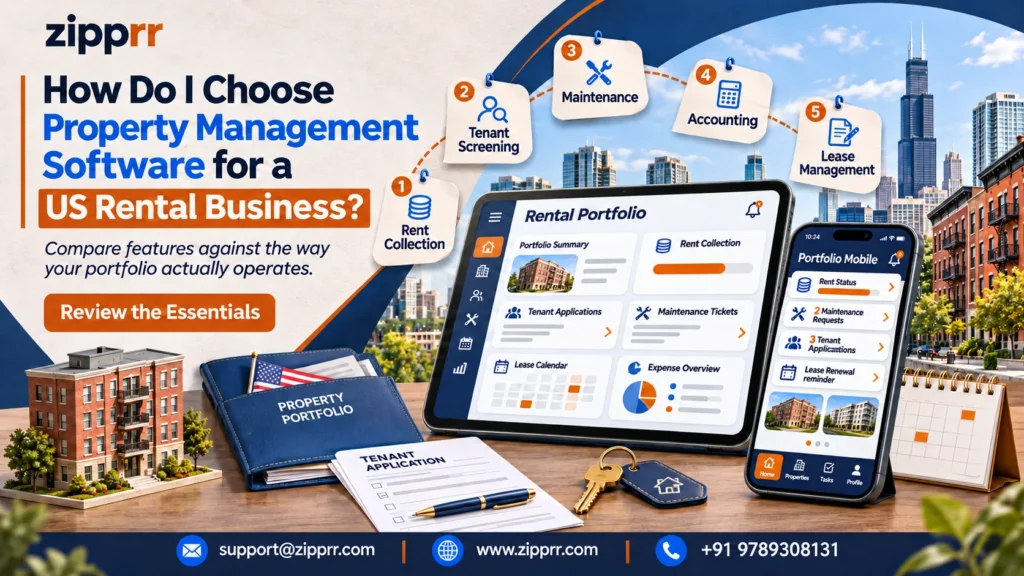
Short answer: choose property management software by scoring it on ten checks: rent collection, maintenance requests, tenant portal, owner reports, lease management, accounting, roles and permissions, communication, ownership and hosting, and launch support. In addition, a platform that scores 24 or more out of 30 on the scorecard in this guide is ready for a US rental portfolio. That holds whether you manage your own units or plan to white label the product for property managers who pay you for access.
Own the platform, brand it as yours and resell it. See the ten checks first, then test them in a live demo.
Why Do Property Management Software Evaluations Go Sideways?
Most buyers in the United States start by comparing feature lists. However, feature lists look similar from vendor to vendor, so they rarely settle the decision. Additionally, a scorecard turns each feature into a pass or fail test you can run in an afternoon.
This guide gives you that scorecard and shows what good looks like for each check. In addition, it walks through a sample scoring session with labelled sample numbers. It is written for entrepreneurs and property managers who want to own a platform or resell one.
Evaluations go sideways when the buyer compares screens instead of workflows. For example, a dashboard with sixty widgets looks impressive in a demo. However, the real question is what happens on the first of the month, when two hundred tenants pay rent and six of them pay late.
Three Habits That Derail Buyers
Three habits cause most of the trouble, and each one has a simple fix.
The US Layer: State Rules and the Fair Housing Act
US buyers carry one extra layer of complexity. Because landlord and tenant rules are set mostly at the state and local level, security deposit limits, return deadlines and eviction notice periods differ from one state to the next. Also, the Fair Housing Act applies nationwide to how you advertise and communicate with applicants.
Software works best alongside a local attorney, and it makes good habits automatic. For example, consistent templates, saved message histories and clear audit trails make it easier to treat every applicant the same way. For a deeper look, read this illustrative study on an AI copilot for apartment leasing compliance.
Here is the short version of the fix. Also, score the software against a fixed list, and score every candidate the same way.
What Is the Zipprr Ten-Point Scorecard for Property Management Software?
The Zipprr Ten-Point Buyer Scorecard is a simple evaluation framework. Moreover, each of ten checks earns 0 to 3 points, so the maximum is 30. In addition, the scorecard is original to this guide, so you can copy it into a spreadsheet and reuse it for every platform you review. Here is how to score each check.
Then read the totals this way:
The Ten Checks and Their Quick Tests
The table below lists the ten checks and what good looks like for each. In addition, use it as your evaluation sheet.
| # | Check | What good looks like | Quick test |
|---|---|---|---|
| 1 | Rent collection | Online payments by card and bank transfer, automatic reminders, and ledger entries that reconcile on their own | Pay a test invoice and watch the ledger update |
| 2 | Maintenance requests | Tenants submit requests with photos, staff assign and track status, tenants see progress | Log a request at 9 pm and follow it to closure |
| 3 | Tenant portal | One login to pay rent, raise requests and read the lease | Complete all three tasks on a phone |
| 4 | Owner reports and portal | A branded owner login showing units, earnings, payouts and statements | Pull a statement for a single owner in under two minutes |
| 5 | Lease management | Digital lease templates, e-signature readiness, renewal dates and stored documents | Create a lease from a template and set a renewal alert |
| 6 | Accounting and invoices | Invoices, payment records and tax-ready reports in one place | Export a month of transactions for your accountant |
| 7 | Roles and permissions | Custom roles for admins, staff, owners and tenants with an audit trail | Create a leasing agent role that sees applicants and hides owner payouts |
| 8 | Communication | Email, SMS and WhatsApp notifications from templates | Send a rent reminder and a maintenance update from one screen |
| 9 | Ownership and hosting | Full source code, your own server, your own domain and data | Ask where the database lives and who holds the keys |
| 10 | Launch and support | A defined launch plan, free installation help and a support window | Ask for the day-by-day launch timeline in writing |
Why Every Check Needs a Quick Test
Notice that every row has a quick test. Moreover, the test matters more than the claim, because a feature you have clicked through yourself is worth more than a feature you have read about.
A useful habit is to run all ten tests in one sitting and write the score in the margin. Two hours of structured testing usually beats two weeks of reading brochures. To see how a vacancy-focused team applies the same thinking to response speed, this illustrative property management case study on faster rental responses shows the workflow from the inquiry side.
Scoring Property Management Software: Rent, Maintenance and the Tenant Portal
These three checks make up the daily life of a rental business. If they work, tenants stay happy and your inbox stays quiet. However, if they stumble, every other feature becomes a distraction.
Rent Collection (Check 1)
Good rent collection feels boring. Similarly, the tenant opens a link, pays, and gets a receipt. Then the ledger updates itself, and you never retype a number. Furthermore, look for these signs of quality:
- Card and bank transfer options through established gateways such as Stripe and PayPal.
- Automatic reminders before and after the due date.
- Reconciliation that matches payments to invoices without manual matching.
- Scheduled owner payouts that follow the collected rent.
The Zipprr property management platform ships with six payment gateways, Stripe and PayPal among them, plus bank transfer. Also, developers can add any additional gateway a market needs. Gateway transaction fees are paid to the gateway, so include them in your cost model.
Maintenance Requests (Check 2)
Maintenance is where tenants judge you. Additionally, a clean workflow turns a stressful moment into a quick, visible fix. First, the tenant submits a request with photos. Next, staff route it to a vendor or technician. Finally, the tenant sees status updates until the job is closed. Likewise, ask three questions during the test:
- Can a tenant attach photos from a phone?
- Can staff assign and reassign a request in two clicks?
- Does the tenant see each status change?
Tenant Portal (Check 3)
The tenant portal is the face of your brand. Also, tenants should be able to pay rent, raise a request and read their agreement from a single login. Because all three live in one place, support calls drop. Also, test the portal on a phone first, since most tenants use one. If the experience feels natural on a small screen, it will work on a laptop too.
Where Short-Term Rentals Fit
Some US portfolios mix long-term leases with furnished or vacation stays. If that describes your plans, check whether a separate booking marketplace would serve those units better than a long-term lease system. In addition, a vacation rental script with source code covers the booking and host side, while property management software covers tenants, owners and leases. As a result, many operators run both under one brand.
Sample Scoring for Checks 1 to 3
Here is a labelled sample. These numbers are illustrative, not measured results.
| Check | Points | Sample note |
|---|---|---|
| Rent collection | 3 | Payments reconciled on all five sample tenants |
| Maintenance requests | 2 | Photos and status worked; vendor routing needed one extra step |
| Tenant portal | 3 | All three tasks finished on a phone in under four minutes |
Subtotal for the sample: 8 out of 9. That is a strong start.
Scoring Property Management Software: Owner Reports, Leases, Accounting and Roles
The second half of the scorecard covers the back office. These checks decide whether the platform can support a growing business, or whether you will outgrow it within a year.
Owner Reports and Portal (Check 4)
Owners care about three numbers: what came in, what went out, and what lands in their bank account. In addition, a good owner portal shows all three without a phone call to you. Moreover, look for a branded login where each owner sees their units, earnings, payouts and statements. Furthermore, the branding matters, because owners should see your company name, not a vendor’s.
In addition, owners who want a listing-style front end that attracts renters and buyers can pair the portal with a real estate marketplace like the Zillow Clone, which feeds new leads into the same business.
Lease Management (Check 5)
A lease system should store agreements, track dates and prompt action before a deadline passes. Digital templates save hours, and e-signature readiness keeps the process moving. However, US leases vary by state, so choose software that lets you edit templates freely. Then your attorney can supply the right language for each jurisdiction, and you load it once. Additionally, run these tests:
- Create a lease from a template in under five minutes.
- Attach a renewal date and confirm an alert appears.
- Store a signed document and find it again by tenant name.
Accounting and Invoices (Check 6)
Accounting inside the platform saves you from copying numbers into a separate tool. Moreover, good accounting records invoices, payments and fees in one ledger. It also exports clean reports for your accountant at tax time. Also, ask for a sample export and read it as an accountant would. Clear columns, dated entries and matching totals are the marks of a ledger you can trust.
Roles and Permissions (Check 7)
As your team grows, you will want a leasing agent who sees applicants and a bookkeeper who sees payments, each with a tailored view. Custom roles with granular permissions make that possible, and an audit trail records who viewed or changed what. This check protects owners and tenants alike. It also protects you, because a clear record settles questions quickly.
Communication (Check 8)
Tenants respond to the channel they already use. Email, SMS and WhatsApp notifications from reusable templates keep reminders consistent. In addition, consistent messages help you treat every applicant and tenant the same way, which supports fair housing practice. Similarly, test one reminder and one maintenance update. Then confirm that templates carry your branding and that sent messages are stored for later review.
Sample Scoring for Checks 4 to 8
Here is another labelled sample for the same imaginary platform.
| Check | Points | Sample note |
|---|---|---|
| Owner reports | 3 | Statement ready in ninety seconds |
| Lease management | 2 | Templates and alerts worked; e-signature needs a connected tool |
| Accounting | 2 | Clean export, but no built-in bank feed |
| Roles | 3 | Leasing role showed applicants and hid payout data as expected |
| Communication | 3 | Email and SMS templates sent correctly |
Subtotal for checks 4 to 8: 13 out of 15. Running total after eight checks: 21 out of 24.
Ready to run these eight checks on a live platform?
Property Management Software Ownership and Hosting: Checks 9 and 10
The last two checks decide your long-term cost and your freedom to grow. They matter most to entrepreneurs who plan to brand and resell the software.
Ownership and Hosting (Check 9)
Software comes in two broad shapes. In addition, a hosted subscription gives you access to someone else’s platform, and the vendor keeps the code. In contrast, self-hosted software gives you the code, and you run it on your own server.
Each shape has strengths. Likewise, subscriptions suit buyers who want a vendor to run everything. Self-hosted software suits buyers who want to own the asset, brand it fully and enjoy flat costs as the portfolio grows. Here is what to verify for ownership:
- Complete source code arrives with the purchase.
- The platform can sit on your own server and domain.
- Unlimited properties and units can run under your own pricing.
- You know which costs sit outside the purchase price, such as hosting, domain and third-party services.
Zipprr’s platform is sold with full source code, so entrepreneurs can own the product and brand it as their own. It is a one-time purchase, and the page describes it as white label. Moreover, the buyer hosts the platform on their own server. However, hosting, domain, SMS or email services, maps and gateway fees are separate, so add them to your budget.
Sample Three-Year Cost Comparison
Suppose a manager runs 200 units. These figures are illustrative examples to show the method, so replace them with real quotes before you decide.
Launch and Support (Check 10)
A platform is only as useful as the day it goes live. Therefore, ask for a written timeline and a named support window. Also, Zipprr states a three-day launch plan on the product page:
- Day one: setup.
- Day two: configuration such as property import, payment gateway and user roles.
- Day three: testing, review and training.
The page lists free installation and 90 days of support. It also gives a customization figure of 20 hours, with further custom features discussed case by case. Confirm anything beyond that in writing before purchase.
Sample Scoring: Final Tally
| Check | Points | Sample note |
|---|---|---|
| Ownership and hosting | 3 | Full source code, own server |
| Launch and support | 3 | Written three-day plan and free installation |
Final sample total: 27 out of 30. Under the scorecard, that platform earns a shortlist.
What Does Property Management Software Cost in the USA?
Cost is the first question most buyers type into a search box. Furthermore, the honest answer is that cost depends on the pricing model, the size of your portfolio and how long you run the business. Three models are common:
Zipprr Pricing at a Glance
Zipprr uses the third model. Both editions are one-time purchases, and the product page recommends each one for a different buyer.
- Web platform and full source code
- Website installation
- 90 days of support
- Regular updates
- Everything in Standard
- Android and iOS apps
- App store submission
Apps carry two small outside costs if you publish them. In addition, the Apple Developer Program is $99 per year, and Google Play is a $25 one-time fee, as the product page notes.
Total Cost Worksheet
Write down five lines before you compare vendors. Additionally, the lines are license, hosting, domain, third-party services and gateway fees. Then add them for year one and again for year three, and divide by your unit count.
Which Property Management Software Buyer Are You?
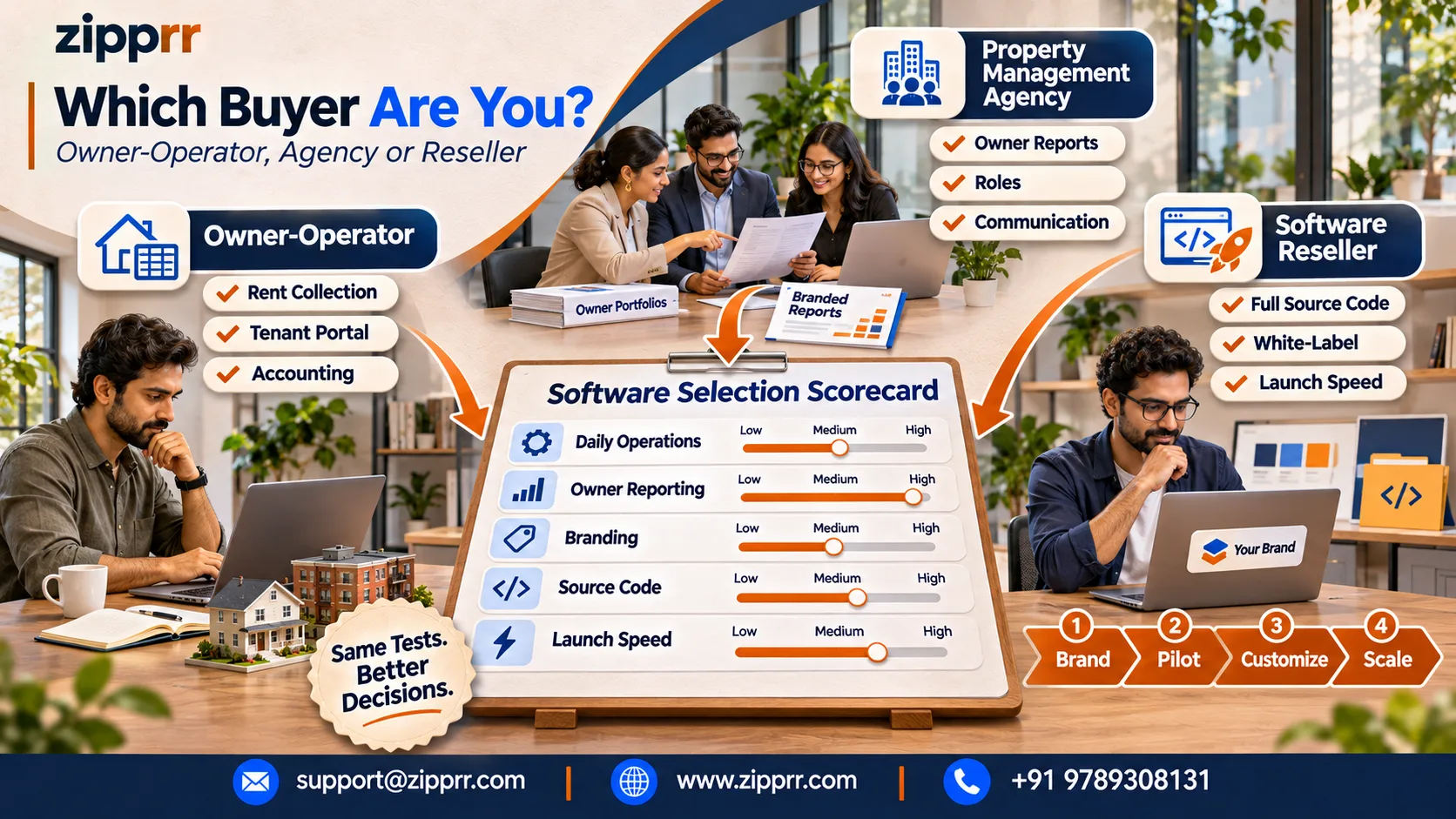
The scorecard works for everyone, but the weights shift by buyer type. Therefore, adjust the importance of each check before you total the points.
A Simple Reseller Path
Here is a simple path for entrepreneurs who plan to resell. You can launch your own white label rental platform with full source code and keep every dollar of recurring revenue:
- Launch the platform on your own domain with your brand.
- Onboard one local property manager as a pilot customer.
- Collect feedback and use the customization hours for the first requested feature.
- Offer the platform to a wider group of managers in your market.
Fair testing: give every candidate the same ten tests, because equal tests lead to better decisions.
Which of these ten checks matters most for your portfolio?
A 48-Hour Dry Run Before You Buy Property Management Software
A dry run turns the scorecard into a decision. It takes two days and uses sample data only.
Day One: Set Up and Test the Money Flow
- Create three sample properties, two owners and five tenants.
- Run the Rent-Day Test and the Statement Speed Test.
- Record the points for checks 1, 4 and 6.
Day Two: Test the People Flow
- Run the Friday Afternoon Test for maintenance.
- Create a custom leasing role and confirm what it can see.
- Send a reminder and a maintenance update.
- Record the points for checks 2, 3, 7 and 8.
Final Hour: Test the Business Questions
- Ask where the data lives and who holds the code.
- Request the launch timeline and support terms in writing.
- Record the points for checks 5, 9 and 10.
Then add the totals and compare them with the thresholds. If two platforms land within three points, break the tie with the ownership check, because it shapes your costs for years.
Questions to Ask a Vendor Before You Pay
Bring these questions to any sales conversation:
- Which payment gateways are built in, and which can I add?
- What do owners see when they log in?
- How are roles and permissions configured?
- What does the launch timeline look like day by day?
- Which costs sit outside the purchase price?
- What support is included, and for how long?
A clear vendor answers each one in plain language. Clear answers are a strong sign of a clear product.
A Note on Fair Housing and Local Rules
Software supports good practice, yet legal duties stay with you. Therefore, keep a local attorney or compliance adviser in the loop for lease language, deposit handling and notice periods. Also, use the platform to store templates, record communications and apply the same process to every applicant.
What Are the Most Asked Questions About Choosing Property Management Software?
Property Management Software Basics
1. What features should property management software have?
It should include rent collection, maintenance requests, a tenant portal, an owner portal with statements, lease management, accounting and invoices, role-based permissions and automated notifications. These features cover the full cycle from applicant to owner payout. Also, test each one with sample data instead of relying on a feature list.
2. How do I choose property management software?
Score each candidate on the same ten checks, such as rent collection, maintenance, owner reports and ownership. Then run a short dry run with sample tenants and owners, record points for each check, and compare totals. Moreover, a score of 24 out of 30 or higher marks a strong shortlist candidate.
3. How much does property management software cost?
Cost depends on the pricing model. Also, subscriptions charge monthly, often per unit, while one-time licenses charge once and leave hosting to you. Similarly, Zipprr’s platform is $490 one-time for the Standard Edition and $890 one-time for the Professional Edition with Android and iOS apps. However, hosting, domain, third-party services and gateway fees are extra.
Value and Branding Questions
4. What is the best property management software for small landlords?
The best choice is the platform that scores highest on rent collection, tenant portal and accounting while keeping total cost low. In addition, a one-time web platform suits owner-operators who want to launch quickly. For example, Zipprr positions its $490 Standard Edition for individual landlords and developers who plan to start on the web.
5. Is property management software worth it?
It pays off when it removes repeated manual work, such as chasing rent, routing repair requests and building owner statements. Likewise, the value grows with unit count and time. Therefore, compare a three-year total that includes license, hosting, services and gateway fees against the hours your team spends on these tasks today.
6. What is white label property management software?
It is a platform you can brand as your own, with your logo, domain and colors. As a result, owners and tenants see your company name, not the vendor’s. Zipprr’s platform is described as white label, and its purchase includes full source code, so you control branding and pricing.
Payments and Hosting Questions
7. Can property management software handle rent collection and maintenance requests?
Yes. Also, good platforms collect rent online through payment gateways, send reminders and reconcile payments to invoices. They also let tenants submit repair requests with photos, route them to staff and show status updates. Zipprr’s platform includes both workflows, with Stripe and PayPal among its six supported gateways plus bank transfer.
8. What is the difference between self-hosted property management software and SaaS?
SaaS is a rented subscription where the vendor keeps the code and runs the servers. In contrast, self-hosted software gives you the source code, and you run it on your own server and domain. Self-hosting offers full control over branding and data, while you handle hosting costs. In addition, Zipprr’s platform is self-hosted and sold as a one-time purchase.
Setup and Compliance Questions
9. How long does it take to set up property management software?
Setup time varies by vendor. Zipprr states that most teams launch within about three working days: setup on day one, configuration on day two, and testing, review and training on day three. Free installation is included, and 90 days of support follow the launch.
10. Does property management software help with fair housing compliance?
Software can support fair housing practice by storing standard templates, keeping message histories and applying the same process to every applicant. However, it works best alongside legal advice. Moreover, the Fair Housing Act applies across the United States, and state rules add detail, so review templates and procedures with a qualified local attorney.
Conclusion: Which Property Management Software Passes Your Ten Checks?
The right property management software is the one that passes the ten checks on your own sample data. Rent collection, maintenance, tenant portal, owner reports, lease management, accounting, roles, communication, ownership and launch support each deserve a hands-on test and a score. Then add the points, compare them with the thresholds, and let the numbers guide the shortlist.
Entrepreneurs gain extra value from the ownership check, because full source code lets you brand, price and grow the product on your terms. To see how Zipprr’s white label platform scores against your own scorecard, run the 48-hour dry run in a live demo.
Which platform will you test first?
Send your list to [email protected], chat with us on WhatsApp, or reserve a free demo and bring your scorecard along. What would a 27 out of 30 look like for your portfolio?