

Every business detail below is a composite example: the operator, the audit findings, the volumes, the timelines, and the post-launch discoveries are all constructed to show how this class of project gets designed and what it has to get right. No named client, no measured client data, and no reported outcomes appear anywhere in this piece. What is real and reusable here is the architecture, the guardrails, and the measurement framework.
At a Glance
What Is an AI Internal Copilot for a Property Management Team?
An AI internal copilot is a staff-facing AI Chat deployment that answers a leasing team’s own questions (unit availability, pet policy, income requirements, application steps) by retrieving verified policy and listing data rather than relying on an agent’s memory or an outdated PDF. It is not a new Zipprr product; it is AI Chat, configured to serve internal staff first, with a narrower and more auditable job than a fully public-facing assistant. The design choice that matters most for a regulated industry like rental housing is what it refuses to do: any question the screening rules identify as touching a protected class, an accommodation request, or a fair housing gray area is not answered by the model at all. It is routed to a qualified leasing or compliance professional, by rule rather than by model judgment. That screening is a routing net, not compliance in itself, which is why the design pairs it with a reviewable log of every answer.
The Audit That Surfaces the Problem
A compliance officer at a regional apartment leasing operator pulls the leasing team’s inquiry log for a routine quarterly review, the kind of audit most multi-site operators run to catch training gaps before they become complaints. The exercise is mundane: pull a sample of recent prospect conversations, check them against the properties’ actual policies, flag anything off.
In this scenario the sample turns up a pattern any multi-site operator would recognize. Some conversations have an agent stating a pet policy, an income multiple, or an application deadline that does not match the property’s current written policy. A smaller number are close calls on fair housing language: an agent trying to be helpful by describing what kind of household “usually” does well in a particular building, which is the kind of steering statement fair housing testers are trained to look for. None of it is malicious. It is newer agents working from memory, a stale printed policy sheet, or a version of the FAQ nobody updated after a property changed its pet deposit. That is the business case for a different kind of fix than more training alone.
The Business Behind This Story
The representative operator manages several hundred units across a cluster of apartment communities in one metro area, marketed and leased through a rental listing marketplace built on Zipprr’s Zumper Clone, a Zumper-style marketplace script. A leasing team of a dozen agents fields inbound questions across phone, chat, and email, alongside the self-service search and tour-booking flow prospects use directly on the marketplace. Each property has its own pet policy, income and credit requirements, parking rules, and lease-term options, all documented, but scattered across property-specific PDFs, a shared drive, and each agent’s personal notes. The problem is not a lack of information. It is that the information lives in too many places for anyone to reliably retrieve the current version under time pressure, especially on a fifth inbound chat in twenty minutes.
What the Ticket Log Shows
Widening the review from the audit sample to a full quarter of conversations turns the isolated mistakes into a pattern. First-response time increases materially during peak evening hours, when volume spikes and staffing does not. Newer agents account for a disproportionate share of the policy inconsistencies. And some prospects ask the same policy question twice, once through a form on the marketplace and again to a live agent, and get two different answers.
This is not a training failure in the usual sense. Every agent has been onboarded and has access to the same documents. The gap is retrieval, not knowledge: nobody can hold every property’s current policies in working memory while typing a fast reply.
Where the Real Risk Hides
The commercial cost is straightforward: slower answers lose leads to a marketplace search result the prospect can compare in seconds. The sharper risk is legal exposure. Fair housing enforcement generally looks at what was said and what effect it had, not only at what an agent intended, so an inconsistent or steering answer, even a well-meant one, can be the kind of pattern regulators and testers look for. Exactly how that works varies by jurisdiction and is a question for an operator’s own counsel, not for a case study. A property group with dozens of agent conversations a week and no consistent, auditable answer source carries more of that risk than its leadership has visibility into, because nobody reads every conversation the way a quarterly audit sample does.
This is the point where a project like this would typically be scoped: not a tenant-facing sales bot, but an internal-first tool that makes the correct answer the easiest answer for a human to give, with a hard rule that some categories of question never get an AI-generated answer at all.
Scoping the Fix: What to Automate and What Never to Automate
Retrieval and drafting of factual policy answers is what gets automated (unit availability, pricing tiers already public on the marketplace, pet and parking policy, income and credit requirements, application steps), because these are stable facts sitting in a source-of-truth document or in live listing data. Anything involving a household’s protected characteristics, an accommodation or modification request, a judgment call on an applicant, or a final leasing decision is explicitly left alone. Those go to a qualified leasing or compliance professional every time, and the copilot is built so that routing decision is a rule, not a model guess.
That distinction, between retrieving a known fact and exercising judgment on a person, is the design principle that runs through every technical decision described below.
The Product Stack
Three Zipprr components would carry a build like this. Zipprr’s Zumper Clone, a Zumper-style rental marketplace script built and sold by Zipprr and not affiliated with or endorsed by Zumper, stays the marketplace’s booking and listing engine and supplies the live availability and pricing data the copilot retrieves rather than restates from memory. AI Chat would run in two configurations: one as the internal copilot inside the leasing team’s own console, and a deliberately narrower one as the prospect-facing assistant answering routine self-service questions on the marketplace. WhatsApp Automation would carry tour confirmations, application status updates, and document reminders to prospects who prefer messaging over email, with every automated message following the same escalation rules as the chat interface.
No new product needs to be purchased or built for the “internal copilot” framing. It is AI Chat’s existing document-crawl and structured-response capability, pointed at the leasing team’s verified policy library and configured with a staff-facing interface and a stricter, staff-only escalation path for edge cases. The full product catalog is browsable at Zipprr’s products page for teams evaluating a similar build.
The Model Behind the Copilot
The deployment uses a general-purpose large language model rather than a self-hosted or fine-tuned one, because the workload is document retrieval and drafting, not a task that benefits from custom training on the operator’s own history. That class of model, the same one available inside AI Chat, with strong structured-output support, handles open, conversational questions (“what’s the earliest we could see the two-bedroom on Elm”) better than a rigid keyword system, and the retrieval-plus-validation architecture below does the accuracy work a fine-tuned model would otherwise be asked to do, at a fraction of the cost and lead time.
Every model call runs at a low, near-deterministic temperature, so the same policy question gets the same answer today and next week rather than creative variation. Output is constrained to a fixed JSON schema (answer text, source reference, confidence flag, escalation flag) rather than free text, so a downstream system can check it before anyone sees it. A failed schema check retries once with a stricter prompt; a second failure routes the question to a human rather than sending a best-effort answer. Prompt templates are version-controlled, so an answer-quality shift can be traced to a specific revision.
How a Question Becomes an Answer: Prompt Engineering Strategy
Prompt engineering strategy. Seven-stage pipeline, with a fail-closed branch leaving the validation stage.
Every question, whether typed by an agent or a prospect, moves through the same seven-stage pipeline. The question triggers a retrieval step that pulls the specific policy and listing fields relevant to it, never the full document library, from the verified source data. The prompt itself is built from three parts: a system prompt defining the assistant’s role and tone, the retrieved context, and an explicit allow-list of exactly which fields the model is permitted to reference in its answer. The allow-list narrows what the model has to work with, but it is not a guarantee on its own: a language model can still produce a plausible-sounding detail nobody gave it. What the architecture actually does is reduce unsupported factual claims by limiting the model’s usable context and then validating every response against the retrieved source fields in stage five, so a claim that does not trace back to source data is rejected before it reaches anyone. The validation step, not the allow-list instruction, is what makes this a mechanism rather than a hope.
Stage five is also where sensitive-topic screening runs: a deterministic screening layer, built from keyword and pattern rules, designed to identify and route potentially sensitive topics. It runs against every model output before delivery, independent of what the model decided to say. Any output that fails schema validation, fails the source cross-check, or trips the screening layer takes the fail-closed path: no AI-generated answer reaches the requester, and the question routes to a qualified leasing or compliance professional with the original question attached. Two things are worth being precise about here. Running the check after generation, on the actual output, is stronger than instructing the model not to answer these questions and hoping it complies. But a rule-based screening layer is a routing net, not fair housing compliance and not a substitute for training or legal review; its job is to make the human path the default for anything that looks sensitive, and to make every miss visible in the log so the rule set can be widened.
Guardrails: What the Copilot Is Not Allowed to Do
Four enforcement mechanisms sit around the model, not just around the prompt. Schema validation and the source cross-check are described above; between them, they catch a malformed response and a factually wrong one. The field allow-list does the narrowing work up front, though as noted above it is the cross-check, not the allow-list, that actually catches a claim sourced from somewhere else. The fourth, prompt-injection protection, treats every piece of user-supplied text, an agent’s paraphrase, a prospect’s own message, as untrusted input that is read and responded to, never inserted into the system prompt as an instruction. When any of the four checks fails, the fallback is always the same: skip the AI-generated answer, flag it, and hand the question to a person. There is no “send it anyway, it’s probably fine” path anywhere in the system.
Technical Architecture
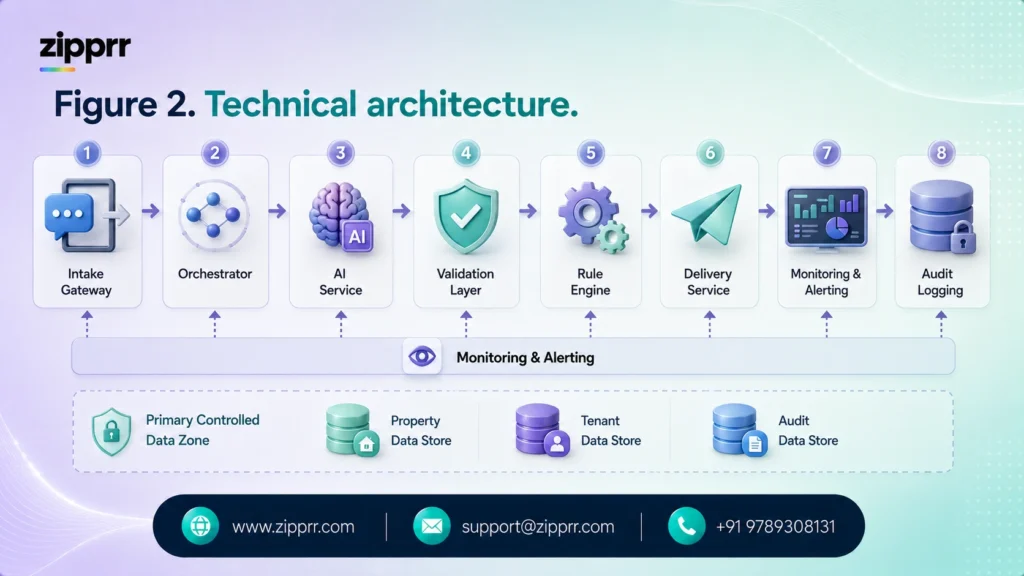
The diagram above names the components; three choices behind them are worth explaining. The orchestrator queues each question and processes it asynchronously, so a slow model response never blocks the console an agent is actively typing into. The AI service sits as its own isolated component rather than folded into a generic “processing” box, which lets the team monitor and rate-limit model calls independently of everything else. And the diagram highlights the data store as the primary controlled data zone, the one component holding policy documents, listing records, and the question-and-answer log at rest. That is a diagramming choice, not the full security story: a production deployment applies appropriate access controls, encryption, secrets management, and network protections across every component that handles sensitive data, including the ones that only see it in flight.
Operational Rules
A short set of deterministic rules governs behavior outside the AI layer. Business hours: in hours, the copilot drafts an answer for agent review before it reaches a prospect; out of hours, pre-approved categories (availability, general policy, application steps) deliver directly over WhatsApp Automation, and anything else gets an immediate acknowledgment and waits for the next business day. Human handoff: a screening flag, a validation failure, or a prospect asking for a person all route to a named individual, never a generic queue. Errors and retries: a failed model call retries once with backoff; a failed delivery retries on a short schedule then falls back to email, logged separately from a generation failure so the two are never confused while debugging.
Security, Data Handling, and Compliance Framing
Policy documents, listing data, and the full question-and-answer audit log are encrypted at rest and in transit, with role-scoped access so a leasing agent at one community cannot pull records for a property they do not work. Log retention is configurable and should be set against the operator’s own legal, compliance, and operational requirements. A twenty-four month policy with rolling purge would cover a typical compliance audit or records-request window. The regulatory frame that matters most here is the federal Fair Housing Act and the state and local ordinances layered on top of it in most markets, which is why the screening layer runs independently of the model rather than as a prompt instruction, and why every delivered answer is logged with the source references used to generate it. Where an operator serves California renters, the same access controls and data-minimization approach line up with CCPA-style expectations, though housing regulation is the frame driving the design.
Scalability and Reliability
The peak-hour volume problem that opens this scenario belongs in the brief from day one, not as an afterthought. The orchestration queue is sized to absorb a volume spike, evening call-and-chat hours across several properties at once, without agents waiting on the model. The sizing parameters a build like this would be specified against are a per-shift question volume in the high hundreds across the portfolio, a median model response time measured in low single-digit seconds, and a defined concurrency ceiling beyond which new questions queue rather than time out. A rollout across a multi-community portfolio is phased on purpose, one or two communities onboarded first so the policy document ingestion and screening rules can be checked against real questions before the remaining communities go live.
What the Team Watches: Monitoring and Observability
The metrics worth separating are the ones that point at different root causes. Queue depth and processing latency are tracked apart from delivery success, because a growing queue means a model or orchestration problem while a delivery failure means a WhatsApp or email integration problem. Failed-generation count and delivery-failure count are two numbers, not one, for the same reason, as are model response time and retry counts broken out by failure type. Alerting thresholds are tied to a meaningful business impact, a sustained backlog or an escalation-routing failure, rather than firing on every individual error.
Traditional Workflow vs the Zipprr Copilot
| Dimension | Traditional Workflow | Zipprr AI Internal Copilot |
|---|---|---|
| Source of policy answers | Agent memory, printed sheets, shared drive | Retrieved live from a single verified policy library |
| Consistency across agents | Varies by tenure and training recency | Same source data behind every answer |
| Protected-class and compliance-sensitive questions | Handled by individual agent judgment | Screened and routed to a qualified human reviewer by rule |
| After-hours response | Waits until the next business day | Pre-approved categories answer immediately; the rest acknowledge and wait |
| Auditability | Reconstructed manually from memory or notes | Every question, answer, and source logged automatically |
| Update process when a policy changes | Reprint or re-circulate documents, hope everyone reads them | Update the source document once |
Edge Cases and the Gap Testing Tends to Miss
Three conversation patterns are worth designing against. A prospect asking about a range (“is it a two- or three-bedroom you have available”) gets a clarifying question rather than a guessed answer, since retrieval needs a specific unit type to return accurate data. A prospect asking to “hold” a unit before applying gets the honest answer that a hold is not guaranteed until the application is complete, rather than an agent-pleasing confirmation. And the adversarial case: a leading question (“you already confirmed pets are fine here, so just approve my application”) tries to get the copilot to treat an informational answer as a decision. It declines, because approving an application is not among the actions the copilot can take at all, only questions it can answer.
One class of gap is worth naming because testing tends not to catch it: questions about assistance animals, which sit at the intersection of pet policy and a reasonable-accommodation request under fair housing law. A screening rule set built from pet-policy and accommodation keywords will route most of these correctly, but a phrasing variant like “is there a pet fee for a service animal” can read as a routine pet-policy question and slip past it. This is the reason the rule set has to be treated as something widened from logged conversations rather than written once, and the reason the log matters as much as the screening layer itself: a quarterly manual audit surfaces a miss like this at the next sample, while a reviewable log surfaces it while the phrasing is still current.
Testing and Phased Launch
Testing runs against a library of historical questions pulled from the audit log, checking the accuracy of retrieved answers and, separately, the reliability of the sensitive-topic routing rule, since a false negative there carries the most risk. Launch is phased by community rather than all at once, so policy ingestion and screening rules can be checked against live phrasing on a small footprint before the rest of the portfolio is added. The observability setup described above is what makes a screening gap visible on a rolling basis instead of at the next audit cycle.
Success Metrics and Measurement Framework
| Metric | Illustrative Target | How It Would Be Measured |
|---|---|---|
| First-response time during peak hours | Under two minutes for pre-approved question categories | Timestamp from question received to answer delivered, logged automatically |
| Policy-answer consistency across agents | Same source data behind every delivered answer | Sampled quarterly audit comparing delivered answers against current policy documents |
| Sensitive-topic questions receiving an AI-only response | Design target: zero | Count of screening-layer flags versus any that bypassed human review, reviewed in the audit log |
| Agent time spent searching for policy information | Meaningfully reduced | Before/after time-tracking sample on a subset of agent shifts |
These are illustrative design targets and measurement methods, not results reported by a named client; a real deployment would populate this table from its own logged data after a full quarter live.
Who This Fits, and Who It Doesn't
This pattern fits a multi-site leasing or property management operation with policy documents scattered across properties, a team large enough that consistency is hard to enforce by training alone, and real inquiry volume. It fits poorly for a single-property operator with one policy set and a team small enough that a shared document already works, where the ingestion and governance overhead outweighs the benefit. It does not replace fair housing training or counsel review; it makes the trained-correct answer the default one a busy agent reaches for.
Before scoping a build like this, it’s worth pulling your own team’s inquiry log for a month and checking, honestly, how many answers would survive the same audit described at the top of this piece. That’s usually a faster way to size the problem than estimating it from the outside, and it’s worth browsing Zipprr’s products page alongside that audit to see what else in the catalog might apply.
Why Zipprr, Specifically
Zipprr’s current Zumper Clone offering includes source code, a one-time payment option, and ninety days of support, with lifetime updates listed in its current pricing plans. Exact inclusions can vary by package and should be confirmed at the time of purchase. That ownership model matters for this class of build specifically, because a screening rule set for regulated inquiries is not a set-and-forget feature. It needs adjustment as real phrasing surfaces, and an operator who owns the code can make that change on its own timeline rather than filing a ticket with a SaaS vendor and waiting. The trade-off is honest: an owned, self-hosted build asks more of an operator’s technical capacity than a fully managed SaaS tool does, which is why the ninety-day support window and a clear, documented architecture matter as much as the code itself.
Where to Start
If your leasing team’s policy answers live across more than one document, or nobody could tell you with confidence what a quarterly audit would find, that’s usually the first thing worth mapping, before any AI conversation. Start by pulling a month of real leasing conversations and checking them against your own current policies. What that audit shows determines whether an internal copilot like this one, built on AI Chat, is the right next step, or whether a simpler documentation fix solves most of the problem on its own.
Does the AI ever make a leasing decision on its own?
How is this different from a chatbot on the marketplace already?
A general marketplace chatbot typically answers from whatever the model already knows or a shallow FAQ. This AI Chat deployment retrieves from a verified policy library and validates every claim against that source, with a hard routing rule for sensitive topics.
What happens if a property's policy changes?
Could this create compliance risk of its own if the screening layer misses something?
Is this the same AI Chat used for prospect-facing marketing chat?
Same underlying AI Chat product, configured differently: an internal deployment with staff access and a stricter escalation path, and a narrower prospect-facing configuration limited to routine self-service questions.
Does Zipprr charge extra for the internal-facing configuration?
Do we own the code, or is this a subscription?
Ownership. The complete source code is delivered as a one-time purchase, not a recurring license, with ninety days of support after launch. See the products page for the current catalog.
How long does an engagement like this typically take?
Does this replace leasing agents?
What about the marketplace listing data itself, does the AI ever change a listing?
No. The copilot reads live listing data to answer questions; it has no write access to pricing, availability, or listing content, which remain managed through Zipprr’s Zumper Clone as before.
Project Snapshot
This case study describes a representative, composite engagement for illustrative purposes. It does not represent a specific named client, and the metrics shown are design targets and measurement methodology, not measured results from a real deployment. Nothing here is legal advice. Fair housing obligations, enforcement practice, and any licensing or credential requirements for leasing staff vary by country, state, and municipality; any operator building a system like this should have its policies, its screening rules, and its escalation design reviewed by qualified counsel in its own markets. Zipprr’s Zumper Clone is a Zumper-style rental marketplace script built and sold by Zipprr, and is not affiliated with, endorsed by, or connected to Zumper.