

We spent the first Monday of the engagement doing nothing but sitting in the leasing office. Not asking questions, just watching. By half past nine the shared inbox had eleven new rental inquiries in it, a phone that had rung four times, and two messages waiting on the company WhatsApp number. The leasing coordinator was working the list in the order she could get to it, which meant the person who had asked about a two-bedroom at 8:40 was still waiting at 10:15 while she finished a call about a completely different unit. She was not slow. She was outnumbered. And every minute a good inquiry sat unanswered was a minute a competing agent down the road could answer it first.
That is where this story starts, because it is the real shape of the problem. Nobody at the firm was doing anything wrong. Inquiries were coming in, viewings were happening, units were getting leased. But the volume arrived in bursts the team could not physically keep pace with, the fastest-moving renters went to whoever replied first, and a surprising number of genuinely interested people simply never heard back a second time. The vacancies were not sitting empty because demand was low. They were sitting empty because the response was slower than the market. To solve this, the firm implemented Zipprr AI Chat, paired with our WhatsApp Automation platform, giving every rental inquiry an instant first response while keeping tenant screening and selection entirely with staff.
The company in this story is a representative composite we will call Kestrel Property Management, a mid-sized residential letting and management firm assembled from the kind of engagements we run regularly. The situation, the workflow, and the decisions are true to how these projects actually go; the name and the specific details are illustrative rather than a single identifiable client. Every tenant-screening and selection decision described stayed with the firm’s licensed staff, in line with fair-housing obligations, and none of it was ever handed to software.
Project at a glance
In short, this is how a mid-sized property management firm gave every rental inquiry an instant, qualified first response and a consistent follow-up, so fewer warm renters slipped away and vacant units filled faster, without letting software make a single tenancy decision.
Property management AI for faster rental inquiry response
Property management AI closes the gap between when a rental inquiry arrives and when someone actually answers it. In this engagement, Zipprr AI Chat handled the instant first response and preference-based qualification while WhatsApp Automation carried the follow-up, so a mid-sized firm could respond to every rental inquiry in seconds, day or night, without adding staff and without letting software touch tenant screening. Here is how that changes the day-to-day compared with a traditional manual process:
| Traditional process | Zipprr AI workflow |
|---|---|
| ✕Manual replies | ✓Instant AI response |
| ✕Manual follow-up | ✓Automated WhatsApp follow-up |
| ✕Office hours only | ✓24/7 availability |
| ✕Spreadsheet tracking | ✓CRM integration |
| ✕Manual scheduling | ✓AI-assisted scheduling |
Where rental inquiries were slipping away
We do not design from a complaint; we design from where the money actually leaks. So before we proposed anything, we spent that first week tracing the path of an inquiry from the moment it arrived to the moment it either booked a viewing or went quiet. We watched the inbox, listened to calls, read the WhatsApp thread, and looked at how leads were logged.
Three leaks showed up quickly, and only one of them was the one the firm expected.
Where rental inquiries leaked Three points where warm renters quietly dropped out before booking. Rental inquiries Booked viewings Slow first response an hour or more No second touch follow-up forgotten After-hours gap cold by Monday The expected leak was speed. Inquiries clustered in the morning and again after work, exactly when the small team was most stretched, so first replies routinely went out an hour or more after the message landed. Widely cited lead-response research, notably the Harvard Business Review study The Short Life of Online Sales Leads, has long reported that the odds of contacting and qualifying a lead fall steeply within the first hour, and rental inquiries behave no differently: the renter who messaged five agents at lunchtime books with whoever answers before they lose interest. Those are other researchers’ published findings, not Kestrel’s own numbers, but the pattern matched what we saw in the inbox exactly.
The second leak was the one that surprised us, and it turned out to be the bigger one. It was not the missing first reply. It was the missing second one. A good number of inquiries did get an answer, then went cold when nobody followed up. The renter did not respond to the first message, or asked to be reminded closer to their move date, and there was no reliable system to circle back. Follow-up depended on whether someone remembered, and on a busy Monday, someone usually did not. The firm was spending real effort winning attention and then quietly losing it for want of a nudge.
The third leak was after-hours. A meaningful share of inquiries arrived in the evening and over the weekend, when the office was closed, and by Monday morning those renters had often already booked elsewhere. The listings never slept; the response did.
Reading it that way reshaped the whole build. Speed was worth fixing, but the second touch was where the real growth was hiding. A common mistake we see firms make is to buy a faster first-response tool and leave the follow-up exactly as leaky as it was. We were not going to do that.
Why AI Was the Right Fit for Property Management Lead Response
Once we understood the three leaks, the honest question was whether this was a hiring problem or an automation problem. We treated it as a real decision rather than a foregone conclusion, and the answer was that more people would not fix it.
The first reason is the shape of the traffic. Rental inquiries do not arrive in a steady trickle; they come in bursts, clustered around mornings, evenings, and the hours right after a new listing goes live. Hiring another leasing coordinator raises steady-state capacity, but it does very little for a Monday-morning spike, and you pay for that capacity through every quiet afternoon too. Burst traffic is exactly the kind of load automation absorbs well and headcount does not.
The second reason is the nature of the questions. A large share of first-touch rental inquiries ask the same handful of things: is it still available, what is the rent, are pets allowed, when can I see it. That is textbook repetitive first-response work, and it is precisely where property management AI earns its place. Learn how our property management software works alongside an AI leasing assistant to automate leasing inquiries without replacing your team. A well-built assistant paired with a property management chatbot can answer those questions instantly and consistently, which is the core of rental inquiry automation and everyday tenant communication automation.
The third reason is coverage. After-hours and weekend inquiries simply cannot be handled by office staff who have gone home, and those are the leads that most often go cold by Monday. An AI leasing assistant does not keep office hours.
What AI is not good for is judgment, and in property management the judgment work is the valuable work. So the whole approach was to let AI carry the repetitive first-response and follow-up, the rental lead management busywork, and hand the leasing team back the hours for the work that needs a person. That division of labor, machine for the repetitive and human for the judgment, is the entire thesis of the build:
Before we scoped a single feature, we drew one line and held it for the rest of the project. The assistant could respond, answer routine questions, capture what a renter was looking for, and book a viewing into an open slot. It could not screen anyone, decide who was eligible, or rank or select applicants. Every one of those judgments stayed with the firm’s staff.
That line mattered for a plain reason: tenant selection sits under fair-housing rules, and a system that started making or even implying eligibility decisions would be both a legal risk and the wrong tool for the job. Drawing the boundary on day one set the firm’s expectations honestly and made the whole build safer, because nothing the assistant did could stray into a decision that belongs to a trained person.
Why an owned assistant beat another portal add-on
Kestrel could have bolted on one more listing-portal messaging feature or a monthly chatbot subscription. We steered them toward Zipprr AI Chat as the core instead, with WhatsApp Automation handling the follow-up channel, and it was worth being clear about why.
Ownership was the first reason. AI Chat is a one-time purchase where complete source code ownership is transferred to the firm, so it can self-host, customize, and maintain the assistant without vendor lock-in and without a per-seat meter that grows with the team. A portal add-on rents you a feature inside someone else’s platform; Kestrel wanted the lead-response layer to be theirs.
Fit was the second. The firm’s inquiries did not arrive in one place. They came through the website, through listing pages, and through WhatsApp, and the follow-up that was leaking most needed to happen where renters actually reply, which is overwhelmingly WhatsApp. Pairing AI Chat for the on-site instant response with WhatsApp Automation for the staged follow-up meant we could meet renters on both surfaces rather than forcing them into an inbox they would ignore. Want to see slow first replies and dropped follow-ups solved on your own listings? That pairing is what this project was built around.
The honest trade-off, which we put on the table, is that owning the system means maintaining it after the support window closes, where a subscription keeps patching it for a recurring fee. Free implementation customization and 90 days of support soften that, and a one-person landlord who never wants to touch software again might still prefer to rent. Kestrel, which wanted control and a cost that did not climb with headcount, found the choice easy.
Property firms rarely run just a leasing pipeline. Many also operate a public listings site or a short-term-rental arm, and the same owned-platform logic applies there: a Zillow-style listings portal, a Zumper-style rental marketplace, or a vacation-rental platform can be owned outright rather than rented, with an AI response layer added the same way. For Kestrel the scope stayed on leasing, but the pattern travels.
Designing an AI-Powered Rental Inquiry Workflow
We built the assistant around Kestrel’s real inquiry types and added as little new software as possible, since every extra system is one more thing the firm has to maintain after we leave. Rather than replacing existing leasing management software, Zipprr works alongside your CRM, calendar, and website to automate the first stages of renter communication.
The first-response side was grounded in the firm’s own listings, not left to improvise. When a renter asked about a unit, the assistant answered from the actual listing data (rent, availability, pet policy, deposit terms) rather than generating a plausible answer that might be wrong, and routed anything it could not confirm to staff. Getting a rent figure wrong in a first message is worse than a slow reply. Qualification stayed light and preference-based: it captured what a renter wanted, matched it against available units, and either offered a viewing slot or passed the details to the team, never framing any of this as screening.
The follow-up side got the most care, because it was the biggest leak. See how our WhatsApp automation software manages follow-ups automatically: we built a short, staged sequence, a gentle reminder for anyone who did not book and a scheduled nudge for anyone who asked to be contacted nearer their move date, so the second touch happened every time instead of only when someone remembered. Anything sensitive, screening, a dispute, or a maintenance emergency, was handed to the leasing team with full context.
Want to see how this would work for your own property management business? Zipprr AI Chat and WhatsApp Automation can answer rental inquiries instantly, day or night, while your team stays focused on leasing. Book a free demo to see it on your own listings.
From inquiry to booked viewing
It helps to see how a single inquiry actually flows. A renter lands on a listing at nine in the evening and asks whether a particular two-bedroom is still available. The assistant confirms availability from the live listing, answers the follow-up about pets and the deposit from the real policy, asks when they are hoping to move and whether they would like to see it, and offers two open viewing slots. The renter picks one. It lands in the leasing calendar, the renter gets a confirmation, and the team arrives Monday to a booked viewing rather than a cold message to chase.
When the renter does not book, the flow does not end. If they went quiet, a single well-timed WhatsApp reminder goes out the next day. If they said “not until next month,” the follow-up is scheduled for then and nobody has to remember it. If they asked something the assistant should not answer, the conversation was handed to the leasing team with full context. The renter always has a clear path to a person.
How the workflow fits together
The shape matters more than any single feature. Inquiries arrive on every channel, get an instant grounded response, and either book a viewing, enter a follow-up sequence, or reach a person, with screening and selection kept firmly on the human side.
Property Management Lead Flow
The assistant responds, qualifies by preference, and follows up.
People screen, select, and lease. A few of those stages are where the deployment is really decided. The grounded-answer layer routes anything it cannot confirm to staff, because a confident wrong answer costs more than a slow one. The follow-up scheduler is deliberately gentle and finite, a small fixed number of touches with a clear stop, since the fastest way to turn a warm renter cold is to pester them (the part we tuned most after launch, below). And the human-handoff gate carries the whole thread with it, so reaching a person feels like continuity rather than starting over.
The edges we planned for
The happy path is easy. The edges are where trust is won or lost, and each one got a safe default:
- A question the assistant could not answer from the listing data, an unusual lease term, a specific accessibility need: surfaced to a person rather than guessed.
- Anything touching screening or eligibility: handed to staff immediately.
- A duplicate inquiry from a renter already talking to the team: recognized and merged into the existing thread rather than starting a second, competing conversation.
- A viewing slot that filled between the assistant offering it and the renter accepting: caught and re-offered rather than double-booked.
- A follow-up that had no confirmed delivery: logged as unsent rather than assumed sent, on the same principle we hold across every deployment, never record something as done that we have not confirmed is done.
The rule underneath all of it was the one from day one. When the assistant is unsure, it does less and brings in a person, rather than more and hopes.
Tuning the follow-up cadence
The moment that most shaped the final build came in the first week of live use, and it was a useful correction. Our initial follow-up cadence was too eager. A renter who did not reply within a day got a nudge, then another a day later, and to a couple of people that read as pushy rather than helpful. One replied, politely, asking us to stop messaging. That single message was worth more than any dashboard.
We changed the cadence the same afternoon. We stretched the timing, cut the number of touches, and made the tone unmistakably easy to opt out of. The lesson was not that follow-up does not work; the earlier reading had already shown the second touch was the biggest opportunity in the whole funnel. The lesson was that follow-up is a courtesy, not a campaign, and the line between the two is thinner than we assumed. What did not work was treating every quiet inquiry as a lead to be pursued; what worked was treating it as a person who might simply need one gentle reminder and then to be left alone.
Rolling it out without dropping a lead
We ran the assistant alongside the existing process at first, on a subset of listings, until the team trusted what it was sending on the firm’s behalf. Nothing went fully live until staff had read enough real conversations to be comfortable.
We deliberately did not switch the whole portfolio over until the cadence was tuned and the handoff triggers were catching the right conversations. The first tuning requests from the leasing coordinator, softening the follow-up timing, adding a listing-specific note the policy data had missed, were the sign the tool had become the firm’s rather than ours.
What changed for the team and the vacancies
The operational changes were concrete and immediate. Framed as workflow improvements rather than revenue claims, the before and after looked like this:
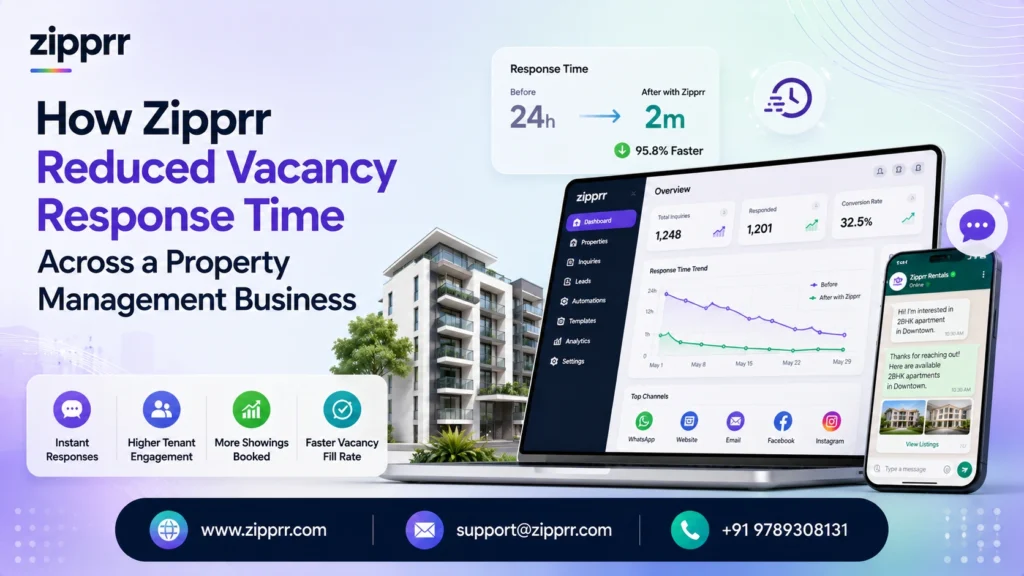
Response workflow: before and after Zipprr AI. Before: After (with Zipprr AI): First response ~60 minutes; under 10 seconds. After-hours response: next business day; immediate. Follow-up consistency: Manual, easily missed; 100% automated. Viewing scheduling: Manual emails; automatic booking. Tenant screening: Human decision; human decision (unchanged). Illustrative workflow changes, not revenue figures.
| Metric | Before | After |
|---|---|---|
| First response | ~60 minutes | Under 10 seconds |
| After-hours response | Next business day | Immediate |
| Follow-up consistency | Manual, easily missed | 100% automated |
| Viewing scheduling | Manual emails | Automatic booking |
| Tenant screening | Human decision | Human decision (unchanged) |
These are workflow improvements, not conversion or revenue figures; those stay the firm’s own numbers to measure. The clearest result was not on a dashboard anyway. It was the leasing coordinator telling us, a few weeks in, that Monday mornings no longer started with an apology backlog. The renters who used to wait an hour now had an answer and often a booked viewing before she sat down, and the ones who went quiet got their one reminder without her having to remember it. Her day moved from chasing to hosting.
We were careful about what we claimed on return. A first response that used to take an hour now went out in seconds, and a follow-up that used to be hit-or-miss now happened every time, but the exact lift in booked viewings and the change in days-to-lease are the firm’s numbers to measure, not ours to invent. We left the hard figures to Kestrel’s own records and told them precisely which to watch so they could judge the payback themselves.
What the firm is now tracking (its own numbers, to be measured in its own books):
- Time to first response, by channel
- Share of inquiries that book a viewing
- Follow-up reply rate
- Average days a unit stays vacant
The one number the owner cared about most was simpler than any of those: whether the same team could fill more units without adding headcount. Early on, the answer was starting to look like yes, and he was watching it in his own books.
More importantly, the project shifted the team’s time from triaging a backlog toward the parts of leasing that actually need a person, showing units, screening applicants, and closing tenancies.
What we would do differently
Two things. We would instrument the funnel before launch, not after. We could measure time-to-first-response from day one, but the follow-up reply rate, the number that told us whether the second touch was landing, we started tracking a week late, and that week was a week of guessing. If the second touch is where the growth is, measure it from the first hour.
And we would test the follow-up cadence on a tiny group before turning it on broadly. The too-eager sequence reached real renters before we caught it. A day of testing with a handful of internal contacts would have surfaced the pushiness without anyone outside the firm ever feeling it. When the thing you are automating is a message a customer receives, the cost of an over-aggressive default is paid in goodwill, and goodwill is the whole point of following up.
Frequently Asked Questions
Does the assistant screen tenants or decide who gets approved?
What happens to inquiries that come in after hours?
Will it replace our leasing team?
How does it avoid giving renters wrong information?
Do we own it, and is it subscription-based?
What happens after purchase?
What if the follow-up needs adjusting after launch?
What is property management AI?
Can AI respond to rental inquiries automatically?
How fast can AI respond to a rental inquiry?
Does property management AI replace leasing agents?
Can a property management chatbot work after hours?
What is rental inquiry automation?
Rental inquiry automation is using software to instantly answer, qualify, and follow up on rental inquiries across channels, so no lead waits for a manual reply.
Does AI handle tenant screening?
No, and it should not. Screening, eligibility, and selection stay with staff under fair-housing rules; the AI only handles response, routine questions, and follow-up.
How does AI follow up with renters?
Can AI book property viewings?
Does an AI leasing assistant integrate with a CRM?
How does AI avoid giving renters wrong information?
Is property management automation compliant with fair housing?
What channels can an AI leasing assistant cover?
How long does it take to set up property management AI?
Do you own the software or rent it?
Project snapshot
Lessons learned
- Find the leak before you build; the second touch mattered more than the first.
- Keep screening and selection with people; automate the response, not the decision.
- Ground every factual answer in live listing data.
- Follow-up is a courtesy, not a campaign; tune the cadence gently.
- Instrument the funnel from day one, especially the follow-up reply rate.
For Kestrel, the biggest improvement was not replacing the leasing team. It was making sure every serious renter received a timely response and consistent follow-up, so the team could spend more time leasing homes instead of chasing inquiries.
Ready to Reduce Vacancy Response Time Across Your Property Management Business?
Every property management company has different inquiry volumes, workflows, and leasing processes. That is why every Zipprr implementation is customized around your existing systems instead of replacing them.
Whether you manage 50 rental units or several thousand, the biggest opportunity is usually not finding more leads, it is responding to every inquiry before someone else does. Book a free workflow review and we will map your current inquiry flow, identify where response delays occur, and show exactly where Zipprr AI Chat and WhatsApp Automation fit, using your own listings and processes.
- Explore AI Chat -> Zipprr AI Chat
- Explore WhatsApp Automation -> WhatsApp Automation
- Explore our property management platform -> property management software
- View more client stories -> Zipprr Client Stories
Future enhancements (candidates, not commitments)
- A light funnel view (time to first response, viewing-booking rate, follow-up reply rate, days vacant) so the firm can measure payback in its own numbers.
- Deeper listing-specific answers as new question patterns recur.
- Only with careful review, gentle re-engagement of past inquiries when a matching unit comes available.