

An Airbnb clone script is pre-built vacation rental marketplace software you license and customize, typically launching in 4–8 weeks for a few thousand dollars. Building from scratch means writing every feature, booking engine, payments, host/guest dashboards, from zero, usually taking 6–12+ months and costing $20,000–$150,000 or more. The right choice depends on your timeline, budget, need for source-code ownership, and how differentiated your marketplace model needs to be from day one.
Two founders can start with the identical idea, a vacation rental marketplace for a niche nobody else is serving well, and end up eighteen months apart in market entry, simply because of one decision made in week one. That decision isn’t the niche, the branding, or even the funding. It’s whether to build the underlying marketplace software from scratch or start from an existing Airbnb clone script and customize it.
This isn’t a trivial technical detail buried in a vendor contract. It is, in practical terms, the decision that determines whether a founder is testing their business model with real hosts and guests by the end of the quarter, or still reviewing wireframes with a development agency while a better-funded competitor claims the niche. Yet most of the content available on this question comes from one of two biased sources: script vendors who obviously want you to buy a script, or development agencies who obviously want you to sell you months of custom engineering. Neither side is lying, exactly, but neither is giving you the full picture either.
This guide takes neither side. It lays out what an Airbnb clone script actually is, what building from scratch actually involves, where the real costs and risks sit in each path, and gives you a structured way to decide, using your specific constraints, not a vendor’s sales script.
Executive Summary
The vacation rental market is projected to reach roughly $106.45 billion globally in 2026, growing at a 3.7% compound annual rate through 2033, according to Grand View Research. Airbnb alone reports more than 9 million active listings and 5 million hosts. That scale creates genuine opportunity for niche and regional players, but it also means new entrants need to move fast enough to matter before a category gets crowded.
An Airbnb clone script, pre-built vacation rental marketplace software covering listings, booking, payments, and host/guest dashboards, lets a founder launch in weeks rather than months, at a fraction of custom-build cost. Building from scratch offers full architectural control and no dependency on a vendor’s roadmap, but it multiplies both cost and time-to-market, and shifts significant execution risk onto a team that may never have built a two-sided marketplace before. Neither option is universally “better.” The right call depends on runway, technical differentiation needs, and how much of your total budget you can afford to spend before a single booking happens.
Industry Overview: Why This Decision Matters More in 2026
Short-term rental supply growth is slowing in several major regions, StayFi’s 2026 data shows Asia-Pacific supply growth falling from 21.7% to 10.4% year-over-year, and Europe from 13.9% to 7.0%. That’s not a sign the category is dying; it’s a sign the easy, generic land-grab phase is ending. What’s still growing is demand for differentiated experiences: 62% of Gen Z travelers and 60% of Millennials say they prefer vacation rentals over hotels, according to the same research, and direct bookings are outperforming OTA bookings on both stay length and booking-window metrics. That combination, slowing generic supply growth, strong demand for niche and direct-booking experiences, is precisely the environment where a well-targeted new marketplace can still win, provided it launches fast enough to matter.
At the same time, 61% of vacation rental operators report using AI in their operations as of 2025, and 70% now maintain a direct-booking website, per StayFi. Guests and hosts increasingly expect the baseline features that mechanism provides, instant messaging, automated confirmations, dynamic pricing, as table stakes rather than differentiators. That raises the floor for what any new entrant, script-based or custom-built, needs to ship on day one just to be competitive, which is exactly why the build-versus-buy decision carries more weight than it did five years ago.
The Problem: Why This Decision Gets Made Badly
Most founders don’t actually weigh build-versus-buy on the merits. They default to one path based on who they happen to be talking to. A founder with a technical co-founder tends to default toward building from scratch, because that’s the option their team is comfortable executing, regardless of whether it’s the right call for the business timeline. A founder who gets a warm introduction to a script vendor tends to default toward licensing, sometimes without checking whether the script actually supports the specific rental category, glamping, extended-stay corporate housing, boat rentals, they’re targeting.
Both defaults skip the actual analysis. And the cost of skipping it is rarely visible until month four or five, when a custom build is still missing basic trust features that competitors shipped on day one, or when a script-based launch hits a wall because the platform can’t support a pricing model the business actually needs.
The honest starting point is recognizing that this is a resource-allocation decision, not a technology decision. Every dollar and month spent on the underlying software is a dollar and month not spent on host acquisition, guest marketing, or the operational work of making a two-sided marketplace actually work. Getting that allocation right matters more than almost any other early decision a vacation rental startup makes.
What Is an Airbnb Clone Script?
An Airbnb clone script is a pre-built software platform that replicates the core functional architecture of a vacation rental marketplace, the parts that are functionally identical across almost every rental business regardless of niche. That includes a listing creation and search system, a booking engine with calendar and availability logic, payment processing with host payouts and platform commission, host and guest dashboards, review and rating systems, and an admin panel for managing users, disputes, and payouts.
The word “clone” is a slightly misleading holdover from earlier eras of this software category. A modern platform like Zipprr’s Airbnb Clone script isn’t a copy of Airbnb’s interface, it’s original software built around the same proven marketplace mechanics, which you then brand, configure, and extend for your specific niche. Think of it less as cloning a car’s paint job and more as starting from a certified engine and chassis that already passed every safety test, so your team’s time goes into the interior, the trim, and the features that make your specific model stand out, not into reinventing brakes.
That distinction matters because it changes what “customization” means. You are not locked into an identical copy of a generic marketplace. You’re choosing which pre-built, battle-tested components to keep, which to reconfigure, and where to bolt on category-specific logic, say, boat-specific safety certifications for a marine rental marketplace, or corporate billing workflows for extended-stay housing.
What Does "Building From Scratch" Actually Involve?
Building a vacation rental marketplace from zero means every one of those components, search, booking logic, payment orchestration, trust and safety, dispute handling, gets specified, designed, coded, tested, and hardened by your own team or agency, with no existing foundation to build on. This is a materially different undertaking than building a single-sided app or a content website, because a marketplace has to work correctly for two different user types with opposing incentives at the same time, plus a third internal user (your ops team) who needs visibility into both sides.
Concretely, a from-scratch build typically requires: a booking and availability engine that prevents double-bookings across time zones and calendar sync sources; a payment layer that can hold guest funds, release them to hosts on a schedule, handle refunds and disputes, and stay compliant with financial regulations in every market you operate in; identity verification and trust signals strong enough that strangers feel safe transacting; a review system resistant to manipulation; an admin layer giving your team the tools to intervene when something goes wrong; and infrastructure that scales as booking volume grows without falling over during a seasonal spike.
None of that is exotic technology, it’s well understood engineering. But “well understood” doesn’t mean “fast” or “cheap.” It means a competent team, given enough time and budget, can build it correctly. The real question a founder needs to answer isn’t “can this be built,” it’s “should my specific business be the one spending its runway building it, instead of buying a working version and spending that same runway on the market.”
The Three Foundations Framework for Deciding
Rather than treating this as a single build-versus-buy question, it helps to break the decision into three separate foundations, each of which can independently point you toward a script or toward custom development. We call this the Three Foundations Framework, and it’s a useful mental model precisely because these three foundations don’t always agree with each other, which is exactly why founders get stuck.
Foundation One: Trust
How much of your competitive advantage depends on marketplace mechanics that don’t exist anywhere yet? If your innovation is genuinely in the transaction model itself, a fundamentally new payment structure, an entirely new trust mechanism no platform has implemented, a script built around conventional mechanics may fight you. If your innovation is in the niche, the curation, the community, or the service layer wrapped around a conventional booking flow, a script’s proven trust mechanics are an asset, not a limitation.
Foundation Two: Time
How much does being first, or being fast, actually matter for this specific niche? A category with low competitive intensity and slow-moving incumbents can absorb a longer build timeline. A category where two or three other founders are visibly moving on the same idea right now cannot. Time-to-first-booking is the metric that matters, not time-to-code-complete, because a marketplace with zero listings and zero guests, however well engineered, produces zero revenue and zero learning.
Foundation Three: Total Cost
This is not just development cost. It’s development cost plus the opportunity cost of the runway consumed before you can validate demand. A $60,000 custom build that takes eight months delays your first real signal about whether hosts and guests actually want this marketplace by eight months. A $3,000–$15,000 script-based launch that takes six weeks gives you that signal in six weeks, and if the signal is bad, you’ve preserved most of your capital to pivot.
Score your situation against all three foundations honestly. Most early-stage vacation rental founders land on “script” for at least two of the three. The exceptions are usually well-funded teams with a genuinely novel transaction model and a multi-year runway to prove it out, a small minority of the market, though a real one.
Feature-by-Feature Comparison
| Capability | Airbnb Clone Script | Building From Scratch |
|---|---|---|
| Listing management & search | Included, ready to configure | Must be designed, built, and tested |
| Booking engine & calendar sync | Included, proven logic | Built from zero, higher bug risk early on |
| Payments, payouts & commission | Pre-integrated with major processors | Requires custom integration and compliance work |
| Host and guest dashboards | Ready, brandable | Fully custom design and build |
| Admin & dispute management | Included | Must be specified and built |
| Mobile apps (iOS/Android) | Often included or low-cost add-on | Separate project, separate cost |
| Source code ownership | Varies by vendor license (Zipprr includes full open source code as standard) | Full ownership by default |
| Category-specific customization | Configurable within platform architecture | Unlimited, but self-funded |
| Time to first booking | Typically 3-7 days | Typically 6–12+ months |
| Ongoing maintenance | Often vendor-supported | Fully owned by your team |
Cost Comparison: What Each Path Really Costs in 2026
Published figures for Airbnb clone development vary widely because “clone” covers everything from a bare-bones white-label package to a heavily customized enterprise deployment. Based on current market pricing research, white-label vacation rental platforms commonly start in the range of roughly $999–$3,000 for a base license, with customized marketplace builds on top of a script typically running $2,000–$15,000 depending on branding depth, feature additions, and mobile app requirements. Fully custom development from zero commonly runs $20,000–$50,000 for an MVP and considerably more, often well past $100,000, for a feature-complete, multi-market platform with native mobile apps and enterprise-grade payment infrastructure.
| Cost Factor | Script-Based Launch | Custom Build |
|---|---|---|
| Base platform license / MVP build | $999 – $15,000 | $20,000 – $50,000+ |
| Native mobile apps | Often included or low add-on cost | $15,000 – $40,000 separately |
| Payment integration & compliance | Pre-built, included | $5,000 – $20,000+ |
| QA and security hardening | Vendor-tested baseline | Fully self-funded |
| Ongoing updates | Often included in license/support | Ongoing engineering payroll |
| Typical total to first booking | $3,000 – $20,000 | $40,000 – $150,000+ |
| Zipprr's Airbnb Clone specifically | $490 one-time purchase, 90 days free support, open source code included | Not applicable |
These are market-observed ranges, not guaranteed quotes, actual pricing depends heavily on the specific vendor, feature scope, and region. Any founder evaluating a script should request an itemized quote rather than relying on a single advertised starting price, since add-ons for mobile apps, multi-language support, and advanced payment routing are frequently priced separately.
As a concrete reference point inside that range, Zipprr’s Airbnb Clone is available for a one-time purchase of $490, which includes 90 days of free support and full open source code, so founders aren’t stuck with a hosted, closed-off license they can never fully own or migrate away from.
Timeline Comparison
| Phase | Script-Based Launch | Custom Build |
|---|---|---|
| Requirements & branding | 1–2 weeks | 3–6 weeks |
| Core platform setup | 2–3 weeks | 4–8 months |
| Payment & compliance integration | 1–2 weeks (largely pre-built) | 1–3 months |
| QA & testing | 1–2 weeks | 1–2 months |
| Launch-ready | 4–8 weeks total | 6–12+ months total |
A Tale of Two Founders: Illustrative Scenario
Consider two hypothetical founders, call them the Builder and the Configurer, who both start, on the same day, with the same idea: a vacation rental marketplace focused on pet-friendly stays, a segment where StayFi’s 2026 research shows pet-friendly listings command an average daily rate roughly $17 higher than comparable non-pet-friendly units: same idea, same market opportunity, same starting capital of roughly $40,000.
The Builder hires a development agency to write the platform from scratch, wanting full control over a proprietary pet-verification feature. By month three, the team is still finalizing the booking engine and payment integration. By month six, mobile apps are in progress, and the budget is nearly exhausted. By month eight, the platform launches, technically sound, but with zero hosts recruited during the build phase because there was nothing live to show them, and with no real signal yet on whether pet owners actually prefer this marketplace over general platforms.
The Configurer licenses a vacation rental clone script, spends two weeks on branding and category-specific fields for pet policies and verification, and launches in week six. By month three, while the Builder is still mid-development, the Configurer has forty listings, real booking data, and has already learned that guests care more about a clear pet-fee disclosure than about the verification feature the Builder is still building. The Configurer uses remaining budget to fund host incentives and marketing instead of engineering, and by month eight has an operating, revenue-generating business with real usage data to raise a seed round against.
Neither founder made a bad decision in isolation, the Builder’s platform, once finished, may well be more differentiated. But the Configurer got the thing that matters most at this stage: a live market test, months earlier, at a fraction of the capital burn. This is the pattern that shows up repeatedly across marketplace startups, regardless of vertical: speed to real usage data usually beats architectural purity in the first year.
Industry Use Cases
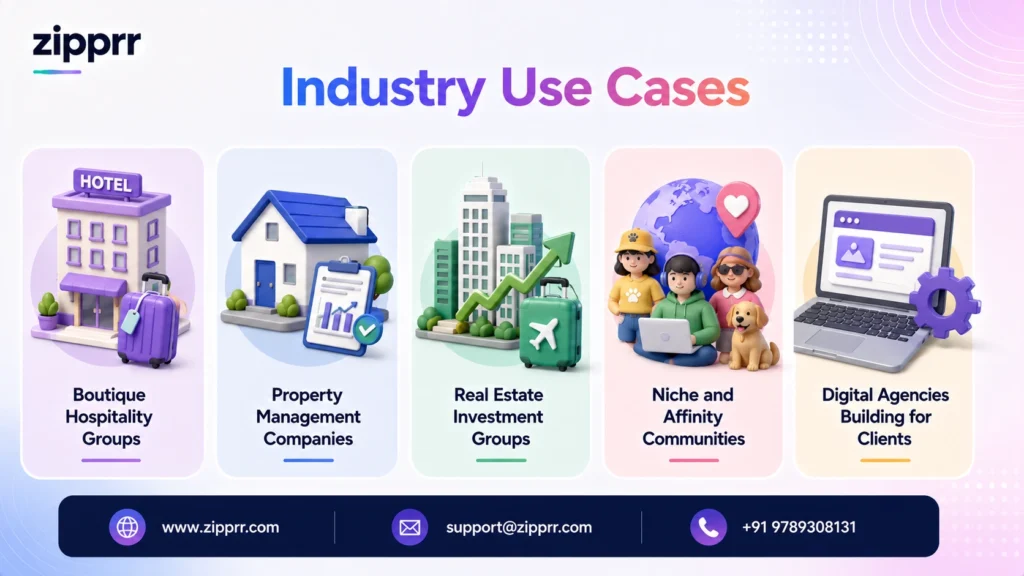
Boutique Hospitality Groups
A regional hotel group expanding into home-share inventory can use a clone script to launch a branded booking layer for its network of managed properties without building a booking engine from zero, going live in time for a single peak season rather than missing it entirely.
Property Management Companies
Property managers overseeing dozens of owner-held units can white-label a script into an owner-branded booking portal, giving property owners direct visibility into occupancy and payouts, a feature guests and owners increasingly expect given that StayFi’s research shows 70% of operators now maintain direct-booking websites. Many pair this with a tool like Zipprr’s AI Chat software so guest questions about check-in, amenities, and house rules get answered instantly instead of piling up in a shared inbox.
Real Estate Investment Groups
Investors consolidating short-term rental units under a single brand can launch a unified marketplace across their portfolio faster on a script, standardizing the guest experience across properties acquired from different previous operators. Some also extend the guest experience with an on-demand transportation add-on, using a platform like Zipprr’s Uber Clone to offer airport transfers alongside the stay itself.
Niche and Affinity Communities
Founders targeting a specific traveler segment, pet owners, remote workers needing month-long stays, accessibility-focused travelers, can validate a niche audience quickly on a script before deciding whether the niche justifies deeper custom investment later.
Digital Agencies Building for Clients
Agencies delivering marketplace projects for hospitality clients can use a script as a foundation to hit client deadlines and budgets that a from-scratch build would blow past, while still delivering meaningful brand and feature customization.
Core Benefits of a Faster Path to Market
Speed is not just a convenience in a two-sided marketplace; it compounds. Every host who lists early becomes a source of reviews, listing inventory, and word-of-mouth for the guests who arrive later. Every guest who books early generates the transaction data that tells a founder which pricing model, which cancellation policy, and which trust features actually matter to the specific niche being served. A marketplace that launches six months later than it could have doesn’t just lose six months of revenue; it loses six months of compounding network effects that a competitor may be busy building instead.
Beyond speed, a proven platform foundation typically brings four concrete benefits that matter to a founder’s day-to-day operations: predictable maintenance costs instead of an open-ended engineering budget, security and payment compliance work that’s already been tested against real transaction volume, a support relationship with a vendor who has seen similar launches before, and the ability to reallocate saved engineering budget directly into host recruitment and guest acquisition, the two activities that actually determine whether a marketplace succeeds.
Challenges of Each Approach, and How to Solve Them
Neither path is challenge-free, and pretending otherwise does founders a disservice. The real work is matching the right mitigation to the right challenge.
Challenge: A script doesn’t natively support one niche-specific feature
Solution: Confirm during vendor evaluation, not after purchase, whether the platform architecture allows custom modules or API extensions. Most modern marketplace scripts, including Zipprr’s, are built with configuration layers precisely so category-specific logic, deposit holds for high-value equipment, multi-night minimum stays for corporate housing, can be added without a full rebuild.
Challenge: A custom build’s payment compliance work balloons past initial estimates
Solution: Scope payment and compliance work as its own line item with its own specialist review before committing to a from-scratch timeline, rather than folding it into general engineering estimates where it’s most likely to be underestimated.
Challenge: Founders can’t tell if a script vendor’s demo reflects real production performance
Solution: Ask for references from live customers running comparable transaction volume, and request access to a working sandbox rather than a scripted product walkthrough.
Challenge: A custom-built team has never shipped a two-sided marketplace before
Solution: Either bring in a technical advisor with specific marketplace experience before committing to a from-scratch timeline, or treat that inexperience itself as a strong signal to start from a proven script instead.
Pros and Cons of Each Approach
| Approach | Pros | Cons |
|---|---|---|
| Airbnb Clone Script | Fast launch, lower upfront cost, proven trust mechanics, often includes mobile apps and support | Some architectural constraints, licensing terms vary by vendor, less suited to truly novel transaction models |
| Building From Scratch | Full architectural control, complete source ownership, no ceiling on customization | High cost, long timeline, higher execution risk, delayed market validation |
Decision Matrix: Which Path Fits Your Situation
| Your Situation | Recommended Path |
|---|---|
| Need to validate demand within 2–3 months | Clone script |
| Budget under $25,000 for the platform | Clone script |
| Core differentiation is niche/curation, not transaction mechanics | Clone script |
| Genuinely novel payment or trust model as the core IP | Custom build |
| Well-funded, multi-year runway, enterprise-scale ambitions from day one | Custom build (or script now, rebuild later) |
| Agency delivering to a client deadline | Clone script |
Implementation Guide: Launching on a Clone Script
A structured rollout matters more than the platform choice itself. A reasonable sequence: first, define your niche and non-negotiable category-specific features (pet verification, corporate billing, marine safety documentation, whatever applies) before evaluating vendors, so you’re scoring platforms against your actual requirements rather than a generic feature list. Second, request a working demo and test the exact booking and payout flow a guest and host would experience, not just a marketing walkthrough.
Third, confirm payment processor coverage for every country or currency you plan to operate in from day one. Fourth, plan branding and configuration work in parallel with host outreach, so your first cohort of hosts is ready to list the day the platform goes live rather than after. Fifth, run a soft launch with a small, motivated group of hosts before a public marketing push, so early bugs surface with a forgiving audience. Many operators also automate confirmations and check-in instructions at this stage using something like Zipprr’s WhatsApp Automation software, so guests get booking details somewhere they’ll actually read them.
Pricing Considerations and ROI
The ROI calculation for a script-based launch centers on time value: every month saved in development is a month of potential revenue and learning gained instead of spent. If a niche vacation rental marketplace can plausibly generate even modest commission revenue per month once live, say low four figures early on, the six-to-nine month head start a script provides can be worth far more than the license fee difference between a script and a partial custom build. The counter-consideration is licensing terms: some clone vendors charge ongoing fees or take a percentage that a fully-owned custom platform would not, so founders should model total three-year cost, not just launch cost, before deciding.
Common Mistakes Founders Make
The most frequent mistake is choosing a development path before defining the niche clearly enough to know which features are actually required, leading to a script that lacks a critical category-specific feature, or a custom build that spends months on generic functionality a script would have provided for free. A second common mistake is underestimating payment compliance work in a custom build, since guest funds, host payouts, tax reporting, and multi-currency support carry real regulatory weight that inexperienced teams frequently discover late.
A third is over-customizing a script immediately, effectively recreating the cost and timeline of a custom build while still paying license fees, defeating the purpose of choosing a script in the first place. A fourth is neglecting host-side trust features in the rush to launch, when in a two-sided marketplace, host trust in getting paid reliably matters just as much as guest trust in property quality. A fifth, easy to overlook, is treating host agreements and rental terms as boilerplate; a tool like Zipprr’s AI Lawyer can generate and review those contracts for each niche’s specific needs instead of reusing a generic template that skips category-specific liability language.
Expert Recommendations
Buyer's Checklist Before You Commit
- Does the vendor provide a live, testable demo of the full booking and payout flow?
- Are payment processors supported in every market you plan to launch in?
- Is source code access or ownership included, or only a hosted license?
- Can the platform support your specific category’s non-negotiable features?
- What is included in ongoing support, and what costs extra?
- Are mobile apps included, or a separate line item?
- What does the vendor’s update and security patch cadence look like?
- Can you export your data if you later migrate off the platform?
Why Founders Choose Zipprr's Airbnb Clone
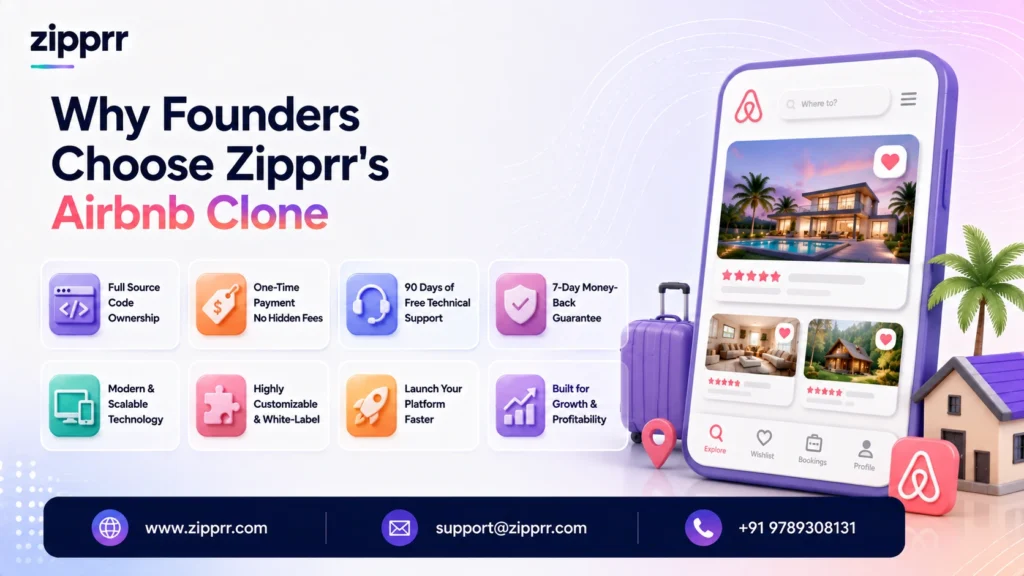
Zipprr’s Airbnb Clone script is built specifically to close the gap this guide has been describing, giving founders a proven booking engine, payment infrastructure, and host/guest dashboard system out of the box, while leaving real room to configure category-specific features for your niche. It’s priced as a one-time purchase of $490, comes with 90 days of free support built in, and includes full open source code, so there’s no ongoing license fee eating into commission revenue and no vendor lock-in if a founder later wants to extend or migrate the platform themselves.
Conclusion
The build-versus-buy decision for a vacation rental marketplace isn’t really about technology preference, it’s about which resource you can least afford to spend carelessly: time, capital, or architectural flexibility. Most founders, especially those testing a new niche without years of guaranteed runway, get more value from spending their scarce early capital on host acquisition and guest demand than on re-engineering commodity marketplace infrastructure a script already provides. The founders who move fastest in this market aren’t always the ones with the most original code, they’re the ones who got real bookings, real data, and real revenue in front of them soonest, and used that evidence to decide where custom investment actually pays off.
If you're weighing an Airbnb clone script against a custom build for your own vacation rental idea
the fastest way to get a real answer is to see the platform working end-to-end rather than reading another comparison. Explore Zipprr’s Airbnb Clone script and request a live demo to test the exact booking, payment, and host management flow your guests and hosts would experience from week one.