
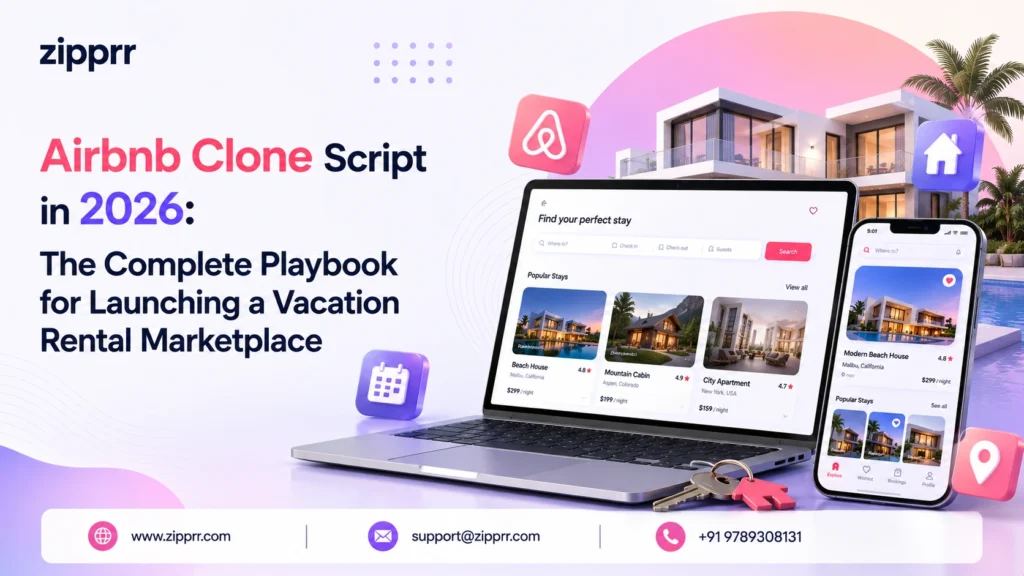
Quick answer: An Airbnb clone script is ready-made, customizable source code for a vacation-rental marketplace, hosts list properties, guests search, book and pay, and you collect a commission on every stay. It replaces a $50,000–$200,000 custom build with a one-time license, and with Zipprr you get full open-source code starting at just $490. Success then depends on solving the cold-start supply problem, building trust and safety, respecting local rental law, and marketing hard enough to hit your first hundred bookings.
What an Airbnb clone script actually is
An Airbnb clone script is pre-built source code that reproduces the core mechanics of Airbnb, property listings, search, bookings, payments, messaging, and reviews, packaged so you can rebrand it and launch your own vacation-rental marketplace. “Clone” is a marketing word, not a legal one: you’re not copying Airbnb’s brand, content, or database. You’re buying a software foundation that follows the same proven marketplace pattern, then making it yours.
Think of it the way a restaurant owner thinks about a commercial kitchen. Nobody forges their own stainless steel, they buy proven equipment and pour their energy into the menu, the service, and the guests. A clone script is your commercial kitchen. The Zipprr Airbnb clone script ships as full open-source code, starting at just $490, on a React Native (mobile) and Laravel (backend) stack, which means you own it outright and can change anything once you know what your market needs.
The appeal is speed and cost. Building from scratch means designing the data model, writing a booking engine that never double-books, integrating payment gateways, building iOS and Android apps, and testing all of it, realistically 6 to 18 months and a large budget. A clone script compresses that into a license and a setup window measured in days.
How the marketplace works: hosts, guests, and admin
Every rental marketplace runs on three interlocking roles. Understanding them is the difference between “I bought software” and “I run a marketplace.”
The host experience
Hosts are your supply, and if you don’t make their life easy, you have no inventory. A good host flow lets someone list a property in minutes with photos, amenities, house rules, and a pricing calendar; set base, weekend and seasonal rates; sync availability so the calendar never double-books; accept, decline, or message guests before confirming; and see upcoming payouts and past earnings in one dashboard.
The guest experience
Guests are your demand. They need to find the right place fast and trust the checkout: smart search and filters, a map view, a clean multi-step booking with a transparent price breakdown, in-app messaging, a wishlist, a trip dashboard, and push notifications for every status change. Every extra tap between “I like this place” and “I paid” costs you money.
The admin (you)
The admin panel is your control tower and revenue lever. From it you set commission, verify hosts and listings, configure payment gateways, run coupons and referrals, edit homepage and SEO content, mediate disputes and refunds, switch currencies and languages, and watch analytics on listings, bookings, revenue, and conversion.
The feature set that matters (and the fluff that doesn't)
| Must have from day one | Nice, but not urgent |
|---|---|
| Reliable booking engine (no double-bookings) | VR / 3D property tours |
| Secure checkout + 2–3 payment gateways | A fifth payment gateway |
| Host & guest verification (KYC) | Blockchain "trustless" anything |
| In-app messaging | In-app video calling |
| Reviews & ratings | Loyalty points program |
| Availability calendar + iCal sync | Native smart-lock integrations |
| Mobile apps (iOS + Android) | Wearable / watch apps |
| Admin commission & payout controls | Multi-vendor ad marketplace |
Real costs: license vs. custom build vs. the hidden stuff
Layer 1, the platform. A custom build runs $50,000 to $200,000+. A source-code clone script is a one-time license; Zipprr’s Airbnb clone starts at just $490 for the Startup plan (and $890 for the Pro plan with multiple licenses), and every plan ships with the full open-source code so you own and control it completely.
Layer 2, the things everyone forgets. Hosting, a domain and SSL, ~3% payment-processing fees, app-store developer accounts, and, depending on market, compliance costs like GDPR, PCI DSS, and local short-term-rental law.
Layer 3, the cost that dwarfs the rest: acquisition. Getting hosts and guests onto the platform is where your real money goes. A cheap license with no marketing budget is a website nobody visits.
Rule of thumb: the license is the smallest line on your budget. Plan as if the software is free and the growth is expensive, because functionally, that’s true.
The 7 things nobody tells you
1. The cold-start problem: you launch with zero listings
A booking site with no properties is useless to guests; a site with no guests is useless to hosts. This chicken-and-egg trap kills more marketplaces than any technical failure. The fix is counterintuitive: ignore guests for the first 60 days and manufacture supply by hand. Pick one city or niche and personally onboard 30–50 hosts, call them, add their listings for them, waive commission for 90 days. Density in one zip code beats ten scattered listings.
2. Trust & safety is your real product
A stranger hands keys to another stranger, and a third stranger’s money sits in the middle. What you’re selling is trust that the transaction is safe. Build it in: ID/KYC verification, payments held in escrow and released after check-in, a clear cancellation and refund policy, a real dispute-resolution workflow, and an optional damage-protection add-on. One viral scam thread can erase six months of marketing.
3. Local rental law will find you
Short-term rentals are regulated city by city, registration numbers, night caps, tourist taxes, zoning limits. Your hosts can be fined and will blame your platform. Build permit and registration fields, auto-collect and remit local occupancy tax where it applies, and surface local rules during listing. Picking a friendlier regulatory market to launch in is a legitimate strategy.
4. The unit-economics math that tells you if this is a business
| Metric | Example |
|---|---|
| Average booking value | $220 |
| Your take rate (host + guest fee combined) | 14% → $30.80 |
| Payment processing (~3%) | –$6.60 |
| Net revenue per booking | ~$24 |
| Bookings needed to clear $5,000/month | ~210 / month (≈7/day) |
Your real goal was never “launch an app.” It’s “drive roughly seven completed bookings a day.” Knowing this before you build changes how much you’ll spend to acquire a customer and which niche is worth chasing.
5. Don’t clone Airbnb, out-niche it
You will not out-Airbnb Airbnb. You can dominate a slice they treat as an afterthought: pet-friendly cabins, film-shoot locations, monthly stays for remote workers, student housing, RV spots, or hostels. The same mechanics power different inventories, the identical codebase can become a hostel booking platform or a peer-to-peer car-rental marketplace by changing what gets listed, not how the platform works.
6. Channel sync: meet hosts where their calendar already lives
Your best hosts already list on Airbnb and Vrbo and dread double-bookings. If your platform imports their existing calendar via iCal and syncs availability both ways, you remove the number-one reason a host says no. This single integration does more for supply than any homepage redesign.
7. Your first 100 bookings come from marketing, not the app store
Early demand comes from local SEO (“weekend cabins near [city]”), useful destination guides, partnerships with local tourism pages, and referral credit for both host and guest. Retention beats acquisition, a guest who rebooks costs nothing, so build repeat-booking nudges, wishlists, and post-stay follow-ups from day one.
How you actually make money (with the math)
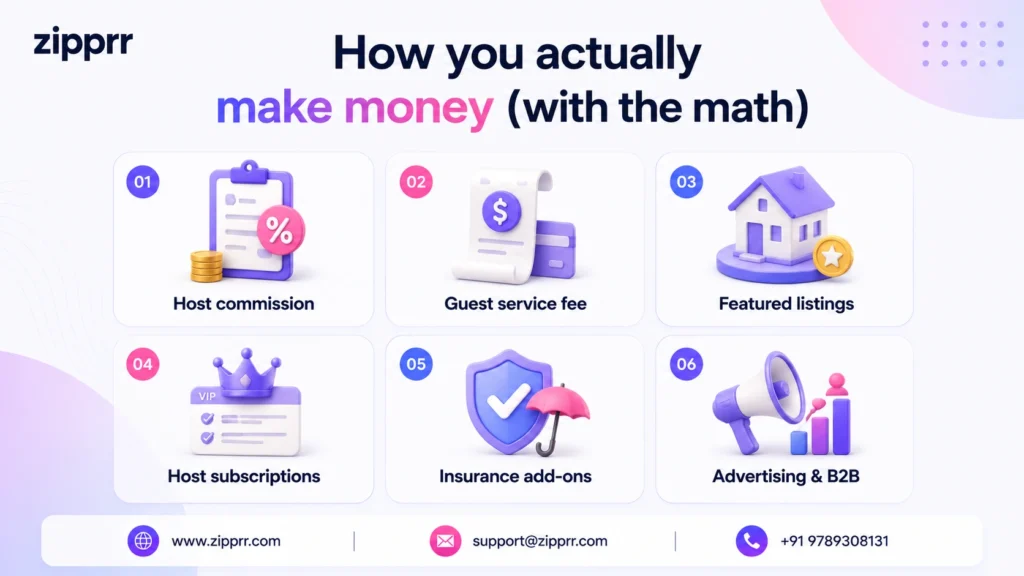
A clone script is a revenue engine only if you turn on the right streams. Most owners rely on one when three or four would compound:
- Host commission: a percentage of each booking, typically 3–15%, set in your admin panel.
- Guest service fee: a separate 5–12% at checkout, splitting fees keeps each side’s rate reasonable.
- Featured listings: hosts pay for premium placement. High-margin, scales with supply.
- Host subscriptions: tiered plans with lower commission, analytics, or priority support.
- Insurance add-ons: earn a referral cut on each policy sold at checkout.
- Advertising & B2B: sponsored placements and bulk deals with property managers as you scale.
Start with commission plus a guest fee, prove the model, then layer in the rest.
2026 AI features worth having (and the ones to skip)
Worth building: AI-assisted dynamic pricing that suggests nightly rates from demand and seasonality; an AI concierge that answers guest questions and drafts host replies; and semantic search that understands “quiet place for two near the beach” instead of rigid filters.
Worth skipping for now: anything that adds cost without moving bookings, VR tours, novelty chatbots, or over-engineered recommendations before you have data. Ship lean, add AI where it deletes manual work.
Buy a script, build custom, or go no-code?
| Path | Cost | Time to live | Best when |
|---|---|---|---|
| Custom build | $50k–$200k+ | 6–18 months | You're funded and your model is genuinely novel |
| No-code / template | Low, but capped | Days | Testing an idea, fine with limits & branding |
| Clone script (source code) | One-time license | Days–weeks | You want ownership + speed to validate for real |
For most founders, a source-code clone is the sensible middle: you own the code, launch in days, and keep freedom to customize. If your model outgrows short-term stays, the same foundation extends into full property rental management or a broader vacation rental app development roadmap without starting over.
Your 30-day launch checklist
- Days 1–3: Buy the script, set up hosting, install, confirm the booking flow works end to end.
- Days 4–7: Brand it, configure payment gateways and your commission structure.
- Days 8–20: Hand-recruit 30–50 hosts in one city or niche. Add their listings. Waive commission for 90 days.
- Days 21–25: Turn on trust features, verification, escrow release, refund policy, dispute workflow.
- Days 26–30: Launch local SEO pages and a destination guide, set up referral credit, open bookings.
See it before you build it
Walk through a live Airbnb clone with our team and get transparent pricing, from just $490 with full open-source code.
Frequently Asked Questions
What is an Airbnb clone script, in one sentence?
How much does an Airbnb clone script cost?
Is it legal to run an Airbnb-style platform?
How do I get listings when I'm brand new?
Do I need to be a developer to launch one?
How long does it take to go live after purchase?
How do I make money from the platform?
Can I customize and rebrand the script completely?
Can the same script be used for niches other than homes?
What's the biggest reason rental marketplaces fail, and how do I avoid it?
Ready to test the idea for real? Explore the Zipprr Airbnb Clone Script (from $490, full open-source code), or book a free demo to see the admin panel, host tools, and guest booking flow end to end.