

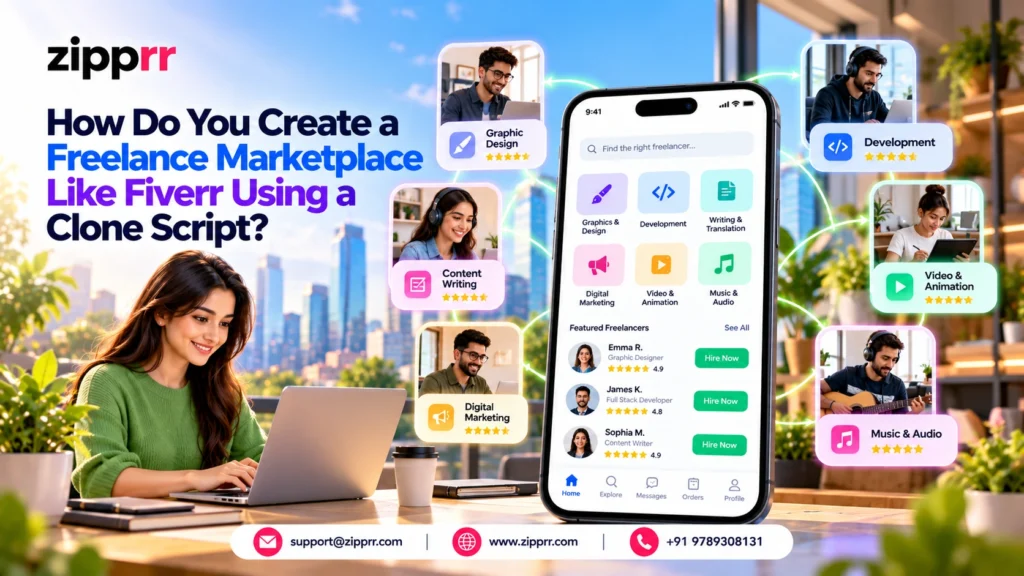
Launching a platform like this? Zipprr clone scripts start at $490 with 100% source code, a 7-day refund and 90 days of free support. Book a free demo or chat with us on WhatsApp.
You start by choosing one narrow niche, then install a ready-made Fiverr clone script and shape its rules around trust, not just features. A founder who tries to copy a giant platform feature for feature usually ends up with an empty site. A founder who serves one specific buyer, such as US small businesses that need website accessibility audits, can win the first 100 orders.
What is a Fiverr clone script?
A Fiverr clone script is ready-made marketplace software where sellers publish fixed-price services called gigs and buyers order them online. It already includes seller profiles, gig pages, checkout, order chat, reviews, wallet payments, disputes and an admin panel. You add your brand, your niche and your commission rules, then launch under your own domain.
Why does this matter in 2026? Upwork’s Freelance Forward research (2023) found that 64 million Americans freelanced that year. The World Bank’s report Working Without Borders (2023) estimated that online gig work involves roughly 4.4% to 12.5% of the global workforce. Demand is clearly there. The open question is who earns the trust of buyers in each niche.
How does a Fiverr clone work from the first click to the payout?
A Fiverr-style site moves every order through the same short path. Knowing the path helps you spot where trust can break.
Each step is a place where a niche site can beat a general one. A general site tells every buyer to “good luck”. A niche site can offer a promise, such as a fixed-scope audit with a clear report.
Should you build a broad or niche freelance marketplace?
Build a niche marketplace first. A broad site needs thousands of sellers before a buyer finds the right one. A niche site needs maybe fifty strong sellers to feel complete. Fewer sellers also means you can check each one by hand.
Use this four-gate niche test before you commit. If a niche fails two gates, pick another.
- Trust gate: Do buyers fear a bad result? Fear is what makes them pay for protection and verified sellers.
- Price gate: Is a typical job at least $100? Very cheap jobs cannot cover support and payment fees.
- Repeat gate: Will the same buyer need this again within a year? Repeat orders cut your marketing cost.
- Reach gate: Can you name ten places where both sellers and buyers already gather? If not, launch will be slow.
Key takeaway: A marketplace is not a feature list. It is a promise to one group of buyers. Pick the group, write the promise in one sentence, and make every rule support it.
Regulated or high-trust services often pass these gates well. Zipprr’s lawyer marketplace script shows how the same marketplace idea can be tuned for one profession.
Gig model or project model: which one fits your niche?
Choose the gig model when the work is standard and easy to price, such as logo design, audits or transcription. Choose the project model when every job is different and needs quotes. Zipprr sells these as two products. The gig model uses the Fiverr clone page. The bidding model uses the project-bidding freelancer script.
A quick rule works well:
- If a seller can list the price today, use gigs.
- If the seller must ask five questions before pricing, use projects.
- If both happen, start with gigs and add custom offers later.
Zipprr also published a longer comparison of how gig, bidding and hybrid freelance marketplaces differ. Read it if your niche sits between the two models.
How should escrow and payouts work on a freelance marketplace?
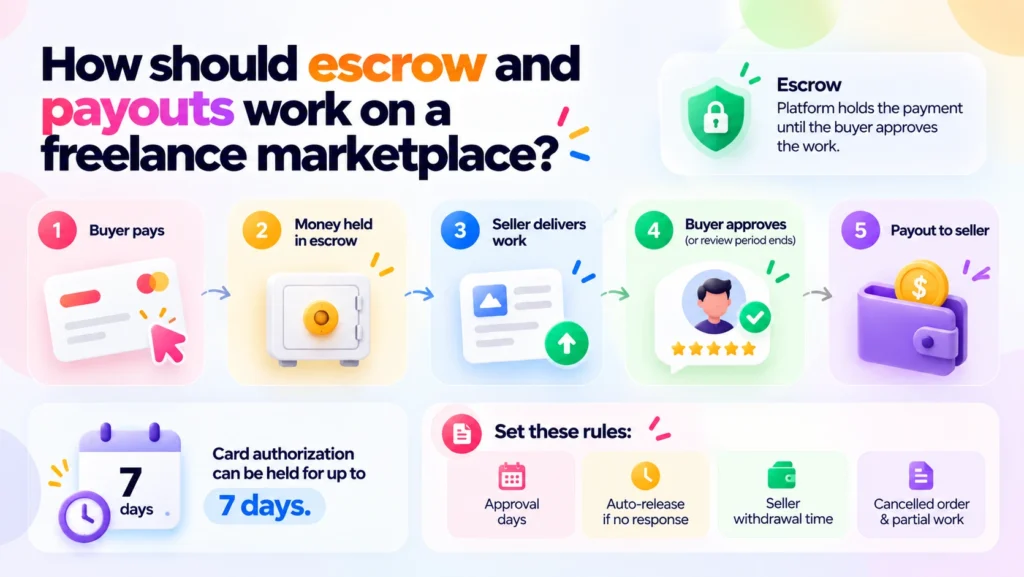
Escrow means the platform holds the buyer’s payment until the buyer approves the work or a set review window ends. This protects both sides. The buyer knows the money is safe. The seller knows the money exists. Zipprr’s Fiverr clone includes a native wallet with escrow and payouts through several gateways.
One technical detail trips up many founders. According to Stripe’s support documentation (2026), a card authorization can be held for up to 7 days. Longer jobs therefore need the payment captured and tracked inside a platform wallet. Talk to a payments or legal adviser in your country about money-handling rules before you go live.
Set these rules in writing on day one:
- How many days a buyer has to approve a delivery.
- When money auto-releases if the buyer stays silent.
- How long a seller waits before withdrawing.
- What happens to partial work on a cancelled order.
How do you handle disputes and revisions fairly?
Handle disputes with a fixed ladder: revision first, then a message-based mediation, then an admin decision with evidence. Most problems end at the first step. A clear ladder also protects you from angry emails, because every user can see the rules before ordering.
Define “done” for each gig type. For an audit, done may mean a report with a page list and fix priorities. For a design, done may mean two revisions and final files. Vague gigs create most disputes. Ask sellers to list what is included and what is not.
Keep all chat and files on the platform. Admin tools for refunds, dispute notes and moderation matter more than any fancy homepage feature.
How do you vet freelancers without slowing your launch?
Use a three-step vetting ladder instead of one strict gate. Step one is identity: collect KYC details through the admin panel. Step two is proof of skill: review a sample or a short paid test job. Step three is performance: promote sellers with good reviews and remove those with repeated complaints.
Early on, approve every seller by hand. It sounds slow, but fifty careful approvals build the quality that later brings buyers back. Later, you can add badges and levels so strong sellers stand out.
Smart matching can also help buyers find the right seller faster. Zipprr’s piece on AI-powered job matching in freelance apps explains where automation helps and where a human check still wins.
What features must a freelance marketplace have at launch?
The essential features of a gig marketplace are seller profiles, gig pages with tiers, search and filters, secure checkout with held funds, order chat, reviews, dispute tools, and an admin panel. Everything else can wait. Zipprr’s script covers these and adds buyer and seller dashboards, custom offers, promo codes and multi-language support.
Check this version-one list against any script you review:
- Gig builder with Basic, Standard and Premium tiers.
- Escrow-style wallet and scheduled payouts.
- Reviews tied to completed orders only.
- Seller identity checks and moderation.
- Commission and fee settings that you control.
- Source code you own, so you can change it later.
How does a website like Fiverr make money?
A gig marketplace earns mainly from a commission on each order. Many owners add a small buyer service fee, paid promotion for gigs, seller membership plans and payout fees. Start with one or two streams. Too many fees at launch scare away the first sellers you are working hard to win.
How much does a Fiverr clone cost, and how long does launch take?
Zipprr’s Fiverr clone is a one-time purchase: $490 for the standard plan, and $890 for the Pro plan. Mobile apps and app store submission belong to the Pro plan. Launch usually takes a few weeks, because the code already exists. A custom build usually takes months.
| Route | Typical upfront cost | Typical time to first live version | Code ownership |
|---|---|---|---|
| Zipprr Fiverr clone, standard plan | $490 one-time | A few weeks | You own the delivered source code |
| Zipprr Fiverr clone, Pro plan (adds mobile apps) | $890 one-time | A few weeks, plus app store review time | You own the delivered source code |
| Custom build by an agency (estimate) | Tens of thousands of dollars; quotes vary | Several months | Depends on contract |
| Subscription marketplace builder (estimate) | Monthly fee, rises with plan | Days to weeks | You rent, you do not own |
Remember that the script is only one cost. You will also pay for hosting, payment fees, marketing and support. The worked example below shows how those add up.
Want to see the admin panel before you decide?
Book the free demo at the end of this guide and ask to see the dispute tools and the payout settings. You will learn more in twenty minutes than from any feature list.
What does a niche marketplace earn? A worked example
Important: every number below is hypothetical. It is a planning model, not a forecast or a promise. Replace each figure with your own.
Imagine a marketplace for website accessibility audits, aimed at US small businesses. Assume these inputs by month six:
- 150 completed orders a month.
- Average order value of $300.
- Seller commission of 15%, plus a 5% buyer service fee.
- Payment processing of about 3% of the buyer’s total payment.
Here is the math:
- Order volume: 150 x $300 = $45,000.
- Platform revenue: $6,750 commission + $2,250 buyer fee = $9,000.
- Processing fees: about $1,400.
- Fixed costs (hypothetical): $2,500 marketing + $1,500 part-time support + $150 hosting and tools = $4,150.
- Monthly profit before tax: about $3,450.
Break-even sits near 82 orders a month, because each order leaves about $50 after processing. If your niche cannot realistically reach that number, change the niche or the pricing before you launch.
What should your launch week look like?
Treat launch as seller recruiting first and buyer marketing second. Here is a simple seven-day plan.
For the growth stage that follows, see Zipprr’s go-to-market playbook for two-sided freelance marketplaces.
Which mistakes do first-time marketplace owners make?
- They launch too broad, so no buyer finds a complete choice.
- They invite buyers before sellers are ready.
- They skip a written dispute policy.
- They charge high fees before they have proven value.
- They allow reviews without a completed order.
- They forget local taxes and payout rules.
- They budget for the script but not for support and marketing.
What red flags should you watch for when choosing a script vendor?
- No live demo of the admin panel.
- No clear statement of what is included in each plan.
- Encrypted code that you cannot change.
- No refund window or support period in writing.
- Pricing that changes after you ask about apps or installation.
- Promises of guaranteed users or income.
Who should buy a Fiverr clone script, and who should not?
It suits you if: you have a niche in mind, you can recruit your first sellers, and you want to own your platform instead of renting it. The one-time price is $490 or $890, and Zipprr adds installation, 90 days of support and lifetime updates according to the live product page. A 7-day refund policy covers clone scripts.
It does not suit you if: you need a heavily unique product with custom workflows from day one. In that case, custom freelance marketplace development may fit better. It also does not suit you if you cannot recruit sellers or have no plan for buyers. Software cannot fix that.
Worried about timeline or support? Ask for a written scope before you pay. A good vendor answers in plain words.
Decision checklist: are you ready to launch?
Answer yes or no. Five yeses mean you are ready to book a demo.
- I can describe my buyer and my promise in one sentence.
- My niche passes at least three of the four gates.
- I chose gig or project pricing on purpose.
- My escrow release and dispute rules are written down.
- I know where my first 20 sellers will come from.
- I have a monthly budget for support and marketing.
- I checked payment and tax rules for my country.
Free launch checklist: ask for Zipprr’s free marketplace launch checklist when you book your demo, and we will send it with your confirmation.
Frequently Asked Questions
1. Is a Fiverr clone script worth it?
It is worth it when you have a niche and a plan to recruit sellers. The script saves months of development and gives you proven marketplace basics. It is not worth it if you expect software alone to produce buyers. Plan time and budget for marketing, support and seller outreach.
2. How much does it cost to build a freelance marketplace like Fiverr?
With Zipprr, the script costs $490 one-time, or $890 for the Pro plan that includes mobile apps. Custom development usually costs far more, with agency quotes often in the tens of thousands of dollars. Also budget for hosting, payment fees, marketing and support after launch.
3. How long does it take to build a freelance marketplace?
A ready-made script usually goes live within a few weeks, including setup and branding. A custom build often takes several months. Apps add store review time. Your real timeline depends more on seller recruiting and content than on code, so start that work early.
4. Can I compete with Fiverr by focusing on a niche?
Yes, but only by being better at one thing. Compete on trust, vetting and clear scope for a single buyer group. Do not compete on size. A small marketplace where every seller is checked can beat a huge site where quality varies.
5. Should I build a general or niche freelance marketplace?
Build a niche marketplace first. It needs fewer sellers to feel complete, and you can check each seller by hand. You can widen to nearby categories once you see steady repeat orders. Starting broad usually leads to thin choice and low buyer trust.
6. How does a website like Fiverr make money?
Most earn a commission on every completed order. Some also charge a buyer service fee, sell promoted gig spots, offer seller memberships or take small payout fees. Begin with commission and perhaps one fee. Add more only after sellers see clear value.
7. What features are essential for a gig-based marketplace?
You need seller profiles, tiered gig pages, search, secure checkout with held funds, order chat, reviews, dispute tools and an admin panel. Add identity checks and commission controls early. Extras like analytics, referrals and promo codes can follow once real orders start.
8. How do I attract freelancers before launch?
Recruit by hand in communities where your niche already gathers. Offer early sellers zero or low commission for a set period, help them build strong gigs, and feature them at launch. Quality beats quantity, so start with twenty good sellers, not two hundred weak ones.
9. What is the biggest risk when launching a Fiverr clone?
The biggest risk is an empty marketplace: buyers arrive, find few good sellers, and leave. Fix it by recruiting sellers first, limiting your niche and approving gigs by hand. Weak dispute rules are the second risk, so write them before the first order.
10. What is the difference between a Fiverr clone and a Freelancer clone?
A Fiverr clone is gig-based: sellers list fixed-price services and buyers order directly. A Freelancer clone is project-based: buyers post jobs and freelancers send proposals. Pick gigs for standard services and projects for custom work.
About Zipprr
Zipprr has built white-label clone scripts since 2020. Its Fiverr clone includes a gig builder, buyer and seller dashboards, escrow-style wallet payments, identity verification, dispute tools and an admin panel. Zipprr’s scripts are independent clone and script solutions and are not affiliated with any brand referenced in this guide.
Ready to launch your own freelance marketplace?
Talk to the Zipprr team about your niche and see the admin panel live. You can also email [email protected].