

A Freelancer Clone is packaged software that hands you a working copy of the machinery behind a freelance marketplace: the sign-ups, the job board, the bidding, the escrow wallet, the messaging, and the feedback scores. Your job becomes running a marketplace, not coding one. Picture buying a furnished, move-in-ready storefront instead of pouring the foundation yourself; the structure already works, and you spend your energy on the brand, the niche, and getting people through the door. What follows walks through the questions founders actually ask before they buy one: what it is, how the money flows, what it costs, how fast you can go live, and which model fits which audience.
If you want the quickest route to launch, Zipprr’s Freelancer Clone hands you the entire system as source code you own outright.
In one line
What is a Freelancer Clone script?
A Freelancer Clone script is a finished, ready-to-deploy codebase that mimics the behaviour of a job-bidding marketplace, so you can spin up your own version where clients list tasks and freelancers compete to win them. It generally lands in your hands as full source code with a live web app already built, and mobile apps available if you want them.
Look past the sales pitch, and what you’re actually paying for is a complete system for a two-sided exchange. One group advertises work, the other group puts forward offers, and your platform stands between them, holding the payment until the job is signed off. Since every page, workflow, and database table is already written and proven against a design that works, the thorny engineering decisions are made for you. That frees you to pour effort into what genuinely decides whether a marketplace catches on: picking a tight audience, building a memorable brand, and pulling in your first sellers and buyers.
Built and supported by Zipprr, the Freelancer Clone script ships with the full source code, a ready web app, and optional iOS and Android apps.
How does a Freelancer Clone work?
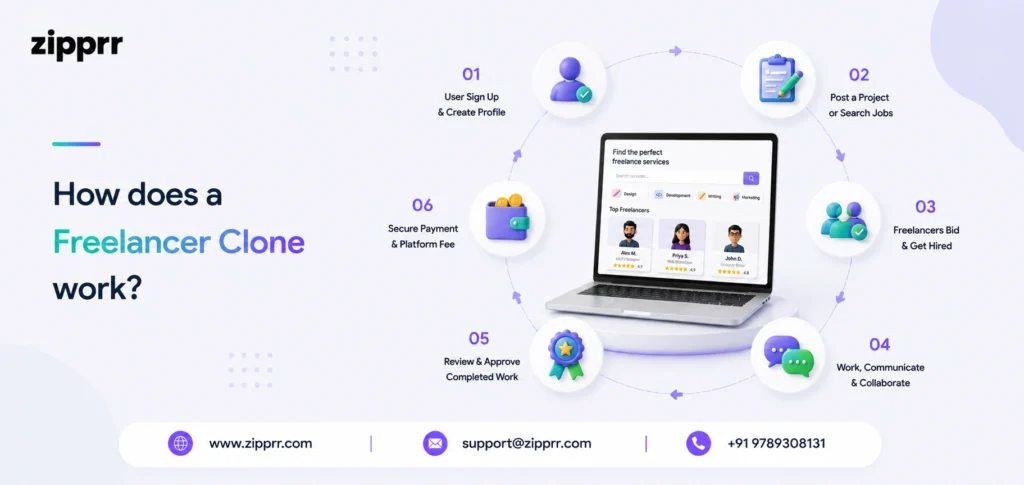
- Accounts get set up. Clients and freelancers join; sellers spell out their skills, show samples, and name their rates.
- A task gets posted. The client writes up the work, gives a budget range and a due date, and files it under the right category.
- Offers come in. Freelancers reply with a price, a delivery window, and a brief pitch; hourly and flat-rate arrangements are options, too.
- Cash goes into escrow. The client picks someone and drops the payment (or the first milestone) into a held account, promised but not yet released.
- Work gets done on the platform. The pair message, trade files, and check off milestones as things advance.
- Payout and feedback. After the client approves, escrow pays the freelancer minus your slice, and the two rate each other.
How much does it cost to launch a freelance marketplace with Zipprr?
Coded from the ground up, a custom freelance marketplace tends to land near $20,000 for something basic, $40,000 to $80,000 for a middle tier, and comfortably above $100,000 (occasionally past half a million) for a polished, fully loaded build. A clone script skips most of that invoice because the heavy lifting is already done; decent ones can be had for a few hundred dollars to get the source code in hand.
What blows the numbers apart is wages. Building from nothing means paying designers, server-side and client-side developers, testers, and ops people for months on end. A clone swaps that long payroll for one license fee, leaving you with the everyday expenses any website carries: a host, a domain, processor charges, and money to market the thing. Hosted no-code builders sit in the middle, roughly $99 to $199 monthly, but they cap how far you can bend the product, and you never actually receive the code. For anyone who wants the platform in their own name and a thin cost base, a self-hosted clone is usually the most affordable option that can still grow with you.
You can check current pricing and try a live preview on the Zipprr Freelancer Clone page.
How fast can you launch a freelance marketplace with Zipprr?
Working from a ready-made Freelancer Clone, the typical marketplace is live in roughly 3 to 7 days, nothing like the 6 to 12 months a ground-up build tends to eat. The software is already written and tested, so what’s left is configuration and branding, not engineering.
The run to go-live is brief: lock in your license and code, get it onto your server (Zipprr installs it on your behalf), then drop in your logo, palette, and domain, lay out categories and fee rates, hook up a payment processor, and push a couple of test orders through. That early lead is the whole appeal of a clone; you can probe the market and start banking fees while a rival starting from scratch is still typing out code.
Freelancer Clone vs Upwork Clone vs Fiverr Clone: what's the difference?
The split comes down to who acts first. On a Freelancer Clone or an Upwork Clone, the client kicks things off with a job post, and freelancers bid for it. On a Fiverr Clone, the freelancer leads, putting up fixed-price “gigs” that clients just buy. Same two-sided concept, different opening move, and that is what decides which one suits each one.
- Freelancer Clone: Clients post, freelancers bid. Best when the work is varied projects, contests, or milestone jobs spread across lots of categories.
- Upwork Clone: Also proposal-driven, but tilted toward hourly contracts, time tracking, and longer working partnerships.
- Fiverr Clone: Sellers post packaged services at set prices, and clients buy on the spot. Made for repeatable, productised work.
Fit the format to how your crowd prefers to hire: tailored, scoped projects lean toward a Freelancer Clone, while quick, standardised services usually do better on a gig setup.
What features should a Freelancer Clone have?
At a bare minimum, it needs member accounts, job posting with bidding, escrow on payments, instant messaging, a way to resolve disputes, a feedback-and-scoring system, support for several currencies and languages, phone apps, and a genuinely usable admin area. Those are the parts that earn enough trust for people to part with real money on your site.
- Split client and freelancer space, carrying profiles, work samples, and skill tags.
- An adaptable offers engine covering flat-rate, hourly, and milestone jobs.
- Milestone-based escrow that pins funds in place and only frees them once work is accepted.
- Built-in chat and file passing so the whole deal stays on your site.
- A trust layer of star scores and written feedback to filter out bad actors.
- A dispute route that lets you intervene when a job heads south.
- Border-crossing readiness via several currencies and interface languages.
- Reliable processors such as Stripe or PayPal, plus options that work locally.
- A mission-control admin area for members, categories, fees, and payouts.
- Apps for Apple and Android phones, since a bigger share of freelance work now kicks off on mobile.
How does a freelance marketplace make money?
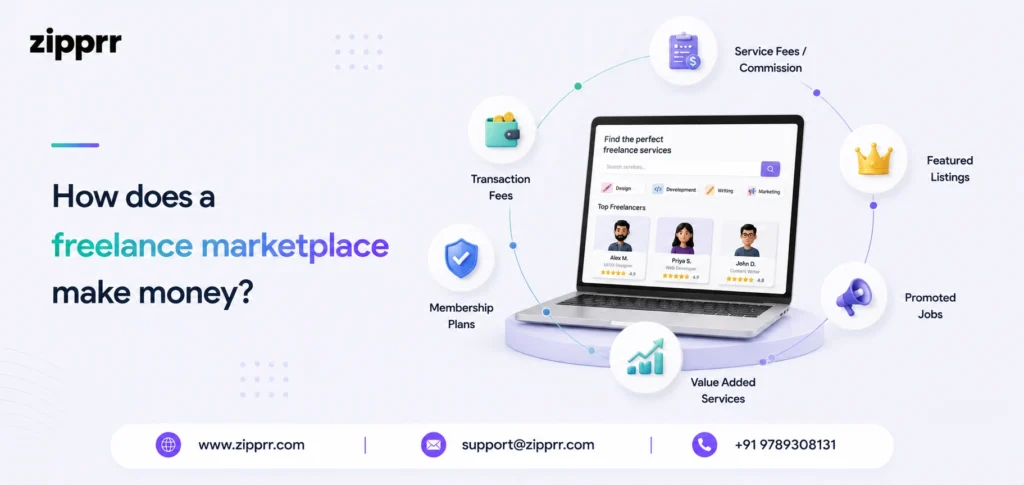
The main motor is commission: you retain a portion of every finished job, charged to the freelancer, the client, or shared between the two. Beyond that, most platforms add a few more income lines on top.
- A cut per deal takes a slice of each job, usually landing somewhere from 5% to 20%.
- Paid memberships are recurring tiers that hand over more bids or extra tools.
- Bought exposure covers, boosted listings, front-page spots, or spotlighted profiles.
- Charges on bids or leads add a token fee once a freelancer burns through a free quota of proposals.
- Selling ad slots brings sponsored placements once your traffic is worth advertising against.
Because a self-hosted clone is yours, each of those levers sits under your control in the admin panel, so you decide the rates and tiers instead of operating inside another company’s rulebook
Is a Freelancer Clone customizable and legal to use?
Yes to both. The package ships with the complete source code, so you can reshape just about anything, and running it is entirely lawful as long as you put out your own branded product rather than passing yourself off as an existing company by copying its name, logo, or content. The mechanics of a marketplace belong to no one in particular; a brand’s identity does, and that is the line you stay on the right side of.
Day to day, owners trim the categories and skills to suit one field, redraw the commission and membership setup, repaint the interface in their own colours, bolt on features their niche calls for, and plug in whichever payment processors they like. Keeping the code also protects your future: as the marketplace expands, you can keep building on it instead of slamming into a wall that a rented platform would put up.
Why choose Zipprr's Freelancer Clone?
Pick Zipprr’s Freelancer Clone if you want a tried-and-tested freelance marketplace handed over as code you fully own, bundled with a web app, optional phone apps, hands-on server setup, language support for global users, and three months of free help once you’re up. It is shaped to get you trading quickly and to grow beneath your own banner.
- The code is yours, so you pay once with no monthly subscription tying you down.
- Nothing is missing: the offers engine, dashboards for both sides, milestone payouts, live chat, and a complete admin area.
- Web plus optional apps, with help getting them through the app stores.
- Installation is handled for you, so deployment never becomes your problem.
- Ready for many languages to reach users worldwide.
- Three months of free support after you launch.
Freelancer Clone at a glance
| Approach | Time to Launch | Typical Cost | Do You Own the Code? |
|---|---|---|---|
| Build from scratch | 6 to 12 months | $20,000 to $500,000+ | Yes |
| No-code marketplace SaaS | 1 to 4 weeks | $99 to $199+/month | No |
| Zipprr Freelancer Clone Script | 3 to 7 days | One-time license | Yes |
What is a Freelancer Clone?
How much does a Freelancer Clone cost?
Getting the source code can start at a few hundred dollars, against the $20,000 to $500,000+ a from-scratch build normally calls for. Your final bill rides on extras such as phone apps, bespoke work, and how much support you want bundled in.
Is it legal to use a Freelancer Clone script?
It is, provided you put out an original, branded platform and steer clear of lifting any established company’s name, logo, or content. The marketplace features underneath are ordinary functionality nobody owns; the only thing protected is a brand’s identity.
How long does it take to launch a freelance marketplace with a clone?
Generally, 3 to 7 days. As the software already exists, that stretch goes on installing it, dressing it in your branding, fixing categories and fees, and testing payments, not constructing anything from nothing.
Can I customise a Freelancer Clone for my niche?
You can. With the full code at your disposal, you’re free to alter categories, skills, layout, features, fee structures, and branding to home in on a niche such as design, IT, or local trades, and to keep widening it as you grow.
How do freelance marketplaces make money?
Chiefly through commission on completed jobs, usually 5% to 20% taken from freelancers, clients, or both sides. Plenty also pulls in revenue from memberships, promoted listings, bid or lead fees, and advertising.
What's the difference between a Freelancer Clone and a Fiverr Clone?
A Freelancer Clone is bid-driven: clients post jobs and freelancers compete with offers. A Fiverr Clone is gig-driven: freelancers list fixed-price services that clients buy outright. Reach for the first when work is scoped and custom, the second when it’s standardised.
Does a Freelancer Clone come with mobile apps?
Plenty do, shipping apps for Apple and Android phones next to the website. That counts in 2026, because a growing slice of freelance activity now starts on a handset.