

Anyone researching how to enter the short-term rental industry eventually hits the same wall: building a booking platform from scratch takes months and a serious budget, but generic booking plugins can’t handle the two-sided marketplace mechanics that a real Airbnb-style business needs: host onboarding, guest verification, calendar sync, commission splits, reviews, and payouts, all working together. An Airbnb clone script exists to solve exactly that problem, and this guide explains what it is, how it works, how much it costs, how the underlying business model makes money, and how to launch one the right way in 2026.
This is not a marketing brochure for a single vendor’s package. It’s a founder-level breakdown of the product category itself: what a clone script includes, where it comes from, how revenue really flows through a vacation rental marketplace, what regulatory issues to plan for, and how to evaluate whether buying a script or building custom is the smarter move for your specific situation.
What Is an Airbnb Clone Script?
An Airbnb clone script is a white-label software product that reproduces the functional architecture of Airbnb’s marketplace model without being an official Airbnb product; it is an independent piece of software a business can license, brand as its own, and operate as a competing or niche vacation rental platform. The word “clone” refers to functional similarity (listings, bookings, payments, reviews), not to copied code or a counterfeit of Airbnb’s trademark; every reputable vendor builds original software and simply mirrors the proven user flow.
Functionally, an Airbnb clone script is a multi-vendor marketplace platform in the same architectural family as ride-hailing, freelance, or food-delivery marketplaces; it just applies that architecture to short-term property rentals. If you want the broader mechanics of how these two-sided platforms are typically structured, Zipprr’s multi-vendor marketplace platform guide covers the shared foundations: vendor onboarding, commission logic, and admin controls that apply across marketplace categories.
The three components every Airbnb clone script needs are:
- Guest-facing apps/website: search, filters, listing pages, booking and payment flow, messaging, reviews.
- Host dashboard: listing creation, calendar/availability management, pricing rules, booking approvals, payout tracking.
- Admin panel: commission configuration, host/guest verification, dispute resolution, payment gateway management, analytics, and content moderation.
Solutions like Zipprr’s Airbnb clone script package all three components together as a ready-to-deploy, white-label platform, so a founder is licensing a functioning marketplace rather than a blank codebase.
How Does an Airbnb Clone Script Work?
An Airbnb clone script works by connecting three user roles (host, guest, and admin) through a shared booking and payment engine. In practice, the flow looks like this:
- Host lists a property. The host creates a listing with photos, amenities, house rules, pricing, and available dates through the host dashboard or app.
- Admin verifies and approves. Depending on platform settings, new listings and new hosts pass through an identity/KYC verification and content-moderation step before going live.
- Guest searches and books. Guests filter by location, dates, price, and amenities, view listing detail pages, and submit a booking request or instant-book reservation.
- Payment is processed and held. The platform’s payment gateway captures the guest’s payment, typically holding funds in escrow until check-in or a set release trigger, protecting both sides from fraud or no-shows.
- Host and guest communicate. In-app messaging lets both parties coordinate check-in details without exchanging personal contact information upfront.
- Stay happens; reviews are exchanged. After checkout, both host and guest can leave reviews, which feed the platform’s trust and ranking systems.
- Admin releases payout. The platform deducts its commission and transfers the remaining balance to the host’s connected payout account (bank transfer, PayPal, Stripe Connect, or similar).
- Admin monitors and reports. Dashboards track gross booking value, commission revenue, cancellation rates, and host/guest activity for ongoing operations.
This loop (list, verify, book, pay, stay, review, pay out) is the same operational backbone used across most reputable short-term rental platforms, and it is exactly what a clone script pre-builds so a new operator doesn’t have to design it from scratch.
Why the Vacation Rental Marketplace Model Is Growing
The global vacation rental market was valued at approximately $101.7 billion in 2025 and is projected to grow to roughly $106.5 billion in 2026, continuing on to about $121.9 billion by 2033 at a compound annual growth rate of around 3.7%, according to Grand View Research’s industry analysis. That steady growth reflects a few durable shifts in traveler behavior and property-owner economics rather than a short-term trend:
- Traveler preference for space and amenities. Families and remote-work travelers increasingly prefer full apartments or houses with kitchens and living space over standard hotel rooms.
- Property owners want flexible income. Homeowners and small-scale property investors treat short-term rental as a more flexible, often higher-yield alternative to long-term leasing.
- Niche and regional platforms are gaining share. Because Airbnb charges meaningful commission and applies global policies uniformly, regional and niche operators (luxury villas, pet-friendly stays, extended-stay corporate housing, boutique local markets) can compete by offering lower fees, local trust, or curated inventory that a global platform doesn’t optimize for.
- Property managers need purpose-built tools. Professional hosts managing multiple units want calendar sync, dynamic pricing, and payout automation; the same underlying tooling a clone-script-based marketplace provides to its own hosts.
This is the opening a founder or agency is stepping into with a clone-script-based launch: not competing head-on with Airbnb’s brand, but capturing a geography, niche, or service layer that a $100+ billion and still-growing market has room for.
Key Features of an Airbnb Clone Script
A production-ready Airbnb clone script needs feature depth across all three user roles. The table below breaks down what to expect in a serious platform versus a bare-minimum listing site.
| User Role | Core Features | Why It Matters |
|---|---|---|
| Guest | Advanced search/filters, map view, instant book, secure checkout, in-app messaging, wishlist/saved listings, review system, multi-currency pricing | Determines conversion rate and repeat bookings |
| Host | Listing builder, calendar & availability sync, dynamic pricing rules, booking approval controls, payout dashboard, promotional tools, performance analytics | Determines host retention and inventory growth |
| Admin | Commission configuration, KYC/identity verification, dispute resolution workflow, payment gateway management, content moderation, tax/reporting tools, multi-language/multi-currency support | Determines operational control and platform trust |
The Airbnb Business Model and Revenue Model Explained
Understanding how Airbnb itself generates revenue is the clearest way to understand how any clone-script-based marketplace should be monetized, because the underlying mechanics (commission on both sides of a transaction) are what most operators replicate.
Airbnb primarily earns through service fees charged to both hosts and guests. As of its most recent published fee structure, hosts using the standard split-fee model pay roughly 3% of the booking subtotal, while guests pay a service fee that typically falls between 14.2% and 16% of the booking subtotal, varying by reservation details and region. Airbnb has also introduced a single host-only fee option (roughly 14–16%) for hosts who use third-party property management software, shifting the full service fee to the host side instead of splitting it. On top of transaction commissions, Airbnb generates additional revenue from host-side services such as damage protection programs, and from its Airbnb Experiences offerings.
What This Means for a Clone-Script Operator
A new marketplace operator doesn’t have to copy Airbnb’s exact percentages (commission structure should reflect local market conditions and the operator’s cost base), but the model itself (a blended commission taken from both host and guest sides of every completed booking) is the proven default. Common revenue streams built into a clone-script platform include:
| Revenue Stream | How It Works | Typical Range |
|---|---|---|
| Host commission | Percentage deducted from host payout on each booking | 3%–15% |
| Guest service fee | Percentage added to guest's total at checkout | 10%–16% |
| Featured/promoted listings | Hosts pay to boost visibility in search results | Flat fee or subscription |
| Damage protection / insurance add-on | Optional protection plan sold at checkout | Percentage of booking or flat fee |
| Subscription tiers for professional hosts | Recurring fee for advanced tools (multi-property dashboards, priority support) | Monthly/annual flat fee |
| Payment processing margin | Small markup on payment gateway processing costs | Basis points on transaction volume |
Operators running a similar peer-to-peer marketplace in an adjacent category, such as car sharing, apply nearly identical commission logic; Zipprr’s peer-to-peer car rental marketplace guide breaks down how that same host/guest commission split is configured for vehicle rentals, which is a useful side-by-side reference if you’re comparing marketplace categories before choosing one.
Airbnb Clone Script vs. Custom Development vs. Property Rental Script
Founders researching this space often conflate three different products. Here’s the distinction, laid out directly:
| Option | Best For | Typical Cost | Typical Timeline | Key Trade-off |
|---|---|---|---|---|
| Airbnb clone script (white-label) | Founders who want proven marketplace mechanics fast, with room to customize branding and features | $2,000–$15,000+ depending on package and customization | 2–6 weeks to launch | Less flexible than fully custom code, but dramatically faster and cheaper |
| Fully custom development | Businesses with unique, non-standard workflows or long-term plans to build proprietary IP | $80,000–$250,000+ | 6–12+ months | Maximum flexibility, but high cost, high risk, and a long time-to-market |
| Long-term property rental script | Landlords and property managers renting units on monthly/annual leases rather than nightly stays | Varies by vendor | 2–8 weeks | Wrong fit for nightly/short-term bookings, a different business model entirely |
That last row matters more than it looks. Short-term (Airbnb-style) rental and long-term property management are genuinely different businesses with different booking logic, pricing models, and tenant/guest relationships. If your business is monthly leases, applications, and tenant screening rather than nightly bookings and instant checkout, a long-term property rental script is the better-fit product. Trying to force a nightly-booking marketplace into a monthly-lease workflow (or vice versa) creates friction for both hosts/landlords and guests/tenants.
For most founders entering the vacation rental space specifically, a white-label clone script is the rational starting point: it delivers the proven two-sided marketplace mechanics without the cost and delay of custom development, while still allowing enough configuration (branding, commission rules, feature toggles, regional payment gateways) to differentiate from competitors.
How to Start a Vacation Rental Marketplace Business
Launching a vacation rental marketplace with a clone script follows a fairly consistent sequence regardless of which niche or geography you target:
- Define your niche and geography. Global competition with Airbnb directly is a losing strategy for a new entrant. Pick a defensible angle: a specific region, property type (villas, cabins, boutique urban stays), or audience (pet-friendly, extended-stay corporate travel, eco-tourism).
- Choose your platform: script vs. custom. Based on budget and timeline (see comparison table above), decide whether a white-label script or custom build fits your stage of the business.
- Configure commission and payment rules. Set host and guest fee percentages, connect a payment gateway (Stripe, PayPal, or region-specific processors), and decide on payout timing (at booking, at check-in, or after checkout).
- Set up verification and trust systems. Configure host identity verification, guest ID checks for high-value bookings, and a review/rating system; trust mechanics are what make guests comfortable booking from an unfamiliar brand.
- Recruit founding hosts before launch. A marketplace with no inventory converts no guests. Manually recruit an initial batch of hosts in your target geography before opening to public guest traffic; this “supply-first” approach is standard for two-sided marketplace launches.
- Launch marketing focused on both sides. Run host-acquisition campaigns (lower commission for early hosts, dedicated onboarding support) alongside guest-acquisition campaigns (SEO content, local travel partnerships, paid search for your niche).
- Monitor unit economics from day one. Track cost per host acquired, cost per booking, average booking value, and take-rate (your commission as a percentage of gross booking value) so you know whether the business is trending toward profitability.
- Iterate on features based on host/guest feedback. Early operators typically add channel-manager integrations, dynamic pricing tools, and mobile apps once the core marketplace proves demand.
Challenges of Running a Vacation Rental Marketplace and How to Solve Them
| Challenge | Why It Happens | Practical Solution |
|---|---|---|
| Chicken-and-egg supply/demand problem | Guests won't book with no listings; hosts won't list with no guests | Manually recruit founding hosts before any guest marketing spend |
| Trust and safety concerns | Guests and hosts are strangers transacting online | Identity verification, escrow-style payment holding, visible review history |
| Local short-term rental regulation | Many cities license, cap, or restrict short-term rentals | Build jurisdiction-aware listing rules and require host compliance acknowledgment at listing creation |
| Payment disputes and chargebacks | Cancellations, property misrepresentation, damage claims | Clear cancellation policy tiers, documented check-in condition photos, defined dispute workflow in the admin panel |
| Host churn to larger platforms | Established platforms like Airbnb offer bigger guest pools | Differentiate on lower commission, niche curation, or superior local support rather than competing purely on traffic volume |
| Seasonal demand volatility | Vacation rental demand fluctuates by season and region | Dynamic pricing tools and diversified geography/property types to smooth revenue |
AI Features a 2026 Airbnb Clone Script Should Have
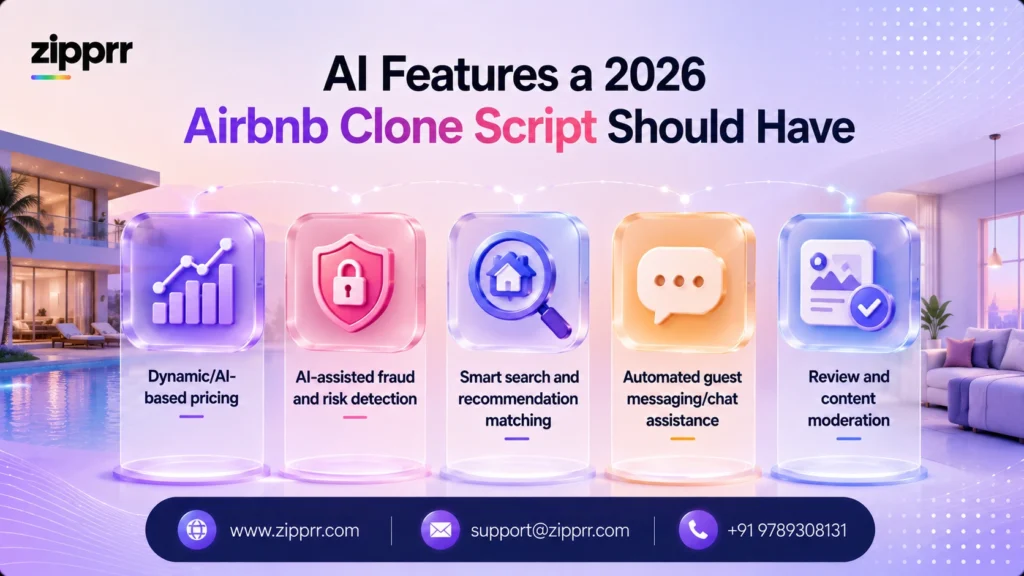
By 2026, buyers evaluating a clone script are asking specifically about AI capabilities, not just core booking functionality. The features with the clearest return on investment include:
- Dynamic/AI-based pricing: automatically adjusts nightly rates based on demand, seasonality, local events, and competitor pricing, helping hosts maximize occupancy and revenue without manual repricing.
- AI-assisted fraud and risk detection: flags suspicious booking patterns, stolen-card usage, or fake listings before they cause chargebacks or trust damage.
- Smart search and recommendation matching: surfaces listings based on guest behavior and preferences rather than simple keyword/location filters, improving conversion.
- Automated guest messaging/chat assistance: handles common pre-booking questions (check-in times, amenities, cancellation policy) instantly, reducing host response burden and improving booking speed.
- Review and content moderation: automatically screens listing photos/descriptions and guest reviews for policy violations or fraudulent content at scale.
These aren’t cosmetic add-ons; they directly affect host retention (less manual work), guest conversion (faster answers, better matches), and platform trust and safety (fraud reduction): the three metrics that determine whether a vacation rental marketplace scales profitably.
Legal and Compliance Considerations
Short-term rental regulation varies significantly by city, state, and country, and it is one of the most commonly underestimated parts of launching this kind of marketplace. Before and during launch, operators should plan for:
- Local licensing and registration requirements for hosts, which vary widely by municipality and change frequently.
- Occupancy limits, zoning restrictions, and rental-day caps that some cities impose on short-term rentals.
- Tax collection and remittance: many jurisdictions require platforms or hosts to collect occupancy/lodging taxes at time of booking.
- Data privacy compliance (such as GDPR in the EU or CCPA in California) for guest and host personal and payment data.
- Payment processor compliance (PCI-DSS) for handling card payments securely.
A clone script does not eliminate these obligations (no software does), but a well-built one gives an admin panel the configurability (jurisdiction-based listing rules, automated tax fields, consent and data-handling settings) needed to operate compliantly rather than bolting compliance on after launch.
Why Choose a White-Label Airbnb Clone Script
For most founders and agencies entering the vacation rental space, a white-label clone script is the more capital-efficient starting point compared to custom development, for three connected reasons: it compresses time-to-market from many months to a few weeks, it reduces upfront technical risk because the core booking/payment/review architecture is already tested in production elsewhere, and it still allows enough branding and configuration control to build a genuinely differentiated business rather than a copy-paste clone.
This logic isn’t unique to short-term rentals; it’s the same reasoning that applies across peer-to-peer rental categories. If your interest extends beyond vacation stays into other rentable-asset categories (equipment, tools, event spaces), Zipprr’s broader P2P rental script applies the same host/guest/admin marketplace architecture to a wider range of rentable inventory, which is worth evaluating if your business model spans more than just properties.
Why Choose Zipprr
Zipprr builds white-label marketplace scripts across ride-hailing, rentals, real estate, classifieds, and service marketplaces, including a dedicated Airbnb clone script that ships with guest and host mobile apps, an admin panel with commission and verification controls, and configurable payment gateway integrations. Because the underlying marketplace architecture (listings, bookings, commissions, reviews, payouts) is shared across Zipprr’s rental product line, businesses evaluating both short-term (Airbnb-style) and peer-to-peer asset rental models can compare feature sets side by side before committing to a package. As with any script purchase, buyers should verify current feature lists, pricing tiers, and customization scope directly with the vendor before purchasing, since packages and pricing are updated periodically.
Ready to see the host, guest, and admin panels in action before you decide?
Book a free demo of Zipprr’s Airbnb clone script and walk through the actual booking, payment, and commission flow with the team before committing to a package.
What is an Airbnb clone script?
How much does it cost to build an app like Airbnb?
How does Airbnb make money?
How long does it take to launch an Airbnb clone script?
What features does an Airbnb clone app need?
Is it legal to use an Airbnb clone script?
What is the difference between an Airbnb clone script and custom development?
Can an Airbnb clone script be customized?
What payment and booking features does a vacation rental platform need?
How do I start a vacation rental business with an Airbnb-style app?
Conclusion
An Airbnb clone script gives founders a proven, two-sided marketplace architecture (listings, bookings, commissions, verification, and payouts) without the months of custom engineering that building the same system from scratch would require. The businesses that succeed with this model aren’t the ones trying to out-market Airbnb globally; they’re the ones who pick a defensible niche or geography, configure a commission structure that works for their market, and execute the supply-first launch sequence that every successful two-sided marketplace depends on. If you’re evaluating whether to buy a script or build custom, start by mapping your budget and timeline against the comparison table above, then look closely at what a production-ready Airbnb clone script actually includes before deciding how much, if anything, needs to be built custom on top of it.