

Most landlords don’t start disorganized. They start with two or three properties, a notebook, and good intentions. Then a fourth unit gets added. Then a fifth. Suddenly, there are six WhatsApp groups, a spreadsheet that nobody fully trusts, and a maintenance complaint sitting in someone’s inbox from three weeks ago.
It’s not that people don’t care. It’s that the tools don’t scale.
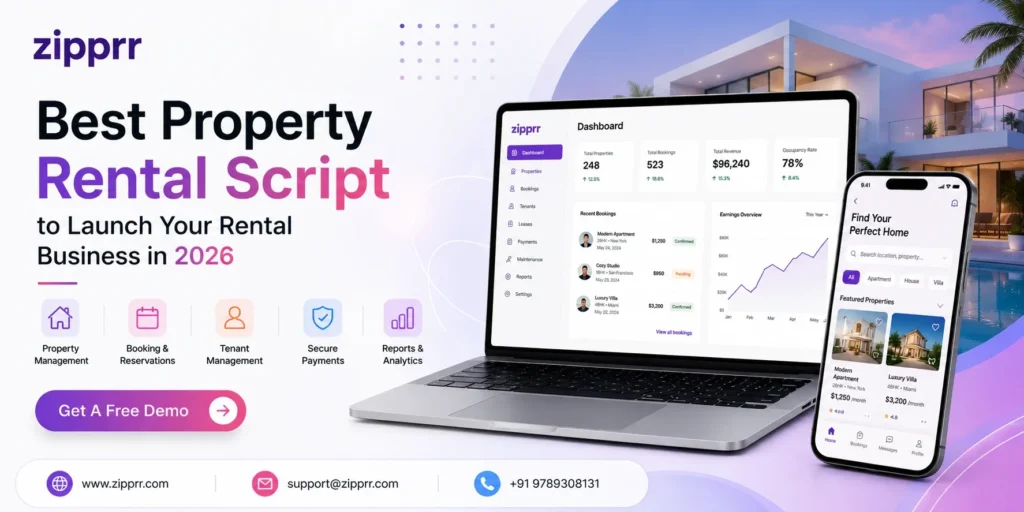
Zipprr’s Property Rental Script is one of the most complete, ready-made solutions available for landlords and rental entrepreneurs today. It covers the full cycle — listings, tenant applications, digital agreements, rent collection, maintenance tracking, and everything in between. And it ships with iOS and Android apps, which matters because tenants aren’t sitting at desktops waiting to pay rent.
Over 500 businesses across more than 10 industries have deployed it. That’s a meaningful number, not a marketing stat. It means the software has been tested against the kinds of edge cases that only show up in real operations.
The Rental Market Has Changed — Most Operators Haven’t Caught Up
Renting isn’t what it was a decade ago. Tenants have lived through the Airbnb era, the Uber era, and the everything-on-demand era. They expect responsiveness, digital payments, clear communication, and professional documentation. A landlord who responds to maintenance requests three days later via text message isn’t meeting that bar anymore.
Meanwhile, property ownership patterns have shifted. Institutional buyers have entered markets that used to belong to individual landlords. Professional property management companies are scaling aggressively. The independent landlord who ignores technology is competing against firms that have invested heavily in it.
That’s real pressure — and it’s accelerating.
What works in this environment is a platform that makes a small operation look and function like a professional one. Tenants don’t need to know whether their landlord owns two units or two hundred. What they experience is whether the payment process is smooth, whether maintenance requests get handled, and whether the lease was easy to understand and sign.
A property rental script built for this purpose bridges that gap. Professionally — and affordably.
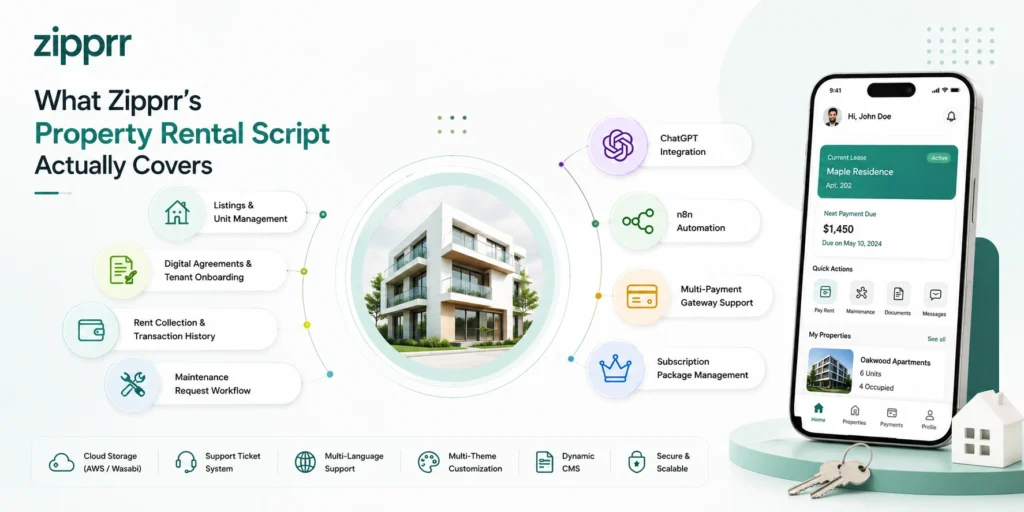
What Zipprr’s Property Rental Script Actually Covers
It’s worth being specific here because “property management software” can mean very different things depending on who’s selling it.
Listings and Unit Management
Multiple units under one property, each with its own availability, pricing, photos, and amenity details. If a landlord owns a building with six apartments, they’re not creating six separate accounts — everything sits under one roof in the system.
Tenant Onboarding and Digital Agreements
Application review, approval, digital lease creation, and e-signing all happen within the platform. The agreement is stored, timestamped, and retrievable whenever it’s needed. This matters more than most people realize — lease disputes are almost always settled by whoever has better documentation.
Rent Collection and Transaction History:
Automated payment collection with full transaction logs. Every payment is recorded with dates, amounts, and reference details. Late payments are visible. Partial payments are flagged. Nothing disappears into a bank statement that has to be manually reconciled each month.
Maintenance Request Workflow
Tenants submit issues directly through the app. Landlords assign them to maintenance staff. Status updates in real time. When it’s resolved, the ticket closes with a complete history attached. This creates accountability on both sides — and removes the “I never received that complaint” problem entirely.
ChatGPT Integration
This is genuinely useful, not just a buzzword feature. AI-assisted property descriptions, automated tenant FAQs, and smart response drafting save real time for landlords managing multiple units. Not every rental script has invested in this. Zipprr has.
n8n Automation
Rent due reminders, lease expiry alerts, maintenance follow-ups — automatable through n8n integration. For anyone running more than ten units, manual reminders become a part-time job. Automating them is one of those changes that feels small until you experience the hours it returns.
Multi-Payment Gateway Support
Stripe, PayPal, bank transfers, and regional options. The payment flexibility matters especially for platforms serving tenants across different cities or countries where preferred payment methods vary.
Subscription Package Management
For entrepreneurs building a marketplace (not just managing personal properties), this feature lets you offer landlords access at different tiers — basic listings, premium analytics, priority support — and charge accordingly.
The platform also includes cloud storage through AWS or Wasabi, a support ticket system for tenant queries, multi-language support, a dynamic CMS for managing homepage content, and multi-theme color customization.
It’s comprehensive. The list reads long because the product actually covers the full workflow — not just the parts that look good in a de
mo.
Two Things That Separate Zipprr from Most Alternatives
First: it’s a one-time payment. No monthly subscription, no per-seat pricing that multiplies as the business grows, no surprise fees when you want to add a feature. The $490 Startup plan and $890 Pro plan are what they are — paid once, owned permanently.
For founders watching cash flow closely, the difference between a $490 one-time purchase and a $150/month SaaS subscription compounds significantly over two or three years.
Second: the source code is actually included. All of it. Clean, structured, fully owned by the buyer. That means the platform can be modified, extended, rebranded, and deployed however the business requires — without asking permission or waiting for a vendor to add a feature to their roadmap.
White labeling is also included at no extra charge. The platform launches under the buyer’s brand, with their logo and identity throughout. Tenants and landlords interact with the buyer’s business — Zipprr stays invisible in the background.
And for anyone cautious about committing, there’s a seven-day full refund policy. That’s an unusual level of confidence for a software product at this price point.
Who Should Be Paying Attention to This
Independent landlords running five or more units who have realized that WhatsApp and spreadsheets don’t scale — this was built for them.
Property management entrepreneurs who want to build a regional platform connecting landlords and tenants in an underserved city or country — the script gives them the infrastructure without the $100,000+ development bill.
Real estate agencies that want to add a digital rental management product to their existing service offering.
Startups entering the PropTech space who want to validate a rental marketplace concept quickly before committing to a full custom build.
The common thread is that all of these are people who need a professional platform faster and more economically than custom development allows. A two-to-six week deployment timeline versus a twelve-to-eighteen month development cycle is a meaningful difference when market timing matters.
Revenue If You’re Building a Marketplace
For anyone building a platform to serve multiple landlords — not just managing their own portfolio — the business model is worth thinking through clearly.
Landlord subscriptions are the most predictable revenue stream. Monthly or annual plans with different tiers create recurring income that grows as more property owners join the platform. This is how most successful rental SaaS businesses are structured, because it aligns the platform’s revenue with landlord success.
On top of that: booking commissions on completed transactions, featured placement fees from landlords who want more visibility in search results, tenant application fees where market convention supports it, and transaction-level service charges.
As platform traffic grows, third-party partnerships become viable — insurers, moving companies, furniture rental providers, and home services businesses. Each of these will pay to reach an audience actively managing rental transactions. That’s a revenue stream most rental platforms don’t think about at launch but wish they’d planned for earlier.
The economics improve with scale. Infrastructure costs stay relatively flat. Revenue per additional landlord added to the platform is nearly pure margin. That’s the compounding advantage of the marketplace model that most subscription-based software businesses can’t replicate.
A Note on the Ecosystem
Zipprr isn’t a single-product company. The property rental script is part of a broader suite that includes a vacation rental platform for short-term bookings, a car rental script for vehicle fleets, a space rental clone for commercial and event spaces, and an equipment rental script for asset-heavy industries.
This matters for founders who are thinking beyond a single vertical. Building on Zipprr’s infrastructure from the start means future expansion into adjacent rental categories doesn’t require starting over with a different tech stack. The groundwork is already compatible.
Pricing at a Glance
| Plan | Price | License Type |
|---|---|---|
| Startup | $490 (one-time) | Single license |
| Pro | $890 (one-time) | Multiple licenses |
Both include the web platform, Android app, iOS app, app submission, server installation, 90 days of post-launch support, regular updates, free bug resolution, and white labeling.
No recurring fees. No hidden costs. Seven-day refund guarantee on both plans.
Start With a Demo
The best way to evaluate this is to see it working.
Zipprr offers a free demo session where the platform is walked through live — features, admin panel, tenant-facing experience, everything. It’s worth thirty minutes before making any purchase decision.
Frequently Asked Questions
Is this genuinely a one-time payment with no subscription later?
Yes. Both plans are one-time purchases. The 90-day post-launch support period is included. After that, optional extended support packages are available, but the platform itself has no recurring fee structure.
What’s actually different between the $490 and $890 plans?
Primarily licensing. The Startup plan covers a single deployment. The Pro plan includes multiple licenses, which makes it relevant for agencies deploying the platform across different clients or entrepreneurs who want to run separate branded platforms in different markets.
Can I run this without a technical background?
Day-to-day operations — managing tenants, tracking payments, updating listings, responding to maintenance requests — all happen through a visual admin dashboard that doesn’t require coding knowledge. For the initial server setup and installation, Zipprr’s team handles it as part of the package.
How customizable is it after I buy?
Completely, because you receive the full source code. Design, workflows, third-party integrations, and additional features — all of it can be modified. Most buyers customize branding and core workflows at launch, then build additional features incrementally as the business grows and requirements become clearer.
Is this the right tool for short-term vacation rentals, too?
It’s designed primarily for long-term residential and commercial property rental management. For short-term, nightly-booking vacation rentals, Zipprr’s Airbnb clone is more appropriate. The two can run alongside each other if a business wants to serve both markets.
What does the 90-day support actually include?
Direct access to Zipprr’s technical team for installation issues, configuration questions, bug fixes, and launch guidance. It’s real support from people familiar with the codebase — not a generic ticket system.
How long does deployment realistically take?
Most deployments go live within two to six weeks. The timeline depends on how much customization is needed and how quickly branding assets and configuration decisions are finalized on the buyer’s side.
What happens if I’m not satisfied after purchasing?
Zipprr offers a 100% refund within seven days of purchase, no questions asked.