

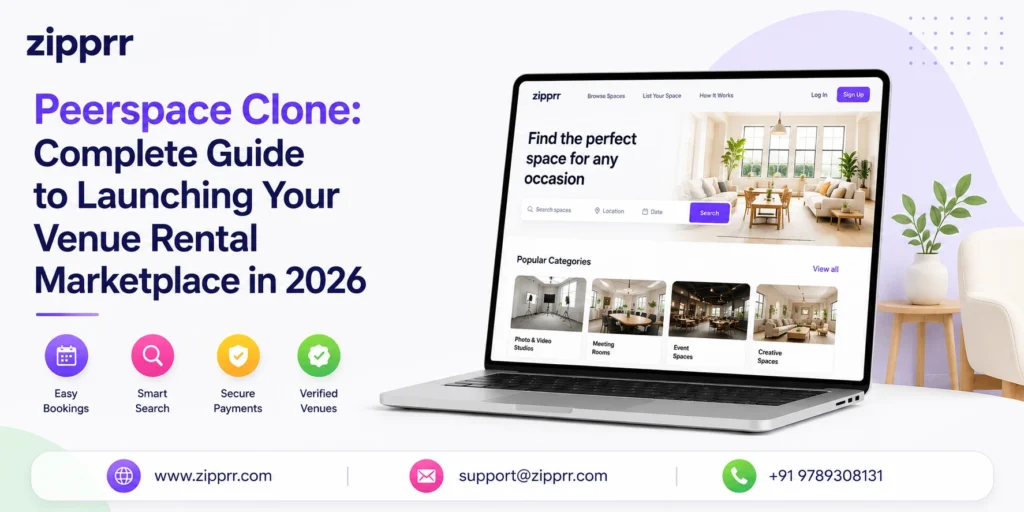
What Is a Peerspace Clone?
A Peerspace Clone is a white-label, production-ready venue rental marketplace platform. It empowers space owners to list venues for hourly booking. Meanwhile, event organizers, photographers, and businesses discover, reserve, and pay entirely within the app. Also, Zipprr’s Peerspace Clone includes AI-powered features, native mobile apps for iOS and Android, and complete source code ownership.
Picture your city at midday on a Wednesday. In addition, a professional photography studio sits locked and dark. A polished corporate boardroom is empty between 9 AM and the next scheduled meeting. A rooftop venue with a skyline view has not had a single booking since Sunday. Meanwhile, across town, a freelance photographer is cancelling a client shoot. The reason is simple: she cannot find a suitable studio at a price that makes sense.
The gap between spaces that sit unused and the people who urgently need them represents a $116 billion global opportunity. It remains wide open for the right entrepreneur to claim.
Why the Hourly Venue Market Keeps Growing
The event venue rental sector is not in decline — it is in acceleration. Industry projections place the global market at $168 billion by 2034, powered by three structural forces: the explosion of the creator economy, the corporate world’s permanent shift toward flexible and remote-first work models, and a new generation of founders who see hourly space access as a smarter alternative to long-term real estate commitments.More than 60% of people seeking event and venue services now begin their search inside an AI-powered search engine before visiting any marketplace. In every major city and secondary market globally, the opportunity to become the go-to hourly venue platform is available right now — and shrinking by the month as more operators recognize it.The obstacle most founders encounter is identical: build the platform from scratch for $50,000–$300,000 over 6–18 months. The alternative is to find a path to market that does not require betting a year of runway on engineering. Additionally, a ready-made Peerspace Clone script from Zipprr is that path. It is a fully white-label, AI-equipped venue marketplace platform that delivers in days what takes years to engineer independently. The whole platform is presented under your own brand.
This is your complete 2026 launch blueprint. Also, every section covers what you need to know: what a Peerspace Clone is and who it is built for, how the platform operates end-to-end, every feature across host, guest, and admin layers, the revenue model, pricing breakdown, trust and safety architecture, niche market opportunities, and how to go live in as little as 7 days.
What Is a Peerspace Clone?
A Peerspace Clone is a pre-engineered, white-label venue-rental marketplace. It replicates the hourly space-booking model at a fraction of the cost of building from scratch. It gives entrepreneurs a fully functional two-sided platform. Space owners list and manage venues while guests discover, book, and pay by the hour. In addition, Zipprr’s Peerspace Clone ships with AI capabilities, native iOS and Android apps, and full unencrypted source code included.
The hourly venue rental model has established itself as one of the most durable marketplace formats of the past decade. On one side of the market sit space owners — operators of photography studios, corporate boardrooms, event halls, rooftop terraces, coworking floors, and film locations — with high-value assets that generate zero revenue for the majority of every day. On the other side are photographers, event planners, production crews, distributed teams, and content creators who require professional environments on a flexible, short-term basis, with no appetite for long-term lease commitments they do not need.
A Peerspace Clone is the infrastructure that connects both groups at scale. It handles every operational component the marketplace requires: space listing and discovery, real-time availability management, hourly booking logic, in-platform payment with deposit protection, host-guest messaging, ratings and verified reviews, mobile applications for both user types, and an administrative control system that gives the platform operator complete oversight.
What comes out the other side is a fully operational venue rental marketplace. It is built on a modern, scalable technology foundation. It is branded entirely as your own product from the day of launch.
How Is a Peerspace Clone Different from Building a Platform from Scratch?
Custom development requires engineering every function — booking logic, payment infrastructure, mobile apps for both platforms, admin architecture. The total investment is $50,000–$300,000 across 6–18 months. A Peerspace Clone eliminates that equation. Additionally, the platform arrives pre-built, fully tested, and deployment-ready in 7–30 days. In short, you own the brand and the niche; every line of engineering is already written.
When a business builds from scratch, every feature must be designed, developed, tested, and debugged before the first booking. Also, payment security alone requires months of development and compliance work. However, native mobile apps for iOS and Android represent separate engineering tracks. Admin systems require their own build cycle. In addition, every delay in the engineering process is a direct delay in revenue.
A Peerspace Clone inverts this entirely. Additionally, the booking engine, payment processing layer, host and guest applications, admin dashboard, and AI features are production-tested. Also, you configure your brand identity, define your commission structure, select your target niche, and launch. Just as an Airbnb Clone compresses years of short-term rental platform development into a deployable package, a Peerspace Clone compresses the hourly venue booking model into a timeline measured in weeks rather than seasons.
Who Should Build a Venue Rental Marketplace Using a Peerspace Clone?
A Peerspace Clone is purpose-built for entrepreneurs entering the event venue rental space, commercial real estate operators with underutilized inventory, event management businesses seeking a proprietary booking channel, and niche market founders targeting photography studios, corporate off-sites, wedding venues, or film locations in any region globally.
The platform serves first-time marketplace founders who want a proven infrastructure base. It also serves established businesses that want to extend into a direct digital booking channel. If you bring market insight, local host relationships, or a defined niche, the Peerspace Clone provides the technological foundation to execute on that advantage — without absorbing years of development time and capital in the process.
How Does a Peerspace Clone Work?
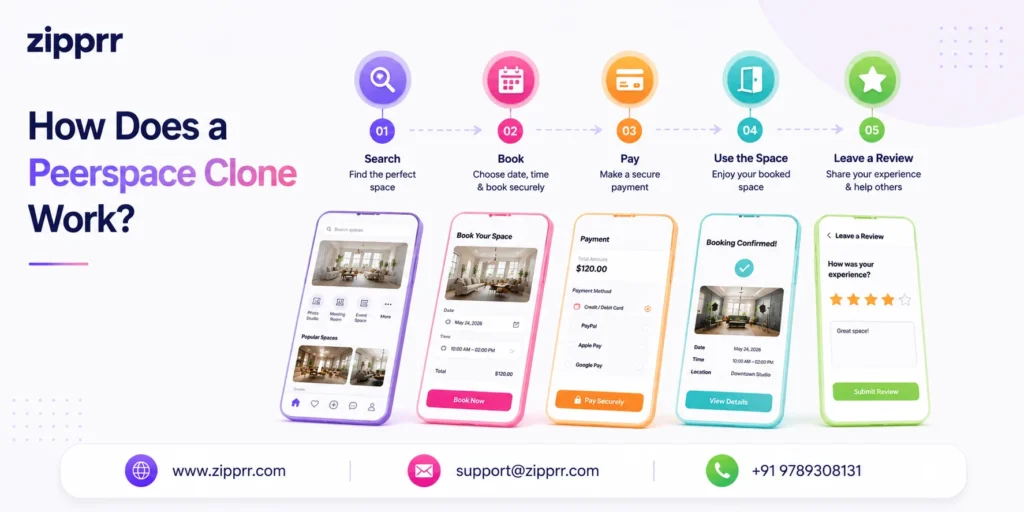
A Peerspace Clone functions as a two-sided marketplace engine. Also, hosts create listings with photos, availability, and pricing. Also, guests search, filter, and reserve by the hour. In addition, all payments — including a protective damage deposit — are handled entirely within the platform. Once a booking concludes, both parties submit reviews. Additionally, the platform admin oversees every transaction, approves listings, and collects commissions through a centralized control dashboard.
Three parallel journeys define how the platform operates. They are the host management experience, the guest discovery and booking experience, and the admin oversight and monetization layer.
How Does the Host Listing Process Work?
Hosts sign up, pass identity verification, and build a space listing. Each listing covers photos, description, hourly rate, capacity, amenities, house rules, and optional add-on services. Each listing includes a configurable availability calendar where hosts block unavailable dates or set repeating open windows. Hosts then choose between instant confirmation or a request-to-book approval model.
After submission, every new listing enters the admin panel’s moderation queue. Also, upon approval, the space becomes fully searchable and bookable across all platform surfaces. From their host dashboard or mobile app, hosts manage incoming bookings, monitor earnings, exchange messages with guests, and initiate damage claims if required — all within a single interface.
How Does the Guest Booking Flow Work?
Guests search using location, space category, group capacity, date and time, and price range. In addition, listings display photo galleries, 360° virtual tours where available, host profiles, and verified guest reviews. The guest completes a booking through an in-app checkout that captures payment and a refundable damage deposit. Right after that, the guest receives a confirmation with full access details.
The guest application calculates the complete booking cost — base rate plus service fees and deposit amount. It does this transparently before any payment is requested. Additionally, push notifications keep guests informed of booking confirmations, upcoming reservations, and host messages. An automated review request is triggered when the booking window closes.
How Does the Admin Manage the Platform?
The admin control panel delivers complete platform oversight: listing approval and moderation, user account management, real-time booking and payment monitoring, commission rate configuration, automated host payout scheduling, dispute and damage claim arbitration, promotional campaign management, and live analytics tracking gross merchandise value, booking velocity, top-performing spaces, and platform conversion performance.
Every financial event, every policy decision, every promotional push, and every dispute resolution flows through this single dashboard. Also, the admin center is device-agnostic. It is accessible from any browser on desktop or mobile. It is also designed for a single operator to run an entire marketplace without additional staffing in the early stages.
What Features Does a Peerspace Clone Include?
Zipprr’s Peerspace Clone delivers three distinct feature layers: the Host App covering listing creation, calendar management, earnings visibility, and messaging; the Guest App covering search, booking, payment, and reviews; and the Admin Panel covering user oversight, commission configuration, analytics, dispute management, and content control. In addition, every layer is white-label ready and included in every pricing plan.
What Features Does the Host App Include?
The Host App provides space listing creation with full rich-media support, an hourly availability calendar with buffer and blackout controls, switchable instant-confirm or request-to-book modes, direct in-app messaging, a real-time earnings dashboard with complete payout history, damage claim submission with evidence upload, identity verification status tracking, and a multi-venue management interface for hosts operating more than one property.
Complete host-side feature breakdown:
- Space Listing Builder — Title, detailed description, space category, maximum capacity, full amenities checklist, house rules, and cancellation policy configuration
- Rich Media Upload — Multiple high-resolution photos, video walkthrough embed, and 360° virtual tour gallery support
- Dynamic Pricing Controls — Base hourly rate, peak-period pricing tiers, minimum and maximum booking duration limits, and optional add-on service fees
- Availability Calendar — Date blocking, recurring availability schedules, and configurable gap buffers between consecutive bookings
- Booking Management — Accept, decline, or message guests for pending requests; complete visibility into upcoming and historical bookings.
- Earnings Dashboard — Live revenue tracking, itemized payout history, pending payout status, and tax-ready income summaries for reporting
- Damage Deposit Claims — Structured post-booking claim submission with photo and written evidence; real-time claim status tracking
- Review Management — Full review visibility, public response capability, and rating trend monitoring over time
What Features Does the Guest App Include?
The Guest App offers location-aware search with an integrated map interface, advanced filters spanning space type, seating capacity, hourly price, specific amenities, and instant-book availability, listing pages with full photo galleries and 360° virtual tours, a live availability checker, secure in-app checkout with a damage deposit authorization hold, direct in-app host messaging, complete booking history access, and a booking-verified reviews system.
Full guest feature list:
- Smart Search and Map View — Proximity-based or city-wide search with seamless toggle between list and map display
- Advanced Filters — Narrow results by space category, guest capacity, price-per-hour range, available amenities, booking confirmation type, and minimum rating
- AI Space Matching — Intelligent recommendations surfacing the highest-relevance venues based on event type, party size, and individual booking history
- 360° Virtual Tours — Immersive space preview capability before any booking commitment is made
- Instant Book or Request Mode — Immediate confirmed booking for instant-book listings, or host-approval request submission for managed listings
- In-App Secure Payment — Full Stripe checkout with damage deposit hold; card details are never exposed to hosts at any stage
- In-App Messaging — Pre- and post-booking communication with hosts entirely within the application
- Verified Reviews — Review content exclusively from guests who have completed a fully confirmed booking on the platform
What Features Does the Admin Dashboard Include?
The Admin Dashboard offers comprehensive management of user and host accounts, listing approval and compliance moderation, real-time booking and payment monitoring, granular commission rate configuration by category or host tier, automated payout scheduling, structured dispute and damage claim resolution workflows, promotional campaign deployment tools, an SEO-friendly CMS for platform landing pages, and a live analytics suite covering all key business metrics.
Administrative capability overview:
- User Management — Approve, restrict, or permanently remove user and host accounts; review identity verification audit trails
- Listing Moderation — Evaluate and approve or decline new listing submissions; flag active listings for policy review
- Booking Oversight — Monitor all platform bookings in real time with filtering by booking status, date range, host, guest, or space
- Commission Configuration — Define platform-wide commission rates or build tiered structures that reward high-volume hosts with reduced take rates.
- Payout Management — Configure automated host payouts through Stripe; apply holds on payouts linked to active disputes.s
- Dispute Resolution — Oversee damage claims end-to-end; review evidence from both parties; issue and communicate full, partial, or zero deposit charge decisions
- Analytics Dashboard — Track total GMV, booking volume trends, cancellation rate, highest-earning space listings, acquisition funnel performance, and host and guest retention metrics
- CMS — Modify homepage content, niche category landing pages, and promotional banner slots directly — no developer involvement required
What AI-Powered Features Does a Peerspace Clone Have?
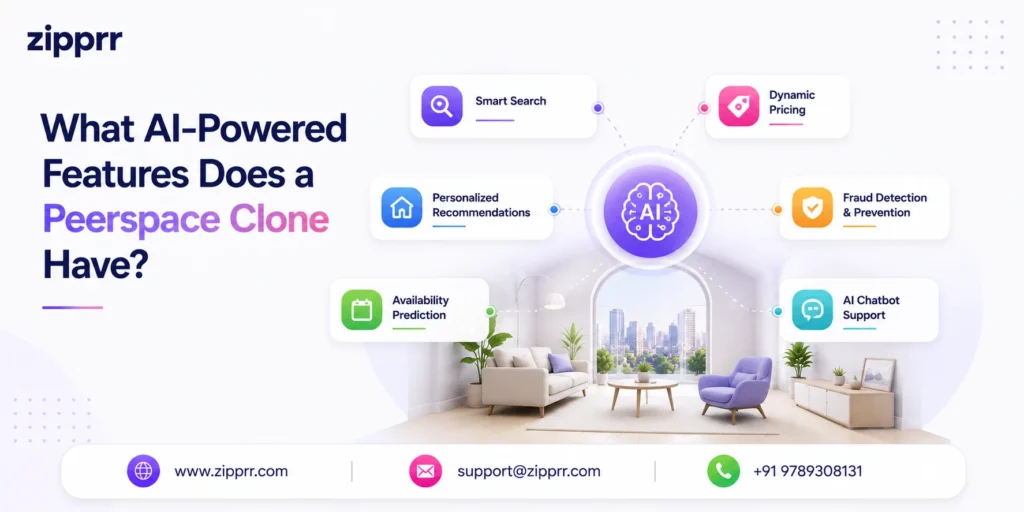
Zipprr’s Peerspace Clone integrates four AI-driven capabilities into the core platform: smart space matching that ranks venues based on event context and user history, a dynamic pricing engine that responds to real-time demand signals, a smart calendar optimization system that identifies and fills revenue gaps in host schedules, and AI fraud detection that evaluates booking risk before any payment is confirmed.
None of these capabilities are add-on modules requiring separate purchase. They are standard components of the platform from day one.
How Does AI Space Matching Work?
The smart space matching system processes each guest’s search query against event type, required capacity, chosen location, and prior booking activity to generate a relevance-ranked list of available venues. Rather than defaulting to a price-sorted output, the platform learns what each individual guest prioritizes and adapts recommendations accordingly. This raises booking conversion rates without any manual curation from the operator.
The matching algorithm evaluates multiple weighted factors simultaneously: how closely the space category aligns with the stated event type, whether the listed capacity fits the guest’s group size, what the sentiment profile of past reviews looks like for comparable event types, and whether the space is available for the requested window. Additionally, listings that score highest for a specific search context receive elevated placement automatically.
How Does Dynamic Pricing Work in a Venue Rental Platform?
The dynamic pricing engine monitors demand signals continuously and adjusts each space’s hourly rate in response: day of week patterns, time-of-day booking density, local event calendar activity, total platform booking volume, and each space’s occupancy history. Also, windows of peak demand carry elevated rates; underperforming time slots receive automatic discount prompts to stimulate bookings.
Hosts operating under dynamic pricing typically realize 20–35% higher revenue per space compared to a static hourly rate. It is a meaningful uplift that requires no additional effort on the host’s part. For the platform, higher per-transaction booking values translate directly into higher commission income without any increase in booking volume.
How Does the Platform Detect Fraudulent Bookings?
The fraud detection layer runs a real-time risk analysis on every booking before payment processing is authorized. It flags accounts showing mismatched identity verification data, abnormal booking frequency patterns, payment card behavior associated with known fraud signals, or activity profiles consistent with platform policy violations. Any booking that exceeds the risk threshold is suspended for admin review before the host receives notification or any payment is captured.
This dual-sided protection prevents hosts from being exposed to guests who damage spaces with no genuine payment intent. It also shields guests from listings created to harvest payment credentials.
What Is Smart Calendar Optimization?
Smart calendar optimization cross-references each host’s booking history with their published availability to identify unfilled revenue gaps. These are time blocks that the platform determines could convert to bookings if pricing or visibility were adjusted. The system generates specific, actionable suggestions for each host: apply a rate reduction to a slow Thursday morning, or activate a last-minute discount to capture a Saturday afternoon that would otherwise go unbooked.
Hosts receive these recommendations as dashboard cards and optional push alerts. The feature functions as a built-in revenue management system for every host on the platform. It surfaces intelligence that would otherwise require a dedicated pricing analyst to generate
What Types of Spaces Can Be Listed on a Peerspace Clone?
A Peerspace Clone accommodates any hourly-bookable space category: photography and creative studios, film and commercial production locations, corporate meeting and boardroom venues, event halls, rooftop terraces, coworking and hot-desk environments, podcast and recording studios, art galleries, pop-up retail and brand activation spaces, and private event venues. In addition, every category is fully configurable through the admin panel with zero code modifications.
Here is how each major space vertical performs within a venue marketplace:
Photography and Creative Studios
Photography studios consistently produce the highest booking frequency of any category on a venue marketplace. Additionally, creators book in recurring patterns, actively refer their professional networks. They also demonstrate strong platform loyalty to listings that deliver accurate representations of the space. A photography studio vertical alone is sufficient to sustain a profitable regional marketplace in any city with an active creative community.
Corporate Meeting and Off-Site Venues
Distributed and remote-first companies generate structurally growing demand for boardrooms, meeting rooms, and half-day off-site retreat spaces. Also, corporate bookings carry above-average order values, recur on predictable quarterly or monthly cycles, and require invoice-based payment processing — all handled natively by the platform’s corporate portal. For operators also accommodating overnight team retreats, our Airbnb Clone extends this hospitality model into short-term residential accommodation.
Film and Production Locations
Commercial production, advertising, and content teams maintain a persistent demand for versatile environments: industrial warehouses, designed residential interiors, loft spaces, rooftop settings, and technically equipped studios. These bookings typically span full days or multi-day periods and command the highest per-booking revenue values across all space categories. In addition, dedicated regional platforms in this vertical face minimal direct competition outside the largest US markets.
Event Halls and Party Venues
Banquet halls, open-plan loft spaces, and elevated outdoor terraces serve a broad guest base: birthday celebrations, networking evenings, brand launch events, pop-up culinary experiences, and professional workshops. Additionally, demand concentrates on weekends and seasonal peaks. This makes dynamic pricing particularly effective for maximizing revenue without increasing listing volume.
Coworking and Flexible Workspace Environments.
Distributed professionals and geographically spread teams book private offices, hot desks, and dedicated meeting pods on an hourly or daily basis. Also, coworking demand fills the revenue gap that weekend-focused event venues experience during weekdays. In fact, converting a space that earns on Saturdays into one generating consistent income across every working day of the week.
Podcast, Recording, and Content Studio Rentals
Content creators — podcast hosts, independent musicians, brand video teams, and streaming professionals — represent one of the highest-growth hourly rental demographics in any major market, and they are almost entirely underserved by dedicated platforms. In addition, a marketplace focused specifically on acoustic studios, recording booths, streaming production setups, and broadcast-quality rooms has a credible path to global vertical ownership within 12–18 months of a well-executed launch.
Pop-Up Retail and Brand Experience Spaces
Independent brands, emerging designers, and established retailers book short-term physical retail environments for product launches, curated pop-up shops, and immersive brand experiences. It is an expanding commercial segment with very limited dedicated marketplace infrastructure serving it at a regional level.
What Technology Powers a Peerspace Clone?
Zipprr’s Peerspace Clone is engineered on React Native for cross-platform mobile delivery, Node.js for the server-side API, React.js for the browser-based web platform, PostgreSQL as the primary relational database, Stripe for all payment infrastructure, Google Maps API for location intelligence and geosearch, and AWS for cloud hosting and media storage. Additionally, the complete stack is production-grade, horizontally scalable, and built for long-term platform growth.
What Frontend Technologies Are Used?
The web-facing platform is built with React.js, producing a fast, component-driven interface that performs reliably across all screen dimensions and device types. Also, mobile applications are developed in React Native, which enables a unified codebase to generate fully native experiences on both iOS and Android — eliminating the cost and complexity of maintaining two separate mobile engineering tracks without any sacrifice in native device integration.
What Backend Technologies Power the Platform?
The platform’s backend is built on Node.js with an Express.js API layer that coordinates all core business logic: booking lifecycle management, payment processing flows, real-time availability computations, commission calculation, notification dispatch, and all administrative data operations. In addition, PostgreSQL serves as the primary database. It is a fully relational, ACID-compliant engine optimized for the high-transaction-volume demands of a live marketplace.
Redis provides session management and powers all real-time platform features, including live messaging and instant availability state updates. Additionally, ElasticSearch handles space discovery queries — delivering fast, faceted search results across large listing inventories with complex filter combinations.
How Are Payments Processed?
Every financial transaction on the platform routes through Stripe, the industry benchmark for marketplace payment infrastructure. Stripe Connect manages split-payment flows — capturing the guest’s payment, deducting the platform’s configured commission, and releasing the remaining balance to the host’s connected Stripe account. Also, damage deposits operate through Stripe’s authorization hold mechanism. This reserves funds on the guest’s card at booking confirmation without executing an immediate charge.
Stripe processes payments across 135+ supported currencies and maintains full PCI-DSS compliance at the infrastructure level. However, the platform itself never stores raw card data. Instead, all cardholder information is tokenized and managed entirely within Stripe’s environment.
Which Cloud Infrastructure Supports the Platform?
The platform runs on Amazon Web Services infrastructure from day one. In addition, static assets and media files are distributed through AWS CloudFront CDN and stored in S3. Also, application workloads run on EC2 instances behind an elastic load balancer that scales capacity in response to traffic patterns. This architecture accommodates growth from the earliest user cohorts through hundreds of thousands of monthly active users without requiring a platform infrastructure redesign.
How Does a Peerspace Clone Make Money?
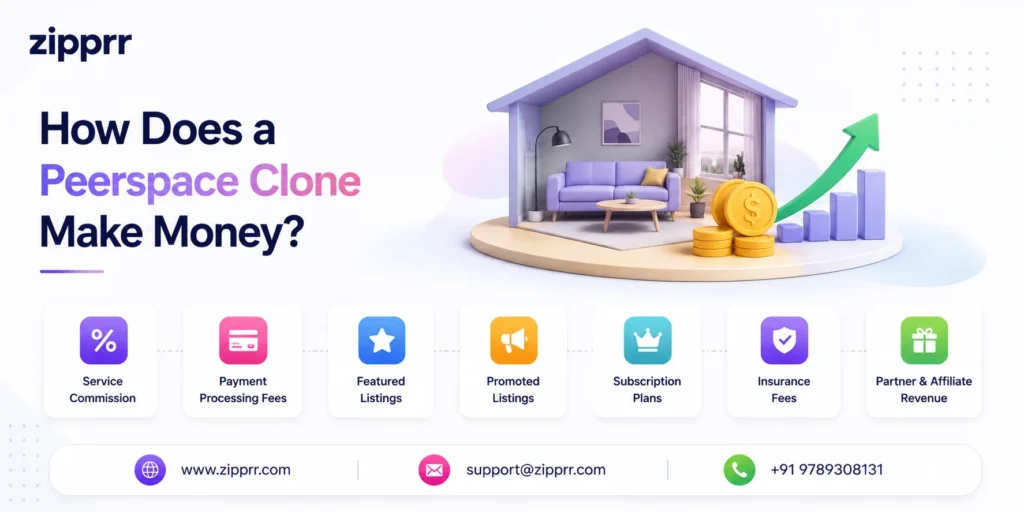
A Peerspace Clone is engineered around five distinct revenue mechanisms: a host commission fee charged on every confirmed booking (15–20%), a guest service fee applied to each transaction (12–18%), subscription tier revenue from frequent hosts who pay for premium access or reduced commission rates, featured placement fees for priority listing visibility, and commissions on add-on services booked through the platform. Additionally, the blended take rate across a standard booking runs between 27–38% of total transaction value.
What Is the Host Commission Model?
Every confirmed and completed booking generates a platform commission deducted automatically from the host’s payout. The rate is typically set between 15–20% of the booking subtotal. Commission rates are configurable globally or by category and host tier, giving operators the flexibility to build tiered structures that reward high-volume hosts with reduced rates while maintaining full-rate collection from the broader base.
A host generating $500 per week in bookings delivers $75–$100 weekly to the platform’s gross margin at zero incremental operational cost. As the number of active hosts on the platform increases, revenue scales proportionally. It is a direct function of listing volume and booking activity rather than additional cost per transaction.
What Is the Guest Service Fee Model?
Guests pay a service fee at checkout calculated as a percentage of the booking subtotal — typically 12–18% — displayed fully and transparently before any payment confirmation is requested. The service fee is collected by the platform on top of the host payout, creating a second revenue event on every completed transaction, independent of the host commission.
A single $200 booking structured with 15% host commission and 15% guest service fee generates $60 in gross platform revenue from one transaction. At scale, the dual-side fee model multiplies revenue per booking compared to single-sided commission structures.
What Other Revenue Streams Does a Venue Marketplace Generate?
Beyond per-booking transaction fees, a Peerspace Clone supports four additional revenue channels: host subscription plans where frequent listers pay a recurring monthly fee for premium features or a reduced commission rate; featured listing placements where hosts pay for elevated position in category and search results; commissions on bookable add-on services such as catering, professional equipment rental, and event photography gear; and corporate account onboarding fees for enterprise clients requiring invoice and PO infrastructure.
Operators who activate all five revenue streams regularly outperform commission-only platforms by 40–60% in revenue generated per listed space. Each layer contributes margin without requiring a proportional increase in platform operating cost.
How Much Does a Peerspace Clone Cost?
Zipprr’s Peerspace Clone is available at $490 for the Basic plan and $890 for the Pro plan — structured as one-time purchases that include complete source code with no recurring licensing fees, no monthly platform charges, and no per-booking royalties. Also, building an equivalent platform through custom development requires $50,000–$300,000 in investment and 6–18 months of engineering time.
What Is Included in the Basic Plan?
The Basic plan at $490 as a single payment delivers the complete core marketplace: native iOS app, native Android app, fully responsive web platform, admin control panel, Stripe payment integration, space listing management, hourly booking engine, in-app messaging, ratings and reviews, and standard post-deployment technical support. In addition, everything required to launch, onboard hosts, and begin processing bookings is included from day one.
The Basic plan is the right starting point for founders who want to validate a market opportunity quickly, launch within a defined city or vertical niche, and progressively unlock advanced capabilities as the platform gains traction.
What Is Included in the Pro Plan?
At $890 one-time, the Pro plan extends every Basic plan capability with the full AI feature suite — smart space matching, dynamic pricing, fraud detection, and calendar optimization — plus 360° virtual tour support, a corporate booking portal with PO and invoice generation, an equipment add-on booking module, an enhanced analytics reporting layer, full multi-language and multi-currency support, and priority technical support access.
The Pro plan is engineered for operators who are launching with enterprise clients in scope, planning multi-city expansion from the outset, or positioning for premium listing quality as a core differentiator. Review the complete Peerspace Clone pricing breakdown for a full feature-by-plan comparison.
How Does the Cost Compare to Custom Development?
Custom development of a venue rental marketplace with the same feature depth costs $50,000–$300,000 with a delivery window of 6–18 months. Additionally, Zipprr’s Peerspace Clone delivers the same foundational infrastructure at $490–$890 with a deployment window of 7–30 days. That is a cost reduction of approximately 99% and a time reduction exceeding 95%.
| Factor | Zipprr Peerspace Clone | Custom Development |
|---|---|---|
| Cost | $490 – $890 (one-time) | $50,000 – $300,000 |
| Launch Time | 7 – 30 days | 6 – 18 months |
| Source Code | Full ownership | Full ownership |
| iOS + Android + Web | All included | Separate builds |
| AI Features | Built-in standard | Optional — additional cost |
| Monthly Fees | None | Ongoing hosting + team |
| Launch Risk | Near zero | Significant |
For operators whose goal is to own a market. The goal is not to fund the engineering of infrastructure that already exists — a Peerspace Clone is the strategically rational decision.
How Does a Peerspace Clone Handle Trust and Safety?
Zipprr’s Peerspace Clone is built around five interlocking trust and safety systems: AI-assisted identity verification applied to every host and guest account, Stripe authorization holds for damage deposit management, a structured and auditable dispute resolution workflow, a booking-verified reviews architecture, and pre-authorization fraud detection that evaluates every booking before payment is processed.
Trust infrastructure is the foundational requirement of any marketplace — not a feature that can be added later. A space owner will not list a professional photography studio worth $2,000 in equipment unless they have meaningful protection against damage and non-payment. A guest will not submit payment for a space they have never physically visited unless they trust the platform to back the transaction. Also, every safety feature in Zipprr’s Peerspace Clone addresses one of these two adoption barriers directly.
How Does Identity Verification Work?
All hosts and guests on the platform complete AI-assisted identity verification as a condition of transacting — either listing a space or completing a booking. In addition, the verification process cross-references a government-issued identification document against a real-time facial biometric capture. Users who have not completed verification can browse listings freely but cannot initiate or receive bookings, and cannot access payouts. Additionally, verification status is visible on every host and guest profile across the platform.
Administrators can view the complete verification record for any account, and the system provides tools to flag accounts for re-verification, place bookings under review, or suspend accounts pending investigation — all from the admin dashboard.
How Are Damage Deposits Managed?
Damage deposit collection operates through Stripe’s payment authorization hold mechanism. The deposit amount configured per listing by the host is placed as a hold on the guest’s payment card at the moment the booking is confirmed — the funds are reserved but not charged unless a damage claim is formally submitted. Also, hosts are given a 48-hour window following the booking’s end time to file a claim with supporting photo and written evidence. When no claim is filed within that window, the hold is released to the guest automatically.
This architecture gives hosts concrete financial protection without creating a double-payment burden for guests. In addition, the identical deposit management model powers our Turo Clone platform for vehicle rental damage protection.
How Are Disputes Resolved?
The dispute resolution workflow is fully structured and documented. Additionally, the host initiates a damage claim by submitting photographic and written evidence through the platform. The guest is notified immediately and given a 24-hour window to submit a response and any counter-evidence. Also, the admin reviews both submissions through a dedicated evidence interface and issues a resolution: full deposit capture, partial charge, or complete release. In addition, every communication in the dispute thread is timestamped and retained in the admin panel for audit purposes.
How Are Reviews Verified?
Every review published on the platform is tied to a verified completed booking — only a guest who finished a fully confirmed booking can submit a review for a space, and only a host whose booking reached completion can review that guest. No anonymous review submissions are accepted. In addition, reviews from cancelled or incomplete bookings are blocked by the system. This ensures that the platform’s reputation signals are grounded entirely in genuine transactional experience.
Consistent high-rating hosts receive automated upward ranking adjustments in search results. Additionally, our Vinted Clone applies the same verified review model to peer-to-peer product marketplace transactions.
How Is Payment Fraud Prevented?
Before any booking payment is processed, the platform’s fraud detection layer performs a real-time behavioral and data analysis: examining the booking pattern for velocity anomalies, checking identity verification data consistency, evaluating payment card risk indicators, and reviewing the account’s activity history against known policy violation profiles. Also, transactions that clear all risk thresholds proceed to payment instantly. As a result, transactions that breach any threshold are suspended and routed to the admin review queue. There, a resolution is issued within 2–4 hours without impacting unrelated bookings.
What Niche Markets Can a Peerspace Clone Serve?
A Peerspace Clone can be configured for any hourly space rental vertical: photography studio marketplaces, corporate off-site booking networks, film and production location platforms, event hall and party venue directories, coworking day-pass booking services, podcast and recording studio marketplaces, and pop-up retail space networks. Each vertical can be deployed as a standalone niche platform or combined into a multi-category marketplace from the same codebase.
Photography Studio Marketplace
Photography studios are the highest booking-frequency vertical on any hourly venue platform. In addition, photographers, videographers, and creative content producers book regularly, actively refer their professional networks to platforms with strong listings. They also demonstrate the kind of retention behavior that keeps customer acquisition costs manageable. A photography-focused platform in any city with an active visual arts community can reach breakeven within 90 days of a well-structured launch.
Corporate Off-Site and Meeting Room Booking
Distributed companies and remote-first teams are a structurally growing demand source for professional short-term spaces. Additionally, corporate clients book at higher average order values, return on predictable schedules — quarterly strategy sessions, monthly team standups, weekly client presentations — and require the kind of billing infrastructure like POs and invoices that the platform’s corporate portal delivers natively. For operators who also want to capture overnight team retreats, our Airbnb Clone extends this hospitality model into short-stay residential accommodation.
Film and Production Location Platform
Commercial production teams, independent filmmakers, and advertising agencies operate with a persistent demand for visually distinctive spaces. Examples include industrial settings, designed residential interiors, architectural rooftops, and purpose-built studio environments. Also, regional markets outside the largest North American cities remain underserved by platforms with the technical specifications and production-grade listings this audience requires. A well-positioned regional platform in this vertical faces limited direct competition.
Coworking and Flexible Workspace Marketplace
Every review published on the platform is tied to a veri Flexible workspace demand fills the weekday revenue gap that exists for venues that primarily book evenings and weekends. In addition, a coworking-focused platform can establish partnerships with hotels, restaurant chains, and underutilized commercial offices — building a hybrid workspace network that earns consistent revenue across the full seven-day week rather than concentrating income on peak periods.
fied completed booking — only a guest who finished a fully confirmed booking can submit a review for a space. Likewise, only a host whose booking reached completion can review that guest. No anonymous review submissions are accepted. Additionally, reviews from cancelled or incomplete bookings are blocked by the system. This ensures that the platform’s reputation signals are grounded entirely in genuine transactional experience.
Podcast, Recording, and Content Studio Rentals.
The global content creator economy is expanding the hourly studio rental market faster than any dedicated platform has yet managed to address. Also, a niche marketplace built specifically for podcast studios, broadcast-quality recording booths, streaming production setups, and audio engineering environments could establish category leadership in this underserved vertical within 12–18 months of a focused launch.
Why Should You Choose Zipprr's Peerspace Clone Solution?
Zipprr’s Peerspace Clone stands as the leading choice for venue marketplace entrepreneurs in 2026 by delivering: fully verified 100% white-label branding, complete unencrypted source code ownership, native iOS, Android, and web apps bundled in one purchase, built-in AI capabilities, multi-language and multi-currency support from the first day, automated damage deposit management, a corporate booking portal for enterprise clients, and a live deployment timeline of 7–30 days.
100% White-Label from Day One
Your brand identity — name, logo, color system, domain, and app store presence — is applied across every platform surface: mobile apps, web interface, booking confirmation communications, admin dashboard, and push notification content. No third-party attribution. No vendor watermarks. In addition, every user interaction occurs entirely within your branded environment.
Full Source Code Ownership
You receive the complete, unencrypted source code covering the iOS application, Android application, web platform, and admin panel in a single delivery. No modules are held back. No licensing terms restrict what your development team can modify, extend, or integrate. Additionally, the code is yours to develop without requiring our involvement in any future change.
iOS, Android, and Web Delivered Together
Most clone solutions deliver the web platform and price the mobile applications separately. Zipprr delivers all three surfaces — native iOS, native Android, and fully responsive web — as a single bundled package, all white-labeled and deployable simultaneously.
AI Capabilities Included as Standard.
Smart space matching, dynamic pricing optimization, smart calendar revenue analysis, and booking fraud detection are built into the platform’s core — not priced as separate enterprise modules. Also, every Zipprr customer accesses AI capabilities from the moment of deployment.
Multi-Language and Multi-Currency Ready.
All platform text is structured for translation through the admin panel. Stripe processes transactions in 135+ currencies. In addition, operators launching in Mumbai, São Paulo, Dubai, or Sydney deploy within existing infrastructure rather than building region-specific technical variants.
Automated Damage Deposit Management
Stripe’s authorization hold mechanism for damage deposits is fully implemented and tested within the platform. Hosts receive financial protection on every booking. Guests are never charged the deposit unless a formally filed and reviewed claim determines it appropriate. This protection layer is among the most cited conversion factors for new hosts evaluating whether to list on an emerging marketplace.
Corporate Booking Portal Available Immediately.
Purchase order generation, invoice workflows, company account management, recurring booking subscriptions, and volume pricing structures are accessible from the admin panel from week one of operation — not as a future upgrade requiring custom development.
Live Within 7 to 30 Days.
The majority of Zipprr customers complete configuration, customization, and deployment within 7 to 30 days of purchase. Additionally, custom development of a comparable platform requires 6 to 18 months. You begin building your host network and acquiring guests while the custom-built alternative is still in the requirements phase.
Request a free live demo of the Peerspace Clone and see every feature demonstrated before making any purchase decision.
View our full pricing structure — Basic plan at $490, Pro plan at $890. One-time payment. Full source code. No ongoing fees.
Peerspace Clone Script vs Custom Development — What Is the Difference?
The defining distinction is this: a Peerspace Clone script delivers a tested, fully featured venue marketplace in 7–30 days for $490–$890 with complete source code included. Also, custom development constructs an equivalent platform from the ground up over 6–18 months for $50,000–$300,000. Both paths deliver source code ownership. Only one delivers it at a cost and speed that makes market entry viable.
| Feature | Zipprr Peerspace Clone | Custom Development |
|---|---|---|
| AI Space Matching | ✅ Standard | Optional — additional cost |
| Dynamic Pricing Engine | ✅ Standard | Optional — additional cost |
| Virtual / 360° Space Tours | ✅ Standard | Optional — additional cost |
| Corporate Booking Portal | ✅ Standard | Optional — additional cost |
| Damage Deposit Automation | ✅ Standard | Optional — additional cost |
| Multi-Venue Host Dashboard | ✅ Standard | Optional — additional cost |
| Full Source Code | ✅ Included | ✅ Included |
| iOS + Android + Web | ✅ All bundled | Separate engineering tracks |
| Equipment Add-On Module | ✅ Standard | Optional — additional cost |
| Identity Verification (AI) | ✅ Standard | Optional — additional cost |
| Verified Reviews System | ✅ Standard | Optional — additional cost |
| Multi-Language and Currency | ✅ Standard | Optional — additional cost |
| Time to Launch | 7 – 30 days | 6 – 18 months |
| Total Investment | $490 – $890 | $50,000 – $300,000 |
Frequently Asked Questions About Peerspace Clone
What is a Peerspace Clone?
A Peerspace Clone is a production-ready, white-label venue rental marketplace platform built for the hourly space booking model. It gives entrepreneurs a complete two-sided platform infrastructure where space owners list and manage venue listings and guests — event organizers, photographers, corporate teams, and content creators — search, book, and pay entirely within the app, without the operator building any of this from scratch. In addition, Zipprr’s version includes AI capabilities, native mobile apps, and full unencrypted source code.
How does a Peerspace Clone app work?
Space owners register on the platform, complete identity verification, and build out venue listings with photos, hourly pricing, capacity details, and availability schedules. Guests search by location, space type, and date, then complete a booking instantly or submit a request for host approval. Additionally, payments — including a configurable damage deposit hold — are processed entirely within the app. Both parties submit reviews after the booking concludes. Also, the admin monitors all platform activity and manages commissions from a centralized dashboard.
What types of spaces can be listed on a Peerspace Clone?
A Peerspace Clone accommodates any bookable space category: photography studios, film and production locations, corporate meeting rooms and boardrooms, event halls, rooftop terraces, coworking environments, podcast and recording studios, art galleries, pop-up retail spaces, and private event venues. In addition, all space categories, search filters, listing fields, and capacity parameters are fully configurable from the admin panel without code modifications.
What features does a Peerspace Clone include?
A Peerspace Clone delivers: rich-media space listings with 360° tour support, hourly availability calendars, instant booking and request-to-book modes, in-app secure payment with damage deposit management, direct host-guest messaging, booking-verified reviews, AI space matching, dynamic pricing optimization, pre-authorization fraud detection, a comprehensive admin control panel, push notification infrastructure, AI-assisted identity verification, and full multi-language and multi-currency support.
How much does a Peerspace Clone cost?
Zipprr’s Peerspace Clone is available at $490 for the Basic plan and $890 for the Pro plan, both structured as single one-time payments with complete source code included and no ongoing licensing fees. Additionally, custom development of a platform with equivalent functionality typically costs $50,000–$300,000 and requires 6–18 months. Review the complete pricing and feature breakdown on the product page.
What is the revenue model of a Peerspace Clone?
A Peerspace Clone generates income through five channels: host commission fees of 15–20% per booking, guest service fees of 12–18% per transaction, monthly subscription plans for high-frequency hosts seeking premium features or reduced commission tiers, featured listing placement fees for premium search positioning, and commissions on add-on services booked through the platform. Also, the combined platform take rate on a standard transaction is typically 27–38% of total booking value.
Can a Peerspace Clone be customized with my own branding?
Yes — comprehensively. In addition, the platform is 100% white-label from initial deployment. Additionally, your brand name, logo, color palette, and domain are applied throughout: mobile apps, web interface, email communications, admin panel, and app store listings. Full unencrypted source code is included in the purchase, enabling your team to modify any feature, redesign any screen, or build any integration after deployment without requiring our authorization. View full customization details on the product page.
Does a Peerspace Clone include mobile apps?
Yes. Additionally, every Zipprr Peerspace Clone package includes native iOS and Android mobile applications for both hosts and guests, alongside the fully responsive web platform — all delivered as a single bundled purchase. In addition, all three surfaces are white-label ready and deploy simultaneously. Preview the Peerspace Clone mobile app experience on our product page.
How long does it take to launch a Peerspace Clone?
A Zipprr Peerspace Clone deployment typically reaches a live, production-ready state within 7 to 30 days, depending on the scope of customization and branding work required. Basic configuration and brand application can be completed within the first week. Custom development of a platform with comparable functionality requires a full engineering team operating for 6 to 18 months before any guest can make a booking.
Does a Peerspace Clone support damage deposits?
Yes. Also, damage deposit management is built into the platform using Stripe’s payment authorization hold. The deposit amount set by each host per listing is placed as a card hold at the moment of booking confirmation — reserved but not charged unless the host files a formal damage claim within 48 hours of the booking’s end time. If no claim is submitted within that period, the hold is automatically released to the guest with no charge applied.
Does a Peerspace Clone support instant booking?
Yes. Each host can independently configure their listing to operate in Instant Book mode — where guests receive immediate confirmation without any manual host approval — or in Request-to-Book mode, where the host personally reviews and approves each incoming booking request. Both modes are available across all plans and can be toggled from the host dashboard at any time without admin intervention.
Can I build a niche venue platform with a Peerspace Clone?
Yes. In addition, the platform’s admin panel provides complete control over space categories, search filters, listing field structures, and pricing logic — making it fully configurable for any narrowly defined niche or broad multi-category marketplace. Whether you are launching exclusively for photography studios, building a corporate meeting room network, or creating a comprehensive multi-vertical marketplace, the platform architecture supports all configurations from the same codebase.
What admin features does a Peerspace Clone include?
The admin panel delivers: full user and host account management, listing submission review and moderation, real-time booking and payment monitoring, flexible commission rate configuration, automated host payout scheduling, structured dispute and damage claim management, promotional campaign deployment tools, live analytics reporting across GMV, booking volume, conversion performance, and top-earning listings, and a built-in CMS for managing platform landing pages and category content.
Does a Peerspace Clone support multiple currencies and languages?
Yes. Additionally, the platform supports multi-currency payment processing across 135+ currencies through Stripe’s infrastructure and full multi-language localization managed through the admin panel. All platform text — including interface labels, notification copy, and booking communications — is translation-ready and configurable without code changes, making the platform deployable in any international or regional market from the first day of operation.
Why choose a Peerspace Clone over building from scratch?
A Peerspace Clone delivers a fully validated, production-tested marketplace at a fraction of the financial and time investment that custom development requires. Also, every core component — booking engine, payment processing architecture, admin control system, and native mobile applications — is already built, tested, and operating. Additionally, you direct your energy toward host acquisition, brand building, and market growth rather than engineering challenges. The Peerspace Clone from Zipprr eliminates development risk, eliminates monthly licensing fees, and gives you a market-ready platform with complete source code ownership.
Next Steps With Your Peerspace Clone
Ready to launch your venue rental marketplace?
we walk you through every feature in a live session, answer every question, and show you the exact path from purchase to live platform.
Basic at $490 / Pro at $890. One-time payment. Complete source code. Zero monthly fees.
Conclusion
The event venue rental industry represents a $116 billion global market expanding at over 6% per year. The core model — connecting space owners with people who need professional environments by the hour. It is validated, scalable, and actively growing across every geography. What most regional and niche markets still lack is a strong, locally operated alternative for the hundreds of millions of event organizers, photographers, corporate teams, and content creators who are underserved by platforms designed exclusively for the largest international markets.
The Peerspace Clone from Zipprr delivers the complete infrastructure: a proven marketplace foundation, an AI-powered booking and pricing engine, a full white-label package that makes the platform entirely yours, and every trust and safety component that transforms a new platform into one that hosts a list of guests and regularly returns to. Whether your vision is a photography studio marketplace in Singapore, a corporate off-site booking network in London, or a local event hall directory in São Paulo, every technical component you need is ready. The only elements left to add are your brand, your market, and your launch.
For entrepreneurs whose interest extends into peer-to-peer asset rental beyond physical spaces, explore our Turo Clone for car-sharing marketplace infrastructure, or our Vinted Clone for peer-to-peer fashion resale marketplace platforms.