


A Zillow clone Canada portal earns money from five paying groups: sellers and landlords who pay per listing, agents who pay monthly subscriptions, agents and brokerages who buy leads, businesses that pay for featured placement, and developers who fund new-build campaigns. Also, buyers and renters browse for free, and that free traffic is the asset everyone else pays to reach.
If you are an entrepreneur planning a city- or province-focused portal, the useful question is which stream to switch on first and how to stack the rest. In addition, the answer shapes your pricing, your launch plan, and the software you pick.
A Zillow Clone from Zipprr gives you the marketplace foundation: listing management, map search, agent dashboards, lead inquiries, buyer accounts, and an admin panel, with agent subscription plans, per-listing fees, and featured promotions already part of the monetization setup.
Zipprr’s Zillow Clone is an independently developed script. Additionally, it has no affiliation with, and is not endorsed by, any real estate brand.
Why Zillow Clone Canada Revenue Looks Different From Other Markets
Canada is a country of regional property markets. Also, each province regulates its own real estate industry, and buyers search city by city, often neighbourhood by neighbourhood. A portal that wins Calgary does not need to win Halifax on day one.
That regional shape is good news for a new founder. In addition, a focused portal can become the obvious place for one city’s agents, landlords, and developers, and that local density is what makes paying customers say yes. To see how large portals structure their own income before you design yours, this breakdown of how a major portal earns is a helpful companion read.
Three Canadian realities influence how you earn:
- Local depth beats national reach. Agents pay for visibility with buyers in their own postal codes, so a tight geography converts better than a thin national spread.
- Two official languages. A bilingual listing experience opens Quebec and bilingual communities elsewhere, and it gives you an edge in markets where search results are mostly English.
- Canadian dollars and Canadian expectations. Prices, taxes, and billing should display in CAD, and your invoices should look familiar to a Canadian small business owner.
Because rules differ by province, speak with a Canadian lawyer or your provincial regulator before you finalise how agents advertise and how referral fees are structured. That one conversation keeps your revenue model clean from the start.
The Revenue Ladder: A Five-Rung Zillow Clone Monetization Framework
Most founders try to switch on every revenue stream at launch. That approach confuses early users and dilutes your message. Instead, a steadier path is to climb in order, adding a rung only when the one below is working.
We call this the Revenue Ladder. In addition, each rung has a trigger that tells you it is time to climb.
- Rung 1, Free discovery. Buyers and renters browse, save favourites, and send inquiries at no cost. Trigger to climb: steady weekly listings and repeat visitors.
- Rung 2, Paid listings. Private sellers and landlords pay a modest fee to publish. Trigger to climb: a few hundred active listings in your launch city.
- Rung 3, Agent subscriptions. Agents pay monthly for a profile, listing slots, and a lead inbox. Trigger to climb: agents asking how to get more inquiries.
- Rung 4, Lead sales. Qualified inquiries are routed to paying agents. Trigger to climb: consistent inquiry volume and reply rates you can measure.
- Rung 5, Featured placement and campaigns. Agents, landlords, and developers pay to appear first. Trigger to climb: busy search pages with real competition for top positions.
The ladder protects the cash flow of a Zillow clone Canada portal and your reputation. Also, each rung rests on proof that people value your portal, so every price you set has a reason behind it.
Want this revenue ladder set up for your city?
Book a free demo and see how a Zillow clone Canada setup runs paid listings, agent subscriptions, lead routing and featured slots running inside a working portal, using your Canadian city as the example.
Rung 2: Zillow Clone Canada Paid Listings for Sellers and Landlords
Paid listings are the most direct way to earn. In addition, a seller or landlord pays a flat fee, and the listing goes live for a set number of days.
In Canada, this works best for independent landlords, owners selling privately, and small property managers who want exposure without hiring a full-service brokerage. Moreover, they already pay for ads elsewhere, so a fair per-listing fee feels familiar.
Design the listing fee around clarity:
- One simple price per listing with a clear duration, such as 30 or 60 days.
- A free first listing for new users, which lowers the barrier and fills your map with real inventory.
- Bundles for repeat posters, such as five listings at a discount, which rewards landlords with several units.
- Easy renewals with a reminder before the listing expires.
Zipprr’s Zillow Clone includes per-listing publishing fees, so you can configure this stream from your admin panel without writing custom code.
Rung 3: Zillow Clone Agent Subscriptions for Predictable Monthly Income
Subscriptions give a Zillow clone Canada portal its steadiest revenue. Also, an agent pays every month for a branded profile, a set number of active listings, and access to the inquiry inbox.
Predictable income lets you plan marketing spend, hire support, and forecast growth. Also, it also builds a base of agents who care about your portal’s success because they have invested in it.
A three-tier structure works well for a city portal:
- Entry tier for newer agents, with a profile and a small listing allowance.
- Growth tier for established agents, with more listings, priority in search results, and lead notifications.
- Brokerage tier for teams, with multiple agent seats, a shared brand page, and reporting.
Keep tier names plain and benefits visible. When an agent can see exactly what the next tier adds, upgrades happen naturally.
Rung 4: Zillow Clone Lead Sales That Reward Agents for Results
Many agents prefer paying for outcomes over paying for exposure. Lead sales let you offer that choice: a buyer or renter submits an inquiry, and the portal routes it to an agent who pays a set price for the contact.
The trick is quality. In addition, a lead is worth paying for when it includes a real name, a working phone number, a property of interest, and a clear timeline. Your inquiry form should collect these details gently, without overwhelming the visitor.
Practical ways to keep lead sales healthy:
- Ask two or three qualifying questions in the inquiry form, such as budget range and move-in timeframe.
- Limit how many agents receive one lead, so each buyer gets a thoughtful reply instead of five competing calls.
- Offer a replacement policy for leads with invalid contact details, which builds agent trust.
- Track response time and show agents their own numbers, because fast replies convert more inquiries.
Canada has federal and provincial privacy rules for personal information, including PIPEDA for private sector organizations and a separate privacy law in Quebec. Moreover, add a clear consent line to every inquiry form, and confirm your lead handling with a Canadian privacy professional before launch.
Rung 5: Zillow Clone Canada Featured Placement and Developer Campaigns
Featured placement sells the top of a page. Agents, landlords, and property managers pay to appear first in search results, on the home page, or at the top of a neighbourhood page.
This stream grows with traffic, which makes it the natural last rung. When a search for “condos near the waterfront” has ten listings competing for attention, a featured slot has real value.
Developers add a second angle. Also, a builder launching a new townhouse community wants a dedicated campaign page, a banner on relevant searches, and a steady flow of registrations. A single campaign can cover several months of a small portal’s hosting costs.
Ideas for featured products that feel useful rather than pushy:
- Top of search for seven days with a visible “Featured” badge.
- Neighbourhood spotlight where one agent owns a neighbourhood page for a month.
- New-build campaign page with floor plans, a registration form, and a lead feed.
- Homepage carousel slot rotating between a few paying advertisers.
Zillow Clone Canada Monetization Map: A Worked Example for a Sample City
Numbers make the Zillow clone Canada revenue ladder easier to picture. In addition, the table below shows a sample month for an imaginary portal serving one mid-sized Canadian city, once all five rungs are active.
These figures are hypothetical sample numbers for planning, not forecasts or results from any real portal. Replace them with prices and volumes from your own market research.
| Revenue stream | Who pays | Sample price (CAD) | Sample monthly volume | Sample monthly revenue (CAD) |
|---|---|---|---|---|
| Paid listings | Landlords and private sellers | 29 per listing | 250 listings | 7,250 |
| Agent subscriptions, Growth tier | Individual agents | 79 per month | 60 agents | 4,740 |
| Agent subscriptions, Brokerage tier | Teams and brokerages | 199 per month | 12 teams | 2,388 |
| Lead sales | Agents and brokerages | 18 per lead | 180 leads | 3,240 |
| Featured placement | Agents, landlords, managers | 35 per slot | 90 slots | 3,150 |
| Developer campaigns | Builders and developers | 600 per campaign | 3 campaigns | 1,800 |
| Total sample monthly revenue | All paying groups | Mixed | Mixed | 22,568 |
Look at how the mix behaves. In addition, subscriptions and listings together form roughly 53 percent of the sample total, giving the portal a stable base. Lead sales and featured slots add upside that grows with traffic.
Now add a sample cost side. Suppose monthly running costs reach CAD 9,000 for local marketing, a part-time support person, hosting, map and SMS usage, and payment processing. That leaves about CAD 13,568 of sample monthly margin.
The lesson is the shape rather than the exact figures. Also, a portal with several modest streams is more resilient than one that depends on a single large one.
How Much Should a Zillow Clone Canada Portal Charge? A Pricing Method That Works Locally
Pricing a new Zillow clone Canada portal feels uncertain because you have no history yet. In addition, a simple method gives you a defensible starting point.
- Collect local reference prices. Note what agents and landlords in your city already pay for ads, signs, and online listings.
- Start below the comfortable ceiling. Launch prices that feel like an easy yes, then raise them as traffic grows.
- Offer a founding member rate. Early agents lock in a lower subscription price in exchange for feedback and testimonials.
- Review quarterly. Compare your price to the inquiries each customer receives, and adjust with data.
Software cost is the other half of your plan. If you want a realistic picture of what a build involves before you decide between custom development and a ready script, this guide on the cost to build a real estate platform with a realtor clone script walks through the numbers.
Canada-Specific Choices That Strengthen Your Zillow Clone Portal
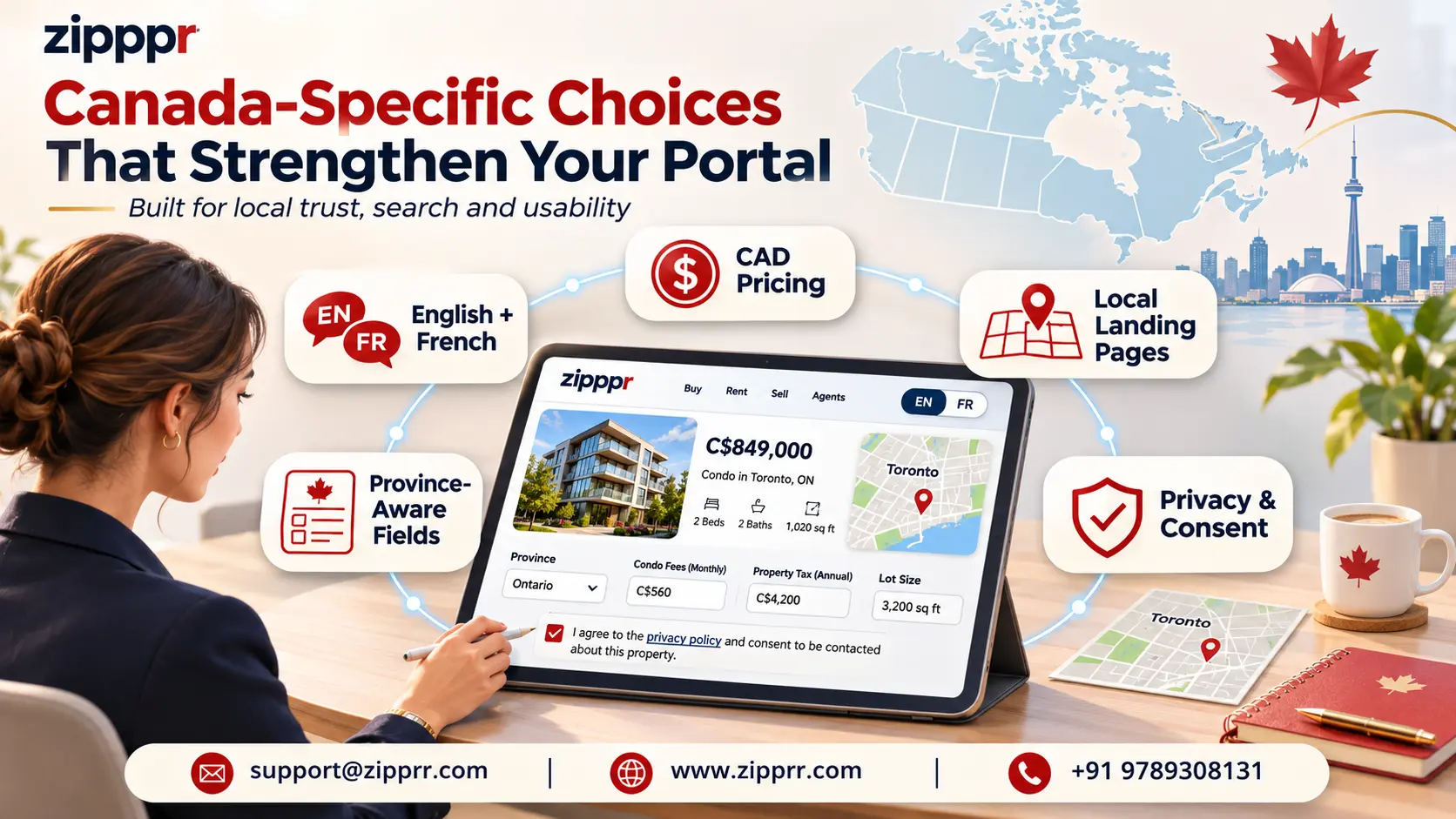
A few design decisions make a Zillow clone Canada portal feel built for Canadians. Also, each one is a small feature with a large trust payoff.
- Bilingual interface. Offer English and French listing pages, filters, and emails. It widens your audience and signals care.
- CAD pricing everywhere. Show prices, fees, and invoices in Canadian dollars so agents and landlords never need to convert.
- City and neighbourhood landing pages. Create pages for each area you serve, with local copy and a map. These pages attract search traffic from people looking for homes in that exact place.
- Province-aware listing fields. Include property types and details that Canadian buyers expect, such as condo fees, property taxes, and lot size.
- Clear consent and privacy language. Plain wording on every inquiry form reassures visitors and protects your business.
Listing data is another planning point. Zipprr’s Zillow Clone supports listings that your agents and landlords add directly. Feeds from real estate boards or data providers are scoped as separate integration work, so decide early whether your launch will rely on direct uploads or a licensed feed.
If you want a development partner to shape those integrations, Zipprr’s real estate app development team can scope them alongside the base script.
Reading the Map: Which Stream Deserves Your Attention First?
The sample table for a Zillow clone Canada portal shows six lines, yet your own portal will lean on one or two of them in the early months. In addition, the right first focus depends on who you can reach fastest.
If you already know many landlords, begin with paid listings and bundles. If you have strong agent relationships, begin with founding member subscriptions. With a developer contact, a single campaign can fund your first quarter of marketing.
Whichever you choose, write down one number to watch each month: active listings, paying agents, qualified inquiries, or featured slots sold. Also, a single clear metric keeps your weekly work focused on growth.
Your First 90 Days: A Zillow Clone Canada Launch Sequence
A clear calendar keeps a new Zillow clone Canada portal moving. In addition, this sequence matches the ladder rungs to realistic milestones.
- Days 1 to 7: Install the script, set your brand, add your city and neighbourhoods, and test the listing and inquiry flows.
- Days 8 to 30: Invite landlords and agents personally, add their first listings yourself if needed, and publish neighbourhood pages. Rung 1 is live.
- Days 31 to 60: Turn on paid listings and founding member subscriptions. Rungs 2 and 3 begin.
- Days 61 to 90: Start routing qualified inquiries to paying agents and test featured slots with a few advertisers. Rungs 4 and 5 begin.
Zipprr states that most buyers launch within 3 to 7 days because installation is included and the full source code is delivered. That leaves nearly all of your 90 days for the work that grows revenue: finding customers and filling the map.
What Zipprr's Zillow Clone Gives You for the Ladder
The product is built around the same revenue logic described above. Core modules include property listing management, advanced search, map-based discovery, a vendor and agent dashboard, lead and inquiry management, buyer accounts with favourites, and an admin control panel.
Pricing is a one-time payment with no subscription, renewal, or revenue share:
- Standard at $490. Includes the responsive website and admin panel, full source code, installation, 90 days of support, and regular updates.
- Pro at $890. Everything in Standard plus Android and iOS apps and app store submission.
Choose Standard when you plan to win your city on the web first. Also, choose Pro when agents and renters in your market expect to search from a phone app. Third-party costs such as hosting, a domain, SSL, and payment, map, or SMS usage are paid to those providers directly.
Every purchase carries a 7-day money-back guarantee, so you can test the fit with confidence. Explore the full Zipprr real estate portal software feature list before you decide.
Next step: see the revenue ladder inside a live demo
Want to see how paid listings, subscriptions, lead routing, and featured slots look inside a working portal? Book your free demo walkthrough, and we will show you the admin settings behind each rung, using your Canadian city as the example.
Zillow Clone Canada Revenue Habits That Keep a Listing Portal Healthy
Zillow clone portals that grow steadily share a handful of habits. Adopt them early, and they become part of your brand.
- Keep listings fresh. Expire old listings automatically and prompt owners to confirm availability. Buyers return to portals they trust.
- Reply to inquiries quickly. Send instant confirmation messages and remind agents about unanswered leads.
- Share results with agents. A monthly report of views, saves, and inquiries shows paying customers the value of their plan.
- Collect testimonials early. A few quotes from founding agents make every later sales conversation easier.
- Publish local content. Neighbourhood guides and market notes attract organic visitors who become inquiries.
These habits cost little, and each one strengthens the value you sell on every rung of the ladder.
Frequently Asked Questions
Revenue Questions
1. How does a Zillow clone make money for a portal owner?
It earns from the people who need exposure to buyers and renters. Additionally, common streams include paid listings, agent subscriptions, lead sales, featured placements, and developer campaigns. Browsing stays free for visitors, so traffic grows and advertisers see value. Also, most portals stack several modest streams instead of relying on one large source.
2. How does a real estate listing website make money?
Online property portals generate revenue mainly through subscriptions from agents and brokerages, per-listing fees from owners and landlords, paid lead delivery, and promoted placements. In addition, many add developer advertising once traffic is steady. The strongest portals begin with one clear stream and add others as their audience grows.
Building and Cost Questions
3. How to build a real estate listing portal in Canada?
Pick one city, choose a script or custom build, add bilingual and CAD support, and invite local agents and landlords to list. In addition, launch with free browsing, then add paid listings, subscriptions, and lead routing. Also, a ready script such as Zipprr’s Zillow Clone installs within days and leaves time for customer acquisition.
4. How much does it cost to build a website like Zillow?
Custom builds vary widely with scope and team. Zipprr’s Zillow Clone offers a ready foundation at $490 for the web platform or $890 with Android and iOS apps and app store submission, both as one-time payments. Hosting, domain, SSL, and payment, map, or SMS usage are separate third-party costs.
5. How to build and monetize a real estate directory website?
Start with structured listings, map search, and agent profiles. Grow inventory first, then monetize in order: paid listings, agent subscriptions, lead sales, and featured placement. Additionally, add a clear admin panel to manage prices and plans. In addition, this sequence builds trust before asking customers to pay more.
Pricing Questions
6. Does a listing portal charge landlords for rental listings?
Many portals offer a free first listing and then charge a modest fee for extended exposure or featured positions. Independent landlords often accept this because it replaces other advertising costs. Also, a flat fee with a clear duration, plus bundles for owners with several units, keeps the offer simple.
7. How much should a listing portal charge agents for leads?
Pricing depends on your city and lead quality. Research what local agents pay for ads and referrals, then start slightly below that range. Collect budget and timeline details in the inquiry form so each lead feels valuable. Moreover, review prices quarterly against how often agents close deals from your leads.
Launch and Setup Questions
8. Can a real estate portal run on a one-time source code purchase?
Yes. With Zipprr’s Zillow Clone, you pay once, receive the complete source code under a commercial licence with white-label rights, and keep all subscription, listing, and lead revenue. Moreover, there is no subscription, renewal, or revenue share to Zipprr. You pay third parties only for hosting, domain, and API usage.
9. Do I need MLS data to launch a listing portal?
No, a portal can launch with listings added directly by agents, landlords, and property managers. Board or MLS-style feeds are separate integrations that are scoped individually. In addition, many founders begin with direct uploads to build a loyal local community, then explore licensed feeds as the business matures.
10. How long does it take to launch a real estate portal?
With a ready script, most Zipprr buyers launch within 3 to 7 days, since the full source code is delivered and installation is included. Also, your exact timeline depends on branding and customization scope, which are confirmed during a free demo. Custom development from scratch typically takes months.
Ready to Build Your Canadian Listing Portal?
Message us on WhatsApp for a customization quote tailored to your city, language options, and revenue plan. Prefer email? Write to [email protected], and the Zipprr team will reply with next steps.
Get a customization quote for your Canadian city
Tell us your city, language options and revenue plan, and the Zipprr team will reply with a tailored quote and next steps. Message us on WhatsApp or book a free demo.