


Zillow is the site almost every American home shopper opens first, yet the company doesn’t buy or sell houses, doesn’t charge browsers a subscription, and doesn’t take a cut of the sale price the way a traditional real estate brokerage does. That combination confuses a lot of people, including the real estate agents, mortgage lenders, and property managers who pay to be on the platform, and the founders who want to build something similar with a platform like Zipprr’s Zillow Clone script. This article breaks down exactly where Zillow’s money comes from, what happened to its infamous home-flipping business, how the company is navigating a rocky 2026, and what a realistic, sustainable revenue model actually looks like for anyone thinking about building a competing or niche real estate marketplace.
How Does Zillow Make Money?
Zillow makes money primarily by selling advertising and leads to real estate agents through its Premier Agent program, which is bundled into a segment the company calls “Residential.” It also earns revenue from mortgage services (its own direct lender, Zillow Home Loans, plus advertising from third-party lenders through its Mortgage Marketplace) and from rental advertising and services sold to property managers and landlords. Zillow does not make money by taking a commission on home sales, and it stopped buying and flipping homes itself (a business called Zillow Offers) in November 2021 after heavy losses. In its 2025 fiscal year, Zillow Group reported total revenue of $2.583 billion, up 16% from $2.236 billion in 2024.
Zillow's revenue at a glance:
- Agent advertising (Premier Agent): the largest revenue source, bundled into the Residential segment at $1.704 billion in FY2025.
- Mortgage services: Zillow Home Loans direct lending plus third-party lender ads through Mortgage Marketplace, $199 million in FY2025.
- Rental advertising: listing fees and Pay-Per-Lease advertising sold to property managers and landlords, $630 million in FY2025.
- What Zillow does not do: earn commissions on home sales, or (since November 2021) buy and resell homes directly.
What Is Zillow's Business Model?
Zillow’s business model is a two-sided online marketplace and media business: it aggregates home listing, rental, and market data to attract a very large audience of home shoppers and renters (the “supply” of attention), then sells access to that audience, in the form of advertising, leads, and software tools, to real estate agents, mortgage lenders, and property managers (the “demand” side that pays). In marketplace terms, Zillow doesn’t sell houses; it sells attention and introductions to the professionals who transact around houses.
This is a familiar pattern across digital marketplaces: a large, free-to-use consumer product funds itself by monetizing the businesses that want access to its users, rather than charging the users directly. It’s the same underlying logic that powers a multi-vendor marketplace style platform in any vertical, and understanding it is the first step before looking at Zillow’s specific revenue lines. If you want to see the architecture and tech stack behind a Zillow-style platform, Zipprr’s Zillow Clone script is built on the same underlying model this article breaks down; this article focuses specifically on the money.
Zillow's Revenue Streams Explained
As of its most recent annual reporting, Zillow Group organizes its business into three reporting segments:
For Sale (which itself contains a Residential sub-segment, largely Premier Agent advertising, and a Mortgages sub-segment), Rentals, and Other. According to Zillow Group’s official Q4 and full-year 2025 financial results, the breakdown for fiscal year 2025 was:
| Segment | FY2025 Revenue | YoY Growth | What It Includes |
|---|---|---|---|
| Residential (part of "For Sale") | $1.704 billion | +7% | Premier Agent advertising, enhanced agent profiles, Showcase listings |
| Mortgages (part of "For Sale") | $199 million | +37% | Zillow Home Loans (direct lending) and Mortgage Marketplace (third-party lender ads) |
| Rentals | $630 million | +39% | Property manager listing fees, Pay-Per-Lease advertising, renter tools |
| Other | $50 million | N/A | New Construction, dotloop, ShowingTime+, display advertising |
| Total | $2.583 billion | +16% | All segments combined |
For context on the trend line, Zillow Group’s total revenue has moved as follows over the last several fiscal years: $1.624 billion (2020), $2.132 billion (2021), $1.958 billion (2022), $1.945 billion (2023), $2.236 billion (2024), and $2.583 billion (2025), reflecting a dip in 2022-2023 tied largely to the wind-down of the Zillow Offers home-buying business, followed by renewed growth once the company refocused on advertising, mortgages, and rentals.
Agent Advertising and Zillow Premier Agent
Premier Agent is the core of Zillow’s business. It’s a pay-for-performance advertising program: real estate agents and teams pay Zillow to have their contact information, profile, and “Contact Agent” or “Request a Tour” buttons surfaced on high-traffic listing pages in their local market. Zillow doesn’t charge a flat listing fee to agents; instead, pricing is typically driven by local market competition and the volume of buyer leads (clicks, calls, and contact-form submissions) an agent wants to receive, which is why Premier Agent cost varies widely by ZIP code and price tier. Some industry estimates put Premier Agent leads anywhere from roughly $20 to over $100 each depending on the market, though Zillow does not publish a fixed public rate card, so treat any specific per-lead number as an estimate rather than an official figure.
Zillow itself does not break out “Premier Agent” as a standalone disclosed line item separate from the broader Residential segment, so third-party claims that it represents a specific fixed percentage of total revenue (figures like 65% or 70% circulate across various blogs) should be treated as industry approximation, not an official Zillow-reported number. What is verifiable is that Residential/Premier Agent advertising, at $1.704 billion in FY2025, is comfortably the largest single contributor to Zillow’s total revenue. Agents who want a lower-cost alternative to Zillow’s lead auction increasingly look at platforms built on Zipprr’s Zillow Clone script to run their own branded lead-generation channel instead of renting attention from a third-party portal indefinitely.
Mortgage Services
Zillow’s Mortgages sub-segment combines two distinct businesses: Zillow Home Loans, where Zillow acts as a direct mortgage lender and earns origination-related revenue, and Mortgage Marketplace, where third-party lenders pay to advertise their rates and services to Zillow’s home-shopping audience, the same advertising logic as Premier Agent, applied to lenders instead of agents. At $199 million in FY2025 and growing 37% year over year, this is Zillow’s fastest-growing reported segment, reflecting the company’s broader strategic push toward what it calls a “housing super app” that keeps the touring, financing, and closing process inside its own ecosystem rather than referring buyers elsewhere.
Rental Advertising and Services
The Rentals segment monetizes the other side of the housing market: property managers and individual landlords pay Zillow for listing visibility, Pay-Per-Lease advertising (where the property manager pays only once a qualified renter signs a lease), and tools like tenant screening. Zillow reports approximately 2.5 million average monthly active rental listings across its network. At $630 million in FY2025 and up 39% year over year, Rentals has become Zillow’s second-largest and fastest-scaling segment behind Residential, accelerated in part by Zillow’s 2021 acquisition of StreetEasy and its ongoing rental-listings partnership with Redfin, a deal that has since drawn regulatory scrutiny (more on that below).
The Rise and Fall of Zillow Offers
Between 2018 and 2021, Zillow ran a very different kind of business alongside its advertising model: Zillow Offers, an “iBuying” operation that used algorithmic pricing to make cash offers directly on homes, then resold them after light renovation. It was a genuine attempt to become a real estate transaction business, not just a media business, and at its peak it was reportedly responsible for a large share of Zillow’s total revenue in dollar terms (though, notably, at very thin or negative margins, since buying and reselling houses is a low-margin, capital-intensive business compared to selling advertising).
The program collapsed quickly. On November 2, 2021, Zillow announced it was shutting Zillow Offers down entirely. CEO Rich Barton said publicly that “we have been unable to predict future pricing of homes to a level of accuracy that makes this a safe business to be in.” The damage was significant: Zillow reported an iBuying-related loss of more than $380 million in the third quarter of 2021 alone, and the company planned inventory write-downs of up to $569 million through the second half of that year as it tried to sell off thousands of homes it had already purchased. Zillow ultimately laid off roughly a quarter of its workforce as part of the wind-down.
The lesson for anyone studying Zillow’s business model is that not every revenue stream a platform touches is a good one to scale. Advertising, lead generation, and SaaS-style tools (like Premier Agent, Mortgage Marketplace, and Rentals) all share a common trait: they carry very little balance-sheet risk, because Zillow never owns the underlying asset. Zillow Offers broke that pattern by putting the company’s own capital directly at risk on tens of thousands of individual home-price bets, in a market that turned out to be less predictable than its pricing algorithm assumed. It’s a cautionary tale that shows up repeatedly in how competing iBuyers like Opendoor have also had to scale back and re-strategize their own home-buying operations in the years since.
How Real Estate Portals Make Money in General
Zillow’s model isn’t unique to Zillow; it’s the dominant pattern across real estate portals globally, though competitors weight the revenue streams differently. Seeing them side by side clarifies what’s actually replicable for a new entrant.
| Platform | Primary Revenue Model | Notable Characteristic |
|---|---|---|
| Zillow | Agent advertising (Premier Agent), mortgage advertising/lending, rental advertising | Largest audience in the U.S.; exited direct home-buying (iBuying) in 2021 |
| Redfin | Brokerage commissions from its own licensed agents, plus rental-listing advertising through a partnership with Zillow | Operates as an actual brokerage in addition to a listings portal, a hybrid model Zillow doesn't use |
| Realtor.com | Agent advertising and lead generation, similar in structure to Premier Agent | Operated by Move, Inc.; positions itself around "official" MLS data accuracy as a differentiator |
| Opendoor | Buys and resells homes directly (iBuying), plus ancillary title/escrow and services revenue | The model Zillow tried and exited; still capital-intensive and sensitive to home-price swings |
The pattern that emerges: portals that stick to advertising, lead generation, and SaaS tools tend to scale with healthier margins because they never take ownership risk on physical property. Portals or hybrids that take on inventory (iBuying) or licensed brokerage operations (Redfin) trade that margin profile for a shot at capturing more of the transaction value: a fundamentally different, higher-risk bet.
Zillow's 2026 Business Challenges
Zillow’s business model is being tested on two fronts in 2026, and both are relevant to anyone studying how durable this kind of revenue model really is.
Financial highlights, Q2 2026:
- Quarterly revenue grew 18% year over year to $772 million.
- Mortgage revenue up 75% to $84 million; rentals up 31% to $209 million; residential up 7% to $465 million, strong top-line growth across every segment.
- The company still posted a $4 million net loss for the quarter, driven by a $36 million restructuring charge (with another estimated $23-28 million expected in Q3).
- The restructuring charge is tied to cutting more than 500 jobs, roughly 7% of its workforce, as part of an efficiency push.
Regulatory pressure:
- The FTC and five state attorneys general have brought an antitrust suit challenging Zillow’s roughly $100 million rental-listings partnership with Redfin, alleging it functions as an agreement to reduce competition in the rental-advertising market.
- A trial was scheduled for August 24, 2026.
- Zillow disclosed roughly $26 million in litigation-related spending year-to-date as of Q2 2026 alone.
Whatever the outcome, the case is a reminder that even a purely advertising-based marketplace model can attract serious regulatory attention once it reaches enough scale in a category, a consideration worth keeping in mind for any founder planning to grow a real estate marketplace aggressively through partnerships and consolidation rather than organic competition.
The Technology Behind Zillow's Business Model
Zillow’s revenue model only works because the underlying technology is built to support it, and this is the part most business-model breakdowns skip entirely. Three technical capabilities do most of the work:
- A real-time listings and data-matching engine. Zillow ingests MLS feeds, public records, and user-submitted data, then indexes and ranks listings so that home shoppers land on the highest-intent pages, which is exactly where Premier Agent ad placements need to appear to be valuable to paying agents.
- A lead-routing and CRM layer. When a shopper clicks “Contact Agent,” that lead has to be captured, scored, and routed instantly to the agent who paid for that ZIP code and price tier, with enough tracking to prove ROI back to the paying customer (the agent). This is effectively a B2B SaaS product sitting on top of a consumer marketplace.
- A valuation and pricing engine. Tools like Zestimate (Zillow’s automated home-value estimate) rely on machine-learning models trained on historical sales, tax, and market data. This is also the technology that powered, and ultimately undermined, Zillow Offers, since pricing accuracy directly determined whether the company made or lost money on every home it bought.
Any team building a Zillow-style marketplace has to treat these as first-class product requirements from day one, not features to bolt on later, because the entire monetization model depends on them working reliably at scale.
How to Build Your Own Real Estate Marketplace Business
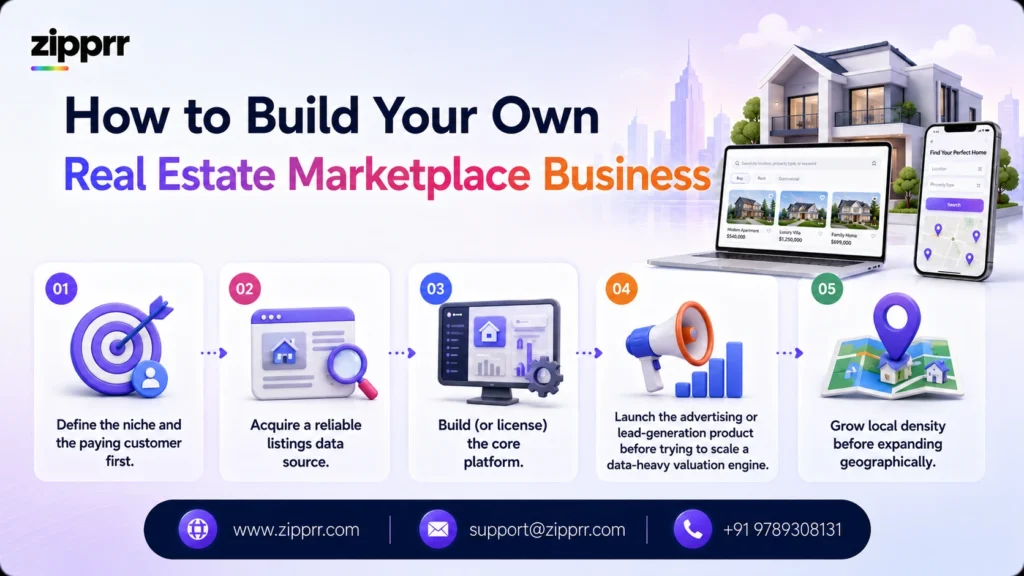
Zillow’s specific scale isn’t realistic for a new entrant to target directly, and it doesn’t need to be. Most successful real estate marketplace businesses today are built around a narrower niche (a single metro area, a property type like vacation rentals or commercial space, or a specific audience like first-time buyers or a particular country’s market) where a large incumbent has weaker local density. Building a comparable business generally follows five steps:
- Define the niche and the paying customer first. Decide upfront whether the business will monetize agents, landlords, lenders, or a combination, since that decision shapes which features matter most.
- Acquire a reliable listings data source. This can mean MLS/IDX integration in the U.S., landlord/property-manager direct submissions, or a hybrid. Without accurate, fresh listings, the consumer side of the marketplace never reaches critical mass.
- Build (or license) the core platform. This includes consumer-facing search and listing pages, a professional-facing dashboard, lead capture and routing, and an admin panel for moderation and monetization controls, matching the architecture and tech stack outlined earlier in this article.
- Launch the advertising or lead-generation product before trying to scale a data-heavy valuation engine. Zestimate-style AVM (automated valuation model) tools take years of data and tuning to get right; advertising and lead-routing monetization can start generating revenue from day one.
- Grow local density before expanding geographically. Real estate marketplaces are hyperlocal: a platform with deep listing coverage in one metro area is more valuable to both shoppers and paying agents than one with thin coverage spread across the whole country.
Revenue Models for a New Real Estate Marketplace
A new entrant doesn’t have to copy Zillow’s exact segment mix. The table below lays out the realistic monetization options, in roughly the order most founders should evaluate them:
| Revenue Model | How It Works | Risk Level |
|---|---|---|
| Agent/broker advertising | Charge real estate professionals for placement, leads, or enhanced profiles on high-traffic listing pages | Low: no inventory risk, proven by Zillow, Realtor.com |
| Featured/promoted listings | Property owners or agents pay a flat fee or subscription to boost a specific listing's visibility | Low: simple to implement, predictable revenue |
| Lead-generation commission | Charge a fee only when a shopper's inquiry converts into a qualified lead or booked appointment | Low-Medium: performance-based, but requires reliable lead-tracking technology |
| Mortgage/service-provider advertising | Lenders, insurers, movers, and inspectors pay to advertise to users at the point of transaction | Low: ancillary revenue that scales with core traffic |
| SaaS tools for professionals | Subscription software for agents/property managers (CRM, showing scheduling, e-signatures) | Low-Medium: sticky recurring revenue, but requires ongoing product investment |
| Transaction/brokerage commission | Operate as a licensed brokerage and earn a percentage of each closed sale (Redfin's model) | Medium: regulatory licensing required, revenue tied to transaction volume |
| iBuying / direct property purchase | Buy properties directly and resell them (Zillow Offers', Opendoor's model) | High: capital-intensive, exposed to home-price volatility, proven difficult even for well-funded players |
A new entrant doesn’t have to copy Zillow’s exact segment mix. The table below lays out the realistic monetization options, in roughly the order most founders should evaluate them:
Challenges and Solutions for New Entrants
Three obstacles come up consistently for founders trying to replicate this model at a smaller scale:
- Chicken-and-egg liquidity. Agents won’t pay for leads on a platform with no traffic, and shoppers won’t return to a platform with thin listings. Solution: seed the marketplace with a manageable, hyperlocal geography first, and consider aggregating public listing data to bootstrap inventory before recruiting paying advertisers.
- Data licensing and accuracy. In the U.S., MLS/IDX access involves broker agreements and compliance requirements that take real time to set up correctly. Solution: budget for this in the launch timeline rather than treating it as a late-stage detail, and start with the data sources (public records, direct landlord submissions) that don’t require MLS relationships if speed to market matters most.
- Underestimating the tech investment behind lead-routing and analytics. Many first-time platform builders focus entirely on the consumer-facing app and treat the professional/lead-management side as an afterthought, but that side is where the revenue actually gets collected. Solution: prioritize the agent/landlord dashboard and lead-tracking system with the same seriousness as the consumer app, from day one.
Why Choose a Ready-Made Script Instead of Building From Scratch
Building a Zillow-style platform from zero (search, listings management, lead routing, admin controls, and mobile apps) typically takes a development team six to twelve months and a six-figure budget before a single paying agent can be onboarded. For most founders, that timeline and cost only make sense once the business model and target market are already validated. This is where a ready-made, white-label real estate marketplace script becomes a practical middle ground. A solution like Zipprr’s Zillow Clone script packages the core pieces described earlier in this article as pre-built, tested software:
- The listings engine that indexes and ranks properties for search.
- Agent and landlord dashboards for managing listings, leads, and payouts.
- Lead-routing tools that capture and assign buyer or renter inquiries.
- An admin panel for monetization rules, moderation, and analytics.
A founder can brand this, configure it for their chosen monetization model (advertising, featured listings, lead fees, or a combination), and launch in weeks rather than months, focusing on liquidity, local data quality, and go-to-market strategy instead of re-engineering infrastructure other platforms have already solved. It’s worth reviewing the full feature list on the Zipprr’s Zillow Clone script page before committing, since the right starting point depends on which revenue model and market you’re targeting, and the broader case for why real estate clone scripts are gaining ground as a category is worth understanding too, since it explains why so many new entrants are choosing this path over custom development in 2026.
Ready to Launch Your Own Real Estate Marketplace?
Understanding Zillow’s business model is the easy part; building the platform to run one is the harder part. If a leaner, niche version of this revenue model fits your market, Zipprr’s Zillow Clone script already includes the listings engine, agent dashboard, lead-routing tools, and admin panel this article covers, pre-built and ready to brand. Reach out to the Zipprr team to get a live demo and a cost estimate for your launch.
How does Zillow make money?
What is Zillow Premier Agent and how does it work?
Is Zillow Premier Agent worth the cost for real estate agents?
Why is Zillow free for home buyers and sellers?
Why did Zillow Offers (Zillow's iBuying business) fail?
How do real estate portals make money in general?
What percentage of Zillow's revenue comes from advertising vs. mortgages vs. rentals?
Is Zillow profitable?
How do I build a website or app like Zillow?
What business model should a new real estate marketplace startup use?
Conclusion
Zillow’s business model is, at its core, an advertising and lead-generation business built on top of the largest real estate audience in the U.S., not a real estate brokerage, and, since 2021, not a home-buying business either. Premier Agent advertising, mortgage services, and rental advertising now do the vast majority of the work, growing 16% to $2.583 billion in FY2025, while the company continues to navigate real 2026 pressures around workforce restructuring and antitrust scrutiny of its rental-listings partnerships. For founders studying this model as a blueprint, the takeaway isn’t to copy Zillow’s national scale; it’s to copy its risk profile: monetize attention and leads before ever considering the far riskier business of owning property directly. Whether that’s built from scratch or launched faster on a proven real estate marketplace script like Zipprr’s Zillow Clone script, understanding these mechanics first is what separates a durable platform from a costly experiment.