
Online grocery shopping stopped being a pandemic-era convenience years ago and turned into a permanent shift in how people buy food and household essentials. Yet for entrepreneurs who want a piece of that market, the path forward isn’t obvious. Building a grocery delivery platform from scratch means months of engineering work across four separate applications – customer, shopper, vendor, and admin – before a single order can be placed. That complexity is exactly why a growing number of founders are turning to a grocery delivery script: pre-built software that replicates the mechanics of Instacart, Shipt, or a regional grocery delivery app, ready to be branded, configured, and launched in weeks instead of months.
This guide covers everything a founder needs before making that decision: what a grocery delivery script actually is, how the underlying business works, which business and revenue models are available, what realistic costs look like, how to launch step by step, and where most new grocery delivery businesses run into trouble. It also includes ten of the most common questions people ask before starting one, answered directly and without the sales fluff.
A grocery delivery script is a pre-built, customizable software platform that lets an entrepreneur launch an on-demand grocery ordering and delivery business – similar to Instacart – without building the technology from the ground up. It typically bundles a customer-facing app and website, a shopper/delivery-partner app, a vendor or store panel for inventory and order management, and an admin dashboard for commissions, payouts, and operations. Instead of spending six to twelve months and a six-figure engineering budget on custom development, a founder licenses a working platform, brands it, connects local stores or a warehouse, and starts taking orders – often within two to six weeks.
What Is a Grocery Delivery Script?
A grocery delivery script – sometimes marketed as an “Instacart clone” – is ready-made software that reproduces the core functionality of a grocery delivery marketplace: browsing products, placing orders, assigning a shopper or delivery partner, and delivering groceries to a customer’s door. The word “clone” here refers to functional similarity, not to copied code; a legitimate script is built as original software that mirrors a proven, well-understood user flow rather than replicating any single company’s proprietary source code or trademark.
Functionally, a grocery delivery script is a specific application of a broader category: on-demand, multi-sided marketplace software. It shares its underlying architecture – vendor onboarding, order routing, commission logic, and payments – with other on-demand platforms. If the goal is to understand how that architecture generalizes across product categories, Zipprr’s multi-vendor marketplace model breakdown is a useful companion reference, since many grocery delivery businesses are run as a variant of a multi-vendor marketplace with individual stores acting as independent sellers.
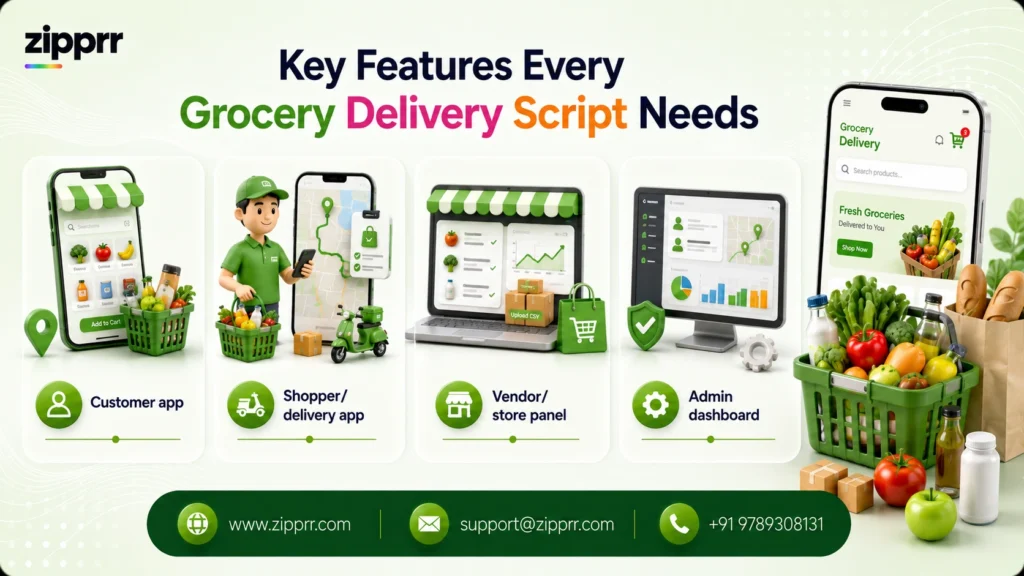
A complete grocery delivery script is made up of four connected components:
- Customer app/website – product browsing by category or store, search, cart, scheduled or instant delivery, order tracking, and payments.
- Shopper/delivery partner app – order assignment, in-store picking lists, substitution handling, navigation, and earnings tracking.
- Vendor/store panel – catalog and inventory management, order queue, promotions, and a sales dashboard for each participating store.
- Admin dashboard – commission and payout control, delivery-zone configuration, vendor approval, dispute resolution, and analytics across the whole operation.
Ready-made products such as Zipprr’s grocery delivery script package all four of these components together, along with native Android and iOS apps, so a founder is buying a functioning platform rather than a blank codebase that still needs to be engineered.
How Does a Grocery Delivery App Work?
Every grocery delivery platform, regardless of which business model sits behind it, follows roughly the same five-step order flow:
- Browse and order. The customer opens the app, selects a store or browses a combined catalog, adds items to a cart, and chooses a delivery window (instant, scheduled, or a fixed slot).
- Order routing. The platform assigns the order to the relevant store (or warehouse) and, in marketplace models, to an available shopper based on proximity, current load, and delivery zone.
- Picking and substitution. The shopper or store staff picks the items from the shelf. If an item is out of stock, the app’s substitution workflow lets the shopper suggest an alternative or contact the customer directly before checkout is finalized.
- Delivery. The picked order is handed to a delivery partner (who may be the same person who shopped it, depending on the model) and delivered to the customer’s address, with live tracking visible the entire time.
- Payment and payout. The customer is charged automatically at checkout; the platform deducts its commission and fees, then settles the remaining balance to the store and the shopper/delivery partner, usually on a scheduled payout cycle.
The entire value proposition rests on removing two points of friction at once: customers no longer need to physically visit a store, and participating stores get access to delivery demand and logistics they would otherwise have to build themselves.
Why the Online Grocery Delivery Market Is Growing in 2026
The growth behind this category isn’t speculative – it’s already reflected in market sizing. According to Mordor Intelligence’s industry research, the global online grocery delivery market was valued at approximately $0.91 trillion in 2026 and is projected to reach $2.43 trillion by 2031, a compound annual growth rate of roughly 21.68% over that period. That pace is significantly faster than general e-commerce growth, driven by rising smartphone-led shopping habits, faster fulfillment expectations, and grocery retailers actively investing in delivery infrastructure rather than treating it as an experiment.
Instacart’s own reported financials illustrate what a mature player in this category looks like in practice: published analyses of the company’s results show it generated roughly $3 billion in revenue in 2023, up about 20% from 2022, split between transaction-based revenue (fees, subscriptions) and a fast-growing advertising business, while serving millions of active monthly customers across more than 80,000 partner stores in the U.S. and Canada. That scale isn’t the realistic starting point for a new entrant – but it demonstrates that grocery delivery, unlike many trend-driven app categories, has a durable, monetizable demand base rather than a temporary spike.
Part of that growth is also technology-driven, not just demand-driven. Route optimization, demand forecasting, and automated substitution suggestions are increasingly built with AI rather than static rules, and AI is already reshaping how grocery delivery apps operate – from smarter inventory prediction to reducing missed or incorrect substitutions, both of which directly affect customer retention.
Grocery Delivery Business Models Compared
Not every grocery delivery business is structured the same way. Choosing the wrong model for your available resources is one of the most common – and most expensive – early mistakes founders make. There are five common approaches:
| Business Model | How It Works | Best For | Startup Complexity |
|---|---|---|---|
| Marketplace model | Platform connects multiple independent stores to customers; stores manage their own inventory | Founders without owned inventory who want to onboard local grocers/supermarkets | Medium - requires vendor recruitment |
| Aggregator model | Platform lists products from stores it doesn't own and manages shopping/delivery itself | Markets with many small stores lacking their own delivery capability | Medium-high - heavier operational load |
| Single-store/chain model | One retailer or chain runs its own branded delivery app | Existing grocery retailers extending into delivery | Low - narrower scope, one catalog |
| Quick-commerce (dark store) model | Platform operates its own small fulfillment warehouses for 10–30 minute delivery | Urban markets prioritizing speed over selection | High - requires owned inventory and real estate |
| Subscription/farm-to-home model | Recurring delivery of curated boxes (produce, essentials) on a schedule | Niche, loyalty-driven audiences | Low-medium - simpler logistics, smaller catalog |
Most first-time founders start with the marketplace or single-store model because both can launch without owning inventory or warehouse space, and both map directly onto the standard four-panel structure (customer, shopper, vendor, admin) that a grocery delivery script already provides out of the box.
Key Features Every Grocery Delivery Script Needs
A grocery delivery platform is judged on execution details most competitors overlook – substitution handling, real-time inventory accuracy, and delivery-zone precision matter more here than in most other on-demand categories, because customers are ordering perishable goods they can’t inspect before checkout.
| Panel | Must-Have Features |
|---|---|
| Customer app | Address-aware storefront, category/brand browsing, live cart, instant or scheduled delivery, multiple payment methods, order tracking, reorder/shopping lists, coupons and wallet credit |
| Shopper/delivery app | Order queue, in-store picking checklist, substitution suggestions with customer approval, navigation, proof-of-delivery, earnings dashboard |
| Vendor/store panel | Bulk catalog upload (CSV), real-time stock updates, order management, store-level promotions, sales and payout reporting |
| Admin dashboard | Vendor and delivery-partner approval, commission and tax configuration, delivery-zone mapping, dispute resolution, multi-store/multi-city management, live operations view |
Two features deserve special attention because they’re the most common source of customer complaints in grocery delivery specifically: real-time inventory sync (to prevent customers from ordering items that are actually out of stock) and a clear, low-friction substitution workflow (so an out-of-stock item doesn’t automatically become a refund or a support ticket).
How Grocery Delivery Businesses Make Money
A grocery delivery platform typically combines several revenue streams rather than relying on just one – this matters because commission alone is rarely enough to cover delivery logistics costs at a sustainable margin.
| Revenue Stream | How It Works | Typical Use |
|---|---|---|
| Commission on orders | Percentage fee charged to the store/vendor per completed order | Marketplace and aggregator models |
| Delivery fees | Flat or distance-based fee charged to the customer per order | Nearly all models |
| Item markup | Small price increase on catalog items vs. in-store pricing | Aggregator and quick-commerce models |
| Subscription/membership | Recurring fee for free or discounted delivery, priority slots | Platforms optimizing for order frequency |
| Advertising | Featured placement or sponsored listings sold to brands/vendors | Larger platforms with meaningful traffic |
| Surge/priority pricing | Extra fee for express or peak-time delivery | High-density urban markets |
Instacart’s published business breakdown is a useful real-world reference for how these streams mature over time: while transaction revenue (fees and subscriptions) remains the core driver, advertising has become one of the fastest-growing lines as the platform scales – a pattern worth planning for even at a much smaller starting scale, since ad revenue from local vendors can become meaningful well before a platform reaches national scale.
How Much Does It Cost to Build a Grocery Delivery App?
Cost is where most independent research on this topic stays vague – competing guides describe features at length but rarely give a founder a real number to plan around. There are two realistic paths, and the cost difference between them is substantial.
| Approach | Typical Cost | Typical Timeline | What's Included |
|---|---|---|---|
| Custom development from scratch | $40,000–$150,000+ | 6–12 months | Fully bespoke design and features, but requires hiring or contracting a full dev team, QA, and ongoing maintenance |
| Ready-made grocery delivery script | Roughly $500–$1,000 one-time (varies by vendor and feature tier) | 2–6 weeks | Pre-built customer, shopper, vendor, and admin apps; source code; installation support; often includes native mobile apps |
As a concrete, transparent example, Zipprr’s ready-made grocery delivery script is offered at two fixed tiers – a Basic package and a Pro package – both as one-time payments that include source code, server installation, a multi-month support window, and native Android and iOS apps, with no per-order fees or revenue share taken by the vendor. That fixed-cost, no-revenue-share structure is worth comparing carefully against agency quotes, since many custom-development shops price the initial build low but attach ongoing maintenance retainers or per-transaction charges that add up over a platform’s first year.
The right choice generally comes down to one question: does the business need a genuinely novel feature set that no existing script supports, or does it need to start generating orders and real market feedback as quickly as possible? For most first-time grocery delivery founders, speed to market and cash preservation outweigh the marginal benefit of a fully custom build.
How to Start a Grocery Delivery Business: Step-by-Step
- Choose your business model. Decide between marketplace, aggregator, single-store, quick-commerce, or subscription based on whether you’ll own inventory and how much delivery infrastructure you’re prepared to run yourself.
- Define your service area. Start with a single city or a small cluster of neighborhoods; grocery delivery margins depend heavily on delivery density, so a tightly bounded launch zone outperforms a wide, thin one.
- Recruit initial supply. Sign on a handful of local grocery stores, or set up your first small fulfillment location, before opening customer signups – you need inventory ready on day one.
- Select your platform. Choose between a ready-made grocery delivery script and custom development based on your budget, timeline, and how differentiated your feature needs actually are.
- Configure commission and payout rules. Set vendor commission percentages, delivery fee structure, and payout schedules before launch, not after the first disputes arise.
- Recruit delivery partners. Build a base of shoppers/drivers sized to your expected order volume in the launch zone; under-supply during week one is one of the most common causes of early churn.
- Run a soft launch. Open to a limited customer list first to stress-test substitution handling, delivery-zone accuracy, and payment flows before a public marketing push.
- Market locally. Focus early marketing on hyper-local channels (community groups, local search, partnerships with the stores themselves) rather than broad paid acquisition, since delivery capacity is still limited.
- Monitor unit economics weekly. Track cost per delivery, average order value, and repeat order rate from week one – these three numbers determine whether the business model is actually viable before you scale spending.
- Expand deliberately. Add delivery zones, stores, or a second city only after the first zone hits consistent, profitable order volume.
Challenges in Running a Grocery Delivery Business (and How to Solve Them)
Grocery delivery has a few operational challenges that don’t show up in most generic “on-demand app” guides, because groceries behave differently from rides, meals, or packages.
Perishability and substitutions. Unlike a restaurant order, a grocery order can have a dozen items, any of which might be out of stock or need a substitute. Solution: build substitution rules directly into the shopper app (suggest → customer approves via push notification → proceed), rather than leaving it to phone calls or after-the-fact refunds.
Thin margins on delivery logistics. Delivery costs per order are relatively fixed regardless of basket size, which punishes small orders. Solution: set a minimum order value for free or discounted delivery, and use delivery-fee tiers based on distance and order size rather than a flat rate.
Inventory accuracy across multiple stores. In marketplace models, stock levels can go stale quickly if vendors don’t update inventory in real time. Solution: require vendors to use the platform’s bulk catalog and stock-sync tools, and flag stores with high substitution/cancellation rates for review.
Rising operating costs. Fuel, labor, and packaging costs erode margins over time if left unmanaged. This is an area where practical, AI-driven cost-cutting tactics – from smarter route batching to demand-based staffing – can meaningfully offset rising delivery costs without cutting service quality.
Compliance and food-safety expectations. Depending on jurisdiction, delivering groceries (particularly age-restricted items like alcohol, or temperature-sensitive items) may carry specific regulatory or licensing requirements. Solution: confirm local delivery licensing and cold-chain handling requirements before launch, and build age-verification into checkout if age-restricted categories are part of the catalog.
Challenges in Running a Grocery Delivery Business (and How to Solve Them)
Grocery delivery has a few operational challenges that don’t show up in most generic “on-demand app” guides, because groceries behave differently from rides, meals, or packages.
Perishability and substitutions. Unlike a restaurant order, a grocery order can have a dozen items, any of which might be out of stock or need a substitute. Solution: build substitution rules directly into the shopper app (suggest → customer approves via push notification → proceed), rather than leaving it to phone calls or after-the-fact refunds.
Thin margins on delivery logistics. Delivery costs per order are relatively fixed regardless of basket size, which punishes small orders. Solution: set a minimum order value for free or discounted delivery, and use delivery-fee tiers based on distance and order size rather than a flat rate.
Inventory accuracy across multiple stores. In marketplace models, stock levels can go stale quickly if vendors don’t update inventory in real time. Solution: require vendors to use the platform’s bulk catalog and stock-sync tools, and flag stores with high substitution/cancellation rates for review.
Rising operating costs. Fuel, labor, and packaging costs erode margins over time if left unmanaged. This is an area where practical, AI-driven cost-cutting tactics – from smarter route batching to demand-based staffing – can meaningfully offset rising delivery costs without cutting service quality.
Compliance and food-safety expectations. Depending on jurisdiction, delivering groceries (particularly age-restricted items like alcohol, or temperature-sensitive items) may carry specific regulatory or licensing requirements. Solution: confirm local delivery licensing and cold-chain handling requirements before launch, and build age-verification into checkout if age-restricted categories are part of the catalog.
Grocery Delivery Script vs. Building From Scratch
| Factor | Ready-Made Script | Custom Build From Scratch |
|---|---|---|
| Time to launch | 2–6 weeks | 6–12+ months |
| Upfront cost | Roughly $500–$1,000 (script) | $40,000–$150,000+ |
| Ongoing dev team required | No (vendor handles core platform) | Yes |
| Customization depth | Configurable within the platform's framework | Unlimited, but expensive to change later too |
| Best suited for | First-time founders, fast market validation | Businesses with a genuinely unique operating model |
| Risk profile | Lower - proven, tested flows | Higher - untested architecture, longer time-to-revenue |
For the large majority of founders entering grocery delivery for the first time, the decision isn’t really “script vs. custom” in the abstract – it’s whether the specific business idea requires something no existing platform architecture supports. Multi-vendor marketplaces, single-store operations, and even quick-commerce dark-store setups are all well-understood patterns a script can already handle.
Why Choose a Ready-Made Grocery Delivery Script
A ready-made script isn’t just faster – it removes the two biggest failure points in a first-time platform launch: unproven technical architecture and an underestimated engineering timeline. Because the customer, shopper, vendor, and admin experiences have already been built and used in live grocery delivery businesses, a founder can spend their time and budget on the parts of the business that are genuinely unique to them – vendor relationships, local marketing, and delivery-partner recruitment – instead of spending the first six months validating basic checkout and order-routing logic.
It also lowers the cost of being wrong. Because the license is typically a fixed, one-time cost rather than a large sunk investment in custom engineering, a founder who needs to pivot the business model (say, from single-store to marketplace) after an early test isn’t stuck absorbing a six-figure sunk cost.
Why Zipprr
Zipprr’s grocery delivery script is built specifically to support the business models covered in this guide – marketplace, single-store, aggregator, quick-commerce, and subscription – through one configurable platform, rather than forcing a founder into a single rigid structure. It ships with all four core applications (customer, shopper, vendor, and admin), native Android and iOS apps, source code ownership, server installation support, and a defined post-launch support window, sold at a fixed one-time price with no ongoing revenue share taken by the vendor. For founders who are also evaluating adjacent on-demand categories, Zipprr’s Uber Eats-style food delivery script runs on a related architecture, which can be useful context if a grocery delivery business later wants to expand into prepared-food delivery as a second revenue line.
Ready to launch your own grocery delivery business?
What is a grocery delivery script?
How much does it cost to build a grocery delivery app like Instacart?
How does a grocery delivery app make money?
Is a grocery delivery business profitable?
What features does a grocery delivery app need?
How do I start an online grocery delivery business?
What business model should I choose for a grocery delivery platform?
How does a grocery delivery app work, from order to delivery?
What is the difference between a grocery delivery script and a food delivery script?
What are the biggest operational challenges in grocery delivery?
Conclusion
Grocery delivery is one of the few on-demand categories with both a large, still-growing addressable market and a well-understood, replicable technical architecture – which is exactly why a ready-made grocery delivery script is a realistic starting point rather than a shortcut that sacrifices quality. The businesses that succeed in this space tend to share the same pattern: a tightly defined launch zone, a business model that matches their available resources, disciplined unit-economics tracking from week one, and a technology platform that lets them focus their time on vendor relationships and local demand instead of core engineering. Whether the right starting point is a marketplace model built on local store partnerships or a single-store branded app, choosing a proven, configurable platform is what turns “How do I start a grocery delivery business?” from a six-month engineering project into a launch that can happen this quarter.