
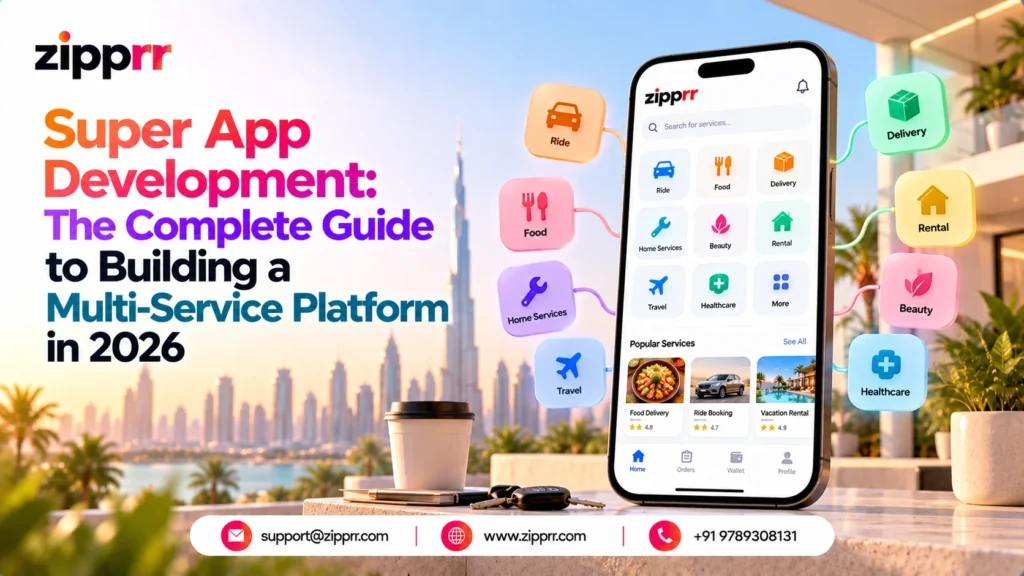
Open the phone of a typical user in Jakarta, Singapore or Shenzhen and you will often find one app doing the job of ten: ordering food, hailing a ride, paying bills, booking a salon, sending money to a friend. That app is a super app. For entrepreneurs elsewhere, the opportunity is clear: build a focused version for a city, a niche or an existing customer base, and own the customer relationship across many services.
This guide covers what a super app is, the revenue models, the features that matter, the cost, the technology and a practical launch path. If you want to see what a ready-made white-label super app platform looks like in practice, Zipprr’s overview is a useful companion read.
What Is a Super App?
A super app is a single mobile (and usually web) platform that bundles multiple services behind one login, one wallet and one customer profile. Instead of installing separate apps for rides, delivery, payments and bookings, users move between services inside one ecosystem. Gojek, Grab, WeChat and Paytm are the best-known examples, and each grew from a different starting service: rides, messaging or payments.
The defining traits are shared identity, a shared payment layer, cross-service data, and (increasingly) a mini-program or partner layer where third parties plug in their own services. The value comes from the connections between services, which is what makes customers stay.
Why the Super App Model Is a Strong Opportunity Now
Three forces make this model attractive for entrepreneurs. First, customers prefer fewer apps: one trusted app for everyday needs wins home-screen space. Second, retention economics: a customer who orders food, books services and pays through the same app returns far more often than one who uses a single service occasionally. Third, data: one customer record across services makes personalization and cross-selling practical.
Analyst forecasts for the global super app market are large and vary by firm and methodology (some project figures approaching a trillion dollars by the early 2030s), so treat any single number as directional. The consistent signal is growth in digital payments, on-demand services and mobile-first commerce, especially in emerging markets.
Trends Shaping Super App Strategy
- Regional and niche super apps. The best opportunity for most founders is a city, country, community or vertical where a focused experience beats a generic global one.
- Embedded finance. Wallets, payments, BNPL and micro-insurance deepen the customer relationship, where regulations allow.
- Mini-apps and partner ecosystems. Local businesses can list services inside your app, expanding what you offer without building every feature yourself.
- AI-driven personalization. Recommendations, dynamic pricing, automated support and smart dispatch are becoming standard expectations.
- Bundled value. Loyalty programs and memberships across services turn occasional users into regulars.
Business Models: How Super Apps Make Money
Most super apps combine several revenue streams. Start with two or three and add more as volume grows.
- Commission per transaction on rides, orders or bookings is the backbone of most platforms.
- Delivery, service and convenience fees add customer-side revenue tied to distance, speed or peak demand.
- Subscriptions and memberships (free delivery, discounts, priority service) are one of the strongest retention levers.
- Advertising and promoted listings grow with traffic.
- Payments and wallet revenue (fees and interchange) are available where licensing permits.
- Vendor SaaS and onboarding fees monetize dashboards, POS integrations and premium merchant tools.
- Aggregated, privacy-compliant insights can be offered to merchants as a value-added product.
Who the Super App Model Works For
- Startup founders targeting a city or region where several everyday services are still being digitized.
- Operators of an existing single-service app (food delivery, taxi, grocery) adding adjacent services to raise customer lifetime value.
- Enterprises, telcos, banks, malls and franchise networks with an existing customer base and loyalty relationship.
- Investors seeking a platform business with multiple revenue lines and strong customer retention.
Popular Use Cases and Service Combinations
The strongest launches pair services with shared demand or supply: food and grocery delivery plus parcel courier; ride-hailing plus delivery (shared driver network); home services plus beauty plus wellness (shared appointment logic); bill payments plus wallet plus recharge (frequent, habitual use).
Models inspired by Gojek combine rides, delivery and on-demand services this way, which is why many founders start from a Gojek-style multi-service foundation and then localize it for their market.
Features That Matter, Mapped to Business Value
| Feature | Business value |
|---|---|
| Unified login and customer profile | Reduces friction and enables cross-selling |
| In-app wallet and multiple payment methods | Raise conversion and keep money inside your ecosystem |
| Service modules | Let you switch on new revenue lines without rebuilding the core |
| Customer app, provider/driver/merchant app and admin panel | The core surfaces, each with real-time order management, notifications and tracking |
| Dispatch and matching | Improves ETAs, cost per order and driver utilization |
| Promotions, coupons and loyalty | Drive acquisition and cross-service stickiness |
| Ratings and reviews | Build trust |
| Admin analytics and commission controls | Let operators tune pricing and track growth |
| Multi-language, multi-currency and local tax settings | Support market expansion |
| Security tooling (KYC, role-based access, encryption, audit logs) | Builds customer confidence |
How AI Creates an Advantage in Super Apps
- Personalized home screens: surfacing the service a user most likely needs now (lunch at noon, a ride home in the evening).
- Demand forecasting and dynamic pricing: positioning drivers before peaks and adjusting fees fairly.
- Smart dispatch and route optimization: faster deliveries at lower cost per trip.
- Fraud detection: flagging suspicious activity and promo abuse automatically.
- AI customer support: instant answers to routine questions, with human escalation when needed.
- Merchant tools: listing optimization, sales insights and inventory suggestions.
- Churn prediction: targeted win-back offers instead of blanket discounts.
AI works best on a platform with active orders and clean data, so launch, instrument everything, and add AI features as your data grows.
Super App Technology Architecture
A scalable super app is modular: a core layer (identity, wallet, notifications, admin) with independent service modules connected through APIs. Native or cross-platform mobile apps (Flutter or React Native are common) sit in front; the backend typically uses scalable cloud infrastructure, a relational database for transactions, caching, real-time messaging for tracking, and map and payment integrations. Modularity means each new service plugs into the same foundation, which keeps expansion fast and predictable.
How Much Does Super App Development Cost?
Cost depends on the number of services, platform scope (iOS, Android, web, provider apps, admin), integrations, custom AI features and team location. Indicative planning ranges:
- Ready-made solution with customization: usually the lowest upfront cost, often tens of thousands of dollars depending on modules and branding.
- Fully custom multi-service build: commonly several hundred thousand dollars or more, over many months to a year-plus.
- Running costs: cloud hosting, maps, SMS, payment fees, support and marketing should be budgeted alongside development.
These are planning ranges, not quotes; ask vendors for an itemized estimate against your own feature list. A ready-made foundation lets you direct more of your budget toward marketing and partner acquisition, which is where growth comes from.
Build vs. Buy: Custom, Ready-Made, or Hybrid
| Approach | What it means |
|---|---|
| Fully custom | Maximum control and a unique architecture, at the highest cost and longest timeline |
| Ready-made | A tested core you can brand and launch quickly, so you start learning from real customers sooner |
| Hybrid | Launch on a ready-made foundation, validate demand, then customize pricing logic, dispatch, loyalty and AI features as revenue grows. The sweet spot for most entrepreneurs |
A simple rule: buy what every platform needs (login, wallet, order tracking) and invest custom effort where customers will notice the difference.
How Zipprr Fits In
Zipprr is a technology partner that provides ready-made software for marketplaces, on-demand apps, booking and delivery platforms and multi-service ecosystems, with customization, scalable architecture and ongoing technical support. For entrepreneurs exploring a super app, the value is faster time-to-market, lower development cost and less technical complexity, so your energy goes into growing the business. A sensible engagement starts by scoping the two or three services to launch first and planning modular expansion.
Not sure which two or three services to launch first? Explore Zipprr’s Gojek Clone to see a modular multi-service foundation, talk it through on WhatsApp or book a free demo. Prefer email? Reach the team at [email protected].
Launch Roadmap: A Phased Approach
- Market and unit economics (weeks 1-4): choose your city or segment, study competitors, and model order values, commission and driver payouts.
- Service selection: start with 2-3 services that share supply or demand.
- Setup and customization (months 1-3 on a ready-made base): branding, local payments, language, tax and admin rules.
- Partner onboarding: sign merchants, drivers and providers before opening to customers.
- Soft launch in one zone: measure completion rate, ETA, repeat rate and customer feedback.
- Refine operations using real data, then increase marketing.
- Scale: add services, zones and partner features as demand grows.
Customer and Partner Acquisition, Demand Generation
Super apps grow by building a strong local network of customers and partners. Onboard merchants and providers first with attractive early-partner terms; concentrate on one dense zone before expanding; use referral programs for customers and providers; partner with communities, housing societies, offices and universities; run launch offers tied to a second service (“order food, get a discount on your first ride”); invest in local SEO and app-store optimization; and use WhatsApp or SMS to bring customers back. Track cost per acquired customer against repeat-order value to guide spending.
Growth and Scaling
Scale in layers: deepen density in existing zones, then open new zones, then add services. Track contribution margin per order alongside order count. Introduce subscriptions once repeat behavior is established. Open partner or mini-app features as traffic attracts third parties. Teams that want a head start often begin with a multi-service super app core so new verticals plug in rather than being rebuilt.
Best Practices for a Successful Launch
- Launch two or three services first and expand once they perform.
- Solve a specific local need rather than copying a global feature list.
- Invest in the provider and merchant experience, since happy partners deliver great service.
- Model unit economics before planning promotions.
- Budget for marketing, support and partner incentives alongside software.
- Choose a vendor with demonstrable modular architecture and responsive support.
Common Buyer Questions, Answered
How do I stand out from large platforms?
Local relevance, niche focus, better partner terms and community trust are advantages that large generic platforms cannot easily match.
Can a ready-made platform be tailored to my brand?
Yes. Quality ready-made platforms are customizable; ask what can be changed and how modular the code is.
Will it scale as I grow?
Modular, API-based architecture on cloud infrastructure is designed for that; ask for load-testing evidence and reference deployments.
Who owns the code and data?
Confirm licensing, source-code access and data ownership in writing before signing.
How to Choose a Super App Development Partner
- Ask for live demos of every module you need.
- Check that the architecture is modular and API-driven.
- Get customization scope, timelines and change pricing in writing.
- Confirm payment gateway support and security practices for your market.
- Understand post-launch support: SLAs, updates and hosting guidance.
- Speak to existing customers of similar scale.
- Compare total cost of ownership over 2-3 years, not just the launch quote.
Comparison Considerations: Ready-Made vs. Custom vs. Agency
Compare on time-to-launch, upfront cost, flexibility, ownership, scalability and support. Ready-made is fastest and most economical to start, and a Gojek clone script is a common starting point for ride, delivery and services bundles; custom offers freedom at higher cost; agencies vary in quality and often do not carry field-tested products. A phased hybrid is the most efficient path for first-time founders, and the best super app platform choices let you add modules over time.
Plan your super app launch
List the two or three services you want to offer in your market, then evaluate platforms against that list. To see how a phased super app plan could work for your business, explore Zipprr’s super app platform and talk to the team at zipprr.com.
Top 10 FAQs on Super App Development
1. What is a super app?
A super app is a single application that combines multiple services, such as ride-hailing, food delivery, payments and bookings, under one login, wallet and customer profile. Gojek, Grab and WeChat are well-known examples.
2. How much does it cost to build a super app?
Costs vary with scope. A customized ready-made super app platform typically costs far less than building from scratch, which for multi-service platforms can run into hundreds of thousands of dollars. Ask for an itemized estimate covering hosting, support and integrations.
3. How long does it take to build a super app?
A customized ready-made solution can often launch in weeks to a few months. A fully custom multi-service build commonly takes many months to over a year.
4. How do I build a super app like Gojek?
Choose two or three services with shared demand or supply (for example rides, food delivery and parcels), launch on a ready-made Gojek-style or modular foundation, onboard drivers and merchants in one zone, then expand services and areas as demand grows.
5. What is a super app script or ready-made super app platform?
It is pre-built software that includes core modules such as customer apps, provider apps and an admin panel. You brand and customize it instead of coding from scratch, which shortens time-to-market and lowers upfront cost.
6. How do super apps make money?
Typically through transaction commissions, delivery and service fees, subscriptions, advertising and promoted listings, payment and wallet fees, and merchant tools.
7. How can AI improve a super app?
AI can personalize recommendations, forecast demand, optimize dispatch and routes, detect fraud, automate customer support and predict churn, improving both customer experience and margins.
8. Should I build a super app from scratch or use a ready-made solution?
Most entrepreneurs benefit from launching on a ready-made foundation and customizing selectively as revenue grows. Fully custom builds suit well-funded enterprises with unique requirements.
9. Is a ready-made super app customizable and scalable?
Yes, when it has modular, API-based architecture and runs on scalable cloud infrastructure. Confirm customization scope, source-code access and load-testing evidence before buying.
10. How do I choose a super app development company?
Evaluate live demos, modular architecture, customization terms, code and data ownership, security, post-launch support and three-year total cost, and talk to existing clients. Zipprr offers ready-made, customizable super app solutions with technical support for entrepreneurs launching multi-service platforms.