

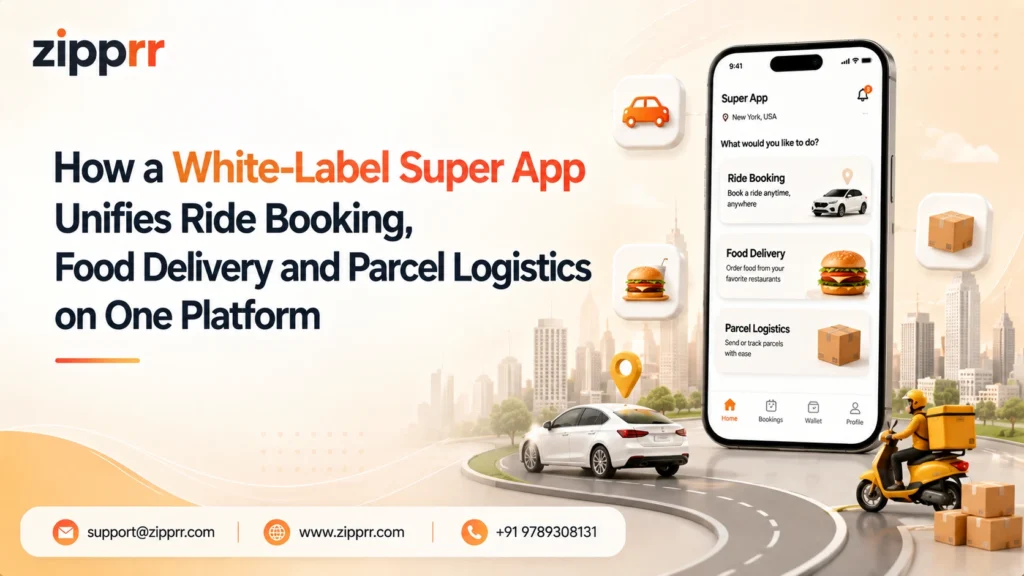
This case study describes the capabilities and architecture of Zipprr’s white-label ride booking and food delivery super app. It does not reference a named client, live deployment, or measured business outcome. No revenue figures, percentages, user counts, or time-savings numbers are claimed anywhere in this document. Where a benefit is described, it is described as an expected or structural benefit of the architecture, not a proven result. The code samples and diagrams below are simplified, illustrative examples built to explain how the platform’s modules work together; they are representative patterns, not literal excerpts from the production codebase.
Note on figures: this case study describes the platform, its architecture, and the implementation journey. No specific customer names, revenue figures, percentages, or time-savings numbers are claimed anywhere in this document. All code samples are illustrative patterns, simplified for readability, not verbatim product source code.
Project Snapshot
Project Overview
The On-Demand Ride & Food Delivery Super App is a white-label, multi-service mobility and delivery platform built for operators who want to run taxi booking, food delivery and parcel delivery as one connected business rather than three separate ones. It follows the operating pattern used by large multi-service platforms in this category: one customer account, one wallet and one driver network serving every vertical the platform offers.
The ecosystem is delivered as eight coordinated components: a Customer/Rider App (Android and iOS), a Driver App (Android and iOS), a Restaurant Partner App, a web-based Admin Panel, a Staff/Support Agent Panel, a structured REST API, a public marketing website, and a web installer for deployment. It sits alongside Zipprr’s broader Gojek clone super app solution as one entry point into the same multi-service category.
Industry & Market Context
Industry: on-demand mobility, food delivery and hyperlocal logistics, commonly described as the super app category.
Combining transportation and delivery under one app is now a well-established operating model rather than an experimental one. Large regional platforms such as Grab, Gojek and Careem each expanded from a single-vertical starting point (ride-hailing, in most cases) into bundled transport, delivery and payments, and the strategic logic behind that expansion is consistent: customer acquisition cost is paid once and spread across multiple services, and a shared driver fleet helps smooth demand, since passenger trips tend to peak at commute hours while food orders peak at mealtimes.
Two further trends shape this category going into 2026. First, the fare-negotiation model popularized by inDrive, where drivers submit competing offers on a rider’s requested trip, has gained traction in price-sensitive markets, pushing platforms toward supporting both fixed algorithmic fares and a bidding marketplace rather than committing to one pricing model. Second, operators expanding across borders increasingly need multi-currency, multi-language and RTL (right-to-left) support from the outset, since fast-growing on-demand markets span South Asia, Southeast Asia, Africa, Latin America and the Arabic-speaking Middle East, where local payment methods such as bKash and MyFatoorah sit alongside cards and cash. Zipprr’s broader catalog of white-label clone app products covers this wider category of mobility and delivery marketplaces.
Business Challenge
Operators entering on-demand transportation and delivery typically start by building or buying separate systems for each service. A taxi platform alone requires rider and driver apps, real-time location tracking, fare calculation and payment processing. A food delivery platform additionally requires restaurant onboarding, menu management, cart and checkout, delivery zones, and a delivery fleet. A parcel service needs its own pickup and drop-off workflow with proof-of-delivery tracking. Built independently, these create a recurring set of operational problems:
- Multiple applications to build, release and maintain across app stores;
- Fragmented customer identity: separate accounts, payment methods and order histories per service, with no shared promotions;
- Duplicated payment and wallet infrastructure, multiplying gateway integrations and reconciliation work;
- Underused driver supply: ride drivers idle between commute peaks while a separate delivery fleet is stretched thin at mealtimes;
- Disconnected admin dashboards with no unified, cross-service reporting;
- Expensive geographic expansion, where every new city or country risks a fresh build, new currency handling and new compliance work;
- Duplicated safety and trust work: verification, SOS and trip-sharing features re-implemented per vertical instead of built once.
Objectives
The project set out to solve the challenge above with a single technical objective: build one platform capable of operating multiple on-demand services on shared infrastructure, broken into specific goals:
- Unify ride booking, food delivery and parcel delivery under one customer app, one account and one wallet;
- Share a single driver network across all service types to improve fleet utilization;
- Support both fixed-fare and driver-bidding pricing, configurable per market;
- Centralize administration, reporting and support across every service and city;
- Build in driver verification, trip safety and compliance workflows from day one;
- Enable multi-currency, multi-language and RTL operation without separate app builds; and
- Keep the entire platform white-label, so any operator can launch it under its own brand.
The Solution: Key Features & Modules
The platform answers each objective through a specific, purpose-built module. The sections below map platform capabilities to the problems they are designed to solve.
1. One customer app for rides, food and parcels
The Customer/Rider App handles the full ride lifecycle: pickup and drop-off selection with automatic location detection, Google Maps integration, vehicle type selection, fare estimation and estimated arrival time before booking, followed by real-time driver tracking, in-app payment, driver ratings and ride history. The same app also exposes scheduled rides (a future pickup date and time, useful for airport transfers, school runs and business travel), intercity rides on admin-configured routes, and parcel delivery requests with pickup location, drop-off location, driver assignment and tracking. One login and one wallet cover every service.
2. Dual ride pricing: fixed fare and driver bidding
Administrators can run either pricing model, per market. Under fixed-price rides, the system calculates fare from configured pricing rules: base fare, vehicle-based pricing, region-based pricing and optional surge pricing during high-demand windows. Under driver bidding, the platform functions as a negotiation marketplace: drivers submit fare offers against a requested trip, and the customer reviews competing offers and selects a driver and price. Because bidding can be enabled or disabled per market, one deployment can run fixed fares in one city and a bidding marketplace in another.
3. A shared driver network: verification, earnings and gamification
The Driver App is one operational surface for every job type. Drivers go online/offline, and can accept, reject or bid on ride requests, navigate to pickup, mark arrival, and start and complete trips, and the same app also delivers food orders and parcel jobs, which is how the platform converts idle time between ride peaks into additional earning opportunities for the same driver.
Trust is enforced through a verification and compliance pipeline: driver document upload, vehicle document upload, admin verification, document expiry tracking and an explicit driver approval process before a driver can go online. Retention is supported with built-in gamification: Experience Points (XP), driver levels and achievement badges that progress automatically as trips complete, alongside a transparent earnings dashboard covering trip and delivery earnings, wallet balance, earnings history, withdrawal requests and admin-side payout management.
4. A multi-restaurant food marketplace
Customers get restaurant discovery, menu browsing by food category, menu items and add-ons, cart management, promo code application at checkout, and delivery-location and payment-method selection, followed by real-time order tracking across restaurant status, driver assignment and delivery progress, plus one-tap reorder from past orders. Restaurants operate through the dedicated Restaurant Partner App: registration with an admin approval workflow, profile and menu management, add-ons configuration, and live order handling: accept, prepare, and hand off to a driver, without phone calls or spreadsheets. Zipprr’s standalone UberEats clone food delivery solution shows this same marketplace layer built as a single-vertical product.
5. Delivery efficiency: batched orders and delivery zones
Two features address delivery unit economics directly. Merged/batch delivery combines compatible orders, using same-restaurant order batching for nearby customers, into a single driver run, so one driver can serve a restaurant and two nearby customers instead of two drivers making duplicate pickups, with configurable order-merging rules per market. Food delivery zones define the geographic areas in which restaurants and delivery operate, each with its own restaurant roster and, where needed, its own zone-specific currency: the mechanism that lets one deployment serve multiple cities or countries cleanly.
6. Parcel delivery on the same driver network
Beyond passengers and food, the driver network can also carry parcels. Customers submit a pickup location and a delivery location, the platform assigns a driver, and the parcel is tracked through to delivery with standard payment support. Because parcel jobs run on the same driver pool used for rides and food, this is delivered as an additional service line rather than a separately staffed operation.
7. Trust and safety across every trip
Safety features apply on both sides of the marketplace: optional 4-digit OTP trip verification (the rider receives a code the driver must confirm before the trip starts, reducing the risk of wrong-passenger pickups), live trip sharing via a public web-based tracking link that family or friends can follow without installing the app, and an in-trip SOS/emergency button available to both riders and drivers. These sit alongside the document-verification pipeline described above as one connected safety layer, rather than separate features bolted onto each service.
8. Payments, wallets and monetization
The payment layer supports Stripe, PayPal, Razorpay, MyFatoorah and bKash, alongside cash payments and a native customer wallet, with gateway availability configured per market by the administrator. The wallet system covers customer balances, driver earnings wallets, transaction records, withdrawal management and region/currency-aware wallet rules. Monetization is built into the platform rather than added afterward: ride and food order commissions, delivery charges, surge pricing, service fees, cross-service promo codes (percentage or fixed-value, with usage limits), and a membership/subscription system, monthly or yearly plans offering ride discounts and free food delivery, with Stripe recurring renewals, cancel-at-period-end handling, expiry management and reminder emails, adding a recurring-revenue layer on top of per-transaction commissions.
9. Built for multi-region operation
Multi-currency support lets different taxi regions and delivery zones run different currencies with region-specific pricing, without separate app builds per market. Multi-language support with admin-controlled translations localizes the customer, driver and restaurant apps from one panel, and full RTL support extends the platform to Arabic-language markets. Region and city management covers taxi regions, delivery zones, intercity routes and city-level operations centrally, so launching a new city is primarily a configuration task.
10. Operations layer: dispatch, live support and centralized admin
The Staff/Support Agent Panel gives operators day-to-day operational control. Dispatchers can create phone-in ride bookings on behalf of customers, which matters in markets where customers still call a taxi company directly. Support agents handle in-app live chat during rides and food orders, process refund requests, and escalate complex tickets to an admin queue. The Admin Panel itself is the operational center: business KPIs; ride, food and driver statistics; management of active, completed, scheduled and intercity rides; bidding and OTP configuration; surge settings; customer, wallet, driver-approval and withdrawal management; restaurant applications; vehicle categories and pricing; global search across platform data; customizable notification templates; and CMS management for the public marketing site.
11. AI-assisted insights and market setup
Two AI-driven capabilities extend the admin layer, both requiring a supported AI provider to be configured. AI-Powered Business Insights add a city health dashboard, demand analysis and demand heatmaps, and automatically generated weekly business summaries, turning raw operational data into a more readable operating picture rather than requiring administrators to interpret every metric by hand. The AI Setup Wizard assists new market launches with guided city onboarding, suggested pricing, configuration proposals, demo data generation and market simulation; administrators still review and apply whatever configuration fits their market. For a comparison point, Zipprr’s Uber clone taxi app solution shows the ride-hailing layer as a standalone product, without the food and parcel modules described here.
Technology Architecture
The mobile apps are built with Flutter 3.x using GetX state management, shipping to Android and iOS from a single codebase. The backend runs on Laravel 11 with PHP 8.2 and a MySQL database, using Blade, Tailwind CSS and Vite on the web side. A structured REST API separates rider, driver, food delivery, pricing, billing and customer-support services into distinct modules, giving the system a maintainable backbone and a foundation for future integrations.
The diagram below shows how the client applications, the API layer, the core platform, and the third-party services fit together.
The table below separates what the platform builds and owns from the third-party services it integrates with, an important distinction, since third-party services are configured separately by the operator and may carry their own usage charges.
| Layer | Built on the core platform | Third-party dependency |
|---|---|---|
| Mobile apps | Flutter codebase, GetX, app UI/UX, business logic | None |
| Backend | Laravel application, REST API, MySQL data model | None |
| Real-time updates | Application logic that consumes real-time events | Firebase Firestore, Firebase Cloud Messaging |
| Maps and location | Booking, tracking and zone logic | Google Maps Platform |
| Payments | Wallet system, commission logic, payout management | Stripe, PayPal, Razorpay, MyFatoorah, bKash |
| SMS/OTP delivery | OTP verification workflow | SMS/OTP provider (configured by operator) |
| AI features | Insight dashboards, setup wizard UI | Supported AI provider/API (configured by operator) |
Technical Deep Dive: Sample API and Backend Logic
The two examples below illustrate, at a simplified level, how the dual pricing model and the batch-delivery module described above translate into API and backend patterns. Both are representative examples written for this case study to explain the underlying logic; they are not literal excerpts from the production codebase.
Example 1: Ride request API, fixed fare vs. driver bidding
A ride request specifies a pricing_mode. Under fixed, the API returns a single calculated fare; under bidding, it returns a list of competing driver offers for the customer to choose from.
					POST /api/v1/rides/request
Content-Type: application/json

{
  "pickup": { "lat": 12.9716, "lng": 77.5946 },
  "dropoff": { "lat": 12.9352, "lng": 77.6146 },
  "vehicle_type": "sedan",
  "pricing_mode": "bidding"
}

// Response: 200 OK
{
  "ride_id": "RID-88213",
  "pricing_mode": "bidding",
  "status": "awaiting_offers",
  "offers": [
    { "driver_id": "DRV-4410", "fare": 245.00, "eta_minutes": 4, "rating": 4.8 },
    { "driver_id": "DRV-2207", "fare": 260.00, "eta_minutes": 6, "rating": 4.9 }
  ],
  "currency": "INR"
}
Example 2: Backend logic for batching compatible food orders
When a new order is accepted by a restaurant, the batching service checks for other accepted, unassigned orders from the same restaurant within a configurable delivery radius, then assigns any match to the same driver as one batch.
					// app/Services/OrderBatchingService.php

public function findBatchableOrders(Order $newOrder): Collection
{
    return Order::where('restaurant_id', $newOrder->restaurant_id)
        ->where('status', 'accepted')
        ->whereNull('driver_id')
        ->whereNull('batch_id')
        ->get()
        ->filter(function (Order $order) use ($newOrder) {
            $distanceKm = $this->mapService->distanceKm(
                $order->delivery_location,
                $newOrder->delivery_location
            );
            return $distanceKm <= config('delivery.batch_radius_km');
        });
}

public function assignBatch(Collection $orders, Driver $driver): void
{
    $batchId = (string) Str::uuid();

    $orders->each(fn (Order $order) => $order->update([
        'batch_id' => $batchId,
        'driver_id' => $driver->id,
    ]));
}
User Workflows
The diagram below shows how a ride request and a food order each move through matching, driver assignment, completion and payment, before splitting into the driver-earnings and customer-rating outcomes.
Rider (ride booking): open app, location auto-detected; set pickup and destination; choose vehicle type; view fare estimate and ETA; confirm a fixed fare, or post the trip to the bidding marketplace and select from driver offers; track the driver on the live map, optionally sharing the public trip link; verify OTP if enabled; ride to destination; pay by card, gateway, wallet or cash; rate the driver.
Customer (food order): switch to food delivery in the same app; discover restaurants in the active delivery zone; build a cart with items and add-ons; apply a promo code; check out; restaurant accepts and prepares the order in the Partner App; platform assigns a driver, potentially batching it with compatible nearby orders from the same restaurant; track restaurant status, pickup and delivery live; receive the order, with reorder available for next time.
Driver: register; upload driver and vehicle documents; await admin verification and approval; go online; accept or bid on ride requests, or run food and parcel deliveries as they arrive; earnings and XP accrue with each completed job, progressing driver level and badges; submit a withdrawal request when ready; admin reviews and processes payout.
Restaurant partner: register; pass admin approval; configure profile and menu; accept incoming orders in the Partner App; mark preparation stages; hand completed orders to the assigned driver; review order history.
Implementation Approach
Deployment follows a consistent sequence. The operator installs the platform using the web-based installer, configures the database, Firebase project, Google Maps credentials and payment gateways, then applies white-label branding: business identity, logo, theme color, app icons, currency, timezone, languages and CMS content. Launching a new market means defining the region, its currency and its pricing rules (with the AI Setup Wizard proposing a starting configuration), onboarding drivers and restaurants through their respective approval workflows, and monitoring the city through the KPI dashboard and AI-generated weekly summaries once it is live.
Outcome
This project demonstrates that ride-hailing, food delivery and local parcel logistics can run on one unified technology ecosystem rather than three separate ones. The platform consolidates customers, drivers, restaurants, payments, maps, deliveries, support and analytics into a single administration and mobile experience. As stated above, the points below describe structural, capability-level outcomes of that consolidation, not measured results from a specific deployment.
- For the operator: one codebase and one dashboard replace parallel systems; cross-service reporting is native rather than a separate data project; and expanding into a new city or currency is a configuration task rather than a rebuild.
- For drivers: one app supplies ride, food and parcel work from a single driver pool, with transparent earnings, wallet withdrawals and XP-based progression.
- For customers: one account and one wallet cover transport, meals and parcels, with consistent safety features (OTP verification, live trip sharing, SOS) across every service.
- For restaurants: the Partner App provides an ordering and delivery channel without the restaurant needing to build or staff one itself.
Business Value
For an operator evaluating this platform, the commercial case rests on three structural advantages rather than any specific projected number. Lower technical overhead: one platform to build, secure and maintain instead of three, which reduces the ongoing engineering burden of running parallel ride-hailing, food-delivery and logistics stacks. Diversified, layered revenue: ride commissions, food commissions, delivery charges, surge pricing, service fees and recurring membership subscriptions all draw from the same customer and driver base, rather than depending on a single revenue line. Faster, lower-risk expansion: because new cities, currencies and languages are handled through configuration rather than a new build, operators can test additional markets without duplicating development cost. Businesses that want to validate the transportation layer first, before adding delivery verticals, can start narrower with Zipprr’s taxi booking script and expand into the full super-app model as the business grows.
Get Started
Considering a ride booking and food delivery super app under your own brand? The fastest way to evaluate fit is to see the platform directly.
Schedule a free demo: https://zipprr.com/schedule-free-demo
Chat on WhatsApp: https://wa.me/919789308131
Email us: [email protected]
Share your target market and we will walk through white-label branding options, payment gateways available in your region, and what it takes to launch under your own business identity.
Frequently Asked Questions
What is a white-label super app?
A white-label super app is one branded app that combines services such as ride booking, food delivery and parcel logistics, built by a software provider and launched under the buyer's own brand name.
Which services does this super app unify?
The case study describes a single platform that unifies ride booking, food delivery and parcel logistics, with shared modules and workflows behind the three services.
Can I launch my own white-label super app?
Yes. Zipprr builds white-label super app solutions. You can discuss your market and book a walkthrough on a free demo at https://zipprr.com/schedule-free-demo/.