
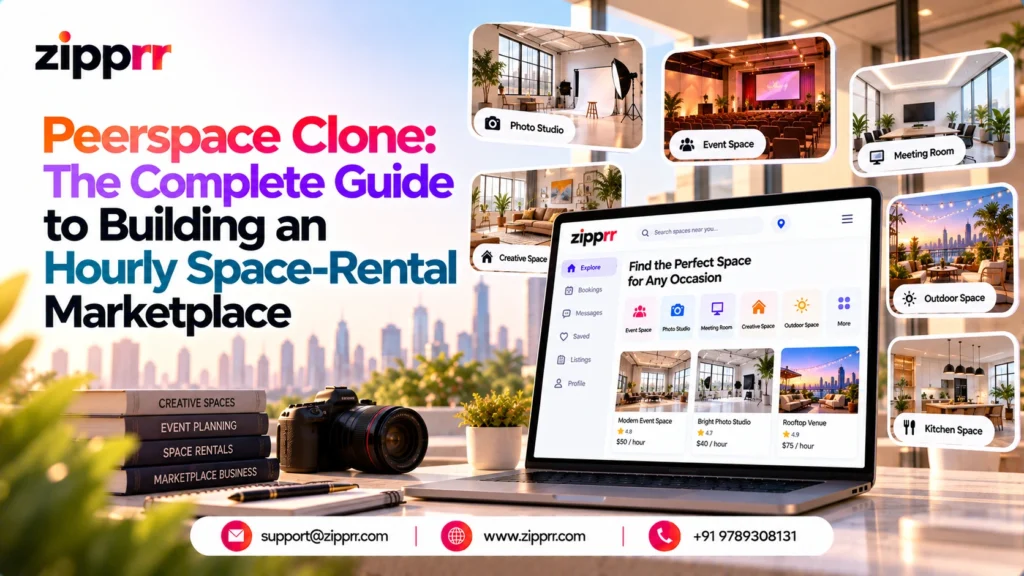
A Peerspace clone is ready-made software for running an online marketplace where owners rent spaces by the hour and renters book and pay online. You earn through commissions and fees. Zipprr’s Peerspace clone offers a ready-made base you can customize and launch much faster than building from scratch.
Every city has unused space: a photo studio that sits empty on weekdays, a loft booked only for weekend parties, a meeting room idle after 5 pm. At the same time, creators, small teams, and event hosts struggle to find affordable, flexible places to work or gather. A Peerspace-style marketplace connects the two. This guide explains what a Peerspace clone is, how the business works, what it costs, and how to launch one without wasting months or budget.
What Is a Peerspace Clone?
Peerspace is a well-known marketplace for booking venues by the hour for shoots, meetings, workshops and events. A Peerspace clone is software that reproduces that category of workflow under your own brand: listings, search, availability, booking, payments, reviews, messaging and an admin panel. This is not about replicating Peerspace’s brand or data. The real work is building your own supply, pricing and market position from the ground up.
Some founders look for this under different labels, such as a Peerspace clone script, Peerspace-style software, a booking platform build, or app development services. These searches are really pointing at the same underlying need: software to run an hourly space-rental marketplace. This guide brings all of those angles together in one place.
Why the Hourly Space-Rental Opportunity Is Worth Examining
Several shifts support the model. Hybrid work has made flexible meeting and workshop space more normal. Content creators and small brands need short-term studios and locations. Property owners look for extra income from assets that sit idle. And customers now expect to search, compare, book and pay in minutes from a phone.
The model is also asset-light: you do not own the spaces. The trade-off is that you must build trust and keep supply and demand balanced. We recommend validating a local niche before assuming a national opportunity. Check current market sizing from a source such as Mordor Intelligence before putting numbers in a pitch deck, as estimates vary widely by definition.
How the Business Works
- Owners list spaces with photos, hourly rates, capacity, rules and availability.
- Renters search by location, activity, date and budget, then book instantly or request approval.
- Payment runs through the platform itself, which holds the funds until the booking is fulfilled, then releases the payout to the owner.
- You earn a share through commission, service fees or subscriptions.
- Reviews and verification build trust that brings repeat bookings.
Business and Revenue Models
- Commission from owners: commonly 10 to 20 percent, varying by market and competition.
- Renter service fee: a small percentage added at checkout.
- Featured listings: owners pay for top placement.
- Host subscriptions: professional hosts pay for tools, analytics or lower commission.
- Add-ons: equipment, catering, cleaning, insurance or staff, with your margin.
- Local advertising and partnerships: photographers, caterers and event planners.
- Niche focus: studios, podcast rooms, pop-up retail, kitchens, coworking, or rehearsal spaces often convert better than a generic venue marketplace.
Start with commission only, which is simple to explain, then layer others after you have booking data. Both aggregator and managed models exist; ready-made space-rental software supports configurable commission and fee settings so you can test pricing.
Who Should Build This
- Startup founders targeting a city or niche with poorly served demand.
- Studio, coworking and event operators who want to add other owners’ inventory to their own.
- Property managers and developers with underused rooms, lobbies or rooftops.
- Event planning and creative agencies with an existing client roster looking to add space booking as a service.
- Investors seeking an asset-light marketplace with recurring transactions.
Take a founder in Berlin who builds a marketplace dedicated entirely to podcast and recording studios, a coworking brand that opens its off-peak rooms to outside renters, or a property manager who converts amenity spaces across 40 buildings into bookable inventory.
Features That Matter and the Business Value They Create
| Feature | Business value |
|---|---|
| Map search with filters (activity, capacity, amenities, price) | Higher search-to-booking conversion |
| Instant booking and request-to-book | Fits both casual and high-touch owners |
| Availability calendar with calendar sync | Fewer double bookings and owner frustration |
| Flexible pricing (hourly, daily, weekend, minimum hours) | Better utilization and owner revenue |
| Secure payments, deposits and payouts | Trust, and protection against leakage |
| In-app messaging and reviews | Keeps conversations on-platform; builds social proof |
| Owner verification and listing approval | Quality control and safer marketplace |
| Admin panel: commissions, disputes, reports, CMS | Operational control without developers |
| Multi-language and multi-currency | Easier expansion to new regions |
| Notifications by email, SMS and push | Reminders reduce no-shows; drive repeat bookings |
How AI Can Make a Space Marketplace Smarter
AI should remove friction and cost; it should not be a gimmick. Practical uses include:
- Personalized recommendations from activity, group size and past bookings.
- Pricing suggestions to owners based on local demand, season and day of week.
- Listing assistance: generate descriptions, tag amenities from photos and flag poor images.
- Fraud and risk detection on payments, fake listings and unusual behaviour.
- Conversational search and support, where a renter can type something like “need a bright space for 12 people, under $80 an hour, near downtown” and get matched results back instantly.
- Demand forecasting that tells you where to recruit more supply.
- Review summarization to help renters choose faster.
Keep a human in the loop for disputes, safety and policy decisions, and be transparent about how AI-driven pricing works.
Technology Overview
A typical stack includes a responsive web app, native or cross-platform mobile apps, a relational database, search service for map and filter queries, cloud media storage with a CDN, payment gateway integrations with payout support, and notification services. Pay attention to security (PCI-compliant payment handling, role-based access), performance of image-heavy pages, and the ability to integrate maps, calendars and analytics. Microservice-level architecture is rarely needed at launch; a clean modular monolith is usually enough.
Cost: What Should You Budget?
Cost depends on scope more than on any single technology choice. As directional ranges:
- Custom build: typically tens of thousands of dollars and several months for web, apps and admin, rising with integrations and design.
- Ready-made script with customization: a fraction of that, depending on modules you add. At the time of writing, Zipprr lists one-time packages on its Peerspace clone page; confirm the current inclusions and support terms with the team.
- Ongoing: hosting, map and messaging APIs, payment processing fees, support, security updates and, above all, marketing and supply onboarding.
Treat software cost as the smaller part of the budget. Many failed marketplaces spent heavily on engineering and almost nothing on acquiring their first hundred bookings.
Build vs Buy, Custom vs Ready-Made
| Factor | Ready-made | Custom build |
|---|---|---|
| Time to market | Weeks | Months |
| Upfront cost | Lower | Higher |
| Uniqueness | Customizable within the base | Fully tailored |
| Risk | Lower; proven workflows | Higher; scope creep |
| Best for | Validating demand, niche launches | Proprietary logic, funded teams |
A sensible path for most founders is to launch on ready-made software, learn from real bookings, and invest in custom modules later where you see differentiation.
Customer and Supply Acquisition: Solving the Cold Start
Marketplaces rarely fail because of code; they fail because of empty shelves or empty rooms. A practical sequence:
- Pick one city and one or two niches. Depth beats breadth.
- Recruit supply by hand. Aim for 30 to 50 quality listings before public launch. Offer free photography, reduced fees or featured placement to early owners.
- Create demand where intent exists: local SEO pages for each space type and neighbourhood, creator communities, event planners, corporate offsite buyers.
- Seed trust: verified profiles, clear cancellation policies and early reviews.
- Retain: repeat-booking offers, saved searches, referral credits and owner dashboards that show earnings.
Growth and Marketing Strategy
Long-term growth comes from content and search (guides such as “best photo studios in [city]”), partnerships with photographers, planners and brands, owner referral programs, email re-engagement, and paid ads once conversion is proven. Also structure pages with clear definitions and FAQs so they can be quoted by AI search tools.
Risks, Challenges and Common Mistakes
- Launching in many cities before one works.
- Ignoring off-platform leakage; keep value on-platform with payments, insurance, messaging and reviews.
- Weak policies for damage, noise, cancellations and capacity.
- Overlooking local permits, zoning and tax rules for event spaces.
- Spending the budget on features instead of supply.
- Poor listing quality; low-quality photos kill conversions.
- Copying competitors’ brand or content instead of building a clear niche.
Launch Roadmap and Scaling
- Weeks 1 to 2: choose niche and city, define commission and policies, shortlist vendor.
- Weeks 2 to 6: configure branding, payments, content, and test the booking flow end to end.
- Weeks 4 to 10: onboard first listings, soft-launch to a limited audience.
- Months 3 to 6: improve conversion, add reviews, run local campaigns, review unit economics.
- Month 6 onward: add subscriptions, AI pricing and recommendations, new niches, then new cities.
Scale by repeating a proven city playbook, monitoring metrics such as listing utilization, repeat-booking rate, take rate and support tickets per booking.
Common Buyer Objections
- “Won’t a clone look generic?” Differentiate through niche, curation, service quality and local community. The software is the foundation, not the brand.
- “Can it handle growth?” Ask about hosting architecture and upgrade path before buying.
- “What if I need unique features?” Confirm customization scope and source-code ownership.
- “Is it safe?” Ask about payment security, verification tools and dispute handling.
How to Choose a Vendor and Compare Options
Compare vendors on: live demo quality, feature depth for renters, owners and admin; source-code ownership; customization and support terms; payment gateway coverage; mobile apps included; update policy; references from live clients; and transparent pricing and refund terms. Also consider alternatives such as no-code marketplace builders, which may suit very simple pilots but can limit deep customization.
Why Zipprr
Zipprr is a technology partner for entrepreneurs launching marketplaces, on-demand apps, booking platforms and digital business ecosystems. Its approach is to provide ready-made, customizable software with scalable architecture and ongoing support so founders spend their effort on supply, partnerships and growth. For space rentals, the Peerspace clone software covers renter, owner and admin workflows, with web and mobile apps and AI-assisted capabilities to build on.
Ready to Explore Your Own Space-Rental Marketplace?
If you are evaluating a platform like Peerspace, you can see how Zipprr approaches it on the Peerspace clone page. Schedule a free demo, message us on WhatsApp at +91 97893 08131, or email [email protected].
Frequently Asked Questions
1. What is a Peerspace clone?
A Peerspace clone is ready-made marketplace software that lets you run your own hourly space-rental business: venue owners list studios, lofts, meeting rooms, kitchens or event spaces, and renters search, book and pay online. The platform handles search, calendar availability, payments, commissions and payouts. It is modelled on the category Peerspace popularised, not a copy of its brand.
2. How does a Peerspace-style platform work?
Owners create listings with photos, pricing, rules and availability. Renters filter by location, activity, capacity and date, then book instantly or send a request. The platform collects payment, holds funds until the booking completes, deducts its commission or service fee, and pays the owner out. An admin panel controls approvals, disputes, fees and reports.
3. How much does it cost to build a platform like Peerspace?
A fully custom build typically runs from tens of thousands of dollars upward and takes several months, depending on scope, platforms and integrations. A ready-made script is a fraction of that, with customization added on top. Ongoing costs to budget for include hosting, map and payment fees, support, marketing and a trust-and-safety process. Ask any vendor for a written, itemized quote.
4. How long does it take to launch a space-rental marketplace?
With a ready-made base, a branded website and apps can often be configured in weeks rather than months, but launch readiness also depends on supply: plan for 4 to 12 weeks to onboard your first listings in one city. Custom builds commonly take six months or more.
5. Can I customize the Peerspace clone software?
Yes, with a reputable vendor. Typical customizations include branding, commission rules, booking flows (instant versus request), local payment gateways, languages and currencies, insurance or deposit logic, and niche categories such as photo studios or coworking. Confirm whether you receive source code and who owns it.
6. Is a ready-made clone solution scalable?
It can be, if the architecture is modular and hosted on scalable infrastructure. Check how search, media storage and payments are handled, whether you can add servers as traffic grows, and whether the vendor ships updates. Most early-stage marketplaces are limited by supply and marketing long before software limits appear.
7. How do Peerspace-like platforms make money?
Common revenue streams are a commission from owners (often 10 to 20 percent, though rates vary by market), a service fee charged to renters, promoted or featured listings, subscriptions for professional hosts, add-on services such as cleaning or equipment, and local advertising. Most platforms start with commission and add others later.
8. How can AI improve a space-rental marketplace?
AI can recommend spaces based on activity and group size, suggest dynamic pricing from demand patterns, auto-write listing descriptions, flag suspicious listings or payments, answer renter questions in chat, summarize reviews, and forecast which neighbourhoods need more supply. It should assist human operators, not replace trust-and-safety decisions.
9. Who should build a Peerspace-style business?
Founders targeting a local or niche market, coworking and studio operators who want to aggregate other spaces, property managers with underused rooms, event-industry businesses expanding online, and investors looking for asset-light marketplace models.
10. What features are essential for an MVP?
Search with map and filters, rich listings, availability calendar, instant and request booking, secure payments with payout, messaging, reviews, owner dashboard, admin panel with listing approval, cancellation rules, and notifications. Add AI features, memberships and advanced analytics after you have real bookings.
11. What are the biggest risks in running a space-rental marketplace?
The main ones are the cold start (no supply, no renters), off-platform leakage where users book directly to avoid fees, damage or liability disputes, local permit and zoning rules, payment fraud, and low repeat usage. Clear policies, deposits, verified profiles and good insurance partnerships reduce these.
12. Should I build from scratch or buy ready-made software?
Buy ready-made if you want to test demand quickly and your needs are close to the standard marketplace flow. Build custom if booking logic is genuinely unique, you need proprietary data models, or you have funding and an engineering team. Many founders launch on ready-made software and invest in custom modules once revenue is proven.
13. How do I get my first venue owners and renters?
Start with one city and one or two niches. Personally onboard 30 to 50 quality listings, offer photography help or reduced fees at first, then drive renter demand through local SEO, partnerships with event planners and creators, social content and referral offers. Supply quality matters more than volume.
14. How do I choose a Peerspace clone provider?
Ask for a live demo, the exact feature list, source-code ownership, support and update terms, payment gateway coverage, references from live customers, and a clear refund or trial policy. Be cautious of vendors who guarantee rankings or revenue.
15. Why choose Zipprr for a space-rental marketplace?
Zipprr provides ready-made marketplace software with web and mobile apps, an admin panel, customization options and launch support, so founders can focus on supply, partnerships and growth instead of engineering. Its Peerspace clone solution covers renter, owner and admin workflows out of the box.