
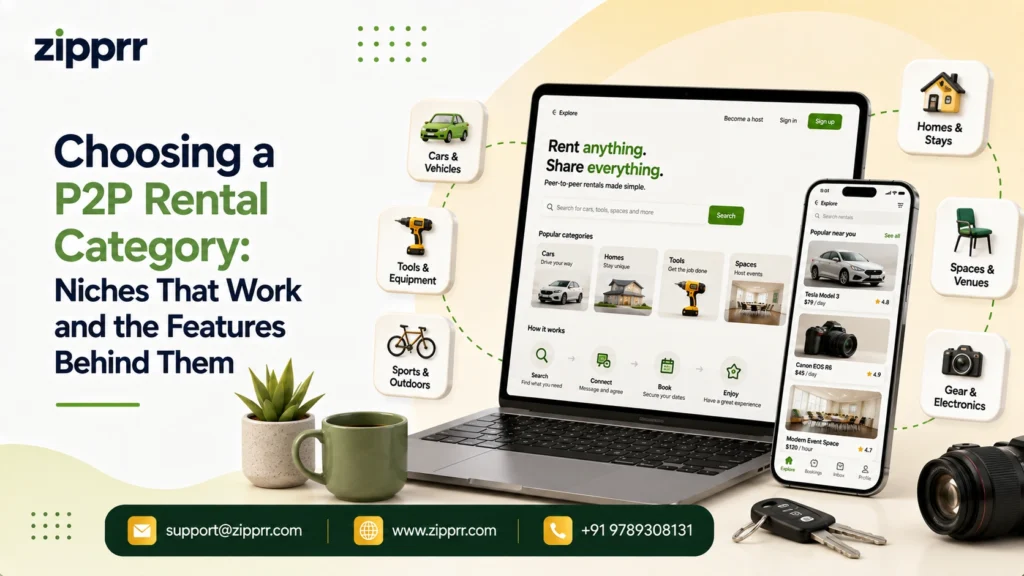
Nine rental niches consistently outperform the rest of the market in 2026: vehicles, construction and heavy equipment, cameras and electronics, event and party supplies, outdoor gear, fashion, tools, baby and kids gear, and event spaces. What separates a thriving marketplace from a stalled one usually isn’t the category itself, it’s whether the platform’s booking, logistics, and trust features actually match what that category’s renters and owners expect.
A power drill and a designer handbag don’t rent the same way, and neither do a backyard studio and an excavator. A camera marketplace succeeds on the strength of its listing photos and filters; an equipment marketplace succeeds on delivery logistics and multi-day booking; a venue marketplace succeeds on hourly, not daily, scheduling. Built around Zipprr’s P2P Rental Script, this guide breaks down which niches are worth building around and the exact features that make each one work, rather than repeating the standard “what is peer-to-peer rental” explainer readers can already find elsewhere.
Which P2P Rental Niches Are Gaining the Most Traction?
Nine categories show up again and again across active P2P marketplaces, each drawing a distinct type of renter:
| Category | Example Items | Typical Renter |
|---|---|---|
| Vehicles & transportation | Cars, bikes, scooters, boats, RVs | Travelers, commuters, weekend trip-takers |
| Construction & heavy equipment | Excavators, generators, scaffolding, power tools | Contractors, hands-on homeowners |
| Cameras, drones & electronics | DSLRs, lenses, drones, projectors, gaming gear | Creators, hobbyists, students |
| Event & party supplies | Tents, tables, sound systems, décor | Event planners, party hosts |
| Outdoor & adventure gear | Camping equipment, kayaks, ski gear, bikes | Once-in-a-while outdoor enthusiasts |
| Fashion & accessories | Designer wear, handbags, jewelry | Event-goers, occasion dressers |
| Tools & home improvement | Drills, saws, ladders, pressure washers | Homeowners, small contractors |
| Baby & kids gear | Strollers, cribs, car seats | Traveling parents |
| Event spaces & venues | Studios, backyards, rooftops, meeting rooms | Hosts, photographers, small businesses |
Vehicles and Transportation: The Feature-Heaviest Category
Vehicle rental set the template for P2P long before other categories caught up. Turo and Getaround spent years proving renters would trust a stranger’s car, and that legacy shows up in what riders now expect by default: mileage and battery or fuel-level logging at both ends of a trip, map-based discovery tied to GPS, pricing that flexes by the hour, day, or week, and a digital handoff step that confirms condition before keys change hands. Founders entering this niche usually start from a purpose-built car rental script rather than a general multi-category template, because vehicle booking logic and pricing rules genuinely diverge from what a camera or a tent rental needs.
Construction and Heavy Equipment: Logistics Decide Everything
Nobody rents a mini excavator and drives it home in the back seat. This category depends on delivery and pickup scheduling being built into the booking flow itself, not left as a side conversation between owner and renter. Minimum rental windows also run longer here, days or weeks rather than hours, and listings need dedicated spec fields for capacity, power source, and any operating certification the equipment requires. A dedicated equipment rental script usually builds these logistics fields directly into the listing form, so owners aren’t left explaining delivery terms in a plain description box.
Cameras, Drones and Electronics: Trust Lives in the Listing
A renter can’t hold a lens up to the light before booking it, so the listing has to do all the convincing. That means high-resolution photo sets shot from multiple angles, spec-style fields for model, condition grade, and included accessories, and filters precise enough to search by brand or resolution instead of one generic “electronics” bucket. This audience also rebooks more than most, so anything that turns a one-time renter into a repeat one, such as saved favorites, following a trusted owner, or one-tap rebooking, earns its keep quickly.
Event and Party Supplies: One Booking, Many Items
A host who needs folding chairs almost never needs only folding chairs; tables, linens, and a sound system usually come along with them. Marketplaces that let an owner package several items into one bookable set, and that show availability across an entire inventory for a date range, tend to outperform platforms limited to single-item checkout. Delivery-radius settings carry more weight here too, since a stack of event tables rarely fits in a courier van.
Outdoor Gear, Fashion, and Tools: Built for the Occasional Renter
Camping gear, ski equipment, designer fashion, and household tools share the same underlying logic: owning them outright rarely makes sense for how often most people actually use them, but renting solves the problem cleanly. These categories respond well to pricing that shifts with the season (ski gear in January, tents in July), a simple pickup-or-delivery toggle at checkout, and a listing flow light enough that a casual owner, someone with one drill or one dress to list, will actually bother to use it.
Baby Gear and Event Spaces: Small Categories, Loyal Users
Baby equipment rental (strollers, cribs, car seats) stays a modest niche, but the parents who use it while traveling tend to come back on every trip, largely because packing a crib in a suitcase is nobody’s idea of a good time. Search that favors proximity to airports and hotels matters more here than almost any other feature. Venue and studio rentals sit at the opposite end of the booking clock: they need hourly slots rather than full-day ones, plus a way for owners to block out personal use on the calendar. Founders weighing this niche often study how a dedicated venue rental marketplace script structures those hourly blocks differently from a standard nightly listing.
Quick tip: Still weighing which category, or mix of categories, fits your market? Book a free demo to see how Zipprr’s rental scripts handle category-specific listing fields and pricing, message the team on WhatsApp, or email [email protected].
What Features Hold Up Across Every Category, No Matter the Niche?
Regardless of which category a founder picks, a short list of features shows up as non-negotiable every time:
- A live availability calendar that blocks a slot the moment it’s reserved, so double-bookings can’t happen
- Listing templates that change by category, so a camera listing asks different questions than a power-tool listing
- Map and location-based search so renters can filter by how close an item actually is
- Messaging that stays on the platform, keeping owner-renter conversations on record rather than moving to personal numbers
- Pricing rules that flex by category (hourly, daily, weekly, seasonal) instead of one rule forced across the whole marketplace
- Dashboards for owners and admins that handle listings, bookings, and payouts without a developer in the loop
A general-purpose P2P rental script is built to run all of this across several categories from one admin panel, which is exactly what lets a founder start in a single niche and add adjacent ones later without rebuilding the platform from scratch.
One Category First, or Several From the Start?
Most P2P rental marketplaces that gain traction start narrow. A single, well-chosen category is easier to market, easier to recruit early owners for, and easier to build word-of-mouth around: a marketplace built only for camera gear can credibly claim to be “the place to rent a lens,” while one that launches with ten unrelated categories at once usually can’t say anything specific to anyone. Still, it’s worth building on infrastructure that supports multiple categories from day one, since adding a second or third niche later is far cheaper than migrating a single-category platform once it’s already live.
| Approach | Best For | Trade-off |
|---|---|---|
| Single-category launch | New founders working with a tight marketing budget | Total addressable market grows more slowly at first |
| Multi-category launch | Founders who already have an audience or supply relationships spanning niches | Harder to build one clear brand identity out of the gate |
Ready to pick your category and launch?
Zipprr’s P2P Rental Script supports 10+ categories out of the box with configurable listing fields, pricing, and commission per niche. Schedule a free demo, chat on WhatsApp, or email [email protected] to get started.
Which P2P rental category is most profitable to start with?
Can a single platform run multiple rental categories at once?
Do different rental categories really need different booking calendars?
What matters most for a heavy equipment rental marketplace?
Is launching with one niche better than several rental categories at once?
What's the easiest P2P rental category for a first-time founder?
The Category Decision Comes Before the Feature List
Which rental script a founder licenses matters less than most assume. The category chosen, and how closely the platform’s features match that category’s real booking and logistics needs, is what actually drives early traction. Vehicles need mileage tracking and GPS discovery; heavy equipment needs delivery logistics built in; cameras need rich, trustworthy listings; event spaces need hourly booking granularity. Match the features to the category first, and the rest of the build becomes a far easier decision.
For a fuller breakdown of how one platform supports all of these categories from a single system, see the complete P2P rental script guide.