

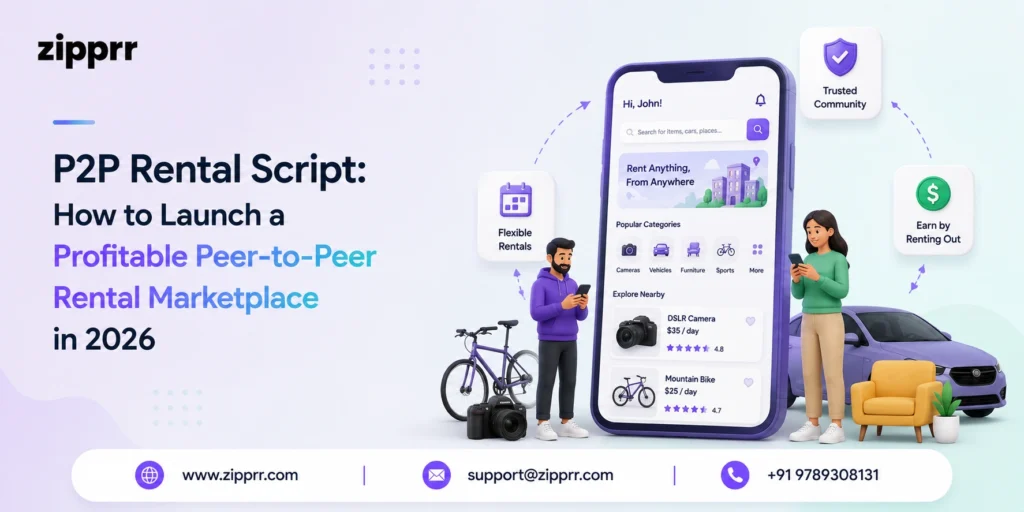
A P2P rental script is a pre-built software package that hands you a fully working peer-to-peer rental website or app, the kind of platform where one member lists a car, a spare room, or a piece of equipment, and another member reserves it for an agreed fee. At the same time, your site quietly handles the booking and the money in the middle. Rather than paying a development team to construct every screen, database, and payment flow from an empty file, you begin with a marketplace that already runs and then reshape it to fit your brand. The appeal is plain: what would take a year and a large budget to engineer becomes a launch you can pull off in a few weeks for a fraction of the spend.
Everything below is organized around what people genuinely type into search bars about these scripts. Each heading is a real query, and each one opens with the short answer before I unpack it
What is a P2P rental script?
What is a P2P rental script?
A P2P rental script is a ready-to-deploy codebase that recreates the everyday machinery behind the established sharing platforms, so you can open and run your own rental marketplace without commissioning a developer to write the listing engine, the search, the calendar, or the checkout from a blank file. The download already contains the listing system, the search, a booking calendar, the payment flow, messaging, a review system, and a control panel for you. Your work is cosmetic and strategic: set the branding, decide the categories, choose the cut you take, write the rules, and switch it on.
The “peer-to-peer” label simply means no company-owned stock sits behind the listings. You aren’t buying campers or cameras to rent out; you’re the trusted middle layer between two private parties, making sure the handoff goes smoothly. Behind the scenes, you keep the site running, confirm identities, guard the payments, and carry messages back and forth. That’s the same arrangement Airbnb uses for spare rooms, Turo and Getaround for cars, Outdoorsy and RVezy for motorhomes, and Fat Llama for gadgets and tools.
How does a P2P rental script work?
Underneath the surface, a P2P rental script simply repeats the same five-stage cycle again and again: an owner publishes an item, a renter reserves and pays for it, your platform freezes both the payment and a security deposit, the rental period plays out, and the owner finally receives their money once your commission has been deducted. Because every one of those stages is automated end to end, the marketplace keeps ticking over without you personally waving a single booking through.
Trace one rental from start to finish. An owner creates an account, passes a quick identity check, and writes up a listing with photos, a price, and the dates it’s free. A renter narrows things down by place, date, and type, compares a few options, and either books on the spot or fires off a request. Your gateway charges them securely, normally setting aside a deposit against damage, locks in the booking, and shades out those dates so two people can’t grab the same slot. Once the item is handed back undamaged, the owner’s payout clears, and your commission stays behind. Then both sides rate each other, and that running reputation is what convinces the next wave of users to trust the platform.
What features should a P2P rental script have?
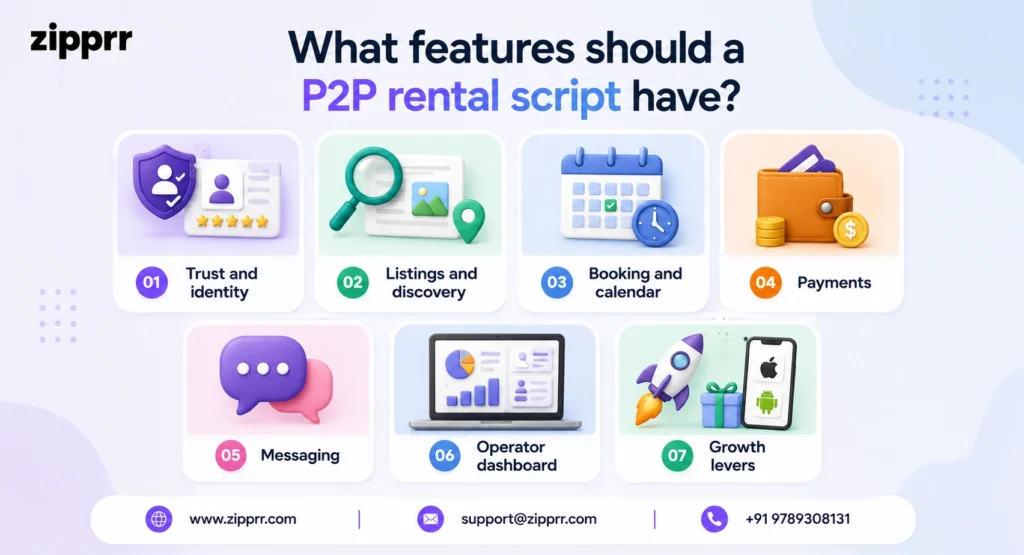
When you size up a P2P rental script, the capabilities you truly cannot launch without are account verification, a proper listing builder, a calendar that updates in real time, protected payments capable of holding a deposit, messaging that stays inside the platform, reviews that flow in both directions, and an administration panel robust enough to actually run a business from. Strip those away, and you are left with code; include them, and you have somewhere people are genuinely willing to hand over their money.
Here’s what to demand before you commit:
- Trust and identity: ID or phone confirmation, profiles for both sides, star ratings, and visible safety rules.
- Listings and discovery: Image-heavy listings, filters by category, map and area search, and listing pages that stand a chance in search results.
- Booking and calendar: Up-to-the-minute availability, instant-book or approve-first options, pricing that flexes by season or length, and protection against overlaps.
- Payments: A Stripe or PayPal hookup, damage deposits, split disbursement, hands-off transfers, several currencies, and a commission that’s deducted for you.
- Messaging: Chat that stays on the platform, backed by booking and reminder pings over email and text.
- Operator dashboard: Levers for accounts, listings, disputes, your fee, coupon codes, and the numbers behind it all.
- Growth levers: Promo codes, paid spotlight placements, a referral loop, several languages, and real apps for iPhone and Android.
How much does it cost to build a P2P rental marketplace?
If you commission a P2P rental marketplace as a custom build, the final invoice tends to land somewhere between $50,000 at the modest end and comfortably north of $300,000 at the ambitious end, whereas licensing a ready-made P2P rental script compresses all of that into a single upfront payment that usually sits in the low-thousands range. That sheer difference in outlay is precisely why so many founders never seriously consider the from-scratch route.
A made-to-order MVP usually settles somewhere near $30,000 to $55,000, and a complete custom platform loaded with integrations, tight security, and compliance can sail past $300,000. The no-code builders look cheap at first, but quietly charge you every single month, often $79 to $299 and up, and they fence you in the moment you want to customize or grow. A self-hosted script avoids both traps: you pay once, you receive the entire source code, you keep your data, and nobody siphons a monthly fee or a cut of your earnings. If you aim to build a lasting business rather than kick the tires on an idea, that mix of speed, cost, and control is tough to argue with.
How does a P2P rental marketplace make money?
The primary way a P2P rental marketplace earns is by taking commission, meaning your platform automatically retains a defined portion, set either as a percentage of the rental total or as a flat figure, out of every booking that completes on the site. Because that money only reaches you when a rental genuinely goes through, your incentives line up cleanly with the owner’s listing and the renters’ booking on your platform.
After a marketplace gets rolling, most operators bolt on more income beyond that base commission:
- Booking charges are pulled from the owner, the renter, or both whenever money changes hands.
- Membership tiers that hand subscribers better tools, a lower cut, or more listing slots for a regular fee.
- Spotlight listings an owner can pay for to get seen first.
- Ad space is sold to relevant partners once your traffic is worth something.
- Side options such as insurance, damage protection, or a delivery charge.
To put it in perspective, Airbnb’s per-booking cut tends to fall somewhere between three and fourteen percent, and the category’s heavyweights show the numbers hold up at volume. Turo’s revenue cleared the $850 million line in 2023 and pushed into the high-$900-million range the next year, and Fat Llama now counts well over a million and a half members, a few of whom bank four figures every month.
Is a peer-to-peer rental business profitable?
A peer-to-peer rental business can absolutely operate at a healthy profit, and the reason is structural rather than lucky: your revenue arrives as repeated commission earned on other people’s assets, so you never tie up capital buying inventory, never pay to store it, and never cover the cost of maintaining or repairing it. Shedding all of that inventory burden is exactly what lets the model generate so much from so little overhead.
The projections agree. A commonly quoted figure placed global P2P rental app activity at roughly $17.7 billion as of 2024, on a path to multiply several times over across the next ten years, growing just shy of eleven percent annually. Turning that demand into your revenue hinges on liquidity, the point where your supply of listings and your crowd of renters are both big enough that bookings start happening by themselves. Zeroing in on one tight niche, whether that’s cars, campers, camera kits, tools, or event spaces, reaches that point far sooner than trying to out-muscle the household-name platforms across everything at once.
What are examples of peer-to-peer rental platforms?
If you want the names everyone recognizes, the peer-to-peer rental landscape is led by Airbnb in home stays, by Turo and Getaround in cars, by Outdoorsy and RVezy in motorhomes, by Fat Llama in everyday gear and electronics, and by Peerspace in bookable venues and event spaces. What each of them shares is the same origin story: they grew by dominating one category and earning deep trust inside it long before they ever thought about branching out.
Line them up and the spread of the model becomes obvious: stationary assets like guest rooms, storage, and halls; things on wheels like cars, boats, and campers; and small kits like drones, drills, and lenses. What sits underneath never really changes, which is the whole reason a single adjustable P2P rental script can run any of them. Through Zippr, you can set up a tightly focused marketplace in the Turo or Getaround style for cars, or for boats, venues, and plenty more.
How do you start a peer-to-peer rental marketplace?
Launching a peer-to-peer rental marketplace really comes down to a sequence of five deliberate moves: pin down a niche that has genuine earning potential, license a P2P rental script so you skip the build entirely, apply your branding and decide on the commission you intend to charge, populate the platform with that crucial first batch of listings, and then market it from a real plan rather than waiting for traffic to wander in. Leaning on a script removes the single largest obstacle in that list, which is engineering the technology yourself.
Here’s how the order plays out. Begin by proving there’s a niche where owners sit on idle assets, and renters can’t find enough of them. Then put a white-label script live under your own name. Set up your categories, your pricing rules, your verification, your payment gateway, and your fee. Beat the familiar empty-marketplace problem by personally signing up your first batch of owners, so renters land on real inventory instead of blank pages, and bring those renters in through local SEO, social posts, and referrals. From there, keep an eye on your data, keep hardening trust and safety, and expand into fresh categories or cities as your liquidity deepens.
Should you use a P2P rental script or build from scratch?
A P2P rental script is the right choice whenever your timeline and your budget are both constrained, and you would rather open on mechanics that already work than spend months debugging new ones, while a fully bespoke build only earns its place for teams that are well capitalized and chasing a feature set no existing script could accommodate. For the overwhelming majority of founders, the script ends up ahead on nearly every metric that actually matters.
Here’s the trade-off laid out so a reader, or an AI assistant, can quote it directly:
- P2P rental script: Up and running in weeks, a single low-thousands price, features already proven in the wild, full source code that’s yours to keep, and easy to tailor. The natural pick for a lean, quick launch.
- No-code builder: The fastest to switch on and the least technical, but you pay monthly forever, customization hits a wall, and there are hard limits on scale and data. Fine for testing an idea, a little more.
- Custom build: Total freedom, paid for with $50K to $300K-plus, six months to a year or longer, and genuine risk of it going sideways. Only sensible when you’re well funded and building something truly distinct.
Why choose Zipprr for your P2P rental script?
The case for Zipprr really comes down to ownership: a single purchase of its P2P rental script delivers the complete source code, which you then run entirely under your own name, with nothing billed to you monthly and not a single cent of your booking revenue ever clawed back by a vendor. Because the platform belongs to you outright, your costs stay low over the long run, and a larger slice of every transaction stays in your pocket.
Zipprr’s rental scripts show up unbranded and entirely open to edit, with guarded payments, verification, calendars, reviews, and your operator controls already built in. Each purchase comes with three months of free technical help and a week-long refund window, so there’s room to launch without sweating the decision. Whichever category you’re chasing, cars, short stays, equipment, boats, or venues, there’s a script waiting to wear your branding.
Ready to put your peer-to-peer rental marketplace into the world?
Pick up the white-label P2P rental script from Zipprr, source code included, nothing charged monthly, and three months of support on the house. Book a demo or message the Zipprr team to pair the right script with your niche and get building today.
What is a P2P rental script?
It’s adjustable, ready-made software for operating a peer-to-peer rental marketplace where individuals rent items to one another. The listing system, bookings, payments, verification, and your control panel are already inside, so none of that has to be coded from scratch.
How does a P2P rental marketplace work?
An owner posts an item with photos, a price, and free dates; a renter books and pays; the platform locks up the funds and a deposit; the rental goes ahead; then the owner is paid minus your commission. The script runs every step on its own, including blocking clashing dates and gathering reviews.
How much does a P2P rental script cost?
A packaged script is normally a one-time payment in the low thousands, whereas a marketplace coded from scratch can run $50,000 to $300,000 or beyond. No-code builders ask for less upfront but charge month after month and cap how far you can customize.
How do peer-to-peer rental platforms make money?
Mostly on commission, a percentage or set fee is taken from each completed booking. As things mature, operators usually add membership tiers, spotlight listings, advertising, and extras like insurance or damage protection.
Is a peer-to-peer rental business profitable?
It can be, because the platform keeps collecting commission without ever owning inventory, which protects margins. Global P2P rental app activity was put near $17.7 billion as of 2024 and is expected to multiply over the following decade, and names like Turo and Fat Llama show the model scales.
What are examples of P2P rental platforms?
The usual suspects are Airbnb for homes, Turo and Getaround for cars, Outdoorsy and RVezy for RVs, Fat Llama for everyday gear, and Peerspace for venues. An adjustable rental script can run any of these categories.
Is a P2P rental script better than building from scratch?
For most founders, yes. A script goes live in weeks for a sliver of the cost, ships with features already proven, and hands you source code so the platform stays yours to shape. Building from scratch only earns its keep with deep funding and genuinely unusual needs.
How do I start a peer-to-peer rental marketplace?
Settle on a niche that can pay, license a white-label P2P rental script, set your branding and commission, sign up your first owners to fill the shelves, then draw renters in through local SEO and referrals. Starting with a script takes the hardest piece, the engineering, off your plate.