
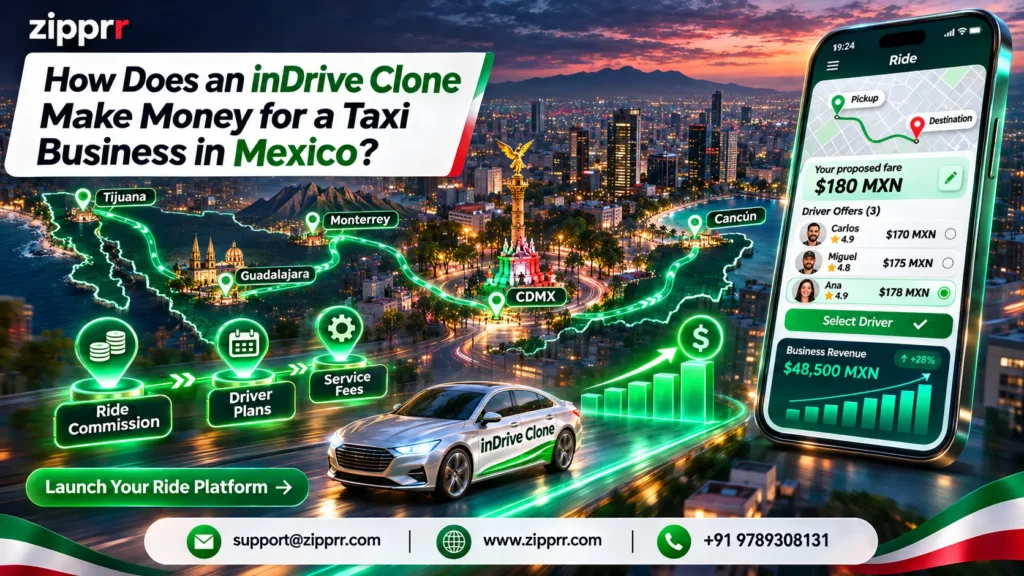
An inDrive clone makes money through a commission on completed rides, a flat driver subscription, or a hybrid of both. For a Mexican city launch, the hybrid is usually the steadiest start: a small weekly pass protects income in slow weeks, and a low commission lets you grow with demand.
inDrive is the ride-hailing app that lets riders name their own fare instead of accepting a fixed price, and that single idea has built a global business. This guide explains why the model is in such demand, then compares the three revenue models using one sample Mexican city and clearly labelled hypothetical pesos.
On cost: Zipprr’s inDrive clone is a one-time purchase. Standard is $490 (web platform, admin dashboard and fleet owner panel). Pro is $890 and adds Android and iOS rider and driver apps with app store submission. Both include 100% of the source code and 90 days of support.
What is inDrive, and why is its model in such demand?
inDrive is a ride-hailing and urban services app built around fare negotiation. The company was founded in 2013 in Yakutsk, Russia. The rider enters pickup and drop-off points and proposes a price. Nearby drivers then accept it, counter it, or skip it, and the rider picks the offer they like. That one change, a price set by the people in the ride, is what separates it from fixed-fare apps.
The demand shows in the numbers. A January 2026 Business Wire release states that inDrive was named the world’s second most downloaded ride-hailing app for a fourth year running, and that it operates in 1,065 cities across 48 countries. Latin America is a core region: the company entered through Mexico in April 2018, and published reports now put its Mexican footprint at more than 58 cities.
Why do riders and drivers keep choosing it? Three reasons stand out:
- Control over price. Riders can offer less than a fixed fare, and drivers can decline offers that do not pay. Both sides feel heard.
- Cash still works. A 2026 Latam Travellers guide notes that cash remains normal for short trips in Mexico, especially outside Mexico City, and that inDrive supports cash payment in most cities where it operates.
- More than rides. The same Business Wire release says inDrive expanded in 2025 into intercity transport, courier, grocery delivery and financial services. More use cases bring riders back more often.
This also shows where a local operator can compete. Large global platforms cover everywhere thinly. A focused local business can win one city with trusted drivers, quick support and fares that fit local trips. That is the opening an inDrive clone gives you, and the rest of this guide shows how to earn from it.
What does an inDrive clone actually sell?
It sells a negotiation. Instead of showing riders a fixed price, the app lets them name a fare. Nearby drivers then accept it, counter it, or skip it.
That loop is the product. Everything you earn comes from making that loop fast, fair and repeatable in your city.
Here is the basic bidding flow in plain steps:
- The rider enters pickup and drop-off points and proposes a fare.
- Nearby drivers see the request and the offered price.
- Each driver accepts, counters with a new fare, or skips.
- The rider compares offers and picks a driver.
- The trip runs, the rider pays, and the platform records its share.
Zipprr’s product page describes this as a “Bid and Go” ride mode. The admin panel lets you switch bidding on or off per city, and you can run fixed fares in one market and bidding in another.
That per-city control matters for your revenue plan. You can test a commission in one district and a subscription in another without rebuilding anything. Want to see the loop in action? You can book a free demo and watch a bid move from request to accepted offer.
Why does fare bidding suit Mexican cities?
Bidding gives riders a sense of control, and it gives drivers a voice in the price. Both groups often value that in busy urban markets where fares, traffic and demand shift through the day.
Fare negotiation is already familiar to riders in several large Mexican cities. A travel guide published in July 2026 by Latam Travellers lists Mexico City, Guadalajara, Monterrey, Puebla and Tijuana among the places where negotiated-fare rides are available. That familiarity lowers your education cost, because riders already understand the idea of naming a price.
Here are the local advantages a Mexican entrepreneur can build on:
- City-level focus: launch in one city, learn its rhythm, then expand.
- Community trust: recruit drivers through local taxi groups, fleet owners and referrals.
- Flexible pricing: test bidding in one zone and fixed fares in another.
- Fleet owner partnerships: bring in owners who manage several vehicles.
Mexico City has also published rules for ride-hail app drivers, as reported by Global Fleet. Regulations differ by city and state, so ask a local transport adviser which permits and driver requirements apply where you plan to operate. Building that into your launch plan from day one keeps your revenue model on solid ground.
What is the Bid Balance Check?
Before comparing revenue models, you need a way to judge whether your bidding marketplace is healthy. We use a simple three-lever framework called the Bid Balance Check.
It applies to any bidding taxi app, and you can run it weekly from your admin dashboard.
- Lever 1, offer speed: how many seconds pass between a rider’s request and the first driver offer? Faster offers keep riders in the app.
- Lever 2, acceptance rate: what share of rider requests end in a booked trip? A low rate means riders are naming fares that drivers will not take.
- Lever 3, driver earnings floor: are drivers clearing enough per hour to stay online? If not, supply will thin out even when demand is strong.
Each revenue model pushes on these levers differently. A high commission pressures the earnings floor. A high subscription pressures driver sign-ups. A hybrid spreads the pressure across both.
Keep the Bid Balance Check in mind as you read the scenarios below. The best model is the one that keeps all three levers healthy in your city.
Revenue scenarios for a bidding taxi app in a Mexican city
The three scenarios below use one shared sample city, so the comparison is fair. Every number here is a hypothetical sample for planning, not market data and not a forecast. Replace them with your own research before you decide.
Here are the sample assumptions:
- A mid-size Mexican city with 180 active drivers on the platform.
- 12,000 completed rides per month at the steady-state level.
- An average fare of 85 Mexican pesos (MXN) per ride.
- Gross monthly booking value of 1,020,000 MXN (12,000 rides multiplied by 85 MXN).
The sample figures ignore payment processing fees, marketing, salaries and taxes. They show revenue behaviour, not profit.
Scenario 1: the commission model
You keep a percentage of each completed fare. The driver keeps the rest.
In our sample, a 12% commission on 1,020,000 MXN of bookings gives you 122,400 MXN per month.
Here is how this scenario plays out:
- Easy to explain: drivers pay nothing until they earn, which lowers the barrier to joining.
- Grows with demand: if rides rise 50%, sample revenue rises to 183,600 MXN.
- Follows demand down too: if rides fall 30%, sample revenue drops to 85,680 MXN.
The commission model suits a launch where you want to attract drivers quickly. It asks for little commitment up front, and your income tracks your success.
The watch point is the driver earnings floor. If the commission feels high relative to bid prices, drivers may counter higher, and riders may drop out. Start modest, then adjust based on your acceptance rate.
Zipprr’s product page lists commission settings for your taxi business, so you can set the percentage in the admin panel and change it by city as you learn.
Scenario 2: the subscription model
Drivers pay a flat fee for platform access, often weekly. You take no cut of individual fares.
In our sample, each driver pays a 150 MXN weekly pass. Over four weeks that is 600 MXN per driver, and 180 drivers give you 108,000 MXN per month.
Here is how this scenario plays out:
- Predictable income: revenue holds at 108,000 MXN whether rides rise or dip, as long as drivers stay subscribed.
- Driver-friendly pitch: drivers keep every peso of each bid, which is a strong message for recruitment.
- Upside is capped: a busy month does not raise your income unless you add subscribers.
Subscriptions reward you for building a large, loyal driver base. They fit cities where many drivers work full time and want cost certainty.
The watch point is the sign-up barrier. A driver pays before earning, so the offer needs to be easy to understand. A short free trial week is a common way to lower that hurdle.
It also helps to remember that a flat fee works best when each driver completes enough rides to feel the value. Track rides per driver, and adjust the pass price if the numbers drift.
Scenario 3: the hybrid model
You combine a smaller weekly pass with a lower commission. Drivers pay a modest entry fee, and you share in the upside of busy weeks.
In our sample, the pass is 80 MXN per week, which is 320 MXN per driver per month. Across 180 drivers that adds up to 57,600 MXN. A 6% commission on 1,020,000 MXN adds 61,200 MXN. The total is 118,800 MXN per month.
Here is how this scenario plays out:
- Balanced income: a stable base from passes, plus growth from commission.
- Gentler on drivers: both the fee and the percentage are smaller than in the single-model scenarios.
- Resilient in slow months: if rides fall 30%, sample revenue is still 100,440 MXN.
- Rewarding in busy months: if rides rise 50%, sample revenue reaches 149,400 MXN.
The hybrid model asks drivers to understand two charges, so clear communication is essential. A one-line explanation inside the driver app, such as a small weekly pass plus a small share per trip, keeps it simple.
The watch point is complexity. Keep both numbers modest at launch, and review them after the first full month of data.
Side-by-side comparison of the three sample models
This table puts the three scenarios together. All figures are hypothetical samples in Mexican pesos per month, using the assumptions above.
| Revenue model | Steady state (12,000 rides) | Busy month (18,000 rides) | Slow month (8,400 rides) | Best fit |
|---|---|---|---|---|
| Commission (12%) | 122,400 MXN | 183,600 MXN | 85,680 MXN | Fast driver recruitment |
| Subscription (150 MXN weekly pass) | 108,000 MXN | 108,000 MXN | 108,000 MXN | Stable full-time driver base |
| Hybrid (80 MXN pass plus 6%) | 118,800 MXN | 149,400 MXN | 100,440 MXN | Balanced growth and stability |
The subscription row assumes all 180 drivers stay subscribed in every month. In real life, a slow month can also reduce your driver count, so treat that row as a best case.
The commission model has the highest upside in this sample. The hybrid model has the best balance between upside and protection.
Ready to compare plans? Start with the pricing
Pricing first: Zipprr’s inDrive clone is a one-time purchase with no per-booking fees on the platform side.
- Standard, $490: web platform, admin dashboard and fleet owner panel, 100% source code, website installation, 90 days of support and regular updates.
- Pro, $890: everything in Standard, plus Android and iOS rider and driver apps, app store submission, and bidding and fixed-fare modes.
- Refund: 100% refund within 7 days of purchase, subject to the refund policy.
See every feature on the inDrive clone product page.
Prefer a quick chat?
Message us on WhatsApp at +91 97893 08131 or write to [email protected].
How do you choose the right revenue model?
Choose by looking at your driver supply and your cash needs. A few simple rules can guide you.
- Few drivers on day one? Start with commission only, or a free trial period. Low friction wins early recruitment.
- Many full-time drivers and fleet owners? A subscription can feel fair and predictable to them.
- Uncertain demand? The hybrid model protects you while you learn the city.
- Several cities? Run a different model in each, then keep the one that holds the best Bid Balance Check scores.
Whichever model you pick, write the rule down in plain language for drivers. Clear terms build trust, and trust is what brings drivers back each week.
A good habit is to review your model every 30 days. If acceptance rate climbs and driver earnings hold, keep going. If either slips, adjust one lever at a time so you can see what worked.
What other revenue streams can a bidding taxi app add?
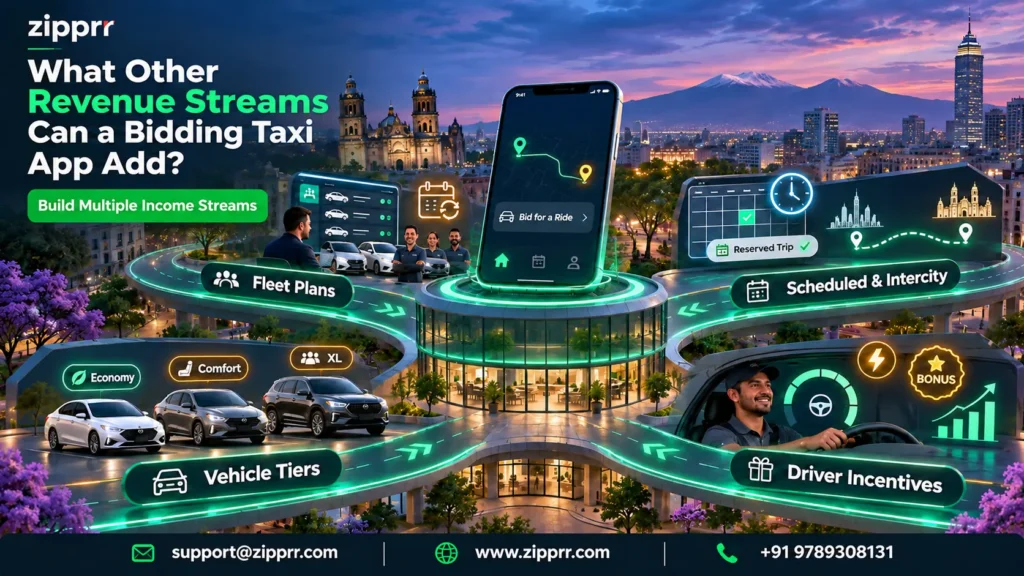
Ride revenue is the core, but a mature platform can earn in other ways. Add them once your main loop is stable.
- Fleet owner programmes: offer owners a dashboard to manage several vehicles and drivers, and charge a monthly fee for larger fleets.
- Scheduled and intercity rides: the product page lists scheduled rides and intercity route management, which suit planned trips with different pricing.
- Vehicle type tiers: offer economy, comfort and larger-vehicle options, each with its own commission or pass level.
- Driver incentives that pay for themselves: small bonuses for peak-hour coverage can lift acceptance rate and ride volume.
Each stream should pass one test: does it improve at least one lever in the Bid Balance Check? If it does not, wait.
What does it cost to run the business beyond the software?
The software is a one-time purchase, but a taxi business has running costs too. Planning for them early keeps your revenue scenarios honest.
Here are the main cost areas to estimate with your own local quotes:
- Map, SMS and payment provider usage fees.
- Server hosting for your platform.
- Driver onboarding and document checks.
- Customer support hours, including evenings and weekends.
- Marketing for both riders and drivers.
- Local permits, insurance and tax obligations.
Subtract these from your sample revenue to see your real margin. A model that looks modest on paper can still be a healthy business if costs stay lean.
An operations-focused view of these costs is covered in this walkthrough on launching a ride-hailing business without running short of drivers. It looks at the supply, dispatch, money, safety and support desks, which apply to a bidding app as well.
How do you attract drivers in a Mexican city?
Drivers are the scarce side of the marketplace. Without them, riders see no offers and leave. These steps work for a city-by-city launch:
- Start with one district: concentrate drivers and riders so offers arrive quickly.
- Recruit through trusted networks: taxi cooperatives, fleet owners and driver referrals carry more weight than ads.
- Explain the bid clearly: show drivers how to accept, counter or skip, using screenshots in their own language.
- Offer a launch incentive: a free first month or reduced pass can bring drivers in.
- Respond fast: answer driver questions on WhatsApp the same day.
Watch the earnings floor in the first weeks. Drivers who earn well tell other drivers, and that word of mouth is your cheapest channel.
Confirm language and currency settings for your market during the demo, so rider and driver screens feel natural from the first trip.
How do you attract riders who are used to naming their price?
Riders arrive with expectations. They want a quick response, a fair price and a safe trip. Here is how to meet them:
- Show the fare estimate: a suggested fare helps new riders bid sensibly.
- Keep offers fast: aim for the first offer within moments, and track it in your Bid Balance Check.
- Use driver ratings and vehicle details: riders choose based on price, rating and arrival time.
- Offer trip sharing: the product page lists live trip sharing, which reassures riders and their families.
Local promotions also help. Partner with universities, offices and neighbourhood businesses to bring your first riders in groups.
What should your first 90 days look like?
A simple three-phase plan keeps the work focused. Adjust the timing to your city.
Days 1 to 30, set up and seed. Finish branding, configure fares and commission in the admin panel, and recruit your first drivers. Zipprr’s page states that launch takes 7 business days after your branding and requirements are received.
Days 31 to 60, test and tune. Run your chosen revenue model and watch the Bid Balance Check weekly. Change only one setting at a time.
Days 61 to 90, scale carefully. Add a second district or a second revenue stream, only if your three levers are healthy.
By day 90, you should know which revenue model fits your city. That knowledge is worth more than any estimate in a guide.
What mistakes should you avoid with a bidding taxi app?
Most early problems come from a few predictable choices. Avoiding them saves time and money.
- Setting commission too high at launch: start modest and earn trust first.
- Launching citywide at once: thin coverage means slow offers and unhappy riders.
- Ignoring driver support: a fast reply builds loyalty.
- Changing several settings together: you will not know which change helped.
- Skipping local compliance checks: confirm permits and driver requirements before launch.
Each of these has a simple fix, and each fix costs far less than a failed launch.
Frequently Asked Questions
1. What is inDrive and how does fare bidding work?
inDrive is a ride-hailing app where the rider names a price for a trip. Nearby drivers accept it, counter with a different fare, or skip the request, and the rider picks a driver from the offers. The trip is booked at the agreed fare, and the platform records its commission or fee.
2. How does an inDrive clone make money?
An inDrive clone makes money through a commission on completed rides, a driver subscription, or a hybrid of both. You choose the model and can change it by city. Many new operators begin with a modest commission or a small pass, then adjust after reviewing a full month of ride data.
3. How much does an inDrive clone cost?
Zipprr’s inDrive clone costs $490 for the Standard plan and $890 for the Pro plan, both one-time purchases. Standard covers the web platform and admin panel. Pro adds Android and iOS rider and driver apps with app store submission. Both include 100% of the source code and 90 days of support.
4. How do you build an app like inDrive?
You can build it from scratch with a development team, or launch faster with a ready-made inDrive clone. A ready-made product gives you rider and driver flows, bidding, an admin panel and source code from day one. Zipprr states launch takes 7 business days after receiving your branding and requirements.
5. Which revenue model is best for a bidding taxi app in Mexico?
The hybrid model suits most new city launches, because a small weekly pass gives a stable base while a low commission shares in busy weeks. Commission-only is easier for fast driver recruitment, and subscriptions suit full-time driver bases. Test your choice for 30 days, then adjust using your own ride data.
6. Does an inDrive clone include mobile apps?
Native Android and iOS rider and driver apps are part of the $890 Pro plan, which also includes app store submission. The Standard plan covers the web platform and admin panel. See what business owners can control in the admin panel in this guide to taxi app admin dashboard controls.
7. Can I launch a bidding taxi app in Mexico?
Yes, many entrepreneurs launch local ride-hailing businesses, and Mexico City has published rules for ride-hail app drivers, as reported by Global Fleet. Rules differ by city and state, so confirm permits, insurance and driver requirements with a local transport adviser before you open to the public.
8. How long does it take to launch an inDrive clone?
Zipprr states you can go live in 7 business days. The clock starts when Zipprr receives your branding and requirements, and the timeline is written into the agreement. App store review times are set by Apple and Google, so Pro plan apps may go live after the web platform.
9. Do I get the source code with an inDrive clone?
Yes. Both plans deliver 100% of the source code, unencrypted, so your team can customise the product and host it where you choose. It is a one-time purchase, and a 100% refund is available within 7 days of purchase, subject to the refund policy.
10. Can I switch between bidding and fixed fares later?
Yes. The product page states you can turn bidding on or off per city and switch to fixed fares later if the market changes. That lets you run bidding in one district and fixed fares in another, then keep whichever performs better for riders and drivers.
Conclusion: pick a model, test it, and keep what works
An inDrive clone gives you the tools to earn from a negotiated-fare taxi business. Commission grows with demand, subscriptions give steady income, and the hybrid blends both. The sample numbers above are hypothetical, but the pattern is clear: match your revenue model to your driver supply, and review it every 30 days using the Bid Balance Check.
If you also want a fixed-fare option alongside bidding, see the fixed-fare taxi app for comparison. Many operators run both pricing styles in different parts of the city.
Start with the plan that fits your city
Standard $490 (web platform and admin panel) or Pro $890 (adds Android and iOS apps and app store submission). One-time purchase, 100% source code, 90 days of support, 100% refund within 7 days. Talk to the team on WhatsApp at +91 97893 08131, or email [email protected]. We will help you pick the plan and revenue model for your Mexican city.