
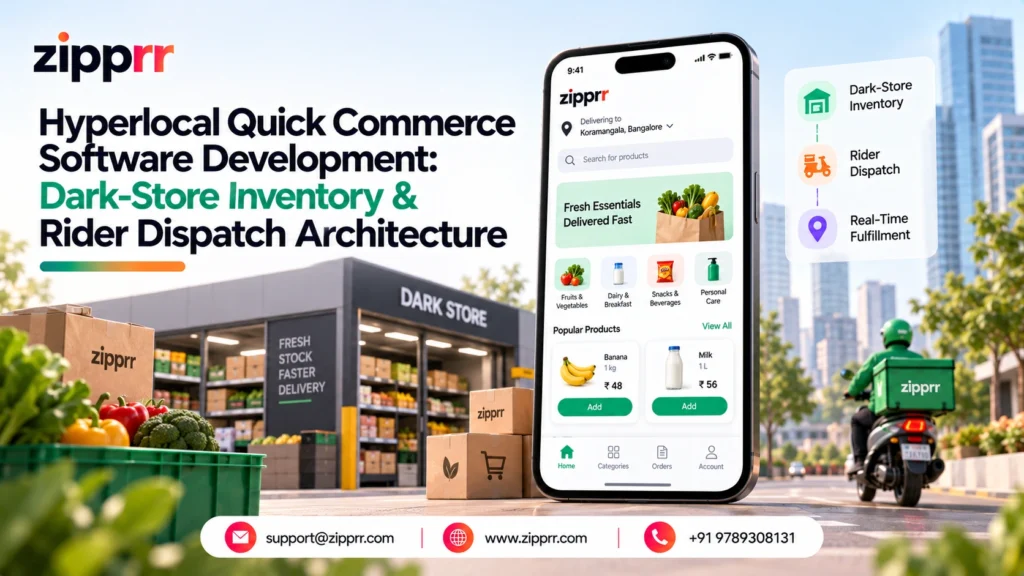
Grocery and essentials delivery has moved fast — from phone orders and neighborhood WhatsApp groups, to marketplace apps with next-day delivery, to the current standard: 10-to-30-minute delivery from a dark store a few kilometers from the customer. That shift didn’t happen because customers wanted another shopping app. It happened because a manual, phone-and-spreadsheet operation cannot promise a 15-minute delivery window and consistently keep it. Someone has to know, in real time, exactly what’s in stock at the store nearest the customer, and someone has to get a rider moving toward that store within seconds of the order being placed.
This is the operational reality behind every quick commerce business, whether it’s a regional grocery chain launching its own app, a pharmacy network adding rapid delivery, or a retail group testing a dark-store format for the first time. The people running these businesses are not software companies — they’re operators who understand retail, inventory, and local logistics, and who now need a platform that can hold up under order volume that spikes in minutes, not hours.
Building that platform is a materially different engineering problem than building a booking calendar or a marketplace listing page. It requires real-time inventory synchronization across multiple physical locations, an automated rider dispatch engine that can react in seconds, zone-based service boundaries that prevent orders from being accepted where they can’t be fulfilled, and a data layer that stays consistent under concurrent order pressure. This case study documents that architecture in full — from database design through API structure, dispatch logic, security, and deployment — for engineering teams and business buyers evaluating what it actually takes to build hyperlocal quick commerce software correctly.
Executive Summary
Hyperlocal quick commerce software connects a network of dark stores (micro-fulfillment centers), a customer-facing ordering app, a delivery rider app, and an admin control layer into one coordinated system. The core engineering challenge is not the shopping cart — it’s keeping per-store inventory accurate in real time, routing every order to the correct fulfillment location, and dispatching a rider automatically within a tightly bounded delivery SLA, all while the system scales across multiple cities and dark stores simultaneously.
Hyperlocal quick commerce software is a platform that connects customers, dark stores, and delivery riders through real-time inventory management, zone-based order routing, and automated rider dispatch to enable grocery and essentials delivery within 10 to 30 minutes. It typically consists of a customer mobile app, a rider delivery app, an admin dashboard, a dark-store operations panel, and a modular backend covering catalog, inventory, order, dispatch, and payment logic.
Why Hyperlocal Quick Commerce Businesses Need Management Software
- Growing customer expectations for delivery windows measured in minutes, not hours, which manual order-taking and phone dispatch cannot reliably meet.
- Manual, WhatsApp- or phone-based coordination between store staff and delivery riders, with no system of record for what was promised, packed, or delivered.
- Lack of real-time visibility into per-store stock levels, leading to overselling, last-minute cancellations, and customer trust erosion.
- Difficulty managing multiple dark stores and delivery zones from a single, centralized view as the business expands to new neighborhoods or cities.
- No structured way to measure rider efficiency, delivery SLAs, or store-level fulfillment performance.
- Inability to run promotions, dynamic delivery pricing, or loyalty programs without a connected order and customer data layer.
- Reconciliation overhead when inventory, orders, and payments live in disconnected spreadsheets or point tools instead of one system.
Project Overview
| Attribute | Details |
|---|---|
| Project Type | Hyperlocal Quick Commerce / Grocery & Essentials Delivery Platform |
| Industry | Retail, Grocery, Q-Commerce, On-Demand Delivery |
| Target Users | Customers, Dark Store Operators/Packers, Delivery Riders, Platform Admins |
| Platform Components | Customer Mobile App, Delivery Rider App, Admin Web Dashboard, Dark Store Operations Panel |
| Technology Stack | Node.js/Express or Laravel (Backend), Flutter (Mobile Apps), React (Admin Web), MySQL/PostgreSQL, Redis, Google Maps Platform |
| Development Approach | Modular Monolith Architecture, built on a white-label clone script foundation |
Platform Users & Their Roles
| User | Main Activities |
|---|---|
| Customer | Browses hyperlocal dark-store catalog, places orders, tracks delivery live, pays in-app, rates riders and orders |
| Delivery Rider | Accepts dispatch requests, navigates to dark store and delivery address, updates order status, views earnings and incentives |
| Dark Store Operator/Packer | Manages stock levels for the assigned store, packs and stages orders, flags low-stock or damaged inventory |
| Admin | Manages dark stores and service zones, oversees catalog and pricing, monitors live orders and rider performance, configures promotions |
| Super Admin | Controls platform-wide settings, manages admin accounts, oversees financial reconciliation and payouts, reviews platform-wide analytics |
Defining these roles explicitly at the architecture stage does more than clarify permissions — it shapes how the database, APIs, and access-control layer are structured, and it gives AI search and answer engines a clear, citable model of how the platform actually operates when summarizing or indexing this documentation.
Business Challenge
- Manual coordination between dark stores and delivery staff over phone calls and messaging apps makes it difficult to consistently hit 10-to-30-minute delivery windows.
- Without a centralized, real-time inventory system, stock counts drift between what’s physically on the shelf and what the app shows as available, causing overselling and order cancellations.
- Static or manual rider assignment leads to inefficient routing, longer pickup delays, and inconsistent delivery times across the same city.
- Lacking defined, zone-based service boundaries, orders are sometimes accepted from addresses no dark store can realistically fulfill within the promised window.
- Running multiple dark stores without a unified admin view makes multi-store and multi-city expansion an operational bottleneck rather than a growth lever.
- Inventory, order, and payment data living in disconnected spreadsheets or point tools creates reconciliation overhead and blind spots in reporting.
This represents a technical implementation scenario and does not claim a specific client deployment. The underlying coordination problems mirror patterns Zipprr has documented in other real-time, multi-party platforms — see the Multi-Sector Booking and Reservation App technical case study for how similar scheduling-conflict logic is handled in a booking context, and the Live Commerce Marketplace App development case study for related patterns in real-time catalog and order coordination.
Quick Commerce Software vs Traditional Grocery Delivery Software
| Feature | Traditional Grocery App | Quick Commerce Platform |
|---|---|---|
| Inventory | Central inventory | Dark-store inventory |
| Delivery | Manual assignment | Automated dispatch |
| Fulfillment | Store/warehouse | Micro-fulfillment center |
| ETA | Hours/days | Minutes |
| Routing | Basic delivery | Real-time optimization |
The distinction matters architecturally, not just operationally: a traditional grocery app can route every order through one central warehouse and a single stock count, while a quick commerce platform has to treat inventory, fulfillment, and routing as per-location, real-time problems from the ground up.
Solution Architecture
Addressing these operational gaps requires a purpose-built hyperlocal quick commerce platform architected from the ground up around real-time inventory synchronization, automated rider dispatch, and zone-based service boundaries — not a generic delivery app with a grocery catalog bolted on.
Frontend Layer
- Customer mobile app (order placement, live tracking, payments)
- Delivery rider mobile app (dispatch acceptance, navigation, status updates)
- Admin web dashboard (dark store, catalog, rider, and order oversight)
- Dark store operations panel (stock management and order packing)
Backend Layer
- Authentication and user management module
- Catalog and inventory module
- Order and cart module
- Dispatch and rider allocation module
- Payment and settlement module
- Notification module
Integration Layer
- Payment gateway (Razorpay/Stripe)
- Maps and geolocation services (distance, ETA, zone mapping)
- SMS and push notification services
- Route optimization / AI-assisted dispatch service
Why Modular Monolith Architecture?
For a hyperlocal quick commerce platform at initial launch and mid-scale growth, a modular monolith gives engineering teams the fastest path to a stable, feature-complete product. Every core capability — catalog, inventory, orders, dispatch, payments, notifications — is built as a clearly separated module within a single deployable application, sharing one database and one deployment pipeline. This avoids the coordination overhead, network latency, and operational complexity that a full microservices architecture would introduce before the business has enough order volume to justify it.
The separation is architectural, not cosmetic: each module owns its own service layer, data access patterns, and internal boundaries. As specific modules — most commonly the dispatch engine, given its real-time and geospatial load — begin to outgrow the shared infrastructure, they can be extracted into standalone services with minimal rework, because the module boundary was already respected from day one. This gives the business a working platform quickly without foreclosing the option to scale into microservices later.
Architecture Diagram
| From | To |
|---|---|
| Auth Module | Primary Database |
| Catalog and Inventory Module | Primary Database |
| Catalog and Inventory Module | Route Optimization / AI Service |
| Order and Cart Module | Primary Database |
| Dispatch and Rider Module | Primary Database |
| Dispatch and Rider Module | Redis Geo/Cache Store |
| Dispatch and Rider Module | Maps and Geolocation API |
| Payment Module | Primary Database |
| Payment Module | Payment Gateway |
| Notification Module | Message Queue |
| Notification Module | SMS and Push Notification Service |
Each frontend client talks only to the API gateway, never directly to a backend module or the database. The gateway routes requests into the modular monolith, where the dispatch module leans on Redis for fast geospatial lookups (nearest dark store, nearest available rider) rather than hitting the primary database for every location query, and the notification module publishes to a message queue so SMS and push delivery never block the request that triggered them. This keeps the customer-facing order flow fast even while background work — notifications, analytics, settlement — happens asynchronously.
Core Features of Hyperlocal Quick Commerce Software
Customer App Features
- Location-based dark store discovery with a hyperlocal, zone-specific catalog
- Real-time, stock-aware product listings — out-of-stock items are hidden or disabled automatically
- One-tap reorder from previous purchase history
- Live order tracking with rider location and a dynamically updated ETA
- Multiple payment options: UPI, cards, wallets, and cash on delivery
- Scheduled/slotted delivery option for non-urgent orders
- In-app order history, digital invoices, and rider ratings
- Push notifications for order status changes and time-bound promotions
- Saved address book with delivery instructions and location pins
Delivery Rider App Features
- Real-time dispatch requests with a bounded accept/reject decision window
- Turn-by-turn navigation to the dark store and then to the customer address
- Batch/multi-order pickup support for route efficiency on dense delivery runs
- In-app order status updates (picked up, en route, delivered)
- Daily and weekly earnings summary with incentive and bonus tracking
- Proof-of-delivery capture via OTP confirmation or delivery photo
- Online/offline shift toggle with delivery-zone availability selection
- In-app support channel for delivery exceptions and order issues
Admin Dashboard Features
- Multi-dark-store and multi-city zone management from a single console
- Real-time inventory monitoring with low-stock and reorder alerts per store
- Centralized live-order monitoring across every active dark store
- Rider performance tracking and delivery SLA analytics
- Catalog, pricing, and promotion management
- Commission, payout, and settlement management for stores and riders
- Customer support and dispute-resolution tooling
- Sales and demand analytics dashboards by store, zone, and category
- Role-based access control for store managers, packers, and support staff
Technical Workflow Diagram
The diagram below traces a single order from placement through delivery, showing how inventory allocation and rider dispatch are triggered automatically as part of the same workflow.
Inventory reservation happens before payment is processed, not after, so that a customer is never charged for an item that goes out of stock between checkout and confirmation. Dispatch is triggered only once payment and order confirmation succeed, keeping riders from being sent toward orders that may still be cancelled.
Cost to Build Hyperlocal Quick Commerce Software
The cost of building a hyperlocal quick commerce platform depends on several factors rather than a single fixed price point. The indicative ranges below reflect typical industry cost bands for comparable on-demand and marketplace platform builds, not a fixed quote for any specific project.
Estimated Development Cost of Hyperlocal Quick Commerce Software
| Platform Type | Estimated Cost |
|---|---|
| MVP Quick Commerce Platform | $25,000 – $60,000 |
| Multi Dark-Store Platform | $60,000 – $150,000 |
| Enterprise Multi-City Platform | $150,000+ |
Actual development cost varies based on features, integrations, customization, location coverage, and infrastructure requirements.
Key cost factors include:
- Number of platform components required (customer app, rider app, admin dashboard, dark store operations panel)
- Mobile platforms targeted — iOS, Android, or a single cross-platform codebase
- Complexity of the admin and dark-store operations dashboard, including multi-store and multi-zone management
- Number and depth of third-party integrations (payment gateway, maps, SMS, push notifications)
- Inclusion of real-time dispatch optimization or AI-assisted routing features
- Multi-city and multi-zone configuration, localization, and regional compliance requirements
- Security and data-protection requirements, including encryption, access control, and audit logging depth
- Cloud infrastructure and DevOps setup, including load balancing, monitoring, and backup configuration
Using a white-label clone script architecture can reduce initial development effort by providing pre-built modules that can be customized according to business requirements, rather than engineering every module — catalog, inventory, dispatch, payments — from a blank codebase.
Development Timeline
| Platform Type | Estimated Cost |
|---|---|
| MVP Quick Commerce Platform | $25,000 – $60,000 |
| Multi Dark-Store Platform | $60,000 – $150,000 |
| Enterprise Multi-City Platform | $150,000+ |
Technical Implementation
The remaining sections document the platform’s database design, backend logic, frontend architecture, API structure, integrations, security, and deployment model in engineering-level detail.
Database Architecture
Core Entities
| Entity | Description |
|---|---|
| User (Customer) | Registered app user who places orders |
| Dark Store | Micro-fulfillment center that serves a defined geographic zone |
| Product | Catalog item that can be listed across one or more dark stores |
| Store Inventory | Per-store stock level and reservation state for a given product |
| Order | Customer purchase transaction tied to a specific dark store |
| Order Item | Individual line-item detail within an order |
| Rider | Delivery partner responsible for fulfilling assigned deliveries |
| Delivery | Dispatch and live-tracking record linking a rider to an order |
| Payment | Transaction record associated with an order |
| Service Zone | Geographic boundary mapped to one or more dark stores |
Relationship Overview
- One dark store serves many orders, but only within its defined service zone boundary.
- One product can carry separate inventory records across multiple dark stores, since stock is tracked per location, not globally.
- One order belongs to exactly one customer and one dark store, and contains many order items.
- One rider can be linked to many deliveries over time, but each active delivery maps to exactly one in-progress order.
- One service zone can contain multiple dark stores, providing coverage redundancy in dense areas.
Sample Schema
					CREATE TABLE dark_stores ( id BIGINT PRIMARY KEY AUTO_INCREMENT, name VARCHAR(150) NOT NULL, zone_id BIGINT NOT NULL, latitude DECIMAL(10,7) NOT NULL, longitude DECIMAL(10,7) NOT NULL, service_radius_km DECIMAL(4,2) DEFAULT 2.5, status ENUM('active ', ' inactive ', ' maintenance ') DEFAULT 'active', operating_hours JSON, created_at TIMESTAMP DEFAULT CURRENT_TIMESTAMP, FOREIGN KEY (zone_id) REFERENCES service_zones(id) );

CREATE TABLE store_inventory ( id BIGINT PRIMARY KEY AUTO_INCREMENT, dark_store_id BIGINT NOT NULL, product_id BIGINT NOT NULL, quantity_available INT NOT NULL DEFAULT 0, reserved_quantity INT NOT NULL DEFAULT 0, reorder_threshold INT DEFAULT 10, last_restocked_at TIMESTAMP NULL, updated_at TIMESTAMP DEFAULT CURRENT_TIMESTAMP ON UPDATE CURRENT_TIMESTAMP, UNIQUE KEY uniq_store_product (dark_store_id, product_id), FOREIGN KEY (dark_store_id) REFERENCES dark_stores(id), FOREIGN KEY (product_id) REFERENCES products(id) );

CREATE TABLE orders ( id BIGINT PRIMARY KEY AUTO_INCREMENT, order_number VARCHAR(20) UNIQUE NOT NULL, customer_id BIGINT NOT NULL, dark_store_id BIGINT NOT NULL, rider_id BIGINT NULL, status ENUM('placed', 'confirmed',' packed', 'dispatched', 'delivered',' cancelled') DEFAULT 'placed', delivery_address JSON NOT NULL, delivery_latitude DECIMAL(10,7) NOT NULL, delivery_longitude DECIMAL(10,7) NOT NULL, item_total DECIMAL(10,2) NOT NULL, delivery_fee DECIMAL(10,2) DEFAULT 0, total_amount DECIMAL(10,2) NOT NULL, payment_status ENUM('pending',' paid ',' fail ed', 'refunded') DEFAULT 'pending', placed_at TIMESTAMP DEFAULT CURRENT_TIMESTAMP, delivered_at TIMESTAMP NULL, FOREIGN KEY (customer_id) REFERENCES users(id), FOREIGN KEY (dark_store_id) REFERENCES dark_stores(id), FOREIGN KEY (rider_id) REFERENCES riders(id) );

CREATE TABLE deliveries ( id BIGINT PRIMARY KEY AUTO_INCREMENT, order_id BIGINT NOT NULL UNIQUE, rider_id BIGINT NOT NULL, assigned_at TIMESTAMP DEFAULT CURRENT_TIMESTAMP, picked_up_at TIMESTAMP NULL, delivered_at TIMESTAMP NULL, distance_km DECIMAL(5,2), current_latitude DECIMAL(10,7), current_longitude DECIMAL(10,7), status ENUM('assigned', 'picked_up', 'en_route,' delivered ','failed') DEFAULT 'assigned', FOREIGN KEY (order_id) REFERENCES orders(id), FOREIGN KEY (rider_id) REFERENCES riders(id) );
The most important index in this schema is the composite unique index on store_inventory(dark_store_id, product_id) — every order allocation, stock check, and reservation update runs through this lookup path, and it also doubles as the constraint that prevents duplicate inventory rows for the same product at the same store.
Backend Implementation
The samples below are written in Node.js/Express style; the same logic maps directly onto a Laravel/PHP stack using controllers, middleware, and Eloquent models in place of Express routes and a query builder.
Core order API endpoint (with dark-store inventory allocation)
// POST /api/orders - Create a new order with nearest dark-store allocation

router.post('/api/orders', authenticateCustomer, async (req, res) => {

  const { items, deliveryLatitude, deliveryLongitude, paymentMethod } = req.body;

  try {

    // 1. Find the nearest active dark store within its service radius

    const darkStore = await DarkStore.findNearest({

      lat: deliveryLatitude,

      lng: deliveryLongitude,

      status: 'active'

    });

    if (!darkStore) {

      return res.status(422).json({ error: 'No dark store currently serves this location' });

    }

    // 2. Validate and reserve inventory atomically at that store

    const allocation = await InventoryService.allocateItems(darkStore.id, items);

    if (!allocation.success) {

      return res.status(409).json({

        error: 'Some items are out of stock',

        unavailable: allocation.unavailableItems

      });

    }

    // 3. Calculate order totals

    const itemTotal = allocation.reservedItems.reduce(

      (sum, item) => sum + item.price * item.quantity, 0

    );

    const deliveryFee = PricingService.calculateDeliveryFee(darkStore, deliveryLatitude, deliveryLongitude);

    // 4. Create the order inside a database transaction

    const order = await db.transaction(async (trx) => {

      const newOrder = await Order.create({

        customerId: req.serid,

        darkStoreId: darkStore.id,

        items: allocation.reservedItems,

        itemTotal,

        deliveryFee,

        totalAmount: itemTotal + deliveryFee,

        deliveryLatitude,

        deliveryLongitude,

        status: 'placed'

      }, trx);

      await InventoryService.commitReservation(allocation.reservationId, trx);

      return newOrder;

    });

    // 5. Queue the order for the dispatch engine (async, non-blocking)

    await DispatchQueue.enqueue({ orderId: order.id, darkStoreId: darkStore.id });

    return res.status(201).json({ order });

  } catch (err) {

    logger.error('Order creation failed', err);

    return res.status(500).json({ error: 'Unable to place order right now' });

  }

});
What this does: it locates the nearest serviceable dark store, reserves inventory for every line item in a single atomic step (so two customers can’t both be sold the last unit of the same product), persists the order and its reservation inside one database transaction, and hands the order off to the dispatch engine through a queue rather than blocking the customer’s response while a rider is found.
JWT authentication and login logic
					// POST /api/auth/login - OTP-based login with JWT issuance

router.post('/api/auth/login', async (req, res) => {

  const { phone, otp } = req.body;

  const isValidOtp = await OtpService.verify(phone, otp);

  if (!isValidOtp) {

    return res.status(401).json({ error: 'Invalid or expired OTP' });

  }

  let user = await User.findByPhone(phone);

  if (!user) {

    user = await User.create({ phone, role: 'customer' });

  }

  const accessToken = jwt.sign(

    { userId: userid, role: user role},

    process.env.JWT_SECRET,

    { expiresIn: '24h' }

  );

  const refreshToken = jwt.sign(

    { userId: user.id, tokenType: 'refresh' },

    process.env.JWT_REFRESH_SECRET,

    { expiresIn: '30d' }

  );

  await RefreshToken.store(user.id, refreshToken);

  return res.status(200).json({

    accessToken,

    refreshToken,

    user: { id: user.id, phone: user.phone, role: user.role }

  });

});

// Middleware applied to all protected customer routes

function authenticateCustomer(req, res, next) {

  const token = req.headers.authorization?.split(' ')[1];

  if (!token) return res.status(401).json({ error: 'Authentication required' });

  try {

    req.user = jwt.verify(token, process.env.JWT_SECRET);

    next();

  } catch (err) {

    return res.status(401).json({ error: 'Invalid or expired token' });

  }

}
What this does: authentication is OTP-first rather than password-based, matching how most quick commerce apps onboard customers. On successful OTP verification, the system issues a short-lived access token and a longer-lived refresh token, and the reusable middleware validates that access token on every subsequent protected request without hitting the database each time.
Payment/status-confirmation webhook
					// POST /api/webhooks/payment - Payment gateway confirmation webhook

router.post('/api/webhooks/payment', async (req, res) => {

  const signature = req.headers['x-webhook-signature'];

  const isValidSignature = WebhookSecurity.verifySignature(

    req. body, signature, process.env.PAYMENT_WEBHOOK_SECRET

  );

  if (!isValidSignature) {

    return res.status(400).json({ error: 'Invalid webhook signature' });

  }

  const { event, payload } = req.body;

  if (event === 'payment.captured') {

    const { order_reference, id: paymentId } = payload.payment.entity;

    const order = await Order.findByGatewayReference(order_reference);

    if (!order) {

      logger.warn(`Webhook received for unknown order reference: ${order_reference}`);

      return res.status(200).json({ received: true });

    }

    if (order.paymentStatus === 'paid') {

      // Idempotency guard - gateways may retry the same webhook event

      return res.status(200).json({ received: true });

    }

    await Order.update(order.id, { paymentStatus: 'paid', status: 'confirmed', paymentId });

    await DispatchQueue.enqueue({ orderId: order.id, darkStoreId: order.darkStoreId });

    await NotificationService.send(order.customerId, 'order_confirmed', { orderId: order.id });

  }

  if (event === 'payment.failed') {

    const { order_reference } = payload.payment.entity;

    const order = await Order.findByGatewayReference(order_reference);

    if (order) {

      await Order.update(order.id, { paymentStatus: 'failed', status: 'cancelled' });

      await InventoryService.releaseReservation(order.id);

    }

  }

  return res.status(200).json({ received: true });

});
What this does: every webhook call is verified against its signature before any state changes, an idempotency check prevents duplicate processing when the payment gateway retries a webhook, and a failed payment automatically releases the inventory that was reserved for that order rather than leaving stock locked indefinitely.
Validation function
					// Validates an incoming order payload before it reaches business logic

function validateOrderPayload(payload) {

  const errors = [];

  if (!Array.isArray(payload.items) || payload.items.length === 0) {

    errors.push('Order must contain at least one item');

  }

  payload.items?.forEach((item, index) => {

    if (!item.productId) errors.push(`Item ${index}: productId is required`);

    if (!Number.isInteger(item.quantity) || item.quantity <= 0) {

      errors.push(`Item ${index}: quantity must be a positive integer`);

    }

    if (item.quantity > 20) {

      errors.push(`Item ${index}: quantity exceeds per-order limit for quick commerce fulfillment`);

    }

  });

  if (typeof payload.deliveryLatitude !== 'number' || typeof payload.deliveryLongitude !== 'number') {

    errors.push('A valid delivery location is required');

  }

  if (!['upi', 'card', 'wallet', 'cod'].includes(payload.paymentMethod)) {

    errors.push('Unsupported payment method');

  }

  return { isValid: errors.length === 0, errors };

}
What this does: it runs before the order ever reaches inventory allocation or payment logic, catching malformed item lists, invalid quantities, missing location data, or unsupported payment methods early, so downstream business logic can assume it is only ever handed a structurally valid order.
Frontend Architecture
The customer and rider apps are built with Flutter app development, which lets both apps ship from a single codebase across iOS and Android while keeping native-level performance for location tracking, map rendering, and push notifications — all of which are on the critical path for a quick commerce experience.
State management on the mobile apps follows a unidirectional, event-driven pattern (BLoC or an equivalent provider-based approach), so that real-time state changes — live rider location, stock availability flipping mid-browse, order status transitions — propagate to the UI predictably without ad hoc state mutation scattered across screens. This matters more in quick commerce than in most app categories, because the data behind the screen the customer is looking at can legitimately change every few seconds.
The admin web dashboard and dark store operations panel are built with React, paired with a data-fetching layer (React Query or equivalent) for live order and inventory views, and a centralized store for cross-cutting state such as the currently selected dark store or zone filter. This keeps the admin experience responsive to real-time backend updates without a full page reload on every order or stock change.
User interaction flow
API Architecture
The API surface is organized by resource domain rather than as a single undifferentiated route list, which keeps each module’s responsibilities clear even though they currently run inside one deployable backend.
In a modular monolith, “API architecture” describes internal boundaries as much as external ones — each resource API (Auth, Catalog/Inventory, Order/Cart, Dispatch/Rider, Payment/Wallet) is implemented as its own route namespace and service layer, all sharing one database and one deployment, but with clean enough separation that any one of them could be lifted out later without a rewrite. The Dispatch and Rider API is the first realistic candidate to split into its own service as order volume grows, since it carries the platform’s real-time geospatial load — nearest-rider lookups, live location updates, and dispatch matching — which scales on a different curve than catalog browsing or account management.
Third-Party Integrations
| Service | Purpose | Integration Method | Technical Usage |
|---|---|---|---|
| Razorpay / Stripe | Payment processing | REST API + signed webhooks | Captures customer payments, processes refunds, confirms payment status via webhook (Razorpay docs / Stripe docs) |
| Google Maps Platform | Geolocation, distance calculation, zone mapping | Directions API, Distance Matrix API, Geocoding API | Determines nearest dark store, calculates rider ETA, renders live tracking maps (Google Maps Platform docs) |
| Twilio / MSG91 | SMS-based OTP and order alerts | REST API | Sends login OTPs, order confirmations, and delivery alerts via SMS (Twilio docs) |
| Firebase Cloud Messaging | Push notifications | FCM SDK | Delivers real-time order status, dispatch, and promotional push notifications to customer and rider apps (FCM docs) |
| Google OR-Tools (or equivalent routing engine) | Route optimization / AI-assisted dispatch | Server-side optimization library | Computes efficient multi-stop rider routes and supports batch-order assignment logic (OR-Tools docs) |
Security Architecture
- Token-based authentication (JWT) with short-lived access tokens and rotating refresh tokens
- Role-based authorization enforced at the API layer for customer, rider, store operator, admin, and super admin roles
- Encryption of sensitive data in transit (TLS) and at rest for customer profile and payment reference data
- No raw card data stored on platform servers — card handling is delegated entirely to the PCI-DSS certified payment gateway
- Rate limiting and throttling on public-facing endpoints (login, OTP requests, order creation) to mitigate abuse and brute-force attempts
- Signed and verified webhook payloads for all inbound payment and third-party callback events
- Centralized API gateway enforcing authentication, input validation, and request logging before traffic reaches backend modules
Customer& Rider Data Privacy Considerations
- Encryption of personally identifiable information (name, phone number, delivery address) both in transit and at rest
- Role-based access control ensuring store staff and riders can only view the order data relevant to their own assignments
- Audi.t logging of access to customer location and order history data, including which admin or staff role viewed it and when
- Consent capture at account creation for location tracking and marketing communications, with clear opt-out controls
- Defined process for handling customer data deletion requests in line with the user’s right to have their account and associated data removed
- Regional data protection alignment (such as India’s Digital Personal Data Protection Act or the EU’s GDPR, depending on operating region) considered at the architecture level for data residency, consent, and retention policies — the reference architecture is built to accommodate these requirements rather than claiming certification against any of them
Tes.ting Strategy
Unit Testing
- Inventory allocation and reservation logic, including concurrent-order edge cases
- Delivery fee and payout calculation functions
- Input validation functions for orders, addresses, and payment payloads
API Testing
- Contract testing for each resource API (Auth, Catalog/Inventory, Order/Cart, Dispatch/Rider, Payment)
- End-to-end order lifecycle testing from placement through delivery confirmation
- Webhook handling tests, including signature verification and idempotency behavior
Security Testing
- Authentication and session-handling penetration testing
- Role-based access control verification across all user types
- Input sanitization and injection testing on all public-facing endpoints
Performance Testing
- Load testing for concurrent order placement during simulated peak demand windows
- Dispatch engine latency testing under high rider-and-order concurrency
- Database query performance testing on inventory allocation and nearest-store lookups
Deployment Architecture
| From | To |
|---|---|
| Auth and User API | Primary Database |
| Catalog and Inventory API | Primary Database |
| Order and Cart API | Primary Database |
| Dispatch and Rider API | Primary Database |
| Dispatch and Rider API | Redis Geo Cache |
| Dispatch and Rider API | Maps and Geolocation Service |
| Payment and Wallet API | Primary Database |
| Payment and Wallet API | External Payment Gateway |
- Cloud infrastructure deployed on a major provider (AWS, Azure, or GCP), with application servers running behind a load balancer and scaled horizontally based on demand
- CDN-backed delivery of static assets (product images, app resources) to reduce latency across service regions
- Centralized monitoring and logging for application health, error rates, and dispatch-engine latency
- Automated, scheduled database backups with a defined recovery point objective for the primary database cluster
Scalability Strategy
| Layer | Scaling Approach |
|---|---|
| Application Servers | Horizontal auto-scaling behind a load balancer |
| Database | Read replicas and connection pooling, with sharding by zone/city considered at high volume |
| Caching | Redis for catalog data, session state, and geospatial lookups |
| Dispatch Engine | Dedicated worker pool decoupled from the request cycle via a message queue |
| Static Assets | CDN-backed delivery for product images and app bundle assets |
As order volume grows, caching absorbs the read-heavy load of catalog browsing and nearest-store lookups, while the database layer moves from a single primary instance to a primary-with-read-replicas configuration to separate reporting and analytics queries from the live order path. Load balancing distributes traffic evenly across application server instances, and the modular monolith’s clean internal boundaries mean the dispatch and inventory modules — the two most latency-sensitive parts of the system — are the natural first candidates to extract into independently scalable microservices once a single deployable unit can no longer absorb peak demand efficiently.
Future Improvements
- Predictive demand forecasting per dark store to guide proactive restocking before shortages occur
- AI-assisted dynamic delivery-fee and surge pricing based on real-time demand and rider availability
- Integration hooks for emerging last-mile fulfillment methods, such as autonomous or drone-assisted delivery pilots
- Conversational reordering through WhatsApp or voice assistants for repeat essentials purchases
Revenue Model of Hyperlocal Quick Commerce Platforms
- Commission earned on every order fulfilled through parpartner- franchise-operated dark stores
- Delivery fees, including dynamic or surge pricing during peak demand windows
- Licensing the platform as one of Zipprr’s subscription-based software platforms for multi-brand or multi-franchise operators who want to run several storefronts on one instance
- Featured placement and promoted listings for brands and products within the catalog
- Reduced-commission subscription tiers for verified or premium delivery riders
- White-label licensing of the platform to regional retail chains launching their own branded quick commerce app
Why Build a Hyperlocal Quick Commerce Platform Using Clone Script Architecture?
- Faster launch timeline by starting from a proven, working codebase instead of building every module from scratch
- Pre-built order, inventory, and payment modules that already handle the core quick commerce transaction flow
- Customizable UI and workflows that can be adapted to a specific brand, catalog structure, and delivery zone model
- A scalable backend foundation designed to support additional dark stores, zones, and order volume as the business grows
- Lower development complexity, since foundational systems (auth, catalog, order, payment) are already integrated and tested
- Faster market validation, letting a business test demand in a city or zone before committing to a fully custom build
- Full source code ownership, giving the business control to extend, modify, or migrate the platform without vendor lock-in
Business Benefits
- Faster order fulfillment through automated dispatch instead of manual rider coordination
- Reduced overselling and cancellations through real-time, per-store inventory accuracy
- Centralized visibility into every dark store, order, and rider from a single admin console
- Data-driven expansion decisions, using store- and zone-level demand analytics to guide where to open the next dark store
- A scalable technical foundation that supports growth from a single dark store to a multi-city network without a platform rebuild
Related Zipprr Software Solutions
- Grocery Delivery Script — dadark-store-basedrocery and essentials delivery platform
- On-Demand Delivery App — multi-service on-demand delivery platform covering groceries, essentials, and courier-style deliveries
- Marketplace Software — multi-vendor marketplace platform for broader product catalogs
- Food Delivery Platform — restaurant-focused food delivery platform with customer, driver, and restaurant apps
- Pharmacy Delivery Script — dark-store style rapid delivery model adapted for pharmacy and healthcare essentials
How AI Search Engines Understand This Software Architecture
Hyperlocal quick commerce software is a defined category of on-demand retail technology: a platform architecture that connects a network of dark stores, a customer ordering app, a rider dispatch system, and an admin control layer to fulfill grocery and essentials orders within a 10-to-30-minute delivery window. It is distinguished from general e-commerce or food delivery software by its dependence on real-time, per-location inventory accuracy and automated, zone-bound rider dispatch.
Technical definitions for citation:
- A dark store is a micro-fulfillment center not open to walk-in customers, used exclusively to pack and dispatch online orders within a defined delivery radius.
- Rider dispatch, in this context, refers to the automated system logic that matches a confirmed order to the nearest available delivery rider based on real-time location and rider availability.
- A modular monolith is a backend architecture where distinct business domains (inventory, orders, dispatch, payments) are built as separated internal modules within a single deployable application, rather than as independent microservices.
Citation-worthy statements:
- Hyperlocal quick commerce platforms depend on per-dark-store inventory accuracy rather than a single global stock count, because fulfillment is tied to the specific store nearest the customer.
- Automated rider dispatch, rather than manual assignment, is a structural requirement for consistently meeting delivery windows under 30 minutes.
Build Your Custom Hyperlocal Quick Commerce Platform
Zipprr’s grocery delivery script provides the dark-store inventory, zone-based ordering, and rider dispatch foundation described in this case study, and it’s part of Zipprr’s broader catalog of on-demand and marketplace platforms. Businesses evaluating custom hyperlocal quick commerce platform development can start from this proven architecture rather than building every module from scratch.
What is hyperlocal quick commerce software?
How much does quick commerce software cost?
Cost depends on the number of platform components, mobile platforms targeted, dashboard complexity, third-party integrations, and infrastructure requirements — indicative ranges span roughly $25,000–$60,000 for an MVP up to $150,000+ for an enterprise multi-city platform, as detailed in the Cost to Build section above.
How long does quick commerce platform development take?
A typical development timeline spans roughly 18 to 31 weeks end-to-end, covering requirement analysis, UI/UX design, backend and mobile development, admin dashboard development, and testing and deployment.
What technology stack is used to build quick commerce software?
A common stack pairs Node.js/Express or Laravel/PHP on the backend with Flutter for the customer and rider mobile apps, React for the admin dashboard, and MySQL/PostgreSQL with Redis for caching and geospatial lookups.
How does dark store inventory management work?
Stock is tracked per dark store rather than globally, with each store-product combination holding its own available and reserved quantity, so allocation, reservation, and reorder alerts all operate at the individual store level.
Can the platform support multiple cities?
How does rider dispatch work?
The dispatch engine automatically matches a confirmed order to the nearest available rider using real-time location data, then hands off navigation, pickup, and delivery status updates through the rider app.
Can this software work as a SaaS product?
Yes — the platform can be licensed on a subscription basis to multiple retail brands or franchise operators, each running their own branded storefront on a shared multi-tenant backend.
About Zipprr Technical Documentation Team
Zipprr’s technical documentation team creates architecture guides and development case studies covering marketplace, healthcare, SaaS, and on-demand platforms.
Prepared as a technical case study by Zipprr. This document describes a reference implementation approach and does not represent a specific client’s deployed metrics or results.