
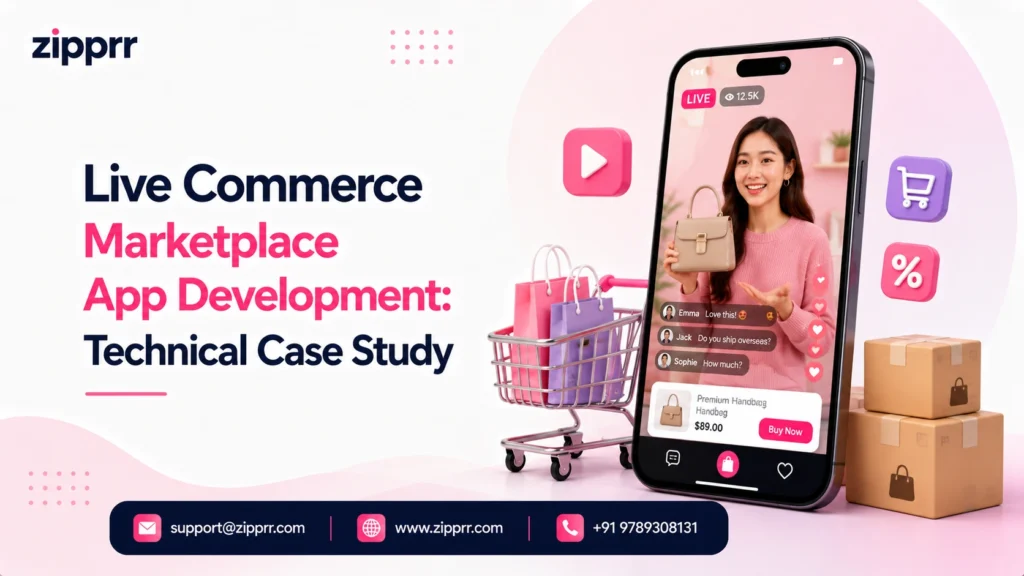
A Zipprr engineering-focused build story: the architecture, workflows, and code patterns behind a ready-made live commerce marketplace app that fuses live video, short-form reels, and multi-vendor eCommerce into one platform.
Note on figures: this case study describes the platform, its architecture, and the implementation journey. No specific customer names, revenue figures, percentages, or time-savings numbers are claimed anywhere in this document. All code samples are illustrative patterns, simplified for readability, not verbatim product source code.
The Live Commerce Marketplace App is a modern multi-vendor social commerce platform designed to transform traditional online shopping into an interactive, real-time buying experience.
The premise is simple to state and hard to build: instead of relying on static product listings, sellers showcase products through live video streams and TikTok-style short-form reels, while customers discover products in a personalized feed, chat with sellers in real time, and complete purchases without ever leaving the broadcast. The buying journey collapses into a single motion: watch, interact, discover, add to cart, pay.
Under the hood, that single motion requires four products fused into one ecosystem: a complete eCommerce marketplace (products, variants, inventory, cart, checkout, order tracking), a live streaming platform built on low-latency video infrastructure, a short-video application with product tagging, and a social shopping network with follows, likes, shares, saves, and a “For You” discovery feed.
This is exactly the category of build that Zipprr specializes in as a white-label software provider: the entire stack (Flutter mobile apps for Android and iOS, a Laravel backend and admin panel, an SQL database, and full source code with setup documentation) is delivered ready to rebrand and launch, rather than developed from scratch over a long custom-engineering cycle.
Industry
Live commerce (also called live shopping or livestream shopping) is one of the fastest-growing formats in global retail. Industry analysts project global livestream-driven sales to pass the trillion-dollar mark, with China’s ecosystem (Taobao Live, Douyin, Kuaishou) proving the model at national scale. Western markets are earlier in the adoption curve, which is precisely why entrepreneurs see white space: TikTok Shop’s shopping livestreams and creator-led selling have normalized the format for a new generation of buyers, while most regional markets still lack a dominant live shopping marketplace.
The format wins for a structural reason: live product demonstration answers the questions a static product page cannot. Viewers see fit, texture, and application in motion. That is why visually-driven categories dominate: fashion, beauty and cosmetics, jewellery, accessories, electronics, handmade goods, collectibles, and creator commerce merchandise. Sellers use industry-standard mechanics like pinned products, flash discounts, and scarcity signals (countdown timers, live inventory counts) to convert attention into orders inside the stream itself.
The platform in this case study is built to be adapted across all of these verticals: from a fashion live shopping app to a reseller marketplace, an influencer shopping platform, a dropshipping marketplace, or a local retail marketplace.
The Challenge
The client brief behind this category of project is consistent: a founder or established retailer wants to launch a branded live shopping marketplace, and traditional eCommerce mechanics are the obstacle.
Conventional marketplaces depend on product images, descriptions, ratings, and paid advertising to convince customers to purchase. That model creates a specific set of problems the platform had to solve:
Discovery is passive. Customers must already know what to search for. There is no equivalent of scrolling a feed and stumbling into a product demonstration that sells itself.
Demonstration is limited. A static gallery cannot show how a garment moves, how a cosmetic applies, or how a gadget actually works. Questions go unanswered at the exact moment purchase intent is highest.
Sellers are anonymous. Vendors on conventional marketplaces struggle to build a personal audience or any direct relationship with buyers. Repeat purchasing depends on the platform, not on seller loyalty.
Commerce and content live in different apps. Influencers and content creators promote products on social platforms, then push audiences to a separate shopping app. Every hop between apps loses buyers.
Engagement and retention are weak. A purely transactional app is opened when a customer needs something, and not before. Marketplace owners need reasons for customers to open the app daily.
Building it custom is expensive. Live video infrastructure, real-time chat, a reels pipeline, a multi-vendor commission engine, and moderation tooling each represent months of specialist engineering, before a single seller is onboarded.
The objective was therefore twofold: create a commerce platform where content discovery, seller interaction, product demonstration, and purchasing happen inside the same application, and deliver it as a ready-made clone script so the marketplace owner’s launch timeline is measured in setup and configuration, not custom development.
System Architecture
The platform follows a clean client-API-services architecture. Three client surfaces (customer app, seller app, admin panel) talk to a single Laravel REST API backend, which owns all business logic and delegates specialized work to dedicated services: ZEGOCLOUD for low-latency live video and in-stream chat, Firebase for authentication and push notifications (FCM), AWS S3 / DigitalOcean Spaces for media storage, an SQL database as the system of record, and pluggable payment gateways (Stripe, Razorpay, PayPal, Paystack, SSLCommerz).
Apps publish/play RTC video directly
Issues stream tokens
Sends push events
Live video + live chat (low latency)
Auth + Push (FCM)
Two architectural decisions matter most here. First, video never touches the Laravel servers: the backend only issues short-lived stream tokens, while the actual RTC traffic flows directly between the apps and ZEGOCLOUD’s edge network. This is what keeps latency low enough for conversational selling, and keeps backend hosting costs independent of viewer count. Second, commerce state lives in one place: whether a purchase starts from a live stream, a reel, or a product search, it converges on the same cart, order, and commission tables, so the marketplace ledger stays consistent across every sales channel.
The Solution
The Live Commerce Marketplace App answers each challenge with a purpose-built feature layer, all pre-integrated in one codebase.
Live streaming that sells, not just broadcasts
The heart of the platform is live streaming shopping. Sellers start live sessions directly from the app, showcase products in real time, demonstrate how they work, and answer questions through live chat, while the products being demonstrated are displayed inside the live session, so a viewer can move from watching to buying without leaving the stream. The buying journey becomes Watch → Interact → Discover Product → Add to Cart → Purchase, eliminating the app-switching that kills conversion on social platforms without native checkout. The streaming layer runs on ZEGOCLOUD live streaming infrastructure, delivering high-quality, low-latency video designed for real-time commerce interaction.
Short videos and reels as a permanent sales channel
Live sessions are events; short-form video is inventory that sells around the clock. The platform includes a TikTok-style reels system where sellers upload product videos and attach products via product tagging. Customers tap a tagged product inside a reel, view its details, and purchase, turning entertainment scrolling into a discovery-to-checkout funnel. Admins can moderate, edit, or remove reels, keeping the feed brand-safe. This gives every seller a library of shoppable video that keeps converting long after a live session ends.
A complete eCommerce engine underneath
The platform behaves like a full multi-vendor eCommerce marketplace: product listing and management, product variants, pricing controls, stock and inventory management, product and shop categories with smart categorisation, shopping cart, checkout, order placement, order tracking through Pending → Shipped → Delivered stages, order and transaction history, plus coupons, discounts, and promotional campaigns that owners can align with live-selling events. Zipprr applies the same commerce-core discipline across its marketplace script product line, and this platform inherits that architecture.
Multi-vendor operations with owner-grade control
The platform is designed for the commission-based marketplace business model. Sellers register through a seller application system; administrators review and approve or reject applications. Each approved vendor gets a dedicated seller profile with product listings, inventory, orders, earnings, live sessions, reels, and customer engagement in one place. The owner configures commission rates, the platform calculates seller earnings automatically on every sale, and vendors submit withdrawal requests that admins approve or reject, with full payout and earnings tracking for vendor settlement.
Social mechanics that drive retention
Customers follow sellers, like and share products and content, save products, and browse a personalized “For You” feed surfacing sellers, reels, live sessions, and best-selling product sections. Push notifications (offers, promotions, seller activity, platform announcements, all admin-controlled) bring customers back between sessions.
Trust, safety, and moderation built in
The platform ships with reviews and ratings (with admin monitoring and spam removal) and a full reporting and moderation system: users report inappropriate content or sellers, admins define custom report reasons, review reports, remove content, and block problematic accounts, plus dedicated live-stream moderation and reels moderation tooling.
Payments, monetization, and going global
Checkout supports Stripe, Razorpay, PayPal, Paystack, and SSLCommerz, configured from the admin panel per market. Google AdMob integration adds an advertising revenue stream, and the architecture leaves room for paid seller visibility, sponsored live events, and premium seller packages. Multi-language support with admin-managed localization, plus flexible authentication (email, Google, and social login backed by Firebase), make the platform ready for international operation.
Inside a Live Shopping Session: Technical Walkthrough
This is the workflow the whole platform is optimized around.
Starting a stream: token issuance (Laravel, illustrative)
The backend never relays video. It authenticates the seller, records the session, and hands back a short-lived ZEGOCLOUD token; the Flutter app then publishes the stream directly to the RTC edge:
					// routes/api.php
Route::middleware(['auth:sanctum', 'role:seller'])->group(function () {
    Route::post('/live-sessions', [LiveSessionController::class, 'start']);
    Route::post('/live-sessions/{session}/pin-product', [LiveSessionController::class, 'pinProduct']);
});

// app/Http/Controllers/Api/LiveSessionController.php
public function start(Request $request)
{
    $seller = $request->user()->seller;

    $session = LiveSession::create([
        'seller_id' => $seller->id,
        'title'     => $request->string('title'),
        'status'    => LiveSession::STATUS_LIVE,
        'room_id'   => 'live_' . Str::uuid(),
    ]);

    // Short-lived RTC token; video traffic goes app → ZEGOCLOUD, never through this server
    $token = ZegoTokenService::generate(
        roomId: $session->room_id,
        userId: (string) $seller->id,
        ttlSeconds: 3600,
        privileges: ['publish' => true]
    );

    // Fan out "seller is live" push to followers via FCM (queued job)
    NotifyFollowersOfLiveSession::dispatch($session);

    return response()->json(['session' => $session, 'rtc_token' => $token]);
}
Shop-while-watching on the client (Flutter, illustrative)
On the viewer side, the pinned-product overlay is just data riding alongside the stream. Tapping it opens a bottom sheet over the video (the stream keeps playing), and add-to-cart is a plain REST call into the same cart the rest of the app uses:
					// Viewer taps the pinned product card overlaying the live stream
void onPinnedProductTap(PinnedProduct p) {
  showModalBottomSheet(               // stream continues behind the sheet
    context: context,
    builder: (_) => ProductQuickView(
      productId: p.productId,
      onAddToCart: (variantId, qty) async {
        await api.post('/cart/items', {
          'product_id': p.productId,
          'variant_id': variantId,
          'quantity': qty,
          'source': 'live_session:${widget.sessionId}',  // attribution
        });
        showMiniCartBadge();          // viewer never leaves the broadcast
      },
    ),
  );
}
Note the source attribution field: because every cart item records whether it came from a live session, a reel, or catalog search, the analytics dashboard can attribute orders to content, which is how a marketplace owner learns which sellers and formats actually sell.
The Commission Engine: Technical Walkthrough
Marketplace revenue depends on one invariant: every paid order is split correctly between platform and seller, exactly once.
Diagram 3: Commission and Seller Payout Flow
Splitting an order (Laravel, illustrative)
					// Fired by the payment gateway webhook once payment is verified
public function handleOrderPaid(Order $order): void
{
    DB::transaction(function () use ($order) {
        foreach ($order->itemsBySeller() as $sellerId => $items) {
            $gross = $items->sum(fn ($i) => $i->unit_price * $i->quantity);

            // Rate is configurable per platform (and can be overridden per seller)
            $rate = CommissionSetting::rateForSeller($sellerId);
            $platformFee = round($gross * $rate / 100, 2);

            CommissionEntry::create([
                'order_id'        => $order->id,
                'seller_id'       => $sellerId,
                'gross_amount'    => $gross,
                'commission_rate' => $rate,
                'platform_fee'    => $platformFee,
                'seller_earning'  => $gross - $platformFee,
            ]);

            Seller::whereKey($sellerId)
                  ->increment('earnings_balance', $gross - $platformFee);
        }
        $order->update(['status' => OrderStatus::PENDING_FULFILMENT]);
    });
}
The ledger at the schema level (SQL, illustrative)
					CREATE TABLE commission_entries (
  id              BIGINT UNSIGNED PRIMARY KEY AUTO_INCREMENT,
  order_id        BIGINT UNSIGNED NOT NULL REFERENCES orders(id),
  seller_id       BIGINT UNSIGNED NOT NULL REFERENCES sellers(id),
  gross_amount    DECIMAL(12,2)  NOT NULL,
  commission_rate DECIMAL(5,2)   NOT NULL,   -- configured by admin
  platform_fee    DECIMAL(12,2)  NOT NULL,
  seller_earning  DECIMAL(12,2)  NOT NULL,
  created_at      TIMESTAMP DEFAULT CURRENT_TIMESTAMP,
  UNIQUE KEY uniq_order_seller (order_id, seller_id)  -- split happens exactly once
);

CREATE TABLE withdrawal_requests (
  id         BIGINT UNSIGNED PRIMARY KEY AUTO_INCREMENT,
  seller_id  BIGINT UNSIGNED NOT NULL REFERENCES sellers(id),
  amount     DECIMAL(12,2)   NOT NULL,
  status     ENUM('pending','approved','rejected','paid') DEFAULT 'pending',
  reviewed_by BIGINT UNSIGNED NULL REFERENCES admins(id),
  created_at TIMESTAMP DEFAULT CURRENT_TIMESTAMP
);
The UNIQUE constraint on (order_id, seller_id) plus the database transaction is what makes the split idempotent: a retried webhook cannot double-credit a seller. Withdrawals then draw down the earnings balance only after an admin approves the request from the dashboard.
API Design
The Flutter apps consume a versioned REST API. A representative response for the discovery feed shows how commerce and content interleave in one payload:
					GET /api/v1/feed        (illustrative)

{
  "items": [
    {
      "type": "live_session",
      "id": 8412,
      "seller": { "id": 907, "name": "…", "followers": "…" },
      "room_id": "live_6f2c…",
      "pinned_product": { "id": 5521, "title": "…", "price": "…", "stock_left": "…" }
    },
    {
      "type": "reel",
      "id": 77120,
      "video_url": "https://cdn…/reels/77120.m3u8",
      "tagged_products": [ { "id": 4218, "title": "…", "price": "…" } ],
      "stats": { "likes": "…", "shares": "…" }
    },
    { "type": "product_section", "title": "Best Sellers", "products": [ "…" ] }
  ],
  "next_cursor": "eyJvZmZzZXQiOjIwfQ"
}
Implementation & Workflow
Because the platform is delivered as a white-label clone script with full source code, implementation is a configuration-and-branding exercise layered over a proven codebase, rather than a ground-up build.
The technology stack as delivered
The package includes the Android and iOS Flutter source code (a single Flutter 3.x codebase with a mobile-first, social-commerce-style UI), the Laravel backend and admin panel source code with optimized REST APIs, the SQL database file, and project setup and configuration documentation. Media storage is configurable across AWS S3, DigitalOcean Spaces, or local server storage; Firebase powers authentication and push infrastructure; ZEGOCLOUD powers live video. The backend is structured and optimized for high traffic, so the platform scales as sellers, inventory, and stream concurrency grow.
Launch workflow for the marketplace owner
- Rebrand. Using the white-label customization layer, replace the app name, logo, brand colors, theme, and imagery.
- Configure the business model. Set commission rates, seller permissions and limits, onboarding rules, report reasons, payment gateways, advertisement settings, and languages from the advanced admin settings.
- Deploy. Stand up the Laravel backend and database, connect storage and Firebase, and publish the Flutter apps to the App Store and Google Play.
- Onboard sellers. Vendors register, apply, and pass admin approval before going live.
- Operate. Run the marketplace from the centralized admin dashboard: users, sellers, products, categories, orders, transactions, commissions, earnings, reels, live streams, reports, reviews, coupons, notifications, withdrawals, and platform settings, with an analytics dashboard for revenue monitoring. Force app update and maintenance mode cover version rollouts and server upgrades safely.
The seller’s workflow
Register → Apply as Seller → Admin Approval → Create Seller Profile → Add Products → Upload Product Videos → Start Live Shopping Sessions → Receive Customer Orders → Manage Fulfilment → Generate Earnings → Request Withdrawal. A seller preparing a live session curates a short list of camera-friendly products, promotes the session to followers, demonstrates and answers questions live, pushes offers during the broadcast, then fulfils orders and tracks earnings, all inside one app.
The customer’s journey
Open App → Explore Personalized Feed → Watch a Reel or Live Stream → Interact with the Seller → Discover a Product → View Details → Add to Cart → Checkout & Pay → Track Order → Receive Product → Rate & Review. Entertainment, social interaction, and commerce in one loop, which is the entire thesis of live commerce.
Outcome
The delivered platform gives a marketplace owner a complete, launch-ready live shopping marketplace: one codebase spanning buyer apps, seller tooling, and marketplace administration, positioned to capture the behaviors driving the live commerce category worldwide.
In line with this document’s no-invented-figures rule, no revenue, conversion, or growth numbers are claimed for any specific deployment. What the architecture makes possible:
- Engagement over transactions: live sessions, reels, and a social feed give customers reasons to open the app daily, in ways a static catalog cannot.
- Better product demonstration: sellers answer objections in real time, at the moment of highest purchase intent.
- Seller-owned audiences: follows, profiles, and live chat let vendors build direct relationships, making the marketplace stickier on both sides.
- Multiple revenue streams from day one: sales commission, in-app advertising, and a clear path to paid seller promotion and sponsored live events.
- Scalable multi-vendor operations: approval workflows, moderation tooling, idempotent commission automation, and payout management keep operations controlled as vendor count grows.
- Speed and cost advantages of white-label delivery: the owner starts from finished, documented source code instead of a multi-team custom build, the same rationale behind Zipprr’s broader catalog of ready-made clone solutions.
For startups and established retailers alike, the Live Commerce Marketplace App demonstrates how eCommerce evolves from a static catalog into an interactive social-shopping ecosystem: a branded platform for live shopping, social commerce, influencer-driven selling, or video-first multi-vendor eCommerce.
Get Started
Ready to launch your own branded live commerce marketplace? Zipprr delivers the complete platform (Flutter apps, Laravel backend, admin panel, and full source code), ready to rebrand and deploy.
- Book a free demo: https://zipprr.com/schedule-free-demo
- Chat on WhatsApp: https://wa.me/919789308131
- Email us: [email protected]
See the platform live, walk through the admin dashboard, seller workflows, and the codebase, and get a launch plan for your market.