
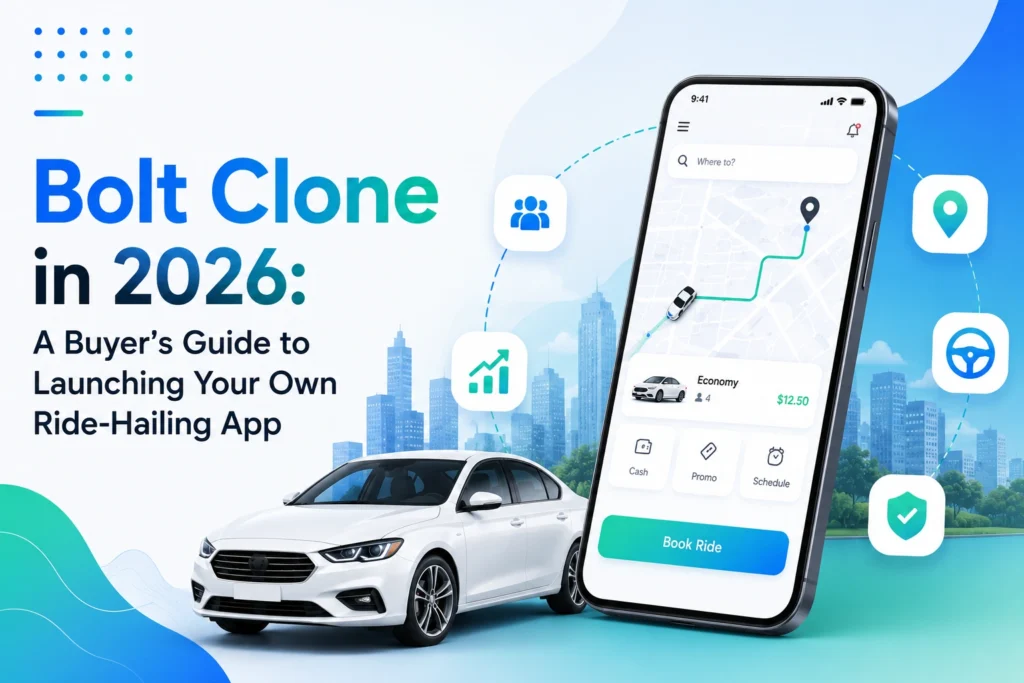
What Is A Bolt Clone?
A Bolt clone is pre-built software that reproduces the booking experience of the Bolt app and lets you sell it under your own brand. Rather than writing a taxi platform line by line, you start from a tested foundation that already handles ride requests, live tracking, fare estimates, payments, and ratings, then add your name, region, and pricing on top.
The original Bolt began in Estonia in 2013 under the name Taxify and has since grown into a mobility platform working across more than 600 cities in over 50 countries, serving 200 million riders and around 4.5 million drivers by 2026. A clone does not touch any of Bolt’s data or company assets. It borrows the concept, which is to connect riders with nearby drivers through a simple on-demand app, and hands you a version you fully own.
A useful way to picture it: building from scratch is like constructing a house brick by brick, while a clone is a finished house waiting for your furniture. The structure is already standing, so your effort goes into branding and moving in, not into laying the foundation.
What is included in a Bolt clone?
A complete Bolt clone is made of three linked applications that operate together in real time. Each one serves a different audience, and the platform only works when all three talk to each other.
- Passenger app: The customer signs up here, sets a pickup and destination, checks the fare before booking, selects a vehicle type, follows the driver on a live map, pays inside the app, and leaves a rating.
- Driver app: Drivers switch to online status, receive nearby requests, accept or decline them, follow turn-by-turn directions, track their earnings, and withdraw their balance.
- Admin panel: This web dashboard is your control room. From here you manage accounts, set commission and pricing rules, watch trips as they happen, settle disputes, run promotions, and read your revenue reports.
Reliable clones run on both Android and iOS, and they usually add a web-based admin plus an optional web booking page. Wide device coverage matters, because your riders and your drivers will rarely all be using the same kind of phone.
How does a Bolt clone work behind the scenes?
A Bolt clone runs as a live marketplace that pairs ride demand with available drivers within seconds. Every trip follows the same short cycle, and understanding it makes the rest of the business much easier to manage.
- Request: A rider enters a destination and sees the price up front before confirming the booking.
- Matching: The system scans for suitable drivers nearby and routes the request to the best option based on distance and availability.
- Acceptance: A driver accepts, and both people see live location, estimated arrival, and trip details.
- Journey: GPS follows the route from pickup to drop-off, and the rider can share the trip with a contact for safety.
- Payment and feedback: The fare is settled by cash or card, the platform keeps its commission, and the two parties rate each other.
While this happens, the admin panel logs every transaction, works out your share, and feeds the reports that show how the business is performing. This loop is the real engine, turning individual trips into an operation you can measure and grow.
Which features matter most in a 2026 ride-hailing app?
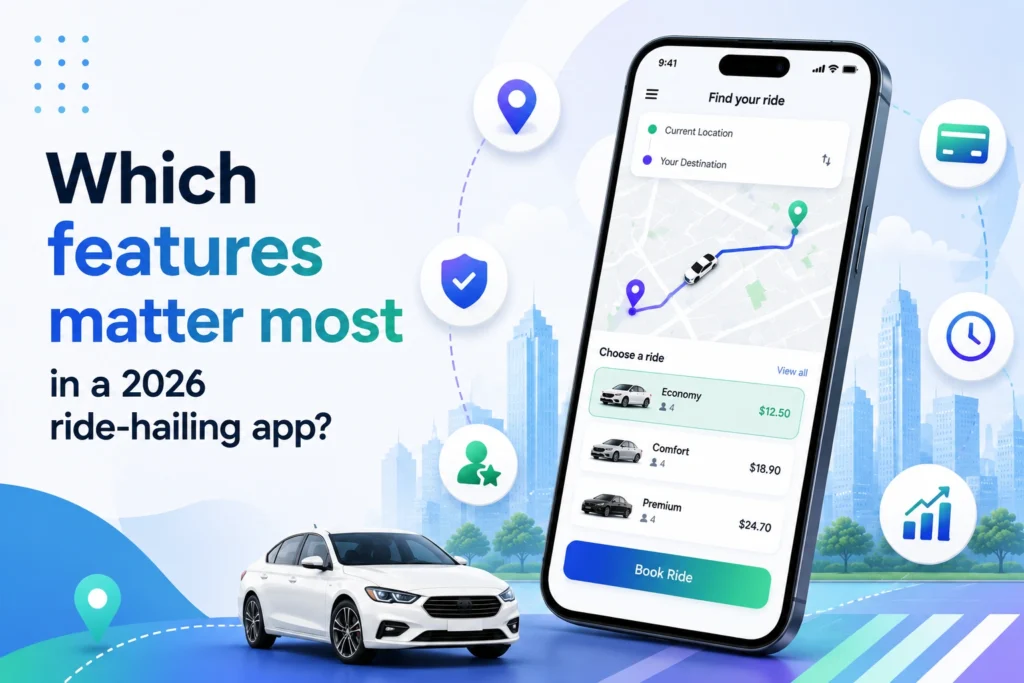
In 2026, riders treat safety, transparent pricing, and smart automation as basics rather than bonuses, so a strong Bolt clone should cover all of them. When you compare providers, look for this set of capabilities spread across the three apps.
- Up-front fare estimates calculated from distance, time, and vehicle class.
- Accurate live tracking with reliable arrival times on a moving map.
- Flexible payments including cards, wallets, cash, and regional gateways.
- Demand-based pricing that raises fares automatically when requests spike.
- Intelligent matching that shortens wait times and reduces empty driving.
- Mutual ratings that keep quality high for riders and drivers alike.
- Safety tools such as an emergency button, trip sharing, driver checks, and masked calls.
- Scheduled and multi-stop trips for airport runs and longer errands.
- Promotions, referrals, and loyalty features that encourage repeat use.
- Multiple languages and currencies for regional or cross-border operations.
An app that skips safety tools or hides the price until the end will struggle this year, because both riders and regulators now expect those elements as a starting point.
What does a Bolt clone cost, and what does Zipprr charge?
A ready-made Bolt clone is far less expensive than custom work. Zipprr keeps it simple with two fixed prices: $490 for the standard package and $890 for the premium package, each delivered in 3 days. A platform coded from scratch normally costs anywhere from $70,000 to more than $140,000, because every feature has to be designed, built, and tested individually.
Here is a straightforward comparison for 2026:
| Option | Price | Delivery | Best suited to |
|---|---|---|---|
| Zipprr Bolt clone, Standard | $490 | 3 days | Founders launching quickly on a tight budget |
| Zipprr Bolt clone, Premium | $890 | 3 days | Businesses that want the complete feature set |
| Custom build from scratch | $70,000 to $140,000+ | 8–9 months | Funded companies with unusual requirements |
The clone route saves both money and time because the difficult engineering is already finished and proven. With Zipprr’s Bolt clone you receive a complete passenger app, driver app, and admin panel, branded for your business and delivered within 3 days, which removes the long timelines and large budgets that custom development requires.
How fast can you actually go live?
With Zipprr, the software arrives in 3 days, whereas a fully custom ride-hailing app generally takes eight to nine months to reach a testable state. The clone is quicker because the core code already exists, so your work centres on branding, configuration, and payment setup rather than ground-up development.
A typical 3-day delivery covers your branding and design, the payment and map configuration, and testing, so you end up with a working, customised set of apps ready for a soft launch. After that, the main tasks before a full public launch are passing app-store review and bringing your first group of drivers on board.
Is it legal to launch an app like Bolt?
Yes, creating an app that works like Bolt is legal, because no company can own a general feature set or a business model. What you must not do is copy Bolt’s name, logo, trademarks, or actual code. As long as your platform is independently built and carries your own brand, you are on solid ground.
That said, being free to build is not the same as being ready to operate. Before going live, take care of the following:
- Use your own identity: a distinct name, logo, and look, never Bolt’s marks.
- Obtain transport permits: ride-hailing is regulated locally, so requirements vary by city and country.
- Respect privacy law: rules such as GDPR in Europe apply because you handle location and payment data.
- Screen your drivers: background and document checks protect riders and limit your liability.
Treat this as a checklist rather than legal advice. Always confirm the exact licensing and compliance rules with a qualified professional in the place where you intend to operate.
Where does the money come from?
A Bolt clone earns chiefly by taking a commission on each finished trip, the same approach Bolt uses when it charges drivers somewhere between 15 and 20 percent. On top of that base, owners commonly layer several income streams to strengthen the business.
- Trip commission: a fixed amount or a percentage taken from every fare.
- Demand-based pricing: higher fares during busy hours, events, or poor weather.
- Driver memberships: a flat subscription used instead of, or alongside, commission.
- Cancellation charges: fees that protect a driver’s time and fuel.
- In-app advertising: promoted listings and banner placements.
- Additional services: food delivery, courier work, or rentals built on the same base.
Because you own the platform outright, you set these rules directly in the admin panel and adjust them as your market matures and your data grows.
Clone or custom build: which makes more sense?
For most people entering this market, a Bolt clone is the wiser starting point, because it costs far less, ships far sooner, and carries much lower risk than custom development. Building from scratch only pays off when you have genuinely unusual needs and the funding to support a long project.
The clone wins clearly on speed, measured in days instead of months, on price, measured in hundreds of dollars instead of six figures, and on reliability, since the core flow has already been tested in the real world. A custom build wins only on complete creative freedom and on owning fully original architecture. A sensible middle path is to begin with a clone, prove demand in one city, and then invest in tailored features once revenue is coming in.
Who benefits most from a Bolt clone?
A Bolt clone suits anyone who wants to enter on-demand transport without a development team or a heavy budget. The clearest fits include the following groups.
- Founders and small startups testing a ride-hailing idea in a single city.
- Existing taxi or fleet operators moving from phone bookings to a proper app.
- Regional entrepreneurs in markets that Bolt serves lightly, such as parts of Latin America, Southeast Asia, the Middle East, and Africa.
- Businesses expanding into delivery or rentals that want one shared platform underneath several services.
If your aim is to confirm demand quickly while keeping capital free for marketing and driver recruitment, a clone is almost always the right choice.
How do you choose a provider you will not regret?
Choose a Bolt clone provider on code ownership, customisation, support, and the ability to scale, not on price alone. A cheap script that fails under load or locks you out of the code will cost far more later. Run through this checklist before you buy.
- Code rights: Do you own the source, or only rent a hosted version?
- Customisation: Can you freely change branding, features, and commission?
- Scalability: Will it handle thousands of simultaneous trips as you grow?
- Security and compliance: Does it support privacy rules and secure payments?
- Support and updates: Is there help after launch, with bug fixes and operating-system updates?
- Proven work: Are there real, verifiable launches behind the demonstrations?
Ask to see a live demonstration of all three apps and request a written list of exactly what is and is not included. A dependable provider answers these questions clearly and puts the answers in writing.
A practical seven-step plan to launch
You can bring a Bolt clone to market in seven manageable steps, even with no coding background.
- Study your market: choose a city and learn its demand, pricing, and competitors.
- Select a provider: compare options against the checklist above and confirm your code rights.
- Brand the apps: add your name, logo, colours, and content for a distinct identity.
- Configure operations: set commission, pricing rules, payment gateways, and maps.
- Test carefully: run real practice trips on Android and iOS before opening to the public.
- Handle compliance: arrange transport permits, driver verification, and privacy policies.
- Launch and promote: start in one city, recruit drivers first, then push rider promotions.
One rule sits above the rest: get enough drivers online before you advertise to riders. An app with no cars available loses customers on the first day, so it pays to build the supply side first.
How should you adapt the app to local markets?
A Bolt clone should be tuned to the market it serves, because rider habits, payment methods, and regulations differ sharply from place to place. The core engine stays the same, but the settings around it decide whether the app feels local or foreign.
In African markets where Bolt is strong, such as Nigeria, Kenya, and South Africa, cash payments, light data usage, and visible safety features carry the most weight. In Europe, privacy compliance, card and wallet payments, and clear pricing matter most. Across Southeast Asia and Latin America, local wallet gateways, several languages, and vehicle types such as motorbike taxis or auto-rickshaws often decide whether people adopt the app. In the Middle East, Arabic right-to-left layouts and premium vehicle tiers are common expectations.
The practical takeaway is to treat the clone as a flexible base, not a fixed product. Before launch, set your currency, language, vehicle categories, payment gateways, and pricing rules to suit the first city you target. An app that ignores local payment habits, for example by forcing cards in a cash-first market, will lose riders no matter how polished it looks.
What mistakes quietly sink new ride-hailing apps?
The most frequent reason a new ride-hailing app fails is advertising to riders before enough drivers are online. Beyond that single supply-side error, a handful of avoidable mistakes undo otherwise promising launches.
- Spreading too thin: trying to cover a whole country on day one instead of owning a single city or zone first.
- Ignoring driver incentives: drivers are your inventory, so early sign-up bonuses and earnings guarantees matter more than rider discounts at the start.
- Overlooking compliance: operating without permits or proper data policies invites fines and shutdowns.
- Picking the cheapest script blindly: a low price with no code rights, weak support, or poor security becomes costly once the app grows.
- Neglecting safety: riders, especially women and late-night travellers, now expect verification, an emergency button, and live trip sharing as standard.
- Underestimating marketing: the app is only half the business, so budget for driver recruitment and rider acquisition from the beginning.
Avoiding these problems comes down to discipline: launch narrow, supply drivers first, stay compliant, and choose a provider you can grow with rather than the cheapest one available today. A focused, well-supplied launch in one neighbourhood beats a thin, underfunded launch across an entire region.
Ready to launch your own ride-hailing app?
Frequently Asked Questions
What is a Bolt clone in simple terms?
How much does a Bolt clone cost?
How quickly can a Bolt clone go live?
Is it legal to make an app like Bolt?
How does a Bolt clone make money?
Is a Bolt clone better than building from scratch?
Do I receive the source code with a Bolt clone?
Can I add delivery or rentals to a Bolt clone?
Final thoughts: should you launch a Bolt clone?
If you want to enter the ride-hailing market quickly and affordably, a Bolt clone is the most practical route in 2026. It gives you a tested passenger app, driver app, and admin panel for a small fraction of the cost and time of custom development, while still letting you own your brand, set your own pricing, and expand into new services later.
The smartest approach is simple. Start with well-built software, launch in one city, get drivers online before riders, stay compliant with local rules, and reinvest your early revenue into the features your market actually asks for. Do that, and a ready-made script can become a real, scalable mobility business.