
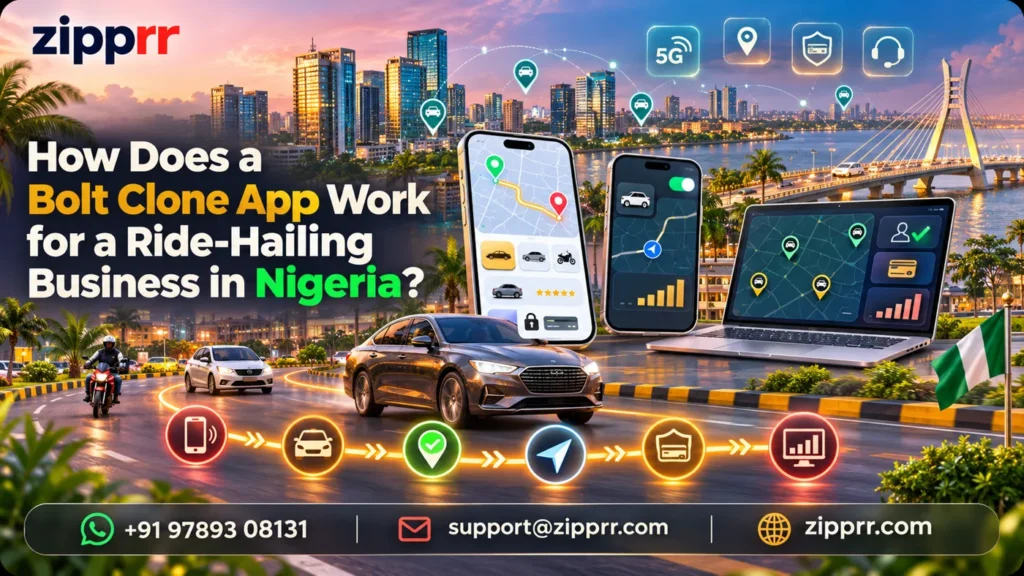
A Bolt clone app works by connecting three apps to one database: a rider app that requests trips, a driver app that accepts them, and an admin panel that sets prices, commission and payouts. Every ride you serve passes through those three screens in a fixed order. This guide follows one Lagos ride from the first tap to the morning report so you can see which feature does what.
The Bolt Clone from Zipprr is an independently developed, ready-made ride-hailing software product. Also, it is not affiliated with, endorsed by, or connected to the Bolt brand. In addition, it gives you the rider app, driver app and admin panel as source code that you own, so you can launch your own taxi brand in a Nigerian city.
If you are an entrepreneur planning a ride-hailing service in Lagos, Abuja, Port Harcourt or Ibadan, this walkthrough gives you a clear picture before you spend anything. Moreover, you will also get a simple framework, the Zipprr Ride Ledger, that you can use to test any ride-hailing demo.
What a Bolt Clone App Actually Is
A Bolt clone is ready-made ride-hailing software that follows the proven pattern of on-demand taxi booking. A rider opens an app, sees a fare, and a nearby driver accepts. Furthermore, the platform owner, which will be you, earns a commission on completed trips.
Think of it as a complete taxi dispatch office that runs on phones. Besides, the software replaces the radio operator, the paper logbook and the cash-count at the end of the day. That is why a ready-made product can go live in days instead of months.
Here is what you receive in a typical build:
- Rider app: booking, live tracking, payment choice, ratings and an in-app safety button.
- Driver app: ride requests, navigation, an earnings dashboard and document upload.
- Admin panel: a browser dashboard for fares, zones, commission, drivers and reports.
A related model prices each trip through driver offers instead of fixed fares. If that interests you, this guide on how a bid-based taxi platform earns revenue covers it. This article stays with the fixed-fare, metered-style flow that most Nigerian riders already know. If you also want to compare a ride-sharing alternative, you can look at the Lyft Clone from Zipprr.
Meet the Three People in This Bolt Clone App Walkthrough
To keep this concrete, we will follow three fictional people on one Saturday evening in Lagos. Likewise, their names and numbers are samples created for this article, not real customers or real market data.
Each moment below shows what Amaka sees, what Emeka sees and what Zainab controls. When you watch a demo, ask to see all three views for each moment. A good product keeps those three views in sync.
The Zipprr Ride Ledger for a Bolt Clone App: Seven Moments From Setup to Report
Every ride creates a small ledger entry that must balance across the rider, the driver and the platform. Also, we call the full path the Zipprr Ride Ledger. In addition, it has seven moments, and each one maps to a feature you should see working before you buy.
The table below is your cheat sheet. Moreover, the sections after it explain each row in plain language.
Moment 0: The Week Before Launch, Zainab Sets the Rules
Before the first ride, your admin panel needs rules. Furthermore, zainab opens the browser dashboard, with nothing to install, and configures how the business will run. This is the most important moment because every later number depends on it.
On the Zipprr page, the delivery team configures the starting setup with you. That includes fares, surge zones, vehicle categories, commission tiers, languages and local currency. For a Nigerian launch, that means setting prices in naira and choosing the cities you will serve first.
Zainab makes four decisions here:
- Base fare and per-kilometre rate: set these from your own test drives across Lagos, not from guesswork.
- Vehicle categories: for example a standard car tier and a premium tier with a separate price.
- Surge zones: areas where fares rise when demand is high, such as business districts at closing time.
- Commission tiers: for example a flat rate for new drivers and a lower rate after a driver completes a set number of trips.
The product page describes commission rules that take effect immediately once saved. Besides, it also says many operators choose a commission between 15 percent and 25 percent. In this walkthrough, we use 20 percent as a sample.
Driver documents and launch timing
Zainab also reviews driver documents. Likewise, drivers upload a licence, vehicle registration and insurance through the driver app. Also, zainab approves them in the admin panel, and she can pause an account while a document is under review.
Launch timing is also useful to know. In addition, the product page says a standard setup takes about seven business days after you share your brand assets and server access. That timeline is quicker than most entrepreneurs expect.
Moment 1: 6:42 pm, Amaka Requests a Ride
Amaka opens the rider app and types her destination in Lekki. Moreover, the app shows the fare before she confirms. Furthermore, she sees the price, the vehicle type and the estimated pickup time on one screen.
The upfront price is the feature that builds trust early. A rider who knows the fare is less likely to cancel or argue at the end. Besides, it also gives Zainab a clean record of what was promised.
Several rider features work together at this moment:
- Instant booking: a short flow from destination to confirmed request.
- Promo codes: Amaka can apply a referral or launch code that Zainab created in the admin panel.
- Scheduling: riders can book ahead, up to seven days, which suits airport runs and early morning trips.
- Language choice: the interface supports many languages, which you switch from the admin panel.
At this same second, Zainab sees a new pin on her live map. Likewise, she does not need to do anything. Also, the system now looks for a driver.
A helpful tip for your demo: ask the presenter to request a ride and then show you the admin map at the same moment. If the pin appears without delay, the connection between the rider app and the admin panel is working well.
Moment 2: 6:43 pm, Emeka Receives and Accepts the Request
Emeka is parked near Surulere with the driver app open. A request arrives with the pickup area, the passenger rating, the drop-off district and his estimated payout. In addition, he can decide in seconds whether the trip suits him.
Showing the estimated payout before acceptance is a good design choice. Moreover, it lets drivers plan their evening and reduces rejected trips later. Furthermore, drivers who feel informed tend to stay with a platform longer.
The Zipprr page lists AI-powered dispatch among its features, along with a predictive ETA engine. In plain language, dispatch logic helps pick suitable drivers for each request. Ask in your demo how nearby drivers are ranked, so you understand how the match is made.
Emeka taps accept. Besides, amaka's screen now shows his name, car, plate number and a live pin moving toward her. Likewise, zainab sees the trip change from searching to assigned.
See these moments live
Want to watch moments 1 to 6 on a real admin dashboard? When you book a 20-minute demo, ask to see the admin dashboard, the driver earnings screen and the payment options in the same session. You can also message us on WhatsApp at wa.me/919789308131 and say you are planning a Nigerian launch.
Moment 3: 6:50 pm, The Trip Itself
Emeka arrives, Amaka gets in, and the trip begins. This is the longest moment in time, but the one with the fewest operator decisions. Still, three features matter here.
- Live tracking: Amaka shares her progress with a friend, and Zainab can see the trip on her map.
- Navigation: Emeka gets traffic-aware turn-by-turn directions, which matters on busy Lagos corridors.
- In-app SOS: one tap sends live trip coordinates to emergency contacts the rider saved earlier.
The safety button deserves attention from every Nigerian operator. Also, riders choose platforms they feel safe on, and a visible safety feature is a strong selling point in your marketing. In addition, it also helps you build the trust that repeat bookings depend on.
The product page also lists a two-way rating system. After the trip, Amaka rates Emeka, and Emeka rates Amaka. Moreover, accounts that fall below a threshold you choose can be flagged for admin review, which helps you maintain service quality.
Moment 4: 7:12 pm, Amaka Pays
The trip ends at the Lekki destination. Furthermore, the sample fare is ₦4,500 for about 11 kilometres. Besides, amaka chooses how to pay, and this is where local payment support matters most.
The Zipprr page confirms three rider payment methods: cash, card and a pre-loaded in-app wallet. Likewise, it also names Flutterwave as a gateway that connects natively. Also, paystack is not listed on the page, so confirm any other gateway you want during your demo.
Cash rides are an important part of the Nigerian market. Nairametrics has reported on drivers in Nigeria taking trips offline because of commission levels. A platform that supports cash and sets a fair commission gives drivers a good reason to keep trips inside the app.
How each payment type looks in the ledger
- Cash: Amaka hands ₦4,500 to Emeka. The trip is logged as a cash ride, and the commission is recorded for settlement.
- Card: the gateway charges Amaka, and the platform receives the payment first. Gateway fees are charged by the gateway provider.
- Wallet: Amaka tops up her in-app wallet earlier, and the fare is deducted at the end of the trip.
Your demo question here is simple. Ask the presenter to complete one ride of each payment type, then show you the record of each in the admin panel.
Moment 5: 7:15 pm, Emeka's Payout Gets Calculated
Now the money splits. With the sample 20 percent commission, the platform earns ₦900 and Emeka keeps ₦3,600 from the ₦4,500 fare. These numbers are samples to show the logic, not a promise of results.
Emeka opens his earnings dashboard. In addition, he can view trips, commission deducted and net payout by day, week or month. That clarity is what keeps drivers loyal, because nobody likes guessing what they earned.
The product page lists three payout styles that you choose between:
- Daily payout to a digital wallet: fast, and popular with drivers who want money the same day.
- Weekly bank transfer: simple to run and easy to reconcile.
- Cash settlement workflow: a process you control for cash rides, where the driver and platform settle the commission.
For a Nigerian launch, many founders start with a mix. Moreover, they offer weekly bank transfers for card rides and a clear cash settlement rhythm for cash rides. Furthermore, you decide the rhythm, and you can explain it to drivers during onboarding.
Incentives also live here. Besides, the driver app tracks streak bonuses, peak-hour multipliers and launch-week promotions. Likewise, zainab can use these to attract drivers in your first month.
Moment 6: Sunday Morning, Zainab Reads the Report
On Sunday morning, Zainab opens the admin panel with her coffee. Also, she does not need a spreadsheet to know how Saturday went. In addition, the dashboard shows live and historical data in one place.
The page lists real-time analytics with hourly revenue graphs and zone-level demand heatmaps. It also describes demand forecasting that sends alerts 20 to 30 minutes ahead. These tools help Zainab answer three practical questions:
- Where was demand highest? Heatmaps show which Lagos districts needed more drivers.
- Which hours earned the most? Hourly graphs guide when to offer driver incentives.
- Which drivers need support? The fleet view shows activity, and Zainab can reassign drivers mid-shift or pause accounts pending document review.
The product page also lists fraud and anomaly detection among its AI features. Ask your presenter to explain what kinds of unusual activity get flagged. That helps you plan your own review routine.
Finally, multi-city control matters if you grow. One login can manage separate fares, zones, currency and payment processors per city. A founder who starts in Lagos can add Abuja or Port Harcourt without a new system.
Sample Week-One Numbers for a Hypothetical Bolt Clone App Launch in Lagos
Numbers help you plan, so here is a simple model. Every figure is a labelled sample and should be replaced with your own local data. Moreover, we keep it small and conservative on purpose.
- Average fare (sample): ₦4,500 per completed trip.
- Commission (sample): 20 percent, which is ₦900 per trip.
- Trips per day (sample): 60 in the first week.
- Daily platform commission (sample): 60 trips multiplied by ₦900, which equals ₦54,000.
If trips grew to 150 per day at the same sample values, daily commission would be ₦135,000. Furthermore, your real figures depend on your city, fares, driver supply and marketing. Besides, use the sample to build your own spreadsheet and test several scenarios.
The product page also gives its own illustration in dollars, with a caution that actual results depend on your market. Likewise, we recommend you treat any projection, including ours, as a planning tool.
Bolt Clone App Cost: What Is Included and What You Pay Separately
Clear costs prevent surprises, so here is what the live page shows today. Also, please confirm the latest figures during your demo, since prices can change.
- Standard plan, $490 one-time: the web platform and admin panel with source code, installation, 90 days of support and lifetime updates.
- Pro plan, $890 one-time: everything in Standard plus native Android and iOS apps, with Zipprr handling app store submission.
- Refund: the page states a 100 percent refund within 7 days.
- No monthly fees and no revenue share: you keep the code and the commissions.
Mobile apps and app store submission belong to the Pro plan. If your riders and drivers will install an app, plan for Pro.
Some costs stay outside the plan, and they are normal for any ride-hailing business:
- Hosting and your domain name.
- Map, SMS and OTP services paid to each provider.
- Payment gateway transaction fees.
- Apple Developer Program at $99 a year and a Google Play account at $25 one-time, if you publish apps.
If you are comparing several taxi software options, you can also see how the fixed-fare model stacks up in the Uber Clone product overview. In addition, it shares the same ride-hailing foundation and helps you judge which fit suits your market.
A Launch Checklist for a Bolt Clone App in Nigerian Cities
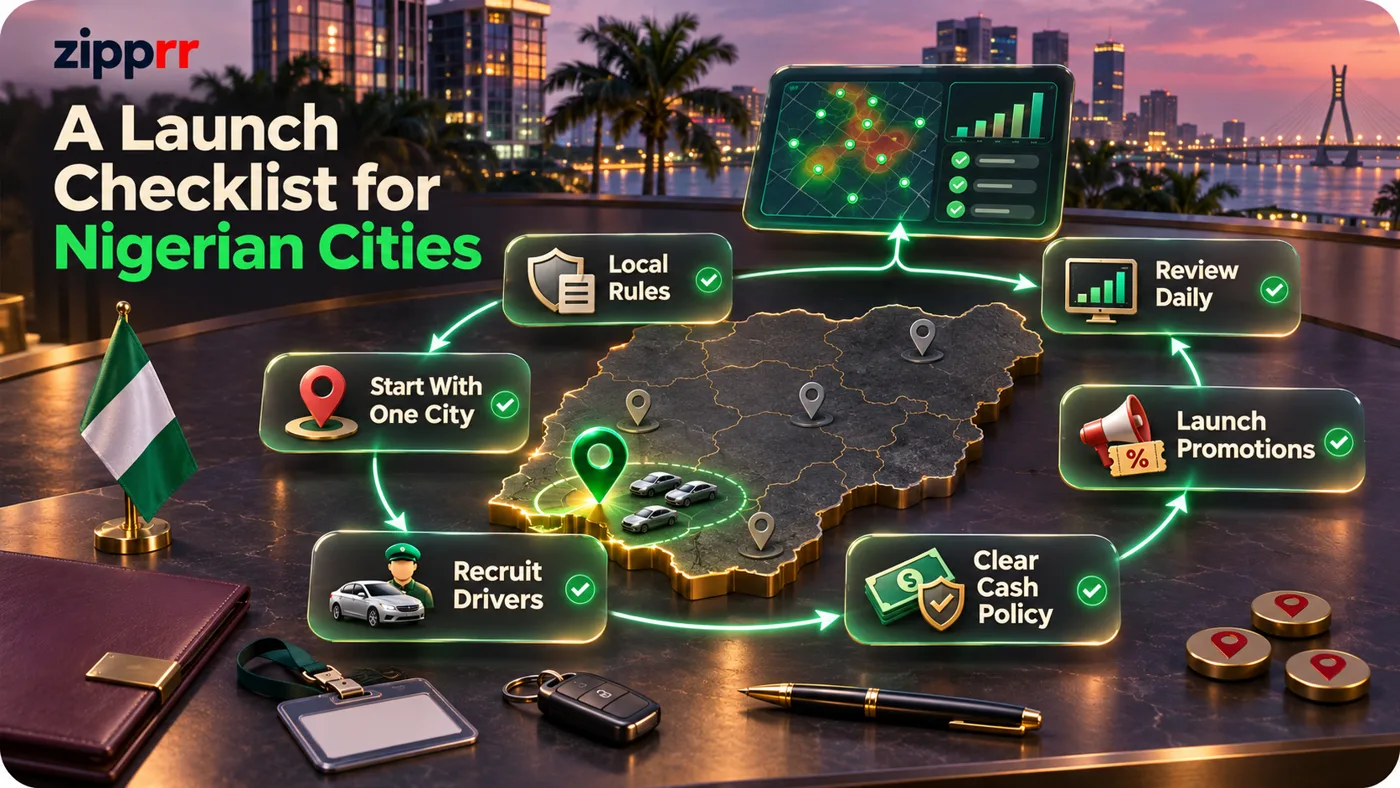
Software is only half of a ride-hailing business. These steps help you turn the walkthrough into a plan.
- Check local rules first. Confirm current transport licensing and registration requirements in your state before you launch.
- Start with one city. A single city keeps driver recruitment, support and marketing focused while you learn.
- Recruit drivers before riders. Aim to have enough approved drivers so the first riders get quick pickups, and read this guide on launching a ride-hailing business without running out of drivers.
- Offer a clear cash policy. Explain commission settlement in simple words during driver onboarding.
- Use launch promotions. Promo codes and referral rewards from the admin panel help you gain early riders.
- Review the dashboard daily. Check zones, hours and driver activity every morning in the first month.
Each of these steps connects to a feature in the Ride Ledger. That is the benefit of walking through a single ride: you learn which setting controls which result.
How to Use the Ride Ledger in Your Own Bolt Clone App Demo
Print the seven moments and tick them off during any demo. A short, structured demo beats a long feature tour. Here is a quick script you can follow.
- Moment 0: ask to see where fares, zones and commission tiers are set.
- Moment 1 and 2: request a ride and accept it, with the admin map open.
- Moment 3: show live tracking and the safety button.
- Moment 4: complete a cash ride and a wallet ride.
- Moment 5: open the driver earnings screen and the payout options.
- Moment 6: view the analytics, heatmap and fleet screens.
If every moment works smoothly, you have a product that supports the whole business. If one moment is weak, you know exactly what to discuss before you decide.
Book a 20-Minute Bolt Clone App Demo and Walk the Ledger
The fastest way to judge a ride-hailing product is to watch one ride travel through it. Book a free 20-minute demo and ask to see the admin dashboard of the Bolt Clone first. Then request one cash ride and one wallet ride so you can see the payout logic.
Planning a ride-hailing launch in Nigeria?
Message us on WhatsApp at wa.me/919789308131. You can also email [email protected] with your city, your expected daily trips and the payment methods your riders use.
Frequently Asked Questions About the Bolt Clone App
What is a Bolt clone app?
A Bolt clone app is ready-made ride-hailing software with a rider app, a driver app and an admin panel. Moreover, it lets you launch your own taxi booking brand without building from zero. Furthermore, zipprr's version is independently developed and not affiliated with the Bolt brand, and you receive the source code.
How does a Bolt clone app work?
A rider requests a trip and sees the fare upfront. A nearby driver accepts, navigates to the pickup, and completes the ride. Besides, the rider pays by cash, card or wallet. Likewise, the platform records the commission, the driver sees net earnings, and the admin reads the results in the dashboard.
How much does it cost to build a ride-hailing app like Bolt?
With Zipprr, the live product page lists a one-time $490 Standard plan for the web platform and admin panel, and an $890 Pro plan that adds Android and iOS apps. Also, hosting, domain, maps, SMS and gateway fees are paid separately. In addition, confirm current pricing in your demo.
How long does it take to launch a Bolt clone app?
The product page states about seven business days after you share brand assets and server access. That covers branding, installation, payment setup and testing. On the Pro plan, app store review adds a few more days, which depends on the review queues of each store.
Can a Bolt clone app accept cash payments in Nigeria?
Yes. Moreover, the product page lists cash, card and an in-app wallet as rider payment methods, and it describes a cash settlement workflow for driver payouts that you control. Furthermore, plan your commission settlement rhythm with drivers before launch, and ask for a cash ride demonstration.
Which payment gateways does the Bolt clone app support?
The product page names Flutterwave as a gateway that connects natively, and gateway integration is part of the software. Besides, transaction fees go to the gateway provider. If you want a specific local gateway, ask about it in your demo so the team can confirm support.
Does a Bolt clone app include Android and iOS apps?
Mobile apps are part of the $890 Pro plan, which adds native Android and iOS apps with app store submission handled by the team. Likewise, the $490 Standard plan covers the web platform, admin panel and source code. Also, apple and Google developer account fees are paid by you.
Does a Bolt clone app support multiple languages and currencies?
Yes. In addition, the product page lists more than 30 interface languages, switchable from the admin panel, with support for right-to-left scripts. Each city can use its own currency, fares, zones and payment processor. That means you can price rides in naira and add other markets later.
Can I set my own commission and surge pricing?
Yes. Moreover, the admin panel lets you set commission tiers, such as a flat rate for new drivers and a lower rate after a number of trips. Furthermore, you can also configure surge pricing by zone, vehicle class and demand level. Besides, changes take effect immediately after you save them.
Can I add food or parcel delivery to my ride-hailing app later?
The product page lists food and grocery delivery among possible revenue streams for a ride-hailing operator. Likewise, treat it as a second-phase plan after your rides run smoothly. Ask during your demo how delivery would fit your scope, so you know the right sequence for your business.