

About this case study: This is an illustrative technical case study based on the documented capabilities of a self-hosted AI advertising creative generator. It does not describe a named client, a confirmed deployment, measured business results, or benchmarks. Statements about what the product includes come from its documented feature list. Statements about what an operator might do are labelled as design considerations. For more articles in this format, see Zipprr's technical case study archive.
Executive Summary: What Is This AI Advertising Creative Generator?
Advertising teams need more creative variations than they can comfortably produce by hand. A single campaign may need a short video, several images, and a handful of headline options.
The AI advertising creative generator in this case study packages that work into one self-hosted SaaS product. Customers write a plain-language brief, choose a format, review the credit cost, generate, and download the result.
Around those formats, the product adds the pieces an operator needs to run a paid service. These include brand kits, a product library, a credit wallet, subscription plans, top-up packs, payment settings, staff roles, support tickets, audit logs, and a CMS for the public site.
The documented stack is built on Laravel 13 and is designed for standard cPanel-style shared hosting. That combination lowers the operational barrier for founders and agencies who want to launch a credit-based AI service without managing a complex server estate.
The Problem the AI Advertising Creative Generator Solves, and Its Intended Users
A marketer usually knows the message, but turning it into video, imagery, and copy takes time and specialist skills.
Generative AI can shorten that path. Still, a raw AI model is not a business. Also, someone has to handle accounts, pricing, payments, support, and content.
This platform addresses both halves. In addition, it gives customers a creative workspace and gives operators the commercial machinery around it. The documented use cases point to three audiences:
Generate creatives without a design team.
Need faster creative production for several brands.
Want to run a credit-based SaaS offering of their own.
Overall, the product is a web application with a responsive customer workspace and an administrator dashboard. No native mobile application is advertised as included.
The Customer Workflow in the AI Advertising Creative Generator, From Brief to Download
The customer journey is deliberately short. Moreover, it starts with a written description of the desired advertisement. The customer then selects an output format and its available settings. Before submitting, they can review the live credit cost.
That last step deserves attention. Furthermore, showing the price before generation lets customers decide whether a request is worth its cost. For an operator, it also reduces surprise at the point where trust is most fragile.
- 1Write a briefFree-text description of the advertisement
- 2Choose a formatVideo, image, or advertising copy, with format settings
- 3Attach contextOptional saved brand kit and product from the library
- 4Review costLive credit price shown before submission
- 5GenerateRequest sent to the configured AI service
- 6Review and downloadCompleted output available from the project record
Every request is stored. The original prompt and generation settings are kept for each project, so customers can look back at what they asked for and what they received.
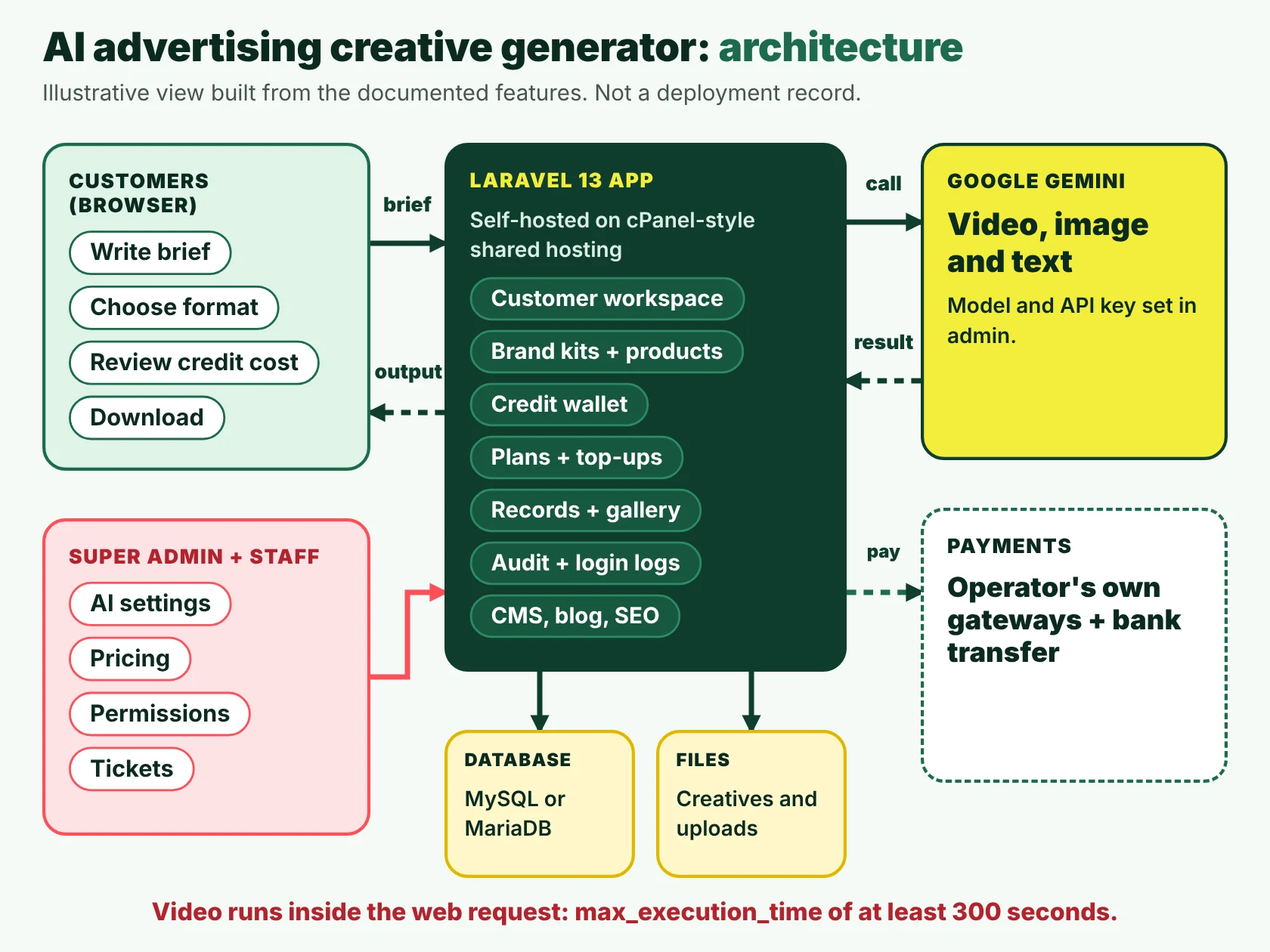
The diagram below shows how that customer flow connects to the records, credit and administration layers around it.
Figure 1: Customer workflow and operating layers (illustrative)
Note: video generation runs inside the web request (max_execution_time of at least 300 seconds).
Video, Image, and Advertising Copy Generation in the AI Advertising Creative Generator
Each format has its own settings and its own price. That separation is useful because the three formats place very different loads on the AI service.
Video Advertisements
Customers can generate promotional videos in three lengths: 3, 6, or 10 seconds. Besides, they can choose landscape or portrait orientation.
Video generation uses the configured AI service. Likewise, it also runs within the web request and needs extended server request time. Also, we return to that constraint later, because it shapes hosting choices.
Zipprr has written about a different approach to video ad generation. In addition, its AI UGC video ad generator case study outlines a proposed mobile-first design with asynchronous rendering queues. That is a separate design and not a feature of the product described here. The contrast is useful for operators deciding how much infrastructure they want to manage.
Image Advertisements
Image generation starts from a written prompt. Customers choose a resolution of 1K, 2K, or 4K. Three image quality tiers are available, and each tier has configurable pricing.
This gives operators a pricing lever. A higher-quality tier or a larger resolution can be priced differently from a basic one. Customers see the cost before they commit.
For a broader view of credit-priced image platforms, Zipprr's multi-engine AI image generator architecture case study covers credit packages and provider adapters in a separate reference design.
Advertising Copy
The copy generator produces advertisement headlines, primary text, and call-to-action variants. Moreover, it has its own configurable credit price.
A customer can draft several alternative angles before spending credits on video or high-resolution imagery. The documentation does not claim any specific cost difference.
Reusable Brand Kits and the Product Library
Generic AI output often looks generic. Two features of the AI advertising creative generator address that.
A brand kit stores a logo, a color palette, and a tone of voice. Customers can attach a saved brand kit to future generation requests.
The product library stores the products used in advertising creatives. A customer attaches a product to a generation request, so generation can reference the real product rather than a generic stand-in.
The result is a reusable identity layer. Instead of re-describing a brand in every brief, a customer saves it once. This supports consistency across visual and verbal creative work, which matters most for agencies handling several brands.
Together, the two features change the shape of a brief. The customer describes the campaign idea, and the brand kit and product supply the identity and subject.
Gemini Provider Configuration for the AI Advertising Creative Generator
The advertised video, image, and text generation uses Google Gemini. Administrators set the model, API key, and base URL from the dashboard.
Changing the model does not require editing files or redeploying. For an operator, that is a practical advantage. Furthermore, model offerings change over time, and a settings screen is easier to manage than a code release.
This pattern of admin-selectable AI providers also appears in Zipprr's AI data analytics platform case study on Laravel, where administrators choose the AI provider behind the product.
Two prerequisites apply on the Google side:
- A Google Gemini API key is needed for generation.
- Image generation can use the provider free tier according to the product listing. Video generation requires a billing-enabled Google Cloud project.
Operators should confirm current Google terms and limits themselves, using Google's Gemini API documentation. This article does not name specific Gemini models or quote provider limits.
The administration dashboard also centralizes creative pricing, payment configuration, and public site content. The stated benefit is that centralized settings reduce the need to edit application code.
Generation Records, Project Gallery, and the Credit Wallet
This is where the product starts to behave like a business rather than a demo.
Each generation is saved with its prompt and settings. Customers can review past generation history, and completed outputs are available for download. The project gallery brings those records into one customer workspace. Customers can browse projects, filter by creative format and generation status, and open project details and generated output.
Customers spend credits on generations. Administrators set each pricing control, and customers see the price before generation.
The documented pricing controls are specific:
Subscriptions and Top-Up Packs for the AI Advertising Creative Generator
There are two ways for customers to obtain credits:
Recurring plans can include monthly credit allowances. Besides, monthly and yearly plan prices are editable in administration.
Customers can buy standalone credit packs. Administrators configure the available packages.
The combination supports a familiar model. A subscription provides a predictable base, and top-ups cover heavier months. Zipprr's AI SaaS platform architecture guide discusses credit billing as a general layer in AI software, which may help readers think through their own pricing design.
Payment Configuration, Transactions, and Pricing Controls
The platform advertises multiple online payment gateway integrations and a manual bank-transfer method. This article does not name specific gateways, because they are not verified from a reliable product source.
However, operators must configure their own payment-provider accounts and credentials. The product does not supply them.
In addition, customers can inspect their credit balance and transaction history. Administrators manage billing rates and subscription packages.
Design consideration (not a documented feature): Before launch, an operator may want to test each payment method end to end, including the manual bank-transfer flow, and confirm how credits appear in a test customer's transaction history.
Customer Workspace and Staff Roles
Customers reach ad generation, Brand Studio, project history, and credit balance from one dashboard. Likewise, generated assets can be downloaded from completed project records.
The product separates three kinds of people:
Select an ad format, provide a brief, review credits, generate, and download.
Handle authorized administrative modules and support requests.
Control billing, AI settings, permissions, and site configuration.
Staff accounts carry granular per-module permissions. This separates limited administrative duties from super-administrator control. A support agent can answer tickets without seeing billing settings, if the operator grants permissions that way.
Support Tickets, Audit Logs, and Login Records in the AI Advertising Creative Generator
Role-based separation is a common pattern in multi-tenant software. Zipprr's multi-tenant omnichannel messaging CRM case study shows a related model of roles, permissions, and a platform-owner admin panel in a different product.
Customers can submit support requests inside the application. Also, staff respond using threaded ticket conversations. Customers do not need to leave the workspace to ask for help.
Administrative audit logging is included, and login activity tracking supports oversight of platform access.
These records matter most when several staff members share administrative duties, because they help an operator review who accessed the platform and what administrative actions took place.
CMS, Navigation, Blog, SEO, and Language Management
A SaaS product like this AI advertising creative generator also needs a public face. The platform includes content tools so operators can manage it without code changes.
Build CMS pages from reorderable content sections and adjust public-facing pages through the administrative interface.
Arrange header navigation with drag-and-drop controls and configure footer menus the same way.
Publish blog articles with categories and cover images. In addition, posts support SEO fields for search presentation.
English, Bengali, and Arabic are included. Administrators can add and edit languages. Moreover, arabic includes right-to-left interface support.
The marketing site, blog, and product therefore live in one system.
Login and Account Security
The documented security features of the AI advertising creative generator are:
The listing does not mention security certifications, and this article does not claim any. Operators handling payments, personal data, or regional privacy obligations should do their own review.
Hosting the AI Advertising Creative Generator: Deployment Requirements
The product is designed for standard cPanel-style shared hosting. Furthermore, bundled dependencies allow upload, database import, and credential configuration without running Composer or Node.js on the server.
Many modern PHP applications assume command-line access and a build step. Here, the package is prepared for deployment through file upload and a database import. The documented technical requirements are:
max_execution_time of at least 300 secondsThe required PHP extensions are listed below. The hosting environment must enable all of them.
A database is supplied with the deployable package. Besides, installation resources include complete source code and a clean database with removable demonstration content. Likewise, step-by-step documentation covers cPanel and Hostinger deployment.
An Illustrative Preflight Script for Your Host
Design consideration (not a documented feature): Before uploading the package, an operator could run a small preflight script on the target host. The snippet below is an illustrative example written for this article. Also, it is not part of the product. Run it through the web server, because the command-line PHP configuration often differs from the web configuration.
<?php
// preflight.php - illustrative hosting check, not part of the product.
// Upload temporarily, open in a browser, then delete it.

$requiredExtensions = [
    'bcmath', 'ctype', 'curl', 'dom', 'fileinfo', 'gd', 'intl',
    'mbstring', 'openssl', 'pdo', 'tokenizer', 'xml', 'zip',
];

$missing = array_filter(
    $requiredExtensions,
    fn (string $extension): bool => ! extension_loaded($extension)
);

// A value of 0 means the limit is disabled, which also satisfies the requirement.
$executionTime = (int) ini_get('max_execution_time');

$checks = [
    'PHP 8.3 or higher'          => version_compare(PHP_VERSION, '8.3.0', '>='),
    'max_execution_time >= 300'  => $executionTime === 0 || $executionTime >= 300,
    'All required extensions'    => $missing === [],
];

header('Content-Type: text/plain; charset=utf-8');

foreach ($checks as $label => $passed) {
    echo ($passed ? '[ OK ] ' : '[FAIL] ') . $label . PHP_EOL;
}

if ($missing !== []) {
    echo 'Missing extensions: ' . implode(', ', $missing) . PHP_EOL;
}
The script checks only the PHP-level requirements listed above. In addition, it does not check the MySQL or MariaDB version, and it cannot detect web server or proxy time limits.
Teams that want to extend or modify a Laravel-based platform may find it useful to review Zipprr's Laravel development services page for the kind of customization work that sits around a product like this. Because the stack is PHP-based, Zipprr's PHP development services page is also relevant for teams planning hosting and backend changes.
Storage Approach and Portable Site Paths
Generated creatives and uploads are saved directly to web-served asset directories. The advertised setup does not require filesystem symbolic links.
That matters on shared hosting, where some hosts restrict symbolic links. Moreover, asset URLs are derived from incoming requests. As a result, deployment can work at a domain root or within a subdirectory.
Design consideration (not a documented feature): Because creatives and uploads live in web-served directories, operators may want to plan disk space, backups, and file-retention habits early. The documentation does not describe automated cleanup or backup features.
Video Request-Time Requirements and Operational Constraints
Video generation runs within the web request. The product description does not advertise a separate background queue for it. The server must therefore allow long requests, and max_execution_time should be set to at least 300 seconds.
What this means in practice:
- The hosting plan must permit that execution time. Some shared hosts cap it, so operators should check before purchase or launch.
- A video request stays open until generation completes.
- Other layers, such as web server or proxy time limits, may need review. The documentation does not specify them.
Likewise, this article makes no performance claims. No generation times, throughput figures, or concurrency limits are documented, and none are invented here.
Design consideration (not a documented feature): Operators expecting many customers to generate video at the same time should test their hosting under realistic conditions before launch, and should treat the request-time model as a scaling boundary to evaluate.
A Realistic End-to-End User Journey
The following walkthrough is an illustration of how documented features connect. Furthermore, it is not a record of a real customer. Imagine a small agency that has deployed the AI advertising creative generator for its own clients.
- A new customer signs up. First, they verify their email, and perhaps enable two-factor authentication.
- They choose a plan or pack. Next, they buy a subscription with monthly credits or a standalone top-up pack through a configured payment method.
- They save a brand kit. Then, they upload a logo, set a color palette, and describe their tone of voice.
- They add a product. After that, the product goes into the library for use in creatives.
- They draft copy first. Meanwhile, they generate headline, primary text, and call-to-action variants at the text rate.
- They generate an image. Later, they choose a resolution and quality tier, check the live credit cost, and submit.
- They generate a short video. In addition, they pick a 6-second portrait format, review the price, and wait for the request to finish.
- They download results. Finally, they open completed project records and download the assets.
- They return later. Afterwards, they filter the project gallery by format and status, and review the stored prompt and settings.
- They raise a ticket. Eventually, a staff member with ticket permissions replies in a threaded conversation.
At no point does the product publish the creative to an advertising network. The customer takes the downloaded assets elsewhere.
What Operators Must Configure Before Launching the AI Advertising Creative Generator
A deployed package is not yet a business. The documentation points to several tasks that belong to the operator:
- Hosting. Confirm PHP 8.3 or higher, the required extensions, the database version, and max_execution_time of at least 300 seconds.
- Gemini access. Next, obtain a Google Gemini API key. For video, use a billing-enabled Google Cloud project.
- AI settings. Then, enter the model, API key, and base URL in the dashboard.
- Pricing. Also, set three image rates, two video rates, and one text rate.
- Plans and packs. In addition, define subscription prices with monthly credit allowances, and configure top-up packages.
- Payments. Besides, set up your own payment-provider accounts and credentials, and decide whether to offer manual bank transfer.
- Staff and permissions. Moreover, create staff accounts with the right per-module permissions.
- Security. Furthermore, decide on OAuth sign-in, reCAPTCHA, and the cookie-consent banner.
- Content. Finally, remove demonstration content, then build pages, menus, blog posts, and language settings.
Design consideration (not a documented feature): Operators may want to review AI output quality and acceptable-use expectations before opening the platform to the public. Zipprr's AI output guardrail layer case study explores one way to think about safety validation and human review in a separate reference design. The product described here does not advertise such a layer.
Limitations of the AI Advertising Creative Generator and Its Scope Boundaries
Clear boundaries make a product easier to evaluate. Based on the documentation:
- No external ad-network publishing. Instead, the platform is not advertised as publishing to Google, Meta, or other advertising networks. Customers download creatives and use them elsewhere.
- No native mobile app. Also, the customer workspace and dashboard are responsive web interfaces.
- No separately advertised video queue. Likewise, video runs within the web request and needs extended server time.
- Gemini-based generation. Therefore, the advertised generation uses Google Gemini, so availability, pricing, and terms depend on that provider.
- Operator-supplied accounts. Besides, payment-provider and AI-provider credentials are the operator's responsibility.
- Three languages included. Moreover, english, Bengali, and Arabic ship with the product. Others can be added by administrators.
For readers comparing scope, Zipprr's AI social media automation and content generation SaaS case study describes a different product that includes scheduled publishing to social networks. That capability is not part of the platform in this article.
Therefore, this article makes no claims about customer results, adoption, revenue, time savings, or benchmarks. The documentation does not supply them.
Who the AI Advertising Creative Generator May Suit
The documented commercial applications are self-service advertising generation, agency creative production, and credit-based SaaS offerings. It may suit:
Who want to launch a credit-based AI creative service with a ready operating layer of payments, plans, support, and content.
That want a branded workspace for producing ad variations across clients, using brand kits and a product library.
Evaluating how credits, subscriptions, and admin-set pricing work together.
Who prefer a self-hosted Laravel application on familiar hosting.
Founders weighing other self-hosted, white-label AI products can also look at Zipprr's AI chat software and AI lawyer software pages. These are different products with different purposes.
It may be a weaker fit for teams that need ad-network publishing, a native mobile app, or video generation handled by background workers. Besides, those needs would call for scoping and customization work, such as the kind of full-stack development Zipprr offers for web and mobile applications.
Conclusion: Is This AI Advertising Creative Generator Right for You?
The strength of this AI advertising creative generator is how its parts connect. A brief becomes a request, a request consumes credits, credits come from plans and packs, and staff roles, audit logs, and tickets keep the service manageable.
However, its limits are just as clear. Likewise, video runs inside the web request, generation depends on Google Gemini, and ad-network publishing is outside the documented scope.
Plan your AI advertising creative generator with Zipprr
If you are considering launching or customizing an AI SaaS platform of this kind, you can schedule a free consultation with Zipprr to discuss your requirements, hosting setup, and customization needs.