

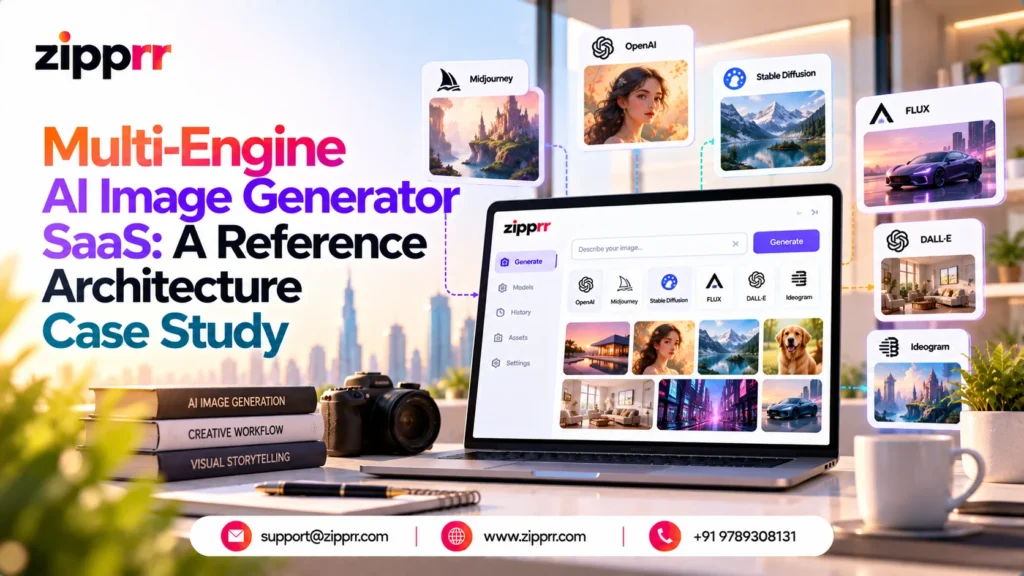
An AI image generator SaaS is a web platform where customers turn text prompts into images and pay with credits. A multi-engine version connects several image providers behind one interface. Customers pick an engine, write a prompt, choose style options, and keep the results in a personal history. Operators decide which engines are on, which packages include them, and what each request costs.
That raises the central engineering question: how can one application coordinate different providers while keeping permissions, credits, and generated assets consistent?
This article answers it with a reference architecture built around one documented product. It covers the generation flow, access rules, credit accounting, image storage, administration, and a plan for checking the whole thing before launch.
Source basis. This case study, published by Zipprr, analyzes the documented features of ImagerAI, an AI image generator SaaS listed on CodeCanyon by wStacks, and recommends engineering patterns for platforms of this type. It does not report an independently verified client deployment, and the product’s code was not reviewed. Provider facts were checked against official documentation on October 6, 2026.
Technical Snapshot
| Item | Detail |
|---|---|
| Application type | Web-based, multi-engine image generation platform with customer and admin areas |
| Listed stack | Laravel 13, PHP 8.x, MySQL, Bootstrap 5.x, jQuery 3.7.1 |
| Roles | Customers, and administrators with configurable roles and permissions |
| Monetization | Credit packages with set prices, per-request credit costs, generation limits, engine access, and watermark permissions |
| Listed engine families | GPT-Image-1; Imagen 3 and 4; Stable Diffusion (Ultra, Core, 3.5 Medium, Large, Turbo); DALL·E 2 and 3; FLUX (Dev, Pro, Schnell, 1.1 Pro) |
| Delivered as | Source code, installation and user documentation, MySQL database file |
| Evidence scope | Product listing and feature specification only. No code, deployment data, or performance measurements |
Three labels appear throughout. Documented means the listing or feature specification states it. Interpretation is our reading of what a documented feature implies. Recommended marks an engineering pattern we suggest, not something the product is claimed to contain.
Why a Model Dropdown Is Not Enough
Adding a second image model looks like a menu change. In practice, each provider has its own rules, and the platform has to absorb them without confusing customers or losing money.
- Creative controls differ by engine. Amazon Bedrock documents a negative prompt (a list of things to leave out) for Stable Image Ultra. Google lists negative prompting as not supported for Imagen 4. OpenAI says its GPT image models do not take a style parameter and that the style should be described in the prompt (OpenAI API reference).
- Request patterns differ. Black Forest Labs (BFL) returns an id and a polling_url that the caller checks until the status is Ready (BFL docs). OpenAI’s GPT image models always return base64-encoded images in the response.
- Providers can refuse requests. BFL’s result statuses include Request Moderated and Content Moderated (BFL get_result).
- Rates and costs vary. BFL advises exponential backoff for 429 (too many requests) responses and caps concurrent requests (BFL integration guidelines).
- Provider outputs can be temporary. BFL says generated images expire after 10 minutes, so the platform has to copy them.
- Models retire. The next section shows how quickly an engine list can age.
These are design constraints any team faces in this kind of product. They are not reports from a specific project.
Five System Responsibilities
The listing describes dozens of features. Grouped by job, they form five systems.
| System | Documented capabilities | Interpretation: what it has to guarantee |
|---|---|---|
| Generation | One interface for multiple engines; prompts with art style, lighting, and camera options that vary by engine; processing and completed states | Only options an engine supports reach that engine |
| Access and credits | Packages set engine access, generation limits, credit cost per request, and watermark permission; users see credit balance and usage | A request runs only if the package allows it and credits cover it |
| Assets | Image history, favorites, downloads subject to package permissions | A customer sees only their own images |
| Payments | Package pricing, payment settings, transaction administration | Credits are added once per confirmed purchase |
| Administration | Dashboard, user activity monitoring, roles and permissions, branding, custom CSS, system pages, SEO settings, live chat, notifications, email and SMS templates, FTP configuration, reCAPTCHA, privacy and cookie pages | Operators change rules without code changes |
The documentation describes responsive web access and multilingual support. Native mobile apps are not established by the material reviewed.
Model Availability: What the Listing Names and What Providers Document Today
The listing’s version 2.0 entry is dated June 30, 2026. Several engine families it names have since changed status in first-party APIs. The table keeps the listing’s claims intact and adds what official documentation says on October 6, 2026.
| Listed engine | Model IDs and routes checked | Status in official documentation |
|---|---|---|
| DALL·E 2 and 3 | dall-e-2, dall-e-3 on POST /images/generations | OpenAI marks both retired on May 12, 2026 (API reference); the removal was announced November 14, 2025 (deprecations) |
| GPT-Image-1 | gpt-image-1 on the same route | Listed by OpenAI as an accepted model and as a recommended replacement |
| Imagen 3 | Vertex AI: imagen-3.0-generate-001, imagen-3.0-generate-002, imagen-3.0-fast-generate-001. Gemini API: imagen-3.0-generate-002 | Vertex AI discontinuation June 30, 2026 (Google Cloud); Gemini API shutdown November 10, 2025 (Google AI) |
| Imagen 4 | imagen-4.0-generate-001, imagen-4.0-fast-generate-001, imagen-4.0-ultra-generate-001 | Vertex AI discontinuation June 30, 2026, with gemini-2.5-flash-image as the replacement (Google Cloud); Gemini API shutdown August 17, 2026, with gemini-3.1-flash-image as the replacement (Google AI) |
| FLUX | BFL API at api.bfl.ai: POST /v1/flux-dev, POST /v1/flux-pro-1.1, GET /v1/get_result | Both endpoints documented, with no deprecation note. Endpoints for the original FLUX.1 Pro and Schnell were not found in BFL's docs index. Schnell weights are published under Apache 2.0 on Hugging Face, so a platform could host it elsewhere |
| Stable Diffusion | Amazon Bedrock: stability.sd3-5-large-v1:0, plus Stable Image Ultra and Core | Documented on Bedrock (AWS). Medium and Turbo availability was not confirmed, because Stability's own API reference could not be loaded |
A retirement notice does not prove the product is broken. Its code may have changed since the listing was written, it may call a different host, and none of these integrations were tested for this article. The real question is what a buyer or operator should verify.
- Send one live test request to every enabled engine.
- Confirm which provider host each engine name maps to.
- Check what customers see when a model is retired.
- Confirm whether the admin can hide an engine before the provider shuts it down.
This is why the architecture below treats an engine’s lifecycle status as data, not as a hard-coded assumption.
Reference Architecture
Laravel, MySQL, Bootstrap, and jQuery are listed technologies. Their presence does not show how pages are rendered, how the database is laid out, how routes are organized, where images are stored, or how the system is deployed. The table keeps those unknowns visible.
| Layer | Documented | Interpretation | Recommended |
|---|---|---|---|
| Web interface | Responsive web access, multilingual support, Bootstrap 5.x, jQuery 3.7.1 | Customers and admins use separate areas | Keep every permission and credit check on the server, never only in browser code |
| Application | Laravel 13 on PHP 8.x | Account, package, and engine rules run here | Run provider calls in background jobs, not inside the web request |
| Database | MySQL; database file included | Likely stores accounts, packages, transactions, and history records; schema not described | Add a credit ledger and a generation-job record |
| Image engines | Listed engine families | Each needs its own request format; actual hosts not stated | Provider adapters and a capability matrix |
| Generated image files | History, favorites, and downloads exist | Files are kept somewhere the app can serve; location not described | Copy provider output into durable, private storage |
| FTP configuration | Added in version 2.0 | Purpose not described | Do not assume it is image storage; confirm what it is for |
| Administration | Dashboard, roles, engine and package controls | Central place for operating rules | Keep an audit trail of engine and package changes |
| Payments | Payment settings and transaction administration | Gateways and confirmation method not named | Add credits only after server-side payment verification |
Provider Adapters and the Capability Matrix (Recommended)
An adapter is a small module that translates between the platform’s internal request and one provider’s API. The rest of the app asks for “an image from engine X with these options.” The adapter handles authentication, field names, polling, and error codes.
A capability matrix is a configuration table that records what each engine accepts: supported aspect ratios, negative prompt support, response style (immediate or polling), lifecycle status, and credit cost. The interface reads it to decide which options to show. The server reads it again to reject anything unsupported.
The matrix also explains how shared options can work across engines. If an engine has no native style parameter, as OpenAI states for GPT image models, the adapter can translate a chosen art style into prompt wording. How the product actually maps its style, lighting, and camera options is not described.
Decision: adapters or scattered integrations? Scattered provider calls ship faster for the first two engines. By the fourth, each provider change touches many files, and retiring a model means hunting for every place it appears. Adapters cost more up front and give each provider one home. For a product whose engine list changes, that tradeoff favors adapters.
Turning this pattern into working code is ordinary Laravel work: queued jobs, database migrations for the ledger, storage configuration, webhook handlers, and tests that fake provider responses. Teams planning that kind of customization can review Zipprr’s Laravel development services.
The Generation Lifecycle
Documented workflow: account access, credits and package, engine selection, prompt and supported options, permission and limit checks, provider processing, displayed result, saved history, favorite or download, updated usage.
The interface shows processing and completed outputs. That does not establish streamed images, WebSockets, guaranteed speed, or automatic failover between providers.
Recommended lifecycle for a successful request:
- Validate the account, engine access, options, and credit balance.
- Reserve credits atomically, so the same credits cannot be spent twice.
- Submit the generation to the provider and record the provider’s request ID.
- Obtain the provider’s result.
- Download and validate the image file.
- Persist it to durable storage and record who owns it.
- Commit the credits once and mark the job complete.
- Show the result in history and downloads.
Three points in plain English:
- A provider response is not a delivered image. The customer has a usable image only after it is stored and linked to their account. If storage fails, the job needs recovery handling, such as retrying the save from the provider result, before it counts as delivered.
- A timeout is an unknown, not a failure. The provider may still be working. Look up the existing provider request by its ID before retrying, releasing credits, or declaring permanent failure. Blind retries can create two images and two provider charges.
- Slow calls stay outside database locks. Reserve credits in a short transaction, release the lock, then call the provider. Laravel’s documentation recommends wrapping row locks such as lockForUpdate in a transaction. A balance lock held during a slow API call would block that customer’s other requests.
Handling other failures (Recommended):
- Invalid options: reject on the server using the capability matrix, before credits move or a provider is called.
- Exhausted credits: block the request with a clear message and a path to buy a package.
- Provider rejection: record the reason, release the reservation under the written policy, and give the customer a plain explanation.
- Duplicate submission: give each request a stable generation ID, and enforce it with a database uniqueness rule so a double click or retry cannot create a second job or second credit movement.
Credits, Packages, and Cost Control
Two currencies run through the platform. Customers spend credits. The operator spends real money on provider APIs, hosting, storage, and payment fees. Package design keeps the second covered by the first.
The listing documents the levers: engine access by package, credit cost per request, generation limits, and watermark permission. It does not state whether billing recurs, which payment gateways are used, whether refunds are automatic, or whether credits expire or roll over, so this article assumes none of those.
A Credit Ledger with Reserve, Commit, and Release (Recommended)
A credit ledger is an append-only record of every credit movement, with its reason and request ID. Balances can then be checked against history. The three movements are:
- Reserve: hold credits when a request is accepted.
- Commit: make the charge final after the image is stored.
- Release: return the hold if the request fails under the refund policy.
Idempotency means that repeating the same request has the same effect as sending it once. Stripe describes idempotency keys as a way to retry a request “without accidentally performing the same operation twice” (Stripe). Here, a unique constraint on the generation ID and movement type means a retry cannot reserve, commit, or release the same request twice.
Payments Before Credits (Recommended)
Add credits only after the server verifies a successful payment, never because a customer reached a thank-you page. Using Stripe as an example of current webhook practice, its documentation says to verify event signatures, expect duplicate deliveries, track event IDs, and not rely on event order (Stripe webhooks). It also notes that two separate events can describe the same underlying object.
So deduplicate twice: by event ID, and by the underlying payment, using a uniqueness rule on the payment ID in the ledger. Also confirm that the paid amount matches the package. The listing does not name its gateways, so each gateway’s confirmation method needs its own check.
Refunds and failed-generation charging need an explicit written policy. The listed features do not show automatic refunds. If a provider bills for a request that the platform releases back to the customer, that cost belongs to the operator.
A Hypothetical Cost Example
These numbers are invented for illustration. They are not Zipprr prices, provider prices, or results from any project.
| Assumption | Value |
|---|---|
| Package | $20 for 200 credits ($0.10 per credit) |
| Engine A | 2 credits per image ($0.20); assumed provider cost $0.05 |
| Engine B | 2 credits per image ($0.20); assumed provider cost $0.18 |
| Failed requests | 10% of Engine A and B attempts fail but are still billed by the provider; customers are not charged for them |
| Case | Engine A contribution | Engine B contribution |
|---|---|---|
| Base case (no failures) | $0.15 | $0.02 |
| With 10% billed failures | about $0.14 | $0.00 |
| Engine B at 3 credits ($0.30) with 10% billed failures | not applicable | $0.10 |
“Contribution” is price minus provider cost, before other expenses. Payment fees, hosting, image storage, support, and taxes all come out of it. The failure case works because provider cost per delivered image becomes cost divided by 0.9.
Decision: per-engine credits or flat pricing? A flat price is simple to explain, but it makes the cheapest engines subsidize the most expensive ones, and customers drift toward whichever engine is underpriced. Per-engine credit costs track provider cost more closely and let operators steer behavior. The cost is a more complex price list and more support questions. The documented per-request credit cost supports the per-engine approach.
Image History, Downloads, and Privacy
The listing documents persistent image history, favorites, downloads subject to package permissions, and watermark permissions. Two kinds of data sit behind those features:
- Application records: who generated what, with which engine, prompt, and options, and when.
- Image files: the actual pixels.
Decision: store generated assets or rely on provider URLs? Provider URLs cost nothing to keep, but they are not storage. BFL says its delivery URLs expire after 10 minutes and advises downloading and storing images immediately. That window concerns the provider’s link, not the customer’s copy. Once the platform has saved the image and the customer has downloaded it, the customer’s file stays put. Storing assets adds storage cost and a retention duty, and it is the only way history, favorites, and later downloads can work.
The listing shows an FTP configuration setting. That does not show that generated images are stored over FTP.
Recommended safeguards:
- Ownership checks. Every history, favorite, and download request confirms the image belongs to the signed-in account.
- Protected originals. Keep stored files private and serve them through an authorized route or short-lived signed link, not a guessable public path.
- Watermark policy. Watermarking only at download time would not protect previews or original files that are otherwise reachable. If packages require watermarks, decide which version each plan may see, preview, and download, and avoid exposing unwatermarked originals to plans that should not have them. The product’s actual behavior needs verification.
- Retention. State how long images and prompts are kept, who can delete them, and what happens when an account closes. Prompts can contain personal or client information, so treat them like the images.
Administration, Stack, and Operations
Laravel 13 and PHP. Laravel 13 was released March 17, 2026. The framework requires a minimum of PHP 8.3, and its support policy lists PHP 8.3 to 8.5 as the supported range. Security fixes run until March 17, 2028 (Laravel releases). Laravel’s deployment guide also lists required PHP extensions. The application’s own packages may narrow the range further, so check its composer.json before choosing a server version. “PHP 8.x” in a listing is not enough.
Frontend. Bootstrap 5 and jQuery are mature, widely understood tools. Whether pages are rendered on the server, in the browser, or both is not described. Either way, polling for results and showing progress should not depend on browser code alone for permission decisions.
Operator controls. Engine switches, package rules, staff roles, branding and custom CSS, system pages, localization, email and SMS templates, notifications, and payment oversight make white-label administration possible without code changes. The risk is operational: a wrong package or engine setting affects revenue immediately, so changes deserve an audit trail.
Security and compliance. reCAPTCHA and privacy or cookie pages help with bot sign-ups and disclosure. They do not prove legal compliance or a complete security program.
If your roadmap includes review of generated content before delivery, Zipprr’s AI output guardrail architecture article covers a general pattern for validating AI-generated output and routing uncertain cases to people. It concerns text and agent output, so it is related background, not an image-moderation integration.
Validation Plan
These are proposed acceptance checks for anyone evaluating or customizing a platform like this. They list expected behavior and the evidence that would confirm it. None has been run against the product.
| Scenario | Expected behavior | Evidence to collect |
|---|---|---|
| User requests an engine outside their package | Server refuses before credits or provider calls | Request log, unchanged balance, no provider call |
| Two requests submitted at once with credits for one | One reserves successfully, the other is refused | Ledger rows; balance never negative |
| Same payment notification delivered twice | Credits added once | Processed event IDs and one ledger entry |
| Two different events for the same payment | Credits added once | Unique payment ID in the ledger |
| Provider times out | Existing request is checked before any retry or release | Provider request IDs, job history, ledger |
| Provider returns a result but storage fails | Job is not marked delivered; recovery runs | Job state history, storage logs |
| Unsupported option sent to an engine | Rejected by server validation | Validation error log |
| User opens another account's image URL | Access denied | Authorization log and HTTP status |
| Admin disables an engine mid-session | New requests blocked; in-flight jobs follow policy | Admin audit log, job outcomes |
| Provider retires a model | Engine hidden before shutdown; customers see a clear message | Engine status record, error rate |
Useful metrics to track include generation success rate per engine, time to complete (median and slowest requests), provider cost per delivered image, credits released per day, and ledger-to-balance mismatches, which should be zero. No target values are implied.
What the Documented Platform Enables, and What Stays Open
Based on the documentation, a platform like this gives operators:
- Unified model access through one account, interface, and balance.
- Differentiated packages that vary engine access, limits, credit costs, and watermarking.
- Organized assets through history, favorites, and permission-based downloads.
- Centralized operations for staff, branding, communications, and payments.
Questions to answer before launch:
- Which engines work today, and what happens when one retires?
- Which provider host does each engine use?
- Which payment gateways are supported, and how are payments confirmed?
- Are credits reserved before generation and refunded on failure?
- Where are image files stored, and how are downloads protected?
- Does generation run in background jobs or inside the web request?
Extensions such as image editing, newer models, or team workspaces are possible directions, not documented features. A related but separate workflow appears in Zipprr’s AI social media automation case study, which covers scheduling and publishing. Those capabilities are not part of the platform analyzed here.
Plan your AI image generator SaaS
If you are planning an AI image or content SaaS and want to talk through provider integration, credit accounting, or launch readiness, you can discuss your AI SaaS project with Zipprr. For more architecture write-ups, see Zipprr’s other technical case studies.
Frequently Asked Questions
1. What is an AI image generator SaaS?
It is a hosted web application where customers create images from text prompts using AI models, usually paying with credits or subscriptions. The operator manages provider keys, pricing, accounts, and administration.
2. How does multi-engine access work?
The platform connects to several image providers and shows each customer the engines their package allows. Each engine needs its own integration because providers use different request formats, options, and response patterns. A provider-adapter layer keeps that complexity in one place.
3. How do credits relate to API costs?
Credits are what customers spend, and API costs are what the operator pays. Setting a credit cost for each engine lets the operator price expensive engines higher so every image covers its own cost, plus fees, storage, and failed requests.
4. Do all models support the same creative options?
No. Stable Image Ultra accepts a negative prompt on Amazon Bedrock, Imagen 4 does not, and OpenAI’s GPT image models take style through the prompt instead of a style parameter. The product’s art style, lighting, and camera options also vary by engine.
5. What should happen when generation fails?
Record the failure, never charge twice, and apply a written refund policy. After a timeout, check the provider’s existing request before retrying, because the image may still be in progress.
6. Can the interface be branded?
The documentation lists branding settings, custom CSS, system pages, multilingual support, and email and SMS templates. That is the basis for white-label operation, though the depth of customization should be confirmed.
7. Are all the listed AI models still available?
Not necessarily. OpenAI retired DALL·E 2 and 3 on May 12, 2026, and Google documents shutdown dates for Imagen 3 and 4. The product may have been updated, so test each engine before relying on it.
8. What should be verified before launch?
Check that each enabled engine works, how payments are confirmed, how credits behave under concurrent use and failure, where images are stored and how downloads are protected, which PHP version your server needs, and your retention policy.