

Something Nobody Tells You About the Car Rental Industry
Launching a platform like this? Zipprr clone scripts start at $490 with 100% source code, a 7-day refund and 90 days of free support. Book a free demo or chat with us on WhatsApp.
QUICK ANSWER: What is a Turo Clone?
Why a Turo Clone Is Not Simply a Car Booking App
Three Pillars the Platform Must Carry
Walking Through the Platform: Three Users, Three Experiences
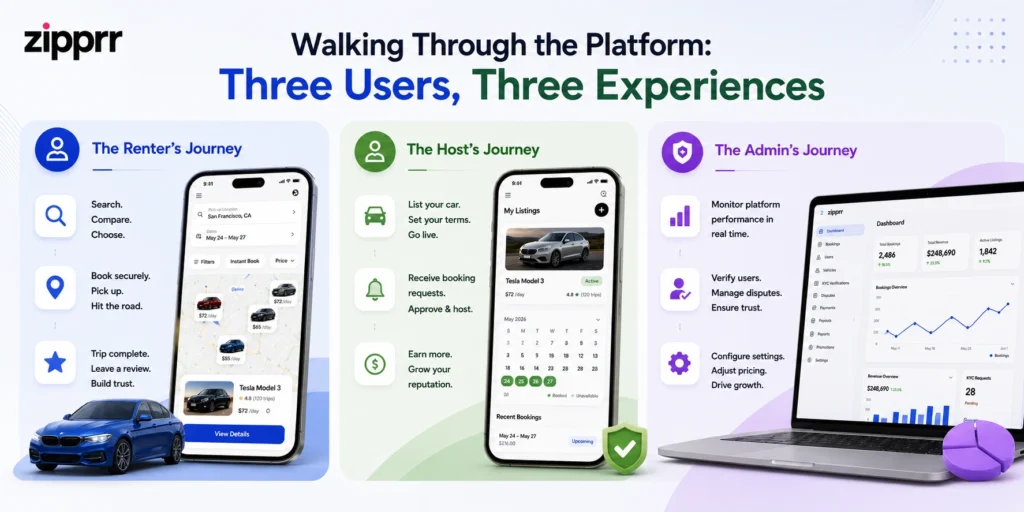
The Renter's Journey
The Host's Journey
The Admin's Journey
Features That Determine Whether Users Come Back
For Renters: What Keeps Them Booking
- Context-aware search: A search that adjusts results based on unstated signals — an airport-area query surfaces cars with airport pickup enabled; a late-night search prioritises hosts with instant confirmation. Renters do not articulate these preferences, but they notice when results feel relevant rather than random.
- AI-assisted damage documentation: Pre-trip and post-trip photo capture with machine-vision comparison is not just a legal tool. It is a psychological one. Renters who know the platform objectively documents vehicle condition book with far less anxiety — and anxiety is the friction that keeps first-time users from becoming regulars.
- Persistent in-app messaging: Every conversation attached to a booking lives inside the platform, timestamped and retrievable. No personal contact details change hands. If a dispute arises, the admin has the full communication record. This is accountability architecture, not just messaging convenience.
- Escrow payment protection: Funds collected at booking are not released to the host until trip completion is confirmed. Both sides gain certainty: the renter knows their money is protected if a host cancels at the last minute; the host knows the renter cannot dispute a completed transaction as unauthorised.
- Doorstep delivery option: Offering vehicle delivery to a renter's chosen address unlocks a substantial segment of users who would not otherwise access the platform. High-demand urban areas, airport corridors, and business travel routes are all served better by delivery-enabled listings.
For Hosts: What Keeps Them Listing
- Demand-driven pricing recommendations: An AI pricing engine that monitors local booking volume, competitor rate data, and upcoming demand events to suggest daily rates in real time. Hosts who follow these signals consistently earn measurably more than hosts who set a fixed price and leave it unchanged for weeks.
- Multi-vehicle management console: Fleet operators managing five to twenty vehicles need a completely different interface than someone renting out one car. Aggregate earnings, vehicle-level availability controls, and bulk calendar editing are features that transform the platform from a personal side-income tool into a viable business channel.
- Listing performance analytics: Search impressions, profile click-through rate, booking conversion, and average trip length presented as per-listing metrics. Hosts who can identify what is underperforming in their listing adjust and improve. Hosts who guess, churn.
- Booking mode flexibility: Auto-approve mode maximises occupancy for hosts who trust the platform's verification layer. Request-based mode gives others granular control over who drives their car. Platforms that force one approach lose the hosts who need the other.
Admin Capabilities That Scale With the Business
- Tiered commission architecture: Setting a single flat commission rate is a short-term shortcut. Mature platforms need rate differentiation by vehicle tier, booking duration, host subscription level, and promotional campaign. The admin panel must support this without engineering involvement.
- Integrated KYC workflow: Automated licence scanning, face-match verification, and manual review queuing for flagged accounts — all before a renter's first trip is confirmed. Damage and fraud incidents cluster heavily in the first three bookings. KYC is the cheapest form of incident prevention available.
- Structured dispute resolution: Both parties submit evidence. Admin reviews and issues a documented decision. Escrow releases or retains based on that outcome. Without this workflow, every dispute becomes an ad-hoc negotiation that erodes host confidence faster than any other platform failure.
- Real-time revenue intelligence: Gross marketplace volume, net commission, active user cohorts, booking velocity by city, and host retention rates visible in a single operational view. Running a marketplace without live financial visibility is operating blind.
What Separates 2026 Platforms From Earlier Car Sharing Scripts
- Demand-responsive dynamic pricing: Rather than reacting to demand after the fact, an AI pricing layer monitors booking velocity, cross-references upcoming local events, and adjusts host rate suggestions before demand peaks hit. Hosts who benefit from peak pricing stay active. Consistent host supply is what prevents demand spikes from becoming unmet demand.
- Behavioural fraud recognition: Machine learning models trained on historical booking behaviour identify statistical anomalies that signal fraudulent intent — account creation patterns, payment method mismatches, trip duration outliers — and flag them before a booking is confirmed. Legitimate users experience no friction. Bad actors get filtered upstream.
- Personalised vehicle recommendations: Each renter's search history, past trips, stated preferences, and in-session behaviour feed a recommendation model that surfaces vehicles they are statistically predisposed to book. This is the feature most directly correlated with second and third booking rates, which is where marketplace unit economics start working in your favour.
- Computer-vision damage assessment: Pre-trip and post-trip photos are processed through an image comparison model that identifies visual differences consistent with damage. Both parties see the same AI-generated report. Objectivity in damage assessment reduces dispute volume by removing the interpretive disagreement that most claims rest on.
- Predictive fleet maintenance alerts: For operators managing commercial vehicle supply, telematics integration enables maintenance prediction before a vehicle is taken offline mid-booking. A breakdown during a rental is the worst outcome measurable — for the renter's experience, the host's rating, and the operator's reputation simultaneously.
Walking Through the Platform: Three Users, Three Experiences
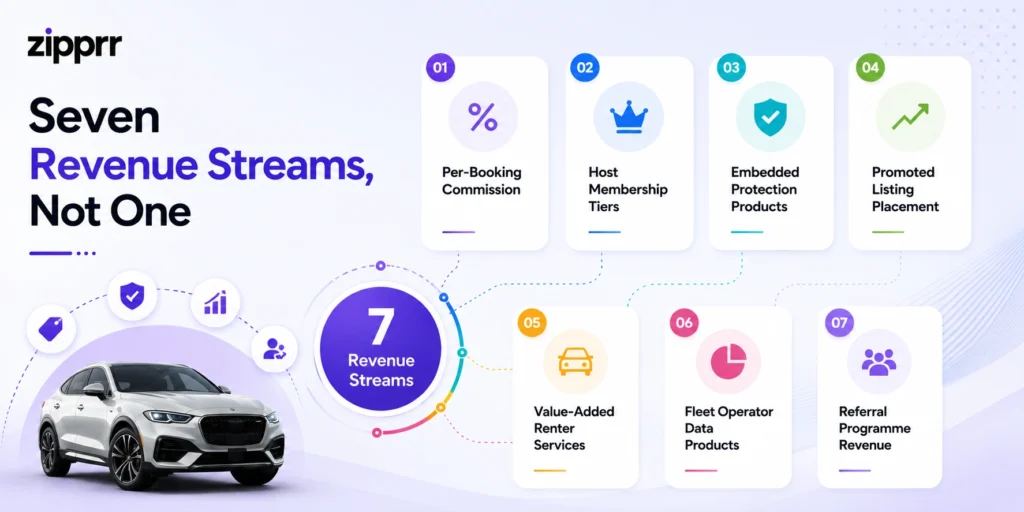
1. Per-Booking Commission
2. Host Membership Tiers
3. Embedded Protection Products
4. Promoted Listing Placement
5. Value-Added Renter Services
6. Fleet Operator Data Products
7. Referral Programme Revenue
What It Actually Costs to Launch: An Honest Breakdown
| Launch Approach | Platform Investment | Time to Live | Included | Right For |
|---|---|---|---|---|
| White-Label Clone | $500 to $5,000 | 7 to 14 days | Renter app, host app, admin panel, source code, white-label setup | First-to-market regional launches, niche verticals, low-risk validation |
| Customised Clone | $5,000 to $25,000 | 4 to 8 weeks | All of the above, plus niche feature development, UI overhaul, and integration work | Differentiated verticals: EV-only, luxury, commercial fleet |
| Full Custom Build | $60,000 to $200,000+ | 6 to 14 months | Fully bespoke architecture designed around a unique operational model | Venture-backed operators with genuinely novel mechanics |
Want a ready-made platform like this?
Skip months of development. Uber Clone, Airbnb Clone, Uber Eats Clone, TaskRabbit Clone and Gojek Clone ship with 100% source code. Book a free demo or chat with us on WhatsApp.
Clone vs. Custom Build: What the Tradeoff Actually Looks Like
| Factor | White-Label Clone | Custom Development |
|---|---|---|
| Time from decision to first live booking | Two to four weeks | Eight to sixteen months |
| Day-one feature completeness | Renter app, host app, admin panel — all functional | Only what you have scoped, funded, and tested |
| Capital requirement | $500 to $25,000 | $60,000 to $200,000 or above |
| Who owns the source code | You, from the day of delivery | You, once development is paid for and delivered |
| Peer-to-peer marketplace mechanics | Pre-built and production-tested | Requires design, specification, and build from scratch |
| Ability to validate market demand | Within weeks of launch | After a year or more of development |
| Risk exposure if the strategy needs adjusting | Contained — adapt or redirect at low cost | Significant — months of sunk development effort |
Zipprr's Turo Clone: What We Built Differently
Built for two distinct host types simultaneously
Admin panel designed for decisions, not just records
Damage workflow treated as a first-class product feature
White-label delivery included at no extra charge
Source code transferred outright at delivery
See the Platform Before You Commit to Anything
Real Questions From Entrepreneurs Evaluating a Turo Clone
What does a Turo clone purchase actually include?
Which markets make the most sense for a Turo clone launch?
How does the platform handle the insurance question?
What happens if a renter causes damage to a host's vehicle?
Can the platform serve both individual car owners and fleet businesses simultaneously?
How long before the first booking realistically happens after launch?
Which payment gateways are available out of the box?
What does GDPR compliance look like in this platform?
Can I position this as a niche platform — for example, electric vehicles only?
Is the source code genuinely mine after purchase?
What does daily admin platform management actually look like?
How and when do car hosts receive payment?
What support exists after the platform goes live?
How is this different from a standard car rental booking system?
Can the platform operate across multiple cities or countries from a single instance?
The Actual Opportunity Is Narrower Than It Sounds — Which Is Good News
Also, from Zipprr: More Ready-to-Launch Clone Solutions
- Vinted Clone — Launch a peer-to-peer second-hand fashion and resale marketplace. Buyer protection, seller dashboards, and AI product tagging included.
- Peerspace Clone — Build an hourly venue rental marketplace for studios, event halls, meeting rooms, and creative spaces.
- Uber Clone — Full ride-hailing platform with driver and rider apps, real-time tracking, and surge pricing engine.
Ready to launch your own platform?
Zipprr gives you 100% source code, a 7-day refund and 90 days of free support, so you can go live without building from scratch. Popular starting points: Uber Clone, Airbnb Clone, Uber Eats Clone, TaskRabbit Clone and Gojek Clone.