
Real estate is now a digital-first industry, and the platforms people trust to search, list, and compare homes are the ones capturing the value.
That shift has made property portals one of the most attractive business models in PropTech, and it is exactly why so many founders are exploring a Zillow clone as their entry point.
Instead of spending a year and a fortune engineering a marketplace from zero, you start with a proven, ready-made foundation and focus your energy on branding, niche, and growth.
This guide breaks down everything you need: what a Zillow clone is, how it works, the features that matter in 2026, real revenue models, honest cost ranges, and a step-by-step roadmap to launch.
By the end, you will know exactly whether this path fits your goals and how to move from idea to a live, revenue-generating platform.
What Is a Zillow Clone?
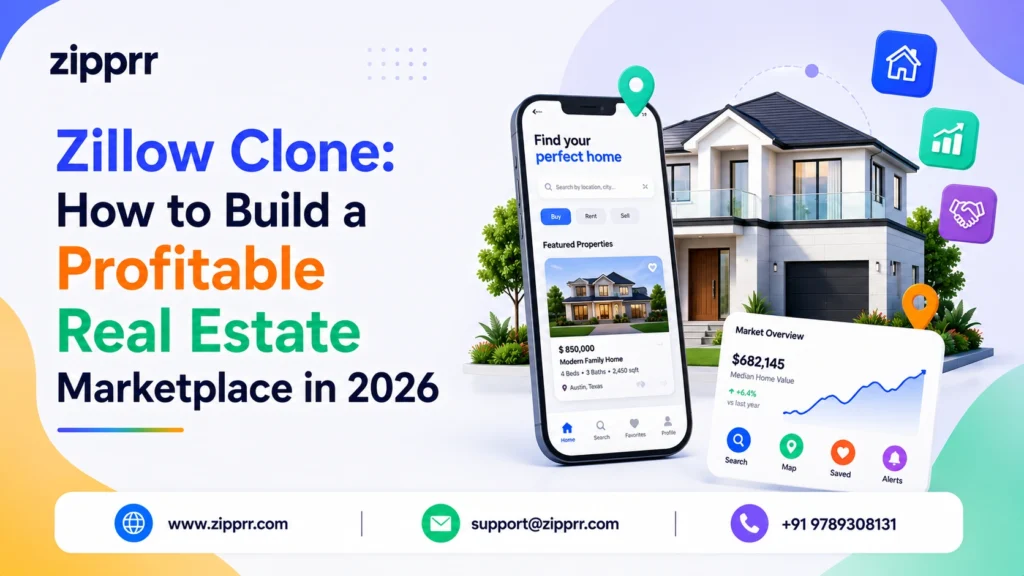
A Zillow clone is ready-made real estate marketplace software that replicates the core features of Zillow.
It lets you launch your own property portal where buyers search listings, sellers post homes, and agents capture leads.
Instead of building from zero, you start with a proven blueprint and customize the branding, features, and market focus.
The result is a faster, more affordable path to owning a functioning PropTech platform.
Why the Real Estate Marketplace Model Works in 2026
Real estate has moved online, and it is not moving back.
These days, almost every home search starts with a tap or a click rather than a drive around the neighborhood. When 97% of buyers start their search online, whoever owns the discovery layer owns the transaction.
A marketplace sits in the middle of that discovery layer. It does not own inventory, carry stock, or hold financial risk the way a builder or lender does.
Instead, it connects supply and demand and monetizes attention, leads, and trust.
That is why the model scales so beautifully. Once the platform exists, adding the ten-thousandth listing costs almost nothing, but each new listing makes the platform more valuable to buyers.
More buyers attract more sellers, and more sellers attract more agents willing to pay for visibility. This self-reinforcing loop is the engine behind every dominant property portal on earth.
A Zillow clone gives you that same engine, pre-assembled and ready to brand.
The Market Opportunity (Data and Statistics)
The numbers behind property technology are hard to ignore.
The global PropTech market is valued at roughly $51-54 billion in 2026 and is forecast to grow at a compound annual rate near 16% through the next decade, potentially exceeding $200 billion by the mid-2030s. That is a rising tide lifting every serious platform.
Zillow itself proves the ceiling is high. Zillow Group reported $2.6 billion in revenue for full-year 2025 and drew a monthly high of 259 million unique visitors in July 2025, with roughly 9.6 billion visits across its portals that year.
Its rentals segment alone grew 45% year over year, reaching 2.4 million average monthly active rental listings.
Here is the strategic insight: you do not need Zillow’s scale to build a profitable business.
Capturing a single city, a single country, or a single niche such as student housing, luxury villas, or commercial space can support a strong, defensible company. The giants are global and generic. Your advantage is being specific.
North America still leads PropTech adoption with over half of global market share, but Asia-Pacific is the fastest-growing region, which means emerging markets remain wide open for focused local players.
How a Zillow Clone Actually Works
At its core, a Zillow clone orchestrates a simple exchange between four groups of people.
Buyers and renters come to search. They filter by location, price, bedrooms, and property type, then browse listings on maps and photo galleries before contacting the person behind the listing.
Sellers and landlords come to list. They create a property profile, upload photos, set a price, and publish it to a ready audience of buyers.
Agents and brokers come to grow. They pay for premium placement, verified badges, and lead capture so their listings surface first when demand is high.
Administrators, meaning you, run the show. From a central dashboard you approve listings, manage users, set commission or subscription rules, monitor fraud, and watch revenue accumulate.
The platform’s job is to make each of these interactions fast, trustworthy, and mobile-friendly. Everything else, from map search to messaging, exists to serve that flow.
Must-Have Features (Buyers, Sellers, Agents, Admin)
A credible Zillow clone needs a complete feature set across every user type. Missing pieces break trust and kill retention.
For buyers and renters:
Advanced search and filters let users narrow results by price, location, size, and amenities in seconds. Map-based browsing with pins and neighborhood boundaries turns a list into an experience.
Saved searches and alerts bring people back when a matching home appears. High-resolution photo galleries, virtual tours, and a mortgage or affordability calculator help buyers decide with confidence.
For sellers and landlords:
A guided listing wizard makes posting a property simple, even for non-technical users. Photo and video uploads, pricing suggestions, and listing analytics show sellers how many people viewed and saved their home.
For agents and brokers:
A professional profile with reviews, a lead inbox, and performance dashboards turns the platform into a business tool. Featured listing options and subscription tiers give agents a reason to pay.
For administrators:
A powerful admin panel governs everything: user management, listing moderation, content control, commission settings, payment tracking, and analytics.
Trust and safety tools, including verification and reporting, protect the marketplace’s reputation, which is its most valuable asset.
Advanced 2026 Features That Win
Baseline features get you to parity. Advanced features get you attention and defensibility.
AI-powered recommendations study a user’s behavior and surface homes they are statistically likely to love, mirroring the personalization people now expect from every app.
Automated home valuation, the concept Zillow popularized with its “Zestimate,” builds instant trust by giving visitors an estimated price the moment they land on a listing.
Interactive maps with heat layers for price, crime, schools, and commute time turn raw data into decisions. Virtual tours and 3D walkthroughs reduce wasted visits and win international buyers.
Conversational AI assistants answer buyer questions around the clock and pre-qualify leads before a human ever responds. Multi-language and multi-currency support unlocks cross-border demand in a single build.
These features are no longer luxuries. In 2026 they are the difference between a portal people bookmark and one they forget.
Revenue Models: How a Zillow Clone Makes Money
A great platform with no revenue model is a hobby. The strength of the marketplace model is that it supports several income streams at once.
Featured and premium listings let sellers or agents pay to appear at the top of relevant searches. This is often the fastest revenue to activate.
Agent and broker subscriptions charge monthly or annual fees for professional tools, verified badges, and lead access. Predictable recurring revenue makes the business far easier to value and scale.
Lead generation fees charge agents for each qualified buyer inquiry routed to them, aligning your income with the value you deliver.
Advertising space sells banner and sponsored placements to mortgage lenders, insurers, movers, and home-service brands eager to reach active buyers.
Transaction or referral commissions take a small percentage when a deal closes through a partner. Add premium data reports and API access, and a single platform can earn from five or more channels simultaneously.
Build vs. Buy: The Real Decision
Every founder faces the same fork in the road: build a real estate portal from scratch or start from a clone script.
Building from scratch offers total control but demands a large team, a long timeline, and a budget that often runs into six figures before the first user arrives. For most founders, that is a slow and risky way to test a market.
A clone script flips the equation. You inherit a tested architecture, a full feature set, and a working admin panel, then invest your energy in branding, differentiation, and growth rather than plumbing.
The honest framing is this: buy the foundation, build the difference.
Use a clone to reach the market in weeks, learn from real users, and reinvest revenue into the custom features that make your platform unique. Speed to learning beats perfection in a pre-launch spreadsheet.
Zillow Clone Cost Breakdown
Cost depends entirely on the path you choose, so treat these as planning ranges rather than quotes.
A ready-made clone script typically starts in the low thousands of dollars for a licensed, customizable codebase. This is the most budget-friendly route and the fastest to launch.
A customized clone, where you adapt the script with your own features, design, and integrations, generally lands in the mid four to five figures depending on scope.
A fully custom build from an agency can run from tens of thousands into six figures, driven by team size, region, and feature depth.
Beyond the build, plan for ongoing costs: hosting and servers, third-party APIs such as maps and payments, security and compliance, marketing, and continuous maintenance.
A useful rule of thumb is to budget your first-year operating costs to roughly match your build cost, so you have runway to acquire users after launch.
Tech Stack and Architecture
The right stack balances performance, scalability, and hiring reality.
On the front end, modern frameworks like React or Next.js deliver the fast, app-like experience buyers expect, with strong support for search optimization and mobile responsiveness.
On the back end, robust languages and frameworks such as Node.js, Laravel/PHP, or Python power listing management, search, and user accounts. A relational database handles structured property data, often paired with a search engine like Elasticsearch for lightning-fast filtering.
Maps and geolocation rely on providers such as Google Maps or Mapbox. Cloud hosting on providers like AWS keeps the platform elastic as traffic grows, and a CDN keeps image-heavy pages fast worldwide.
Payments flow through gateways like Stripe or PayPal, and third-party APIs handle messaging, notifications, and identity verification.
The exact stack matters less than the principles: build modular, cache aggressively, secure everything, and design for mobile first.
Step-by-Step Launch Roadmap
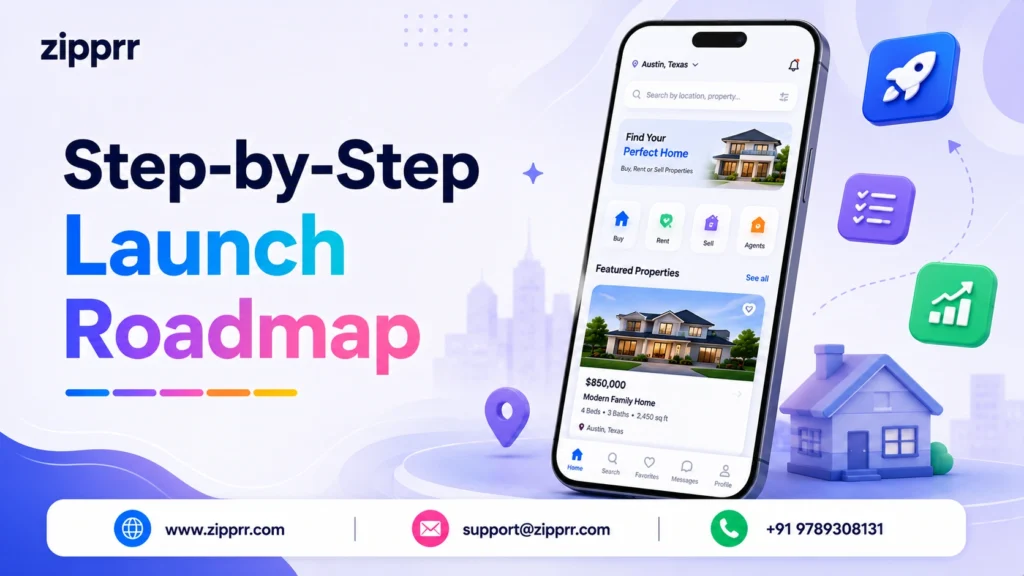
Turning an idea into a live marketplace follows a predictable path.
First, define your niche and geography. A focused portal for one city or one property type will out-compete a generic clone every time.
Second, select your foundation. Choose a reputable clone script or development partner and confirm you receive full source code and licensing rights.
Third, customize branding and features. Apply your identity, refine the user flows, and add the one or two features that make you distinct.
Fourth, integrate services. Connect maps, payments, messaging, and verification, then load initial listings so the platform never looks empty on day one.
Fifth, test rigorously. Validate on real devices, run security checks, and fix friction in the search and listing flows before real users arrive.
Sixth, launch and seed supply. Recruit early agents and sellers, because an empty marketplace repels buyers. Finally, market relentlessly through search optimization, local partnerships, and paid acquisition, and iterate based on real behavior.
Comparison Table: Clone Script vs. Custom vs. SaaS
| Factor | Clone Script | Custom Build | SaaS Rental |
|---|---|---|---|
| Upfront cost | Low | High | Very low |
| Time to launch | Weeks | 6-12+ months | Days |
| Source code ownership | Yes | Yes | No |
| Customization freedom | High | Complete | Limited |
| Scalability | High | High | Depends on vendor |
| Ongoing fees | Hosting + maintenance | Hosting + team | Recurring subscription |
| Best for | Founders wanting speed + ownership | Funded teams with unique needs | Testing an idea, more affordable |
Common Mistakes to Avoid
Even strong concepts fail on avoidable errors.
Launching too broad is the most common trap. A portal that tries to serve every city and every property type competes directly with giants and wins nowhere.
Ignoring supply is the second. Founders obsess over buyer features while forgetting that an empty listing page kills trust instantly. Seed your inventory first.
Neglecting mobile performance loses the majority of your audience, since most property searches happen on phones. A slow, clunky mobile experience is a silent conversion killer.
Skipping trust and verification invites fraud and fake listings that poison your reputation permanently. Underinvesting in search optimization leaves you dependent on paid ads forever.
Finally, buying a more affordable script with no source code or support locks you into a dead end. Ownership and a real update path are non-negotiable.
Pro Tips From the Field
A few hard-earned lessons separate portals that grow from those that stall.
Win one niche before expanding. Dominating student rentals in three cities beats being the 50th generic option nationwide.
Treat listing quality as a product. Professional photos, complete data, and verified badges do more for conversion than any algorithm.
Build search optimization into the architecture, not as an afterthought. City and neighborhood landing pages, structured data, and fast load times compound into free, durable traffic.
Make the agent your best customer. Agents bring inventory and pay the bills, so obsess over their dashboard, leads, and ROI.
Instrument everything. If you cannot see which searches fail and which listings convert, you are optimizing blind.
Pros and Cons
Pros of a Zillow Clone
Fast time to market lets you validate a real business in weeks, not years. Lower upfront cost preserves capital for marketing and growth.
A proven feature set reduces product risk, and full source code gives you complete ownership and freedom to scale. Multiple revenue streams create a resilient business model.
Cons and Considerations
You still must earn your market, since software alone does not create demand. Seeding initial supply takes real effort.
Differentiation is on you, because a stock clone looks like every other stock clone until you shape it. Ongoing maintenance, security, and support remain your responsibility. Success depends on execution, not just the codebase.
Launch Checklist
Use this as a pre-launch gate before going live.
- Niche and target geography clearly defined
- Reputable clone script or dev partner selected with full source code
- Branding, logo, and design system applied
- Buyer search, filters, and map fully functional on mobile
- Seller and agent listing flows tested end to end
- Payment gateway and subscription tiers live
- Maps, messaging, and verification integrated
- Initial listings seeded so no page looks empty
- Security, SSL, and data protection verified
- Search optimization fundamentals in place (structured data, city pages, speed)
- Analytics and conversion tracking installed
- Early agents and sellers recruited before public launch
Key Takeaways
A Zillow clone is the fastest, most capital-efficient way to launch a real estate marketplace in 2026.
The PropTech market is large, growing near 16% annually, and still wide open for focused local and niche players.
The model wins through network effects and multiple revenue streams, from featured listings to agent subscriptions to advertising.
Buy the foundation and build the difference: use a clone for speed, then differentiate through niche focus, listing quality, and standout features.
Execution beats code. Seed supply, obsess over agents, prioritize mobile and search optimization, and iterate on real user behavior.
Ready to launch your own real estate marketplace?
If you want a proven foundation instead of a year of expensive development, a customizable Zillow clone gets you to market in weeks with full source code and complete ownership.
Tell us your niche and target market, and we will help you map the features, revenue model, and launch plan that fit your goals.
Book a free consultation or request a live demo today, and turn a validated idea into a working platform that earns.
Frequently Asked Questions
What is a Zillow clone?
Is it legal to build a Zillow clone?
How much does a Zillow clone cost?
How long does it take to launch a Zillow clone?
How does a Zillow clone make money?
Do I get the source code with a Zillow clone?
Can I customize a Zillow clone script?
What features are essential in a Zillow clone?
What is the difference between a Zillow clone and custom development?
Is a Zillow clone worth it in 2026?
Conclusion
The opportunity in online real estate is real, large, and still open to focused newcomers.
A Zillow clone removes the hardest part of entering this market, the slow and expensive build, and hands you a working foundation you can launch in weeks.
From there, success comes down to execution: pick a sharp niche, seed your supply, treat agents as your best customers, and compound traffic through search optimization.
Buy the foundation, build the difference, and you can turn a validated idea into a durable, revenue-generating marketplace in 2026.