

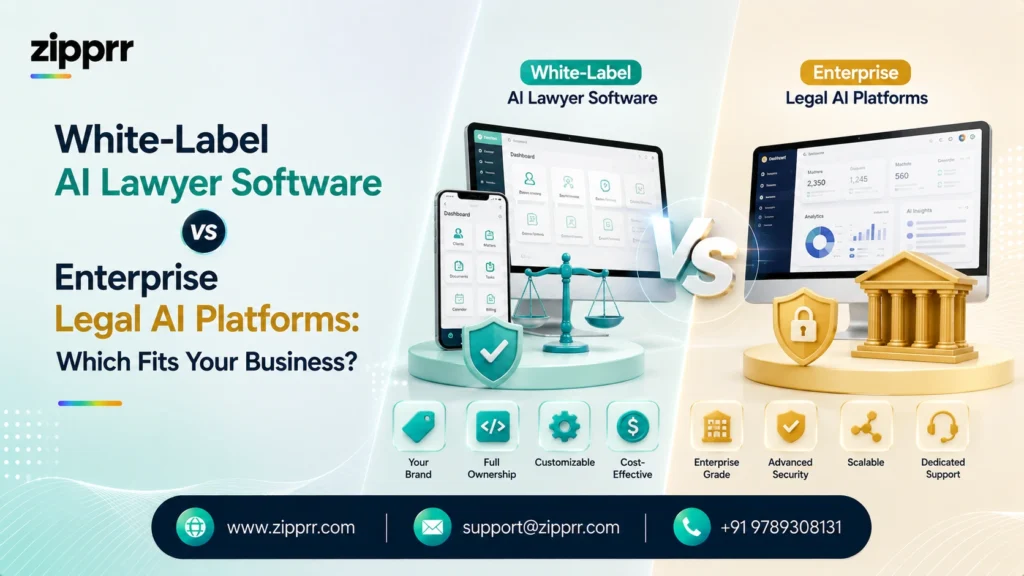
Choosing legal AI software isn’t just a feature comparison; it’s a decision about how much you want to spend, who ends up owning what you pay for, and whether that software can ever become a revenue source instead of a recurring cost. Businesses evaluating “AI lawyer software” typically fall into one of two buying categories: those who want to license a tool for internal use, and those who want to acquire and operate a legal-AI product under their own brand. This guide compares white-label AI lawyer software against enterprise legal AI platforms head-to-head on pricing, ownership rights, feature depth, and total cost of ownership, so you can make an informed purchase decision based on which category actually fits your business.
White-label AI lawyer software is purchased once, usually with the source code included, and run under whatever brand the buyer chooses, which means full ownership and freedom to price it however they like for their own users. AILawyer software, for instance, sells for a flat $490, ships with 100% open-source code, and includes 90 days of free support, with nothing billed monthly. Enterprise legal AI platforms work the opposite way: access is rented seat by seat, commonly $179 to $350 per user each month for mid-market products, climbing past $3,000 per seat a year on enterprise-tier contracts, and the vendor keeps ownership the entire time. So the real question has nothing to do with which product packs in more features. It’s whether you want to use legal AI as a tool inside your business, or operate it as a product you sell to others.
What Is White-Label AI Lawyer Software?
ANSWER: It’s a ready-built legal-AI platform that a business buys outright, typically as a one-time purchase with source code included, then rebrands, hosts, and runs as if it were their own in-house product. The buyer keeps every dollar of the pricing they set and owns the relationship with whoever ends up using it.
Think of it less like renting a storefront and more like buying the building. The heavy lifting, the AI model, the chat interface, the document generator, the admin panel, is already finished; what’s left for the buyer is branding it and turning it on. AILawyer software is a working example: a self-hosted platform built around 100% open-source code, priced once at $490, with 90 days of support folded in, and no ongoing per-user charge afterward.
This category exists for a buyer most legal-AI comparison articles forget about entirely: the entrepreneur, agency, or small business that wants to sell legal-AI access to their own customers, not just quietly use it themselves.
What Is Enterprise Legal AI Software?
ANSWER: Picture a subscription rather than a purchase. Products in this space, Harvey, Legora, and Spellbook are recognizable names, get billed per user to law firms and corporate legal teams looking to move faster on contract review, legal research, and drafting. Ownership never transfers; the buyer is paying, month after month or year after year, for continued access.
What these platforms sell is depth, not the ability to bend the product into something new. They’re engineered around how a big legal department already functions: dense contract analysis, plugging into whatever document-management system is already in place, and compliance-ready audit trails. Reselling or rebranding was never the design goal. Sign up for Spellbook and you remain a Spellbook customer indefinitely. There’s no route from there to running it as your own independent offering.
How Are They Different?
The dividing line isn’t really about capability. It’s really about who holds the reins after the sale closes, and what kind of ongoing relationship the buyer ends up having with the software.
| Feature | What It Does |
|---|---|
| Bulk / broadcast campaigns | Send templated messages to segmented contact lists for promotions and announcements |
| No-code chatbot builder | Build automated conversation flows for FAQs, lead qualification, and order support without writing code |
| AI auto-reply | Generate contextual responses to common customer questions, including outside business hours |
| 24/7 auto-reply | Automatically respond when no agent is available, keeping customers informed around the clock |
| Shared contact database | Centralize customer and lead information across the whole team in one place |
| Drip campaigns | Send a scheduled sequence of messages over time to nurture leads or onboard customers |
| Multi-agent inbox | Let multiple team members manage one WhatsApp number without duplicate or missed replies |
| Lead / sales automation | Route, tag, and follow up with leads automatically to reduce lead leakage |
| White-label branding | Deploy and present the platform under your own company name and domain |
Cost Comparison
QUESTION: How much does white-label AI lawyer software cost compared to enterprise legal AI?
ANSWER: Money changes hands very differently in each model. Buy AILawyer software and you pay $490 once, get the codebase, and receive three months of support with the purchase, nothing more owed after that. Sign up for an enterprise seat instead and the meter never stops running: figure on somewhere between $179 and $350 monthly for a mid-tier tool, and north of $3,000 a year per seat once you’re looking at enterprise contracts (Legora is a known example, said to require ten seats minimum, which pushes the yearly bill past $30,000). Skipping both routes and building something from scratch lands in its own bracket entirely, commonly $10,000 on the low end and well past $150,000 for anything sophisticated, plus a few thousand dollars a month just to keep the AI running behind the scenes.
Zoom out to a three-year horizon and the numbers stop looking close. Ten seats at $3,000 each racks up $90,000 across that span, and none of it converts into ownership; the moment payments stop, so does access. Set that against a single $490 payment and the difference isn’t subtle. The buyer also keeps the platform indefinitely and can onboard as many paying users as the business can find, with zero cost per additional seat.
None of this is entirely free of trade-offs, though. Enterprise subscribers get continuous updates and support baked directly into what they’re paying. Someone running a self-hosted white-label deployment eventually takes that job on themselves, in AILawyer’s case, once the three-month support window closes. It’s a real obligation, just one that’s considerably lighter than an endless per-seat bill.
Ownership and Control
QUESTION: Who owns the software in each model?
ANSWER: With white-label software, the license, and usually the underlying source code, belongs to the buyer, who decides how it’s hosted and is free to modify it. With enterprise SaaS, ownership never leaves the vendor; what the customer holds is a subscription seat bound by that vendor’s terms, nothing more.
Ownership becomes the deciding factor in two specific situations: first, when a business intends to resell access to its own customers, something only a white-label license permits cleanly, and second, when a business wants cost predictability that isn’t at the mercy of a vendor’s future price hikes or the risk of a platform shutting down entirely.
Feature Comparison
Here’s how the two models line up feature by feature, using AILawyer software as the white-label reference point.
| Feature | White-Label (e.g., AILawyer Software) | Typical Enterprise Platform |
|---|---|---|
| AI legal chat assistant | Yes | Yes |
| Contract review/analysis | Yes | Yes, often deeper/more specialized |
| Document generation | Yes | Varies |
| E-signature integration | Yes | Sometimes, via third-party integration |
| Admin dashboard for managing users | Yes | Limited, vendor-controlled |
| White-label branding | Yes | No |
| Billing/subscription management for end users | Yes | No (billing is vendor-to-buyer only) |
| Enterprise-grade legal research depth | Basic-to-moderate | Often deeper, case-law-specific |
| Multi-tenant support (for reselling) | Yes | No |
Enterprise tools tend to pull ahead in one narrow lane: going deep on a single legal workflow, like litigation-grade contract analysis. White-label platforms make up for that with business-side flexibility instead. Multi-tenancy, resale rights, and full branding control simply aren’t things enterprise vendors are trying to offer.
Who Should Choose White-Label Software?
- Entrepreneurs and agencies wanting to launch a branded legal-AI product for a specific niche or region.
- Businesses that want to offer legal-AI as a value-added service to their own customers, for example, a startup accelerator adding legal Q&A for its portfolio companies.
- Operators who’d rather pay once and own the outcome than keep paying a vendor indefinitely for updates they may not need.
- Teams comfortable managing their own hosting, or willing to self-host in exchange for keeping data control in-house.
Who Should Choose an Enterprise Platform?
- Law firms needing litigation-grade research and analysis tools integrated with existing legal practice management systems.
- In-house legal departments at large companies needing audit trails, compliance certifications, and vendor-managed security.
- Teams that would rather hand off hosting and maintenance entirely and just pay a recurring fee for it.
- Organizations where the software will only ever be used internally, with no intention of offering it externally under their own brand.
Security and Compliance Considerations
QUESTION: Is white-label AI lawyer software as secure as enterprise platforms?
ANSWER: The honest answer is: it depends entirely on setup. Host it yourself and encryption, data storage, and access control become your call to make, and your problem to fix if something goes wrong, though a well-configured deployment can hold up just as well as anything vendor-run. Enterprise vendors take that decision away from the buyer, running security centrally and pointing to their own compliance paperwork as proof.
Security isn’t inherently stronger on either side; accountability is what shifts. A smaller team with no technical bench will usually feel safer under an enterprise vendor’s managed protections. A team that can code, or that partners with a capable hosting provider, can stand up a self-hosted white-label deployment that’s every bit as solid, while never losing direct control of its own data.
Implementation Timelines
QUESTION: Which is faster to launch?
ANSWER: A white-label platform can usually be live within days to a couple of weeks once branding and setup are done, since the AI engine underneath it is already finished. Getting a single legal team onboarded onto an enterprise platform can move quickly too, often just days to weeks, but that’s a different comparison entirely. The real alternative to buying white-label software is building an equivalent branded product from the ground up, and that route regularly takes several months.
Revenue Potential (White-Label Only)
Enterprise legal AI sits on the expense side of the ledger; it’s a tool a firm pays to use, full stop. White-label AI lawyer software flips that script. The operator decides on subscription tiers, per-query pricing, or bundled packages for their own end users, converting one modest upfront license into an income stream that keeps paying out. That’s really the core strategic split between the two categories, and why they almost never compete for the same buyer: one is money going out, the other can become money coming in.
How to Choose Between Them
- Clarify your role: are you a user of legal AI, or do you want to operate a legal-AI product?
- Model the three-year cost: weigh total subscription spend against a one-time license plus whatever hosting will cost you.
- Check resale rights: enterprise subscriptions almost never allow reselling access, so don’t assume otherwise without checking the fine print.
- Assess your technical capacity: self-hosting a white-label platform calls for at least basic operational know-how.
- Evaluate depth needs: heavy litigation research work tends to favor specialized enterprise tools.
- Confirm branding requirements: if end users need to see your brand, not the vendor’s, white-label is the only path of the two.
- Test both before committing: run a demo of the white-label platform’s chat and document features, and try a trial seat on any enterprise tool you’re considering.
Common Mistakes When Deciding
- Comparing sticker price only: a $490 one-time license and a $350-a-month subscription aren’t comparable without looking at several years, not one month.
- Assuming enterprise tools can be rebranded: most enterprise legal AI contracts flatly rule out resale or rebranding.
- Underestimating hosting responsibility: self-hosted white-label software needs someone accountable for uptime and security once support ends.
- Ignoring the “who owns the customer” question: for anyone planning to build a legal-AI product, this single factor usually settles the decision on its own.
- Choosing based on brand recognition alone: a familiar enterprise vendor name isn’t automatically the right pick if what you actually need is a resellable, branded product.
The Future of This Market
Both categories look set to keep growing further apart rather than blending together. Enterprise legal AI is pushing deeper into litigation and specialized research as large firms demand more of it. White-label legal AI is moving toward simpler multi-tenant setups as more entrepreneurs try to enter legal-tech, particularly in markets that established vendors haven’t bothered to serve yet. Regulators in several jurisdictions are also paying closer attention to AI-generated legal content, which will likely nudge both categories toward clearer hand-off points to human attorneys down the line. That’s a plausible direction, not a certainty, and worth keeping an eye on before locking into either model for the long haul.
Ready to Launch Your Own Legal-AI Platform?
If owning a white-label platform sounds like the right move for your business, the next logical step is looking at the product itself rather than reading more about it secondhand. Explore AILawyer software to check out its features, request a demo, and see exactly what’s included in the $490 one-time license before deciding.
What is white-label AI lawyer software?
What is enterprise legal AI software?
Which is cheaper, white-label or enterprise legal AI?
Can I rebrand and resell enterprise legal AI software?
Is white-label legal AI software secure?
Who should choose white-label AI lawyer software?
Who should choose an enterprise legal AI platform?
How fast can white-label legal AI software launch?
Does white-label AI lawyer software include the same features as enterprise platforms?
Can white-label AI lawyer software generate revenue?
Is it worth buying legal AI software instead of subscribing to one?
What is the ROI of white-label legal software?
What is the difference between SaaS and white-label software?
Is white-label legal AI software legal to resell?
Can I white-label an existing AI legal chatbot?
Final Verdict: Which Should You Choose?
If this is purely a purchasing decision for internal legal work, an enterprise platform’s depth and vendor-managed upkeep might well justify paying for it every month. But if the plan is to run a legal-AI product, serve your own clients, or step into legal-tech under your own name, white-label software runs on a completely different economic logic: a small one-time cost, full ownership, and the chance to build recurring revenue instead of just handing it over.
AILawyer software sits squarely in that second lane. A single $490 payment gets you the codebase plus three months of support, sidestepping the recurring per-seat expense that makes enterprise legal AI costly to scale, while leaving the operator fully in charge of branding, pricing, and the relationship with whoever ends up using it.