

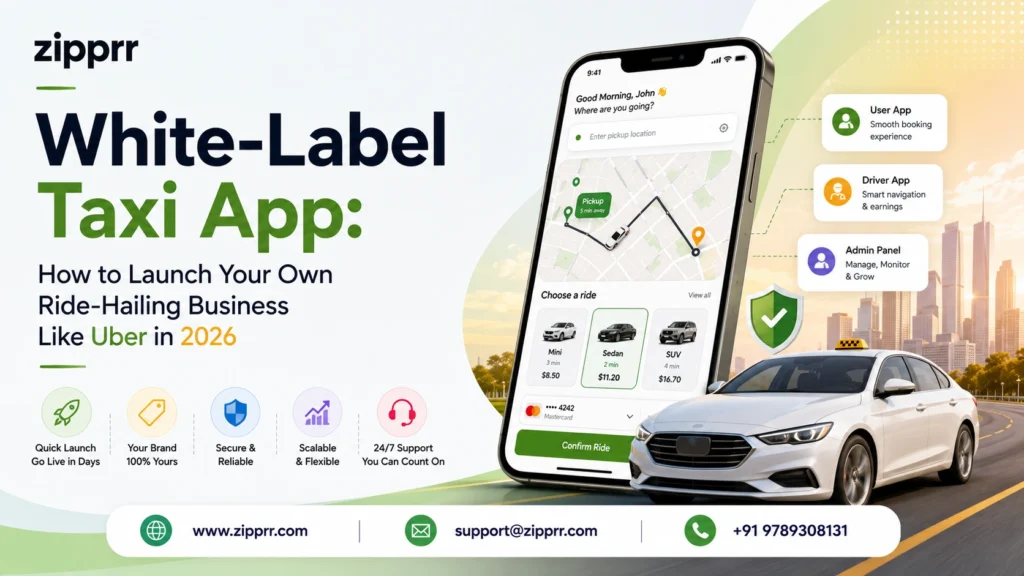
Every city still needs reliable rides, and riders are done waiting on street corners for a cab that may never come. That gap is exactly why ride-hailing remains one of the most dependable ways to build a local tech business in 2026. The hard part was never the idea. It was the engineering: building a driver app, a passenger app, live GPS tracking, and a payment system that actually works, all before you have a single paying customer.
A white-label taxi app removes that barrier. Instead of hiring a development team and waiting a year for version one, you license a fully built platform, brand it as your own, and start onboarding drivers within weeks. This guide walks through exactly what a white-label taxi app is, how it works, what it costs, and how to launch your own ride-hailing business without writing a single line of code.
A white-label taxi app is ready-built ride-hailing software, similar in function to Uber, that you rebrand and launch as your own business. A solution like the Zipprr Uber Clone already includes the driver app, passenger app, live tracking, fare calculation, payment processing, and an admin panel. You add your logo, set your city, configure your pricing, and go live, typically in two to four weeks instead of the twelve or more months custom development usually takes.
Key Takeaways
- A white-label taxi app lets you launch a ride-hailing business on proven, working software instead of building from zero.
- You keep full ownership of your brand, your driver network, your riders, and every dollar of commission you set.
- Core software includes a driver app, passenger app, live tracking, dispatch, fare calculator, payment gateway, and admin panel.
- Launch timelines shrink from 10-14 months of custom development to a few weeks with a ready-made platform.
- Picking the right partner matters more than picking the cheapest one — support, source code ownership, and update cadence decide whether your business survives year two.
What Is a White-Label Taxi App?
A white-label taxi app is a complete ride-hailing software package built by one company and licensed to many businesses, each of which rebrands it as their own. Think of it the way a franchise works, except you are not paying ongoing royalties on every sale, and the technology is yours to run under your own name.
The word “white-label” simply means the product ships without another company’s branding baked in. You add your own logo, your own app name, your own colors, and your own pricing rules. Riders who download your app never know it started as a template. They just see your brand, your drivers, and your service.
This matters because the engineering behind a taxi platform is genuinely hard. Real-time GPS tracking, dynamic fare calculation, driver-passenger matching, and secure payments each take specialized skill to build correctly. A platform like Zipprr’s Uber Clone has already solved those problems, tested them with real usage, and packaged them so a new founder can focus on the business side: recruiting drivers, marketing to riders, and setting the right price for their city.
Is Ride-Hailing Still Worth It in 2026? Here's Why
Public transit doesn’t reach every neighborhood, and car ownership keeps getting more expensive between insurance, parking, and maintenance. That combination keeps demand for on-demand rides high in cities of every size, not just major metros.
There’s also a shift happening at the local level. Riders and city officials increasingly favor regional or niche ride-hailing brands over giant national platforms, especially where drivers feel underpaid or riders feel ignored by generic support. A locally branded, well-run taxi service can win loyalty that a distant global app never will.
Finally, the underlying technology has matured. Mapping APIs, payment processors, and cloud infrastructure are cheaper and more reliable than they were even three years ago. That means a new ride-hailing brand can launch on solid technical ground without the massive capital a pioneer needed a decade ago.
White-Label vs. Building From Scratch
Founders usually consider two paths: hire developers to build a taxi platform from the ground up, or license a white-label solution and customize it.
Custom development gives you full control over every feature—but that control comes at a cost. Expect six figures in development spend, a team of five or more specialists (backend, mobile, DevOps, QA, design), and 10 to 14 months before your first ride even happens. Bugs discovered after launch are yours to fix, on your dime, on your timeline.
A white-label platform flips that equation. The core product is already built, tested, and running for other businesses. You spend your budget on branding, marketing, and driver acquisition instead of software engineering. Most founders launch in four to eight weeks, sometimes less, and updates or bug fixes are handled by the platform provider rather than an in-house team you have to hire and manage.
Core Features Every Taxi App Needs
A ride-hailing platform is really three connected apps working as one system. Here’s what each side needs, and what a solution like Zipprr includes by default.
Passenger App. Riders need to book a ride in seconds: set pickup and drop-off, see a live fare estimate, choose a vehicle type, and track their driver’s arrival on a map in real time.
Driver App. Drivers need a simple way to go online, accept or decline ride requests, navigate to the pickup point, and see their earnings update after every trip. A driver who fights with a clunky app will not stick around.
Live Tracking. Both riders and drivers need to see accurate, real-time GPS positioning throughout the trip. This single feature does more for trust than almost anything else in the app.
Fare Calculator. Automatic, transparent pricing based on distance, time, demand, and vehicle type keeps riders from feeling surprised or cheated at drop-off.
Dispatch System. Behind the scenes, the platform needs to match the nearest available driver to each request instantly, factoring in traffic, driver rating, and vehicle type.
Ride Scheduling. Not every trip happens right now. Airport runs and early meetings need a book-ahead option that guarantees a driver shows up on time.
Payment Gateway. Riders expect to pay by card, wallet, or cash without friction, and drivers expect their share of the fare to land in their account without delay.
Admin Panel. You need a command center: manage drivers, monitor live trips, handle disputes, set commission rates, and pull performance reports, all from one dashboard.
Driver Earnings Dashboard. Drivers who can see their daily, weekly, and monthly earnings clearly are drivers who stay loyal to your platform instead of switching to a competitor.
How a White-Label Taxi App Actually Works
Under the hood, three pieces talk to each other constantly. When a rider requests a trip, the passenger app sends the pickup location to the dispatch engine. The dispatch engine checks which drivers are online nearby, ranks them by distance and availability, and pushes the request to the best match.
Once a driver accepts, both apps switch into live-tracking mode. GPS coordinates stream from the driver’s phone to the server and back to the rider’s app every few seconds, which is what makes the moving car icon on the map feel instant. The fare calculator runs in the background throughout the trip, factoring in distance and time, and finalizes the total the moment the driver marks the ride complete.
Payment settles automatically through the integrated gateway: the rider is charged, the platform takes its commission, and the driver’s earnings update in their dashboard. The admin panel logs every step, so if a dispute comes up later, you have a complete record to resolve it fairly.
Step-by-Step Guide to Launching Your Taxi Business
Step 1: Define your city and niche. Pick a launch city where demand is underserved, whether that’s a mid-size metro, a college town, or a specific vertical like airport transfers or women-only rides.
Step 2: Choose your platform. Evaluate white-label providers on feature completeness, source code ownership, update history, and support responsiveness, not just sticker price.
Step 3: Customize your branding. Add your app name, logo, color scheme, and language settings so the platform feels unmistakably yours from the first screen.
Step 4: Set your pricing and commission. Research what riders currently pay for taxis or rideshare in your city, then set base fares and your driver commission percentage to stay competitive while remaining profitable.
Step 5: Recruit your first drivers. Your app is worthless without supply. Target existing taxi drivers, gig workers between platforms, and part-time drivers looking for flexible income.
Step 6: Test thoroughly before public launch. Run real trips with your recruited drivers and a small group of friendly testers to catch any pricing, routing, or notification issues.
Step 7: Launch marketing in your city. Combine local social media ads, driver referral bonuses, and rider sign-up discounts to build both sides of the marketplace at once.
Step 8: Monitor, iterate, and expand. Use your admin dashboard’s reporting to spot slow pickup times or driver drop-off, fix what’s broken, then repeat the launch playbook in your next city.
Real-World Use Cases
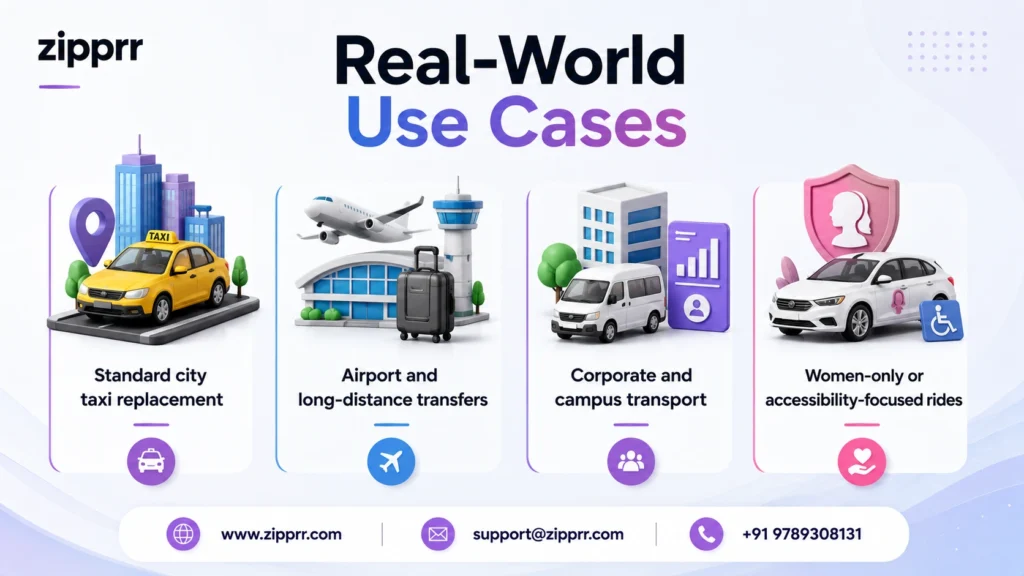
Standard city taxi replacement. A founder in a mid-size city launches a branded ride-hailing app to compete directly with national platforms, winning riders on faster pickup times and local customer support.
Airport and long-distance transfers. A niche operator focuses exclusively on pre-scheduled airport runs, using ride scheduling and fare transparency as the core differentiator.
Corporate and campus transport. A business or university deploys a private-label version of the app for employee or student shuttle requests, with the admin panel tracking usage and cost centers.
Women-only or accessibility-focused rides. A founder builds trust with an underserved segment by adding verified driver profiles and specialized vehicle options on top of the core platform.
Pros and Cons
Pros:
- Launch in weeks instead of months or years
- Lower upfront cost than custom development
- Proven, tested features from day one
- Ongoing updates and bug fixes handled by the provider
- Full ownership of your brand, drivers, and revenue
Cons:
- Less flexibility than a fully custom build for highly unusual business models
- Quality varies significantly between providers, so vetting matters
- You still need real capital for driver incentives and local marketing
- Ongoing hosting or license fees depend on the provider’s model
White-Label vs. Custom Development Comparison Table
| Factor | White-Label Taxi App | Custom Development |
|---|---|---|
| Time to launch | 4-8 weeks | 10-14 months |
| Upfront cost | Low to moderate | High (six figures common) |
| Team required | Marketing and operations | Full engineering team |
| Feature reliability | Pre-tested, proven | Depends on your team |
| Updates and fixes | Handled by provider | Your responsibility |
| Customization depth | Branding and business rules | Unlimited, but slow |
| Best for | Founders who want speed | Businesses with unique technical needs |
Pricing Factors
The cost of a white-label taxi app depends on a handful of concrete factors, not a flat number every provider quotes the same way.
Feature scope. A basic package with the core driver and passenger apps costs less than one bundled with advanced dispatch logic, multi-language support, or loyalty programs.
Platform coverage. Pricing usually scales with whether you need Android, iOS, or both, plus a web-based admin panel and rider portal.
Source code ownership. Solutions that hand you full source code ownership, like Zipprr’s Uber Clone, typically involve a one-time license fee rather than a recurring revenue share, which changes your long-term math significantly.
Customization level. Light rebranding costs less than deep customization such as unique matching algorithms or specialized vehicle categories.
Support and updates. Ongoing maintenance, security patches, and feature updates are sometimes included and sometimes billed separately, so read the terms closely before you commit.
Implementation Guide
Getting from purchase to launch smoothly comes down to sequencing. Start with a technical onboarding call to confirm hosting, domain, and app store account setup. Next, complete your branding assets: logo, app icons, splash screens, and your city’s map boundaries.
Configure your pricing rules and commission structure inside the admin panel before recruiting a single driver, since changing fares after drivers are active creates friction. Run a closed beta with five to ten drivers and twenty to thirty riders for at least a week to catch edge cases like poor GPS signal areas or payment failures.
Once the beta is stable, submit your apps to the Apple App Store and Google Play Store, a process that typically takes a few days to two weeks depending on review queues. Plan your public launch marketing to start the same week your apps go live, so momentum doesn’t stall between approval and public availability.
Best Practices
Keep your onboarding flow for both drivers and riders under two minutes. Every extra screen costs you sign-ups. Offer driver incentives for the first 30 days to build supply before you spend heavily on rider acquisition, since an app with no available drivers loses new riders permanently.
Respond to support requests, especially payment issues, within hours, not days, during your first three months. Early trust is fragile and word travels fast in a local market. Review your admin dashboard data weekly to catch patterns like consistently long pickup times in one neighborhood before they become public complaints.
Common Mistakes to Avoid
Launching without enough drivers is the single most common failure. A rider who opens your app and sees “no drivers nearby” twice will delete it and never come back. Skipping the beta test phase is another costly shortcut; issues that seem minor in testing become public relations problems at scale.
Underpricing to compete on cost alone rarely works long-term, since it squeezes driver earnings and hurts retention on the supply side. Choosing a provider based purely on the lowest quote, without checking source code ownership or support quality, often costs more in the long run through hidden fees or an abandoned product.
Expert Tips
Treat your first 90 days as a controlled experiment, not a finished business. Track your driver retention rate weekly; a healthy ride-hailing business keeps at least 70% of active drivers month over month. Use ride scheduling data to identify predictable demand spikes, like weekday morning commutes or weekend nightlife hours, and pre-position driver incentives around those windows instead of spreading incentive budget evenly across the day.
Future Trends in Ride-Hailing
Expect deeper integration between ride-hailing apps and messaging platforms, where riders book and track trips through chat interfaces instead of switching apps. AI-assisted dispatch that predicts demand before it happens, rather than just reacting to it, is becoming standard rather than a premium feature.
Sustainability is also shaping rider expectations, with growing demand for electric vehicle options and carbon-conscious ride choices built directly into the booking flow. Finally, super-app behavior is spreading beyond major markets, with riders increasingly expecting food delivery, package delivery, and ride-hailing to live inside a single branded ecosystem.
Why Choose Zipprr
Zipprr’s Uber Clone gives you the driver app, passenger app, live tracking, dispatch, fare calculator, payment gateway, admin panel, and driver earnings dashboard as a complete package with full source code ownership, so you’re never locked into a recurring revenue-share model you don’t control. If you’re also planning to communicate with riders and drivers through automated updates, Zipprr’s WhatsApp Automation software pairs naturally with your taxi launch, and an AI chat assistant can staff your customer support around the clock while your team focuses on growth. Every feature is built to be customized to your city, your pricing, and your brand from day one, backed by a team that understands what a first-time ride-hailing founder actually needs to launch successfully.
Conclusion and Action Checklist
Launching a ride-hailing business no longer requires a year of development and a seven-figure budget. A white-label taxi app gives you the same core technology proven platforms rely on, ready to brand and launch on your timeline. The founders who win in this space aren’t the ones with the fanciest custom code; they’re the ones who move fast, recruit drivers aggressively, and treat their riders like people, not transactions.
Before you launch, confirm you have: a defined launch city, a vetted platform provider with source code ownership, your branding assets ready, a pricing structure that’s competitive but sustainable, at least ten committed drivers for your beta, and a marketing plan ready to fire the same week your apps go live. Explore Zipprr’s full feature set and browse the blog for more launch guides before you commit.