


AI lawyer software puts language-model technology to work on the parts of legal practice that eat the most hours, reviewing contracts, digging up case law, drafting first passes, screening new clients, so a licensed attorney spends time on judgment calls instead of repetitive grunt work. It never sits a bar exam, never signs a filing, and never carries responsibility for an outcome; a human attorney still owns every decision it helps shape.
Every firm has a version of the same story: someone stuck late, re-reading a clause they’ve already read twice, because a number or a word quietly shifted between drafts and nobody wants to be the one who missed it. Multiply that by every contract sitting in every inbox on a given night, and you get a fair picture of why AI lawyer software stopped being a gadget for early adopters and started showing up as a line item in ordinary firm budgets.
Most of what gets written about this topic lands in one of two camps: pitch decks that make it sound like software is one update away from arguing a motion, or op-eds that buried the whole category after a few embarrassing headlines. Neither camp is much help if you’re the one actually deciding whether this belongs in your firm or your business. So consider this the guide for the people standing between those two camps, the ones who just want a straight answer on what the software does, what’s actually running under the hood, where it earns its cost, where a human still has to step in, what it costs in real dollars, and how to shop for it without getting oversold.
Executive Summary
Rewind three years and fewer than one lawyer in five had touched an AI tool for actual work. Ask the same question today and the answer lands somewhere in the low-to-mid eighties, by percentage, per recent industry surveys. Sounds like a done deal, right? Not quite. Almost all of that jump is one person, one laptop, one chatbot, quietly used without any firm policy behind it. Ask how many firms have actually rolled AI out as a governed, firm-wide system instead, and the number falls to roughly one in three. That gap, between people quietly experimenting and firms actually building AI into how work gets done, is the real subject of everything that follows.
Pull back further and the dollar figures stop being casual. Analysts tracking legal technology globally put the 2026 market somewhere in the low $30 billion range, with a path toward $60-plus billion within the decade at a strong annual pace. That growth doesn’t erase the category’s rough edges, though. Researchers who’ve stress-tested commercial legal AI research tools have found genuine hallucination and citation problems baked into specific products, which is exactly why nothing here treats double-checking the work as optional. What follows is a straight accounting: where this technology earns its keep, where a licensed professional still has to verify the output, what the different pricing models actually cost, and how to size up a vendor before signing anything.
The Problem: Why Legal Work Resists Scale
Most service businesses grow the obvious way, hire more people, have them do what everyone else on the team already does. Law breaks that formula. A big chunk of what a lawyer brings to the table is judgment, and judgment doesn’t hand off well to someone junior or someone cheaper. But underneath that judgment sits a mountain of grunt work: comparing clauses side by side, cross-checking dates across a stack of documents, drafting yet another version of something the firm has already produced a hundred times. Tedious enough to wear people down, specific enough that handing it to a generic assistant is asking for trouble.
What that produces is an odd mismatch. Some of a firm’s most expensive, most experienced people spend real hours on tasks that don’t call for two decades of courtroom instinct at all, they call for pattern recognition, something anyone trained on the firm’s own standards could apply if only someone had the bandwidth. Add clients who now expect same-day answers because that’s the pace of everything else in their lives, and you get exactly the pressure that pushed AI lawyer software out of novelty status and into something closer to standard infrastructure.
Step outside a law firm and the shape of the problem changes, but the underlying tension doesn’t. A founder signing off on a new vendor agreement every couple of weeks. A property manager working through lease renewals across two dozen buildings. A retail brand keeping tabs on franchise paperwork spread across forty markets. None of them can justify hiring in-house counsel for what is mostly routine review, and yet all of them are exposed the moment that review quietly stops happening. That’s the gap this category exists to close: more legal surface area than anyone can realistically ignore, not enough budget or bandwidth to staff it the old way.
Industry Snapshot: Legal AI Heading Into the Back Half of 2026
Three patterns define how legal AI is actually being used right now, separate from how it’s being sold. First, the split already mentioned: casual individual use has gone mainstream while structured, firm-wide rollout still trails well behind it. Second, in-house legal teams have quietly moved faster than a lot of outside firms expected, more than doubling their generative AI usage in roughly a year according to joint research from corporate counsel groups and e-discovery vendors, likely because in-house teams run leaner and feel document-volume pressure more directly. Third, and less flattering, is a governance gap: most firms surveyed still offer no formal AI training, a large share have never written down an AI use policy, and a meaningful number don’t disclose AI involvement on client invoices at all, even as several bar associations have started updating professional conduct rules to catch up.
The time savings being reported are genuine but modest for most firms today, typically an extra hour or two reclaimed out of every ten-hour work week. Meanwhile only a small slice of firms can point to a measurable business outcome, more matters closed, more revenue booked, tied directly back to adopting AI. Line those two facts up and the picture sharpens: the technology clearly works at the task level, drafting a clause, summarizing a deposition, flagging an outlier term, but most firms haven’t yet turned that task-level win into an actual competitive edge.
Closing that gap is the entire point of a properly implemented platform, rather than one people dabble with informally.
What Is AI Lawyer Software?
Strip the marketing gloss away and AI lawyer software is a layer of applied language-model technology sitting on top of material a firm or business already owns: contracts, case files, statutes, intake forms, discovery documents. What that layer adds is the ability to search, summarize, draft, and flag risk across all of it in seconds instead of hours. Hand it a lease and it tells you which clause breaks from your standard. Hand it a pile of case law and it hands back the handful of precedents that actually matter. Ask it for a first pass at an NDA and it produces a working draft, so a human starts editing instead of staring at a blank page.
What the category isn’t matters just as much as what it is. It doesn’t stand in for a licensed attorney, and any vendor worth your time is upfront about that line instead of blurring it for a better pitch. The loose “AI lawyer” phrase that shows up in headlines really describes software that helps a person understand a situation, produce a draft, or walk into a conversation with real counsel already prepared, not software licensed to practice on its own. Every jurisdiction’s rules against the unauthorized practice of law apply just as fully to a business running this software as they did before the software existed, something this guide comes back to further down.
A Few Terms Worth Untangling
The market throws around several adjacent phrases as though they’re interchangeable, and that trips up plenty of buyers. Legal AI software is the umbrella label, spanning everything from contract tools to litigation analytics. Contract lifecycle management with AI covers one specific journey, drafting through negotiation, signature, renewal, with AI doing the redlining and risk-flagging along the way. Legal research AI narrows in specifically on searching and summarizing case law and statutes. An AI legal chatbot usually means the conversational front door, often client-facing, that gathers facts and triages a request before a human ever answers the phone. What most buyers mean today when they say “AI lawyer software” is a platform bundling several of these functions together, rather than one narrow tool doing a single job well.
How AI Lawyer Software Actually Works
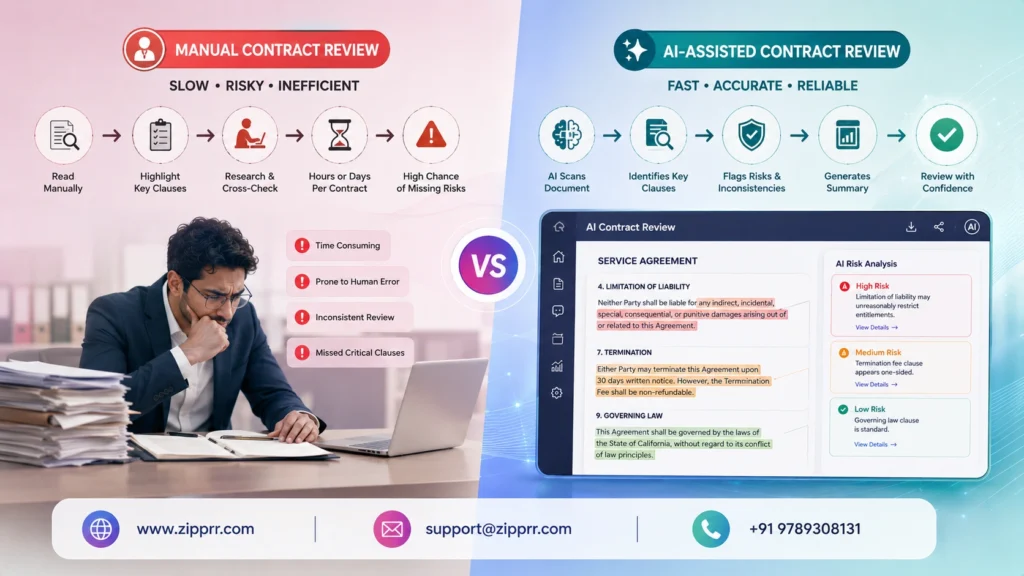
Peel back the interface and most serious platforms are stacked from three distinct layers. Layer one is a large language model, the same broad family of technology behind consumer AI assistants, tuned with legal-specific instructions and, in stronger products, grounded against real legal material like case-law databases and a firm’s own document history. Layer two is retrieval: rather than trusting whatever the model already “remembers” from training, a well-built system pulls the actual clause, the actual precedent, the actual source text, and hands that to the model right at query time. That single design choice, generally called retrieval-augmented generation, is the difference between a model reasoning off a real document and a model quietly inventing something that merely sounds plausible.
Layer three is workflow logic, and it isn’t AI at all. It’s the plumbing deciding how a document moves from intake through review to signature, who gets pinged the moment something risky surfaces, and how a flagged clause lands in front of the right human for sign-off. This layer is what actually separates a purpose-built platform from a general chatbot pointed at a legal question. A chatbot can summarize a contract in isolation. A properly built system summarizes it, flags the clauses breaking from your playbook, routes those flags to whichever attorney owns the matter, and keeps a running log of who reviewed what and when, without ever leaving the same screen.
Think of It as a Tireless Researcher, Not a Decision-Maker
Feature Breakdown: What These Platforms Actually Do
Look across enough vendors and the same eight capabilities keep resurfacing, though rarely all handled equally well inside a single product.
Contract review and risk flagging. The software ingests an uploaded contract, checks it against a configurable playbook of acceptable and unacceptable terms, and surfaces anything unusual, often in under a minute for work that would otherwise eat an associate’s entire hour.
Legal research and case summarization. Plain-language questions pull back relevant statutes and precedent with citations attached, shrinking early-stage research from an afternoon into a handful of minutes.
Drafting and templating. Routine documents, NDAs, offer letters, service agreements, come out as a first draft from a short intake form, so a lawyer starts editing rather than starting from zero.
Client intake and conversational triage. A chat interface gathers facts from a prospective client, screens for conflicts, and routes the matter before a human ever picks up the phone.
E-discovery at scale. For litigation, the platform sorts and prioritizes massive document sets by relevance and privilege far faster than any manual first pass could manage.
Analytics and outcome patterns. Some platforms mine historical case outcomes by judge or jurisdiction to sharpen litigation strategy and settlement posture.
Compliance monitoring. In regulated industries, the software tracks shifting regulations and flags where existing agreements may have quietly drifted out of compliance.
Billing and matter support. AI-assisted time capture and invoice narratives chip away at the administrative overhead that eats billable hours without anyone noticing.
Can AI Replace a Lawyer?
Short answer: no, and you won’t find a credible vendor saying otherwise. AI lawyer software absorbs the repetitive slice of the workload, not the judgment, not the ethical accountability, not the license hanging on the wall. A better frame is multiplier rather than replacement: it compresses the hours spent on research, drafting, and first-pass review so a lawyer’s actual expertise reaches more matters, faster, instead of fewer matters at the same old pace. Courts, bar associations, and malpractice carriers still hold the human attorney of record fully responsible for the finished work product no matter what tool touched the first draft, which is exactly why “assistant, not decision-maker” is more than a line from a pitch deck.
Is AI Lawyer Software Safe and Accurate?
That answer hinges entirely on which platform you’re talking about and how disciplined the team running it actually is, and it deserves more diligence than any other question on this list.
Independent researchers who’ve stress-tested commercial legal AI research tools have documented real, sometimes substantial, hallucination and citation-error rates that swing widely from product to product. Don’t read that as “the whole category is broken.” Read it instead as “verification isn’t a nice-to-have, it’s the job.” Platforms worth your trust ground every answer in retrieved source text, show exactly where a claim came from, and admit openly that they’re a drafting and research aid rather than the final word on legal truth. Any team treating AI output as ready to file without a human reading it first is carrying risk the tool was never designed to absorb.
Who Should Use AI Lawyer Software?
Business Use Cases and Industry Examples
Inside a law firm, a mid-size litigation practice might lean on AI lawyer software almost entirely for early case assessment, sorting through a new matter’s evidence within the first week rather than the first month, which hands partners a data-backed basis for advising on settlement versus trial far sooner than usual. A transactional boutique might put the exact same category of software to work almost entirely for drafting and playbook-based redlining, shrinking the gap between an engagement letter and a signed agreement from two weeks down to two days on routine work.
In real estate, brokerages and property managers use it to catch non-standard lease or purchase terms right at the point of contract generation, before a frantic pre-closing scramble ever has to happen. In healthcare, compliance teams lean on it to track vendor and business-associate agreements against a regulatory landscape that never sits still, a volume problem genuinely hard to manage by hand. In retail and hospitality, multi-location operators use it to keep franchise agreements, supplier contracts, and lease renewals consistent across dozens or hundreds of locations, work that used to demand either a sizable in-house legal team or an expensive standing arrangement with outside counsel just to stay current.
Startups might be the fastest-growing segment of all, not because their legal needs run especially deep, but because those needs never stop arriving and the budget behind them stays thin. A founder signing an NDA before every sales call, a founding-team equity agreement, a first commercial lease, none of it alone justifies a full legal engagement, but stacked together it adds up to real exposure if handled carelessly. Zipprr’s own AI lawyer software was built with exactly that profile in mind: lean enough to match a founder’s day-to-day contract volume, capable enough that they can move at deal speed without leaving the business exposed.
Two Firms, One Technology, Two Very Different Years
Take two fictional five-attorney firms handling nearly identical commercial leasing caseloads and similar client rosters. Firm One treats AI as a side curiosity: one associate occasionally runs a long document through a free consumer chatbot, with no firm-wide policy behind it, no link to the firm’s document system, and no shared sense of what “acceptable risk” even means in a lease clause. Firm Two goes a different route: they license a proper platform, build a firm-specific playbook of acceptable lease terms exactly once, wire it directly into their existing document workflow, and train every attorney and paralegal on when an AI-flagged issue needs to go straight to a partner.
A year later, Firm One has banked scattered pockets of time here and there, but has no real way to measure any of it, no consistency in how different people actually use the tool, and one uncomfortably close call where a fabricated case citation nearly slipped into a client memo before a partner caught it on a final read. Firm Two has cut average lease turnaround by roughly 40%, can point to a specific number of associate-hours redirected toward higher-value client strategy, and now has a written, defensible AI governance policy that satisfies both their malpractice carrier and a growing number of clients whose outside-counsel guidelines explicitly ask about AI use these days. The gap between these two firms was never about who had access to better software. It came down entirely to discipline in how that software got rolled out, which is exactly where the next section picks up.
Implementation Guide
A structured rollout beats an improvised one every time, and the pattern that tends to work regardless of firm size runs through five stages. Start by auditing existing workflows to spot where repetitive, document-heavy tasks are eating disproportionate senior time, contract review and early-stage research almost always sit near the top of that list. Next, build or import a playbook, a documented set of acceptable and unacceptable terms, common clause variations, and clear escalation triggers, since the software is only as sharp as the standard it’s checking work against. Third, pilot on one practice group or matter type before going firm-wide, which surfaces integration hiccups and training gaps while the stakes stay small. Fourth, put real governance in writing: an AI use policy, billing disclosure practices where required, and a clear path for anything the system flags as ambiguous. Fifth, expand and actually measure the results, tracking hard numbers like review time per document type and hours freed up, rather than going by a vague gut feeling about whether the tool “seems helpful.”
One thing worth knowing up front: this doesn’t automatically take months. Turnkey, white-label platforms compress the timeline dramatically compared to a custom build. Some vendors, Zipprr included, deliver a fully configured, ready-to-brand AI lawyer platform within roughly three business days of purchase, which shifts the real bottleneck from “building software” to “configuring a playbook and training your team.”
Pricing Considerations and ROI
AI lawyer software pricing generally splits into three buckets. Per-seat subscriptions bill monthly per licensed user, usually somewhere between $50 and $400 depending on how deep the feature set runs, and suit firms that want costs tied predictably to headcount. Usage-based pricing bills per document or per query, a better fit for businesses with seasonal or lumpy document volume, like a real estate office during a busy closing season. Enterprise and white-label licensing, the model behind platforms like Zipprr’s AI lawyer software, works differently again: a one-time fee buys a fully brandable platform outright, which suits anyone who’d rather own a piece of legal-tech infrastructure than keep paying per seat as the team grows.
Zipprr’s own pricing is worth spelling out plainly, since it flips the usual math on its head. The platform runs as a one-time purchase of $490, period, no recurring monthly or annual charge attached anywhere. The build itself typically lands within 3 days of purchase, far faster than the multi-week timelines most heavily customized platforms demand. That purchase comes bundled with complete open-source code, meaning the buyer genuinely owns and can modify the underlying platform instead of renting access to something a vendor controls from outside.
Layered on top of that is 90 days of free support covering setup, playbook configuration, and launch questions, so nobody’s left troubleshooting deployment solo during the first critical weeks. Stack that against a recurring per-seat subscription that can quietly climb into the thousands annually once a firm scales past a handful of users, and a one-time structure like this genuinely reshapes the ROI math, especially for solo practitioners, small firms, and non-legal businesses who’d rather pay once than carry an open-ended subscription line item forever.
Return on investment is best measured against the fully loaded cost of the hours the software displaces, not the sticker price sitting on its own. A firm paying an associate roughly $60 to $100 an hour in fully loaded cost, redirecting even ten hours a week away from first-draft review toward higher-value client work, typically recovers a mid-tier subscription platform’s cost inside the first month, well before counting the harder-to-quantify edge of faster client turnaround. Against a one-time cost in the neighborhood of Zipprr’s $490, that payback window shrinks from weeks down to days.
Feature Comparison: AI Lawyer Software vs. Traditional Legal Workflow vs. Generic AI Chatbot
The table below lines up three approaches side by side: the fully manual method firms have leaned on for decades, a generic consumer chatbot used informally, and a purpose-built platform. The final three rows carry the most weight, pricing, launch speed, and support, since that’s exactly where a one-time-purchase, open-source vendor like Zipprr pulls ahead of both the manual approach and subscription-based rivals.
| Capability | Traditional Manual Workflow | Generic AI Chatbot | Purpose-Built AI Lawyer Software |
|---|---|---|---|
| Contract review speed | Hours per document | Minutes, but ungrounded in the actual source text | Minutes, grounded in retrieved source clauses |
| Playbook-based risk flagging | Manual, dependent on reviewer memory | Not available | Configurable, consistent across every reviewer |
| Citation accuracy for research | Reliable, but slow | Inconsistent, no built-in verification | Stronger, with retrieval-based source citations |
| Client intake automation | Manual intake calls | General conversation only | Structured intake with conflict screening |
| Compliance audit trail | Manual documentation | None | Built-in logging and version history |
| Integration with firm systems | N/A | None | Native integrations with document management, CRM, e-signature |
| Pricing model | N/A, internal labor cost only | Usually free or low-cost, limited capability | Varies by vendor; Zipprr offers a one-time purchase of $490 instead of a recurring subscription |
| Time to launch | N/A | Immediate, but not purpose-built for legal work | Varies by vendor; Zipprr delivers a ready-to-configure build in about 3 days |
| Source code ownership | N/A | Not applicable | Varies by vendor; Zipprr provides full open-source code with purchase, so the buyer owns the platform |
| Post-launch support | N/A | Community forums only | Varies by vendor; Zipprr includes 90 days of free support after purchase |
ROI Analysis: Estimated Monthly Impact for a Five-Attorney Firm
This table estimates the operational shift a typical five-attorney firm can expect before and after adopting AI lawyer software. The last row also flags how the payback window changes under a one-time-purchase model versus a recurring subscription.
| Metric | Before AI Lawyer Software | After Implementation (Typical Range) |
|---|---|---|
| Avg. hours per standard contract review | 1.5 - 2.5 hours | 20 - 40 minutes |
| First-draft turnaround for routine agreements | 2 - 5 business days | Same day to 1 business day |
| Associate hours reclaimed per week (firm-wide) | — | 15 - 40 hours, workload dependent |
| Estimated cost recovery vs. software cost | — | Typically 3x - 8x monthly software spend in reclaimed billable capacity under a subscription; under a one-time $490 model like Zipprr's, recovery is typically realized within the first week or two of use |
Cost Comparison: Hiring vs. Software vs. Hybrid Approach
This table stacks the ongoing monthly cost of adding headcount or outside counsel against AI lawyer software, split into recurring subscription pricing and a one-time-purchase alternative. Zipprr’s model, a $490 one-time purchase with the platform ready in about 3 days, open-source code included, and 90 days of free support, gets its own row because it removes the recurring line item entirely.
| Approach | Approx. Cost | Best Fit |
|---|---|---|
| Additional full-time paralegal | $3,500 - $6,000+ per month | Sustained, high-volume document work |
| Outside counsel on retainer for routine review | $2,000 - $10,000+ per month | Occasional complex matters, not routine volume |
| AI lawyer software (recurring per-seat, small team) | $150 - $1,200 per month across a small team | Routine, repetitive document work at any volume |
| AI lawyer software (one-time purchase model, e.g. Zipprr) | $490 one-time, no recurring fee, platform ready in about 3 days, open-source code included, 90 days of free support | Firms and businesses that would rather own the platform outright than pay indefinitely per seat |
| Hybrid: AI software + part-time paralegal oversight | $1,500 - $3,500 per month | Most small-to-mid firms and legal departments |
Implementation Timeline
This timeline reflects a typical structured rollout, from the first audit through ongoing measurement. Row two flags that turnkey, white-label vendors compress the delivery step dramatically compared with custom-built alternatives; Zipprr’s roughly 3-day delivery window is one concrete example of that gap.
| Phase | Typical Duration | Key Milestone |
|---|---|---|
| Workflow audit and vendor selection | 1 - 2 weeks | Playbook draft and shortlist finalized |
| Platform delivery (turnkey/white-label vendors) | As little as 3 days for vendors like Zipprr; longer for custom-built platforms | Working build delivered, ready to configure |
| Pilot deployment (single practice group) | 2 - 4 weeks | First measurable time-savings data |
| Governance and policy finalization | 1 - 2 weeks | Written AI use policy approved |
| Firm-wide rollout and training | 3 - 6 weeks | All practice groups onboarded |
| Measurement and optimization | Ongoing, quarterly review | ROI dashboard established |
Challenges and How to Solve Them

The most serious challenge is the line between AI assistance and the unauthorized practice of law. Every jurisdiction restricts who can hand out legal advice, and software that crosses from “helping someone understand their situation” into “telling a non-lawyer what their rights are” in a way that substitutes for licensed counsel opens up genuine regulatory exposure. The fix here is architectural: platforms worth using stay explicit about their role as a drafting and research tool, keep a licensed attorney in the loop on anything client-facing, and avoid language implying the software itself is dispensing legal advice.
Confidentiality and data security make up the second major challenge, since legal documents are often the single most sensitive material a business holds anywhere. The fix is diligence during vendor selection: checking encryption standards, data residency, access controls, and whether the vendor trains shared models on customer data, something the stronger platforms switch off by default.
Hallucination and citation accuracy remain the third major challenge, exactly as the research on commercial legal AI tools mentioned earlier demonstrates. The fix is procedural more than technical: mandatory human verification of any AI-generated citation before it reaches a client or a filing, paired with choosing platforms that ground output in retrieved source documents rather than leaning purely on a model’s internal training.
Finally, change management is a real, underrated hurdle. Attorneys are trained to be skeptical by nature, and a poorly introduced tool that produces one bad output in its first week can sour an entire practice group’s appetite for trying again. The fix is honest expectation-setting from day one: positioning the tool explicitly as a first-draft accelerator, never as an infallible oracle.
Common Mistakes to Avoid
The most frequent misstep is rolling out AI lawyer software with no documented playbook, leaving the system flagging risk against no consistent standard and producing wildly inconsistent results from person to person. A close second is skipping the pilot phase and going firm-wide immediately, multiplying the cost of any early misconfiguration. A third is treating AI output as client-ready without review, a habit that a handful of well-publicized sanctions cases have made expensive for the attorneys involved. A fourth is picking a platform on price alone without checking whether it grounds answers in retrieved source documents, since the cheapest option turns expensive fast the moment a bad citation lands in a filing. A fifth, more common outside of law firms, is assuming “AI lawyer software” means a business no longer needs any licensed legal relationship at all, rather than understanding it as the thing that makes that relationship dramatically more efficient.
Expert Recommendations
Start with the highest-volume, lowest-complexity document type in your practice, standard NDAs, routine leases, common vendor agreements, since these deliver the fastest, most measurable wins and build trust in the tool early. Build the playbook before the software rollout, not after, since a platform without configured standards is just an expensive way to summarize documents rather than actually catch risk. Insist on retrieval-grounded, citation-backed output from any research or review feature, and treat a vendor who can’t explain how they avoid hallucination as a genuine red flag, not a minor technical footnote. Put a written AI use policy in place before broad adoption, not as an afterthought once a client or regulator asks about it. And measure adoption in hours reclaimed and turnaround time, not vague satisfaction surveys, since that’s where the actual business case lives.
Buyer's Guide and Decision Matrix
What should businesses actually look for in AI lawyer software? At minimum, check for retrieval-grounded accuracy (does it cite the real source document instead of leaning purely on model memory), configurable playbooks for risk flagging, integration with your existing document management and e-signature tools, real data security controls including model-training opt-outs, audit trails suitable for compliance and malpractice insurance, and pricing that fits both your document volume and your ownership preference, whether that’s a recurring per-seat subscription or a one-time purchase with source code included.
| Buyer Profile | Priority Features | Recommended Pricing Model |
|---|---|---|
| Solo practitioner / small firm | Drafting templates, research summarization, low setup complexity | Per-seat, monthly, or a one-time purchase if long-term ownership is preferred |
| Mid-size firm | Playbook-based review, integrations, audit trails | Per-seat or tiered enterprise |
| In-house legal department | Contract review at scale, compliance monitoring | Usage-based or enterprise license |
| Non-legal SMB (real estate, retail, healthcare) | Simple contract triage, client-facing intake chat | Usage-based, white-label, or one-time purchase |
| Software company / agency building a legal-tech product | White-label, source code ownership, customizable branding | One-time licensing with open-source code included |
Pre-Purchase Checklist
Before signing with any AI lawyer software vendor, confirm the following: the platform grounds its answers in retrievable source documents rather than pure model memory; customer data isn’t used to train shared models without explicit opt-in; the vendor can show real integration with your existing document management, CRM, or e-signature systems, Zipprr’s AI lawyer software was built with exactly that kind of integration in mind; pricing scales sensibly with your actual document volume and matches your preference for recurring versus one-time cost; whether the vendor offers source code ownership if that matters to your long-term technology strategy; how fast the platform can genuinely be deployed once purchased; what post-launch support window is included; the vendor provides audit logs sufficient for malpractice insurance and, where applicable, client outside-counsel guidelines; and the contract includes a clear data-portability clause so you aren’t locked in if the platform underdelivers.
Schedule a free demo
If your firm or business is ready to move past casual experimentation and into a properly built, brandable AI lawyer software platform, complete with configurable playbooks, retrieval-grounded accuracy, and the integrations your team already relies on, take a look at Zipprr’s AI lawyer software, a one-time purchase of $490, ready in about 3 days, with open-source code and 90 days of free support included, and see how a structured rollout can compress your document review and drafting timelines without asking you to trade away accuracy, compliance, or ownership.
Frequently Asked Questions
What is AI lawyer software?
Can AI replace a lawyer?
No. It handles the repetitive document and research work but can’t take over a licensed attorney’s judgment, ethical responsibility, or authority to practice law, and you won’t find a credible platform claiming otherwise.
Is AI lawyer software accurate?
Accuracy swings widely by platform. Independent research has turned up real citation and hallucination error rates in some commercial legal AI tools, which is exactly why grounding output in retrieved source documents and requiring human verification matter so much.
Is AI lawyer software safe to use with confidential client documents?
How much does AI lawyer software cost?
Does Zipprr's AI lawyer software require an ongoing subscription?
How long does it take to get Zipprr's AI lawyer software up and running?
Who should use AI lawyer software?
What features should businesses look for in AI lawyer software?
Does using AI lawyer software count as the unauthorized practice of law?
How is AI lawyer software different from a generic AI chatbot?
What is the ROI of implementing AI lawyer software?
What industries benefit most from AI lawyer software?
Can AI lawyer software integrate with existing legal practice management tools?
What's the biggest risk of adopting AI lawyer software poorly?
Treating AI-generated output as client-ready without human verification, a habit that has already produced real, publicly documented sanctions cases where a fabricated citation reached a court filing.
Conclusion
AI lawyer software has quietly shifted from experimental curiosity to standard infrastructure for any firm or legal-document-heavy business that wants to stay competitive. The numbers back that up: individual adoption well above 80%, a legal technology market pushing past $30 billion in 2026 and still climbing at a healthy clip, and in-house legal teams more than doubling their generative AI usage in a single year. What separates the businesses getting real value from those merely dabbling isn’t access to better technology, most serious platforms now offer roughly comparable core capability. It comes down to discipline in how the rollout happens: a documented playbook, a real governance policy, a pilot before a full launch, and an unwavering habit of verifying anything AI-generated before it ever reaches a client. Build that discipline now, and you’ll be setting the pace in your market well before everyone else catches up.