
Secondhand shopping has gone fully mobile. People now sell a dress they wore once, list a pair of sneakers gathering dust, or clear out a closet — all from their phone, in minutes. Behind every one of these smooth experiences sits a marketplace platform. If you want to own that platform, a Vinted Clone like the one from Zipprr is the fastest way in.
This guide answers the questions founders actually search for: what a Vinted Clone is, how it works, what features it needs, what it costs, and how to launch one without spending a year writing code. By the end, you will have a clear, practical path from idea to a live secondhand marketplace app.
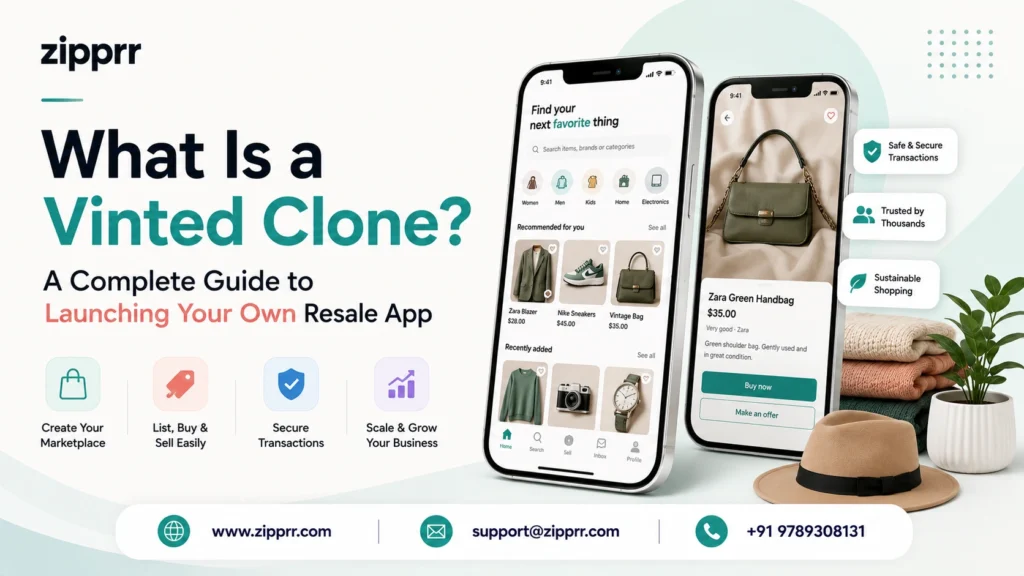
A Vinted Clone is a ready-made, customizable software solution that lets you launch your own peer-to-peer secondhand marketplace app — similar in function to popular resale platforms — without building everything from scratch. A solution like the Zipprr Vinted Clone comes with the core pieces already built: product listings, secure payments, buyer protection, shipping, seller dashboards, and an admin panel. You customize the brand, niche, and rules, then launch in weeks instead of months.
Key Takeaways
- A Vinted Clone is pre-built marketplace software you customize to launch a resale app quickly.
- It connects individual buyers and sellers, and you earn a fee on every transaction.
- The core includes listings, secure payments, buyer protection, shipping, seller dashboards, reviews, and an admin panel.
- Using a clone like Zipprr’s is far faster and cheaper than custom development from zero.
- Trust features — held payments, buyer protection, and reviews — drive the growth that flashy design cannot.
What Is a Vinted Clone?
A Vinted Clone is packaged software that recreates the core functionality of a modern secondhand fashion marketplace, ready for you to brand and launch as your own. Instead of building listings, payments, and shipping from nothing, you start with those features already working — which is exactly what a solution like Zipprr provides.
The platform itself holds no inventory. It provides the storefront, the payment rails, the shipping labels, and the trust layer that lets strangers buy and sell with confidence. In return, you earn a fee on each sale. This is the classic peer-to-peer (P2P) or consumer-to-consumer (C2C) marketplace model, and it powers some of the fastest-growing apps in retail.
If you want a foundation that already includes the marketplace essentials, the Zipprr Vinted Clone script removes most of the heavy engineering so you can focus on your niche and brand from day one.
Why Secondhand Marketplaces Are Booming
Three forces are pushing resale into the mainstream at the same time.
First, value. Rising prices have shoppers hunting for deals, and buying gently used fashion for a fraction of retail feels smart, not second-best.
Second, sustainability. Younger buyers care about waste, and extending the life of a garment beats sending it to a landfill. Resale turns “eco-friendly” into an everyday habit.
Third, ease. Listing an item used to mean photos, forms, and shipping headaches. Modern apps compress all of that into a few taps, so casual sellers actually follow through.
For a founder, the takeaway is simple: the demand already exists. You are not inventing a new behavior — you are giving an existing crowd a better place to do what they already want to do, and a platform like Zipprr gives you the tools to serve them fast.
Benefits of Launching With a Vinted Clone
Starting from a proven foundation changes your entire risk and timeline.
You control the fees, so the margin on every transaction flows to you. You own the customer relationship, which means email lists, retargeting, and repeat sales are yours to grow. You shape the brand and niche, letting you target streetwear, luxury bags, or kids’ clothing instead of fighting in a crowded general market.
You also skip the slowest, most expensive part of building — engineering the core. With a ready-made option like Zipprr, that means less money burned before launch, fewer technical risks, and a live product earning fees while custom-built competitors are still in development.
Core Features Every Vinted Clone Needs
A resale marketplace lives or dies on a small set of features working together smoothly. Here is what belongs in your first version, and what Zipprr includes out of the box.
Product listings. Sellers should add photos, size, condition, brand, and price in under a minute. Smooth listing is the single biggest driver of supply.
Search and discovery. Buyers filter by size, brand, category, condition, and price so they find the right item fast.
Secure payment gateway. Money moves safely, with funds held until the buyer confirms delivery. This escrow-style flow is the backbone of trust.
Buyer protection. A clear guarantee — refund if an item never arrives or is badly misrepresented — removes the fear that stops first purchases.
Shipping integration. Prepaid labels and tracking built into the app cut friction and reduce disputes.
Seller dashboard. One place to manage listings, track orders, print labels, and see earnings.
Ratings and reviews. Public feedback builds reputation and separates reliable sellers from risky ones.
Admin dashboard. Full control to manage users, resolve disputes, set fees, and remove bad actors.
The Zipprr secondhand marketplace script ships with these essentials already built and tested, so you configure them rather than code them.
How a Vinted Clone Works Step by Step
The magic of a resale app is that a full transaction runs from photo to payout without either party ever meeting.
A seller lists an item with photos and a price. A buyer discovers it through search or the feed, then buys it or sends an offer. Payment is captured but held by the platform, not released yet. The seller ships using an integrated label, and tracking flows into the app. Once the buyer receives the item and it matches the listing, funds release to the seller, minus your platform fee. If something goes wrong, buyer protection and your admin team step in.
That held-payment step is the quiet hero. Because the platform sits in the middle, buyers feel safe paying strangers and sellers feel safe shipping to them. This entire workflow already comes wired into the ready-made Zipprr Vinted Clone solution, which is why launching one is so much faster than starting from a blank codebase.
How to Build and Launch Your Marketplace
Here is a practical path from idea to a live app.
Step 1: Pick a focused niche. “General resale” is hard to launch into. “Luxury handbags” or “vintage sneakers” gives you a clear buyer, a clear seller, and a message that lands.
Step 2: Map your money flow. Decide your selling fee, whether buyers pay a protection fee, and how shipping is shared. Your economics should be clear before launch.
Step 3: Choose your build path. Decide between custom development and customizing a ready-made clone such as Zipprr. This one choice shapes your timeline and budget more than any other.
Step 4: Customize the core flows. Prioritize the seller’s listing flow and the buyer’s checkout flow. Everything else is secondary until these two feel effortless.
Step 5: Configure payments and shipping. Connect your payment gateway with held-funds support and a shipping provider for labels and tracking.
Step 6: Test relentlessly. Run real transactions end to end — buy, sell, ship, refund, dispute — on both web and mobile before any real user does.
Step 7: Seed your supply. A marketplace with no listings feels empty. Recruit a first wave of sellers so early buyers find real inventory.
Step 8: Launch to your niche. Go live with the community you chose in Step 1, gather feedback fast, and improve in tight loops.
Real-World Use Cases
A Vinted Clone flexes across many categories, and that versatility is part of its appeal.
A fashion resale app lets people sell everyday clothing, shoes, and accessories — the classic model.
A luxury consignment platform focuses on authenticated designer bags and watches, adding verification that justifies higher fees.
A kids’ clothing exchange serves parents who cycle through sizes fast and want an easy way to buy and sell outgrown outfits.
A streetwear and sneaker marketplace targets collectors who value condition, authenticity, and rare drops.
A local resale community keeps buyers and sellers in the same city so items can be handed off in person, cutting shipping entirely.
Each runs on the same core engine — the kind Zipprr provides — so what changes is the niche, the trust rules, and the tone, not the machinery.
Pros and Cons to Weigh
Every model has trade-offs, and resale is no exception.
Pros: You hold no inventory, so risk and upfront costs stay low. Revenue scales with transactions, not headcount. Sustainability gives you a story that markets itself. And network effects make an established marketplace hard for newcomers to displace.
Cons: You face the classic chicken-and-egg problem — buyers want listings, sellers want buyers. Trust and fraud must be actively managed. And reaching critical mass takes focused effort in the early months.
The good news is that every one of these challenges is solvable with the right features and a sharp niche.
Vinted Clone vs. Building From Scratch
One of your biggest early choices is whether to code everything yourself or start from a customizable clone. This table lays out the honest trade-offs.
| Factor | Building From Scratch | Vinted Clone (e.g. Zipprr) |
|---|---|---|
| Time to launch | Many months | Weeks |
| Upfront cost | High | Much lower |
| Core features | Built one by one | Included and tested |
| Payment & shipping | Integrated from zero | Pre-integrated |
| Customization | Total, but slow | High, and fast |
| Technical risk | Significant | Reduced |
| Best for | Deep-pocketed teams | Founders who want speed |
For most founders, a proven, customizable Vinted Clone from Zipprr is the faster, safer route to a live product and real revenue.
Pricing Factors That Shape Your Budget
The cost of launching a resale marketplace depends on a few key levers.
Your feature scope is the biggest factor — a lean core costs far less than a platform loaded with authentication, live chat, and AI recommendations on day one. Your build path matters too, since custom development runs far higher than customizing a ready-made clone like Zipprr. Platform choice (web, iOS, Android, or all three) multiplies the work. Design polish, third-party integration fees for payments and shipping, and ongoing hosting and support all add to the picture.
The practical takeaway: launch with a focused core, prove demand, then reinvest revenue into the extras. You do not need every feature to earn your first fee.
Best Practices for Launch and Growth

A few habits separate marketplaces that stall from those that snowball.
Solve the supply side first, because buyers follow listings — recruit sellers early and make listing effortless. Obsess over trust, since visible buyer protection, honest reviews, and fast dispute resolution turn nervous first-timers into repeat users. Keep the listing flow brutally simple, because every extra field costs you inventory. Start local or niche to reach critical mass in one pocket before expanding. And talk to your earliest users constantly; their friction points are your roadmap.
Common Mistakes to Avoid
Learning from predictable missteps saves months of wasted effort.
Do not launch too broad — a general marketplace with thin inventory everywhere beats no one. Do not ignore the seller experience; if listing is painful, your supply dries up. Do not skimp on buyer protection, because one bad, unresolved transaction can poison word of mouth. Do not overbuild before launch, adding features no one asked for while real problems go unsolved. And do not neglect mobile, since the vast majority of resale activity happens on phones.
Expert Tips for Standing Out
Once your core works, small advantages compound into real differentiation.
Make onboarding a delight by letting new sellers list their first item in under a minute. Reward your best sellers with visibility, since they are your inventory engine. Use smart notifications — price-drop alerts and saved-search matches — to pull buyers back without annoying them. Lean into your niche’s culture with the right language, categories, and community feel. And publish clear, human policies so both sides always know what to expect when something goes wrong.
Future Trends in Resale Commerce
The resale space keeps evolving, and building with tomorrow in mind pays off.
AI-assisted listing is on the rise, where a single photo auto-fills brand, category, and suggested price. Authentication technology is maturing, making high-value luxury resale safer and more mainstream. Live shopping — sellers showcasing items in real time — is turning resale into entertainment. And deeper sustainability tracking, showing the environmental impact of buying used, is becoming a real selling point.
You do not need all of this at launch. But a flexible platform like Zipprr lets you fold these in as your marketplace grows.
Why Choose Zipprr
Building all of this from zero is slow and expensive. Zipprr gives you a ready-made, fully customizable foundation so you can launch in weeks instead of months.
The Zipprr Vinted Clone ships with the features that matter: rich product listings, powerful search, a secure payment gateway with held-funds support, built-in buyer protection, and shipping integration for labels and tracking. Sellers get a clean dashboard to manage listings, orders, and earnings, while you get a complete admin panel to oversee users, resolve disputes, and set your fees. Reviews and ratings build the trust that keeps buyers coming back.
Because the Zipprr core is already built and tested, you spend your energy on your niche, your brand, and your community — the things that actually differentiate you — rather than reinventing payment flows.
Conclusion
A Vinted Clone turns one of the clearest opportunities in modern commerce into something you can launch fast. The demand is already here, the model keeps your risk low, and a well-run marketplace becomes a compounding asset thanks to network effects. The path is straightforward: pick a sharp niche, nail the buyer and seller flows, lean on a trusted core like Zipprr, seed your supply, and launch to a community that already wants what you offer.
The only real question is speed. You can spend many months coding every feature from scratch, or you can start with a proven Zipprr foundation and be live in weeks. For most founders, faster to market — and faster to your first fee — wins.
Action Checklist
- Choose a focused resale niche with clear buyers and sellers.
- Define your fees, buyer protection, and shipping economics.
- Decide between custom build and a ready-made Vinted Clone like Zipprr.
- Prioritize the seller listing flow and buyer checkout flow.
- Configure the trusted core: listings, search, payments, protection, shipping, dashboards, reviews.
- Test full transactions end-to-end on web and mobile.
- Seed early inventory before inviting buyers.
- Launch to your niche, gather feedback, and improve fast.
Ready to launch your own secondhand marketplace with Zipprr?
Book a Free Demo to see the platform in action, or Chat with us on WhatsApp to get your questions answered today.