
What Is a Vinted Clone?
Related Zipprr Secondhand & Classified Marketplace Scripts
How Does a Vinted Clone Work?
Seller joins free
Item listed in under three minutes
Buyer discovers through smart search
Purchase with transparent fee
Seller ships with a pre-printed label
Delivery triggers payout
Both sides leave a review
How Does a Vinted Clone Make Money?
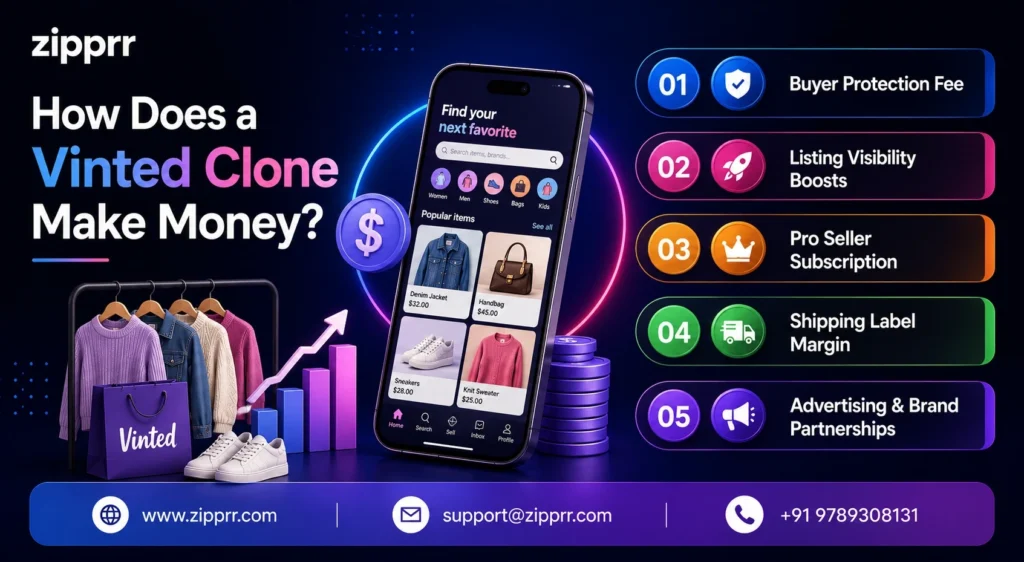
1. Buyer Protection Fee — The Primary Engine
2. Listing Visibility Boosts — Seller-Side Upsell
3. Pro Seller Subscription — Recurring Revenue
4. Shipping Label Margin — Passive Income at Scale
5. Advertising and Brand Partnerships — Scale Revenue
| Revenue Stream | Payer | Scales With |
|---|---|---|
| Buyer Protection Fee | Buyer | Transaction volume |
| Listing Boost Credits | Seller | Active seller count |
| Pro Seller Subscription | Seller | Platform maturity |
| Shipping Label Margin | Seller | Daily order volume |
| Advertising / Brand Deals | Brands | Total user base size |
How Does a Vinted Clone Make Money?
- Speed — Custom development of a comparable marketplace takes 8–18 months. A Vinted Clone from Zipprr goes live in 2–6 weeks. Every week you are not in market is a week competitors are acquiring the sellers and buyers you need.
- Cost — A properly engineered fashion resale platform from a development agency costs $80,000–$250,000. Zipprr's Vinted Clone is a one-time purchase. The money saved funds marketing, seller acquisition, and community building — the things that actually determine whether a marketplace succeeds.
- Risk reduction — Custom builds carry execution risk — scope creep, developer turnover, API failures. A tested, validated codebase with hundreds of successful deployments eliminates those risks before you write a single line of configuration.
| Criterion | Verdict |
|---|---|
| Launch speed | Vinted Clone: 2–6 weeks vs custom: 8–18 months |
| Upfront investment | Vinted Clone: $499–$2,999 vs custom: $80K–$250K+ |
| Technical risk | Vinted Clone: tested and validated vs custom: unknown until live |
| Feature completeness at launch | Vinted Clone: full marketplace day one vs custom: MVP with gaps |
| Ownership | Vinted Clone: 100% source code vs SaaS: no ownership |
Who Should Build a Vinted Clone?
- Entrepreneurs wanting to enter the $350B resale economy without years of engineering
- Fashion industry insiders — buyers, stylists, vintage dealers — who understand their audience and want a platform built for their niche
- Existing e-commerce operators adding a resale channel to complement their primary business
- Sustainability-focused founders building around circular economy principles
- Regional entrepreneurs who see an underserved local or national market Vinted does not prioritise
- Investment-backed startups that need a working product quickly to demonstrate traction before their next funding round
What Features Does a Vinted Clone Include?
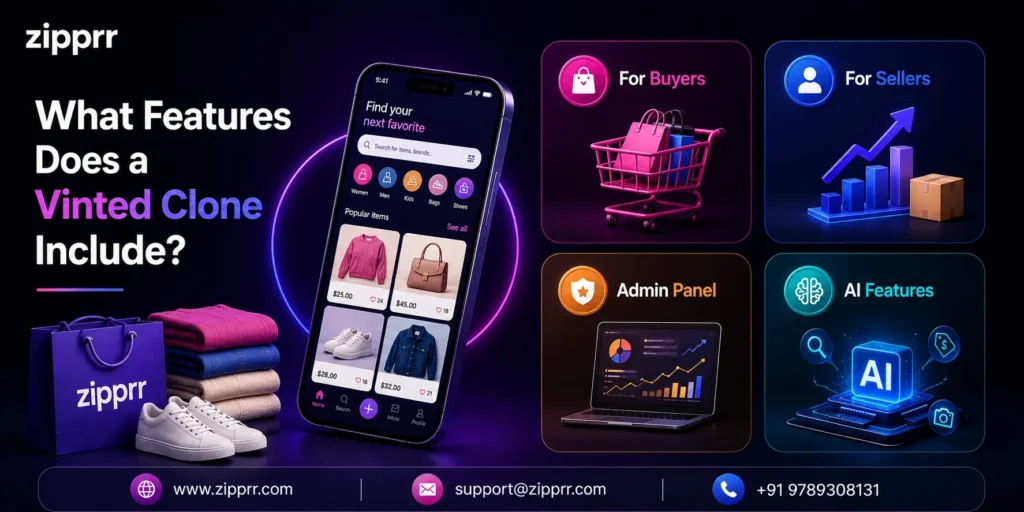
What Features Do Buyers Get?
- Eleven-filter search: category, brand, size, condition, colour, price band, location, material, gender, occasion, and posting date
- Visual search: photograph any clothing item to surface visually similar listings across the marketplace
- Personalised home feed that adapts continuously to individual browsing and purchase behaviour
- Wishlist and saved searches with real-time price-drop push notifications — so buyers never miss a deal
- In-app direct messaging with sellers: negotiate price, ask questions, request bundle discounts
- Single-step checkout with the buyer protection fee displayed before confirmation — no hidden charges at the final screen
- Payment options: card, PayPal, Apple Pay, Google Pay, and in-app wallet balance
- Live shipment tracking embedded in the app, with push alerts at every carrier scan event
- Dispute portal: raise a claim, upload photographic evidence, track resolution status transparently
What Features Do Sellers Get?
- Unlimited free listings — no listing fee, no commission, no expiry on live listings
- AI-assisted listing: computer vision pre-fills category, gender, and occasion from the uploaded photo
- AI price suggestion: the engine analyses thousands of comparable sold listings to recommend a competitive asking price
- Bulk upload mode: add up to twenty items in one session — ideal for clearing an entire wardrobe quickly
- Wardrobe Spotlight boost: pay to promote listings to the top of category or search pages
- Bundle deal automation: set a multi-item discount percentage applied automatically at checkout
- Seller analytics dashboard: listing views, click-through rate, wishlist adds, total revenue, average selling price
- Prepaid shipping label generation inside the selling flow — no separate carrier account required
- Pro Seller subscription: advanced analytics, monthly free boost allocation, and priority support
What Does the Admin Panel Include?
- User management: verify, suspend, or ban accounts; view full registration and activity history
- Listing moderation: automated keyword and image flagging, manual review queue for suspicious content
- Financial ledger: every payment, escrow event, payout, refund, and fee collected — searchable and exportable
- Dynamic fee configuration: adjust buyer protection rate, boost pricing, and Pro subscription cost from admin UI without touching code
- Dispute case manager: view full evidence, shipping tracking data, and message history — issue binding resolution with one action
- Real-time analytics: GMV, daily and monthly active users, top-selling categories, buyer acquisition rates, revenue by stream
- Broadcast notifications: push messages to all users, a geographic segment, or individual accounts
- Promotional engine: create referral bonuses, first-purchase discounts, and seasonal campaigns without developer involvement
What AI Features Are Included?
- Pricing intelligence model trained on millions of resale data points — suggests competitive price range per listing
- Automated listing categorisation: computer vision identifies item type, gender, and occasion from uploaded photos
- Vector-based visual search engine: finds listings that look like any photographed item
- Measurement-based size compatibility: buyers enter measurements once; the system surfaces items within their fit range
- Behavioural fraud detection: flags patterns associated with counterfeit listings, fake reviews, and payment manipulation
- Personalisation engine: reinforcement learning refines each buyer's feed with every session
Also Explore — Zipprr Classified & Resale Marketplace Scripts
How Much Does a Vinted Clone Cost?
| Build Route | Total Cost Estimate | Time to Market |
|---|---|---|
| Zipprr Vinted Clone (white-label) | $499 – $2,999 one-time | 2 – 6 weeks |
| Freelance team (custom build) | $18,000 – $55,000 | 5 – 9 months |
| Mid-tier development agency | $60,000 – $130,000 | 8 – 14 months |
| Top-tier product agency | $150,000 – $300,000+ | 12 – 20 months |
| SaaS marketplace platform | $350 – $1,200/month (forever) | 3 – 5 weeks (no ownership) |
How Long Does It Take to Launch a Vinted Clone?
- Week 1 — Setup & Branding: Receive source code, provision hosting, apply your brand name, logo, colours, and domain. Configuration-level work — hours, not days.
- Week 1–2 — Payments and Shipping: Connect Stripe Connect, configure buyer protection fee rates, activate EasyPost carrier accounts, and run a test transaction end-to-end.
- Week 2 — Category Configuration: Build your category tree, size charts, condition grades, and prohibited item rules through the admin panel.
- Week 2–3 — App Store Submission: Submit iOS and Android builds. Apple App Store review: 3–7 days. Google Play: 1–3 days.
- Week 3–6 — Supply Seeding: Before opening to buyers, recruit 100–200 sellers and seed the marketplace with live listings. A supply-rich launch converts new buyers at significantly higher rates.
Which Niche Is Best for a Vinted Clone in 2026?
| Niche | Why It Wins in 2026 |
|---|---|
| Children's and baby clothing | Parents cycle through sizes every few months. Repeat purchase rate is among the highest in any clothing segment. Vinted's interface is not optimised for age-based size filtering. |
| Luxury and designer authentication | Adding a verification layer creates a trust premium generalist platforms cannot match. Authentication justifies higher buyer protection fees and attracts higher AOV transactions. |
| Streetwear, sneakers, and limited editions | Intensely community-driven with its own vocabulary and grading standards. A niche platform converts at dramatically higher rates than a generic marketplace. |
| Vintage and pre-1990s fashion | Growing at accelerating rate. Specific buyer demographic with strong return behaviour and willingness to pay for well-curated inventory. |
| Sports, outdoor, and athletic gear | High-cost items with rapid obsolescence — cycling kits, ski gear, running shoes — perfect for affordable resale. |
| Local city pickup model | Remove shipping entirely. Faster transactions, zero carrier cost, strong community ownership. Vinted has minimal investment in local-first features. |
| Sustainable and ethical fashion only | Partner with eco-focused brands offering trade-in programmes — your platform becomes their resale channel with a built-in supply pipeline. |
Can I Build a Vinted Clone Without Coding?
Is a Vinted Clone Worth It? An Honest Assessment
What Technology Powers a Vinted Clone?
| Layer | Technology and Why It Was Chosen |
|---|---|
| Mobile apps (iOS & Android) | Flutter — one codebase, native performance on both platforms |
| Buyer/seller web app | Next.js (React) — server-side rendering for SEO indexability and fast first load |
| API backend | Node.js — non-blocking architecture handles thousands of concurrent requests |
| Primary database | PostgreSQL — ACID compliance ensures financial escrow data is never corrupted |
| Listings database | MongoDB — flexible schema for varied item attributes across hundreds of categories |
| Real-time messaging | Socket.io — sub-100ms delivery for negotiation and support conversations |
| Search engine | Elasticsearch — full-text and faceted filter search across millions of listings in milliseconds |
| Payments and escrow | Stripe Connect — PCI-compliant multi-party payments and automated seller payouts |
| Image storage and CDN | AWS S3 + CloudFront — images served from edge locations near each user globally |
| Shipping integration | EasyPost API — USPS, FedEx, DHL, UPS, Royal Mail, and 100+ regional carriers |
| AI and ML | Custom Python microservices: price prediction, image classification, visual search, fraud scoring |
| Infrastructure | AWS ECS with auto-scaling — capacity grows automatically during traffic spikes |
Vinted Clone vs Depop Clone vs Poshmark Clone: Which Model Should You Choose?
| Dimension | Vinted Model (Zero Seller Fee) | Depop / Poshmark Model (Seller Fee) |
|---|---|---|
| Who pays the fee? | Buyer pays the protection fee at checkout | Seller pays 10–20% on each completed sale |
| Seller incentive | Very high — free listing, zero friction | Moderate — sellers calculate net take-home per sale |
| Supply growth speed | Rapid — free listing drives high listing volume | Slower — sellers are selective about what they list |
| Average listing density | High sellers do not filter out low-value items | Lower — items below $15 often not worth listing after fees |
| Platform revenue driver | Transaction count — benefits from volume | GMV — benefits from higher average order values |
| Best market fit | Everyday fashion, high-frequency buyers/sellers | Curated vintage, premium streetwear, high-value designer pieces |
Does a Vinted Clone Come With Shipping Integration?
- Supported carriers include USPS, FedEx, DHL, UPS, Royal Mail, Australia Post, Canada Post, and dozens of regional carriers
- Labels are generated inside the app at point of sale — sellers never visit a separate carrier website
- Buyers receive a tracking number immediately after label creation, with live status updates at every carrier scan.
- The platform retains a margin between bulk carrier rate and label price charged to sellers — passive revenue at volume
- Return labels can be configured for specific categories or dispute resolution cases through the admin panel
Is a Vinted Clone Good for a Sustainable Fashion Marketplace?
- CO2 savings tracker: display estimated carbon saved per transaction based on item category — a shareable metric that drives social referral
- 'Items saved from landfill' counter on seller profiles and platform-wide statistics pages
- Eco-brand verified seller badge for brands offering official trade-in or resale programmes
- Sustainable packaging partner integration: connect with eco-packaging suppliers and offer discounted packaging to sellers
- Impact reporting dashboard in the admin panel: track GMV, estimated CO2 saved, and items diverted from waste streams
Why Choose Zipprr's Vinted Clone Over Other Solutions?
| What You Need | What Zipprr Delivers |
|---|---|
| Full ownership | Complete source code transfer — no SaaS fees, no royalties, no forced migrations |
| Deep white-labelling | App name, icon, splash screen, colours, domain, email templates — zero Zipprr branding visible to your users |
| Proven AI layer | Six AI modules: pricing engine, visual search, size matching, categorisation, fraud detection, personalisation |
| Global shipping ready | EasyPost — 100+ carriers activated from the admin panel: USPS, FedEx, DHL, UPS, Royal Mail, Australia Post |
| Multi-region payment | Stripe Connect, PayPal, Razorpay (India), Flutterwave (Africa) — activate by region |
| Language and RTL | Multi-language with full RTL support for Arabic, Hebrew, and Urdu |
| Mobile and web coverage | Flutter iOS & Android apps plus responsive Next.js web marketplace |
| Support after launch | 90-day technical support window + extended packages available |
| Niche flexibility | Categories, size systems, condition grading, fee structures — all configurable without code |
| Admin power | Fees, disputes, analytics, campaigns, moderation — no developer required for daily operations |
Explore All Zipprr Secondhand & Resale Marketplace Scripts
- Vinted Clone — Zero-Fee Fashion Resale Marketplace
- Secondhand Marketplace Script — All-in-One Resale Platform
- Depop Clone — Fashion Resale with Seller Commission Model
- Sellpy Clone — Managed Secondhand Resale Platform
- Carousell Clone — Peer-to-Peer Classified Marketplace
- Letgo Clone — Local Buy & Sell App Script
- Shpock Clone — Mobile Classified Marketplace Script
- Full Marketplace Script — Multi-Category Platform