
Menu

How to Build a Profitable Vinted Clone App in 2026

Table of Contents

Why Building a Vinted Clone App Is the Smartest Move Right Now

The second-hand fashion industry is no longer a niche corner of the market; it has become one of the fastest-growing segments in global retail.
Platforms like Vinted proved something remarkable: people do not just want to buy new clothes. They want to buy smart, sell smart, and do it in a way that feels good for their wallet and the planet. That simple insight turned a small Lithuanian startup into a billion-dollar resale giant with tens of millions of users across Europe and beyond.
Today, entrepreneurs across North America, Southeast Asia, Latin America, and the Middle East are asking a powerful question: Can I replicate that success in my own market?
The answer is yes, and a Vinted-clone app is your fastest, most cost-effective path to it.
In this guide, you will discover how the resale fashion market actually works, which features make or break a second-hand marketplace app like Vinted, how to monetize it profitably, and why 2026 is exactly the right time to launch.

Why the Vinted Clone Business Model Is Booming in 2026
Ask any founder who launched a marketplace business in the last five years, and they will tell you the same thing: timing matters. Right now, the timing for a second-hand fashion marketplace could not be better.
Here is what is driving the growth:
01

Sustainability Is No Longer Optional

Generation Z and Millennials have made sustainability a purchasing criterion, not just a preference. They actively choose platforms that align with circular economy values. A Vinted clone app lets them participate in sustainability without sacrificing style or spending more.

02

Cost-of-Living Pressures Are Real

Inflation has pushed consumers to stretch their budgets. Pre-owned fashion offers brand-name quality at a fraction of the retail price. This dual value — economic and environmental — creates a buyer pool that keeps growing year after year.

03

The Global Resale Market Is Surging

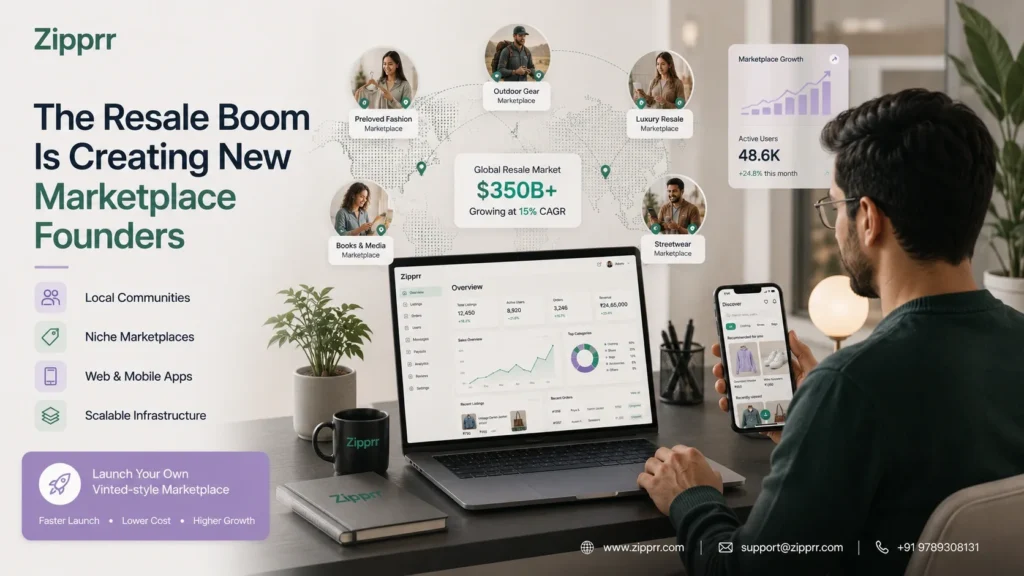
The global resale market is projected to reach $350 billion by 2027, according to ThredUp’s annual resale reports — more than double what it was just a few years ago. Clone script owners who enter the right region at the right time can capture serious market share.

04

Social Commerce Is Accelerating

Younger users are comfortable buying from strangers online. Trust signals like ratings, reviews, and verified payments have matured enough that peer-to-peer commerce feels completely natural and safe.

What makes the Vinted clone model particularly powerful is that it flipped the traditional marketplace fee structure. Vinted charges buyers, not sellers, removing the biggest friction point that kept casual sellers off older platforms. That single decision unlocked millions of new supply-side users almost overnight.

What Makes a Vinted Clone App Truly Stand Out

Building a Vinted clone is not just about replicating the interface. It is about understanding which features create retention, trust, and long-term revenue for your buy and sell clothes app.

1. Seamless User Registration for Your Vinted Clone App

First impressions matter. Users should be able to sign up in under two minutes using email, phone number, or social login options like Google or Apple ID.
Profiles should display seller ratings, total items sold, response time, and verified payment status. These trust signals are what turn a first-time visitor into a repeat buyer and a casual seller into an active one.

2. Friction-Free Product Listing on Your Buy and Sell Clothes App

Your sellers are your supply engine. If listing an item feels like a chore, sellers leave, and your inventory dries up.
A well-built listing module for your Vinted clone app includes:
The smoother the listing experience, the more active inventory your platform builds, and the more inventory brings more buyers.

3. AI-Powered Smart Search and Filtering for Fashion Resale App Discovery

Buyers need to find exactly what they want, fast. Weak search kills conversion before the checkout ever loads.
Your second-hand marketplace app search module should support:

4. Secure In-App Messaging Between Buyers and Sellers

Allow buyers and sellers to negotiate, ask questions, and confirm shipment details without ever leaving the platform. Every conversation should be logged and monitored for policy compliance. This protects both users and your platform’s reputation.

5. Integrated Payment Gateway for Your Fashion Resale App

Payments are the heart of any Vinted clone marketplace. Buyers will not complete a purchase if the checkout feels risky or slow.
Your platform should support:

6. Seller Shipping Integration That Removes the Biggest Headache

Logistics anxiety is the number one reason sellers abandon resale platforms. Solve it by integrating directly with major courier APIs so sellers can generate pre-paid shipping labels inside the app without visiting a third-party site.
That single feature alone dramatically increases seller completion rates and repeat listings.

7. Ratings and Review System That Builds Marketplace Trust

After every completed transaction, prompt both parties to leave a review. Reputation is currency on any peer-to-peer marketplace. A seller with two hundred five-star ratings will outsell an unknown seller at the same price point every single time.
Make reviews visible, easy to leave, and impossible to fake.

8. Push Notifications and Smart Personalization to Drive Repeat Visits

A Vinted clone app that goes quiet between purchases loses users fast. Keep people coming back with:

9. Powerful Admin Dashboard for Vinted Clone Management

Your team needs real-time visibility across every part of the operation. A well-built admin panel for your marketplace clone script should cover user management, listing moderation, dispute resolution workflows, payment oversight, and full analytics dashboards with exportable reports.

10. Mobile-First Design for Your Second-Hand Marketplace App

The overwhelming majority of resale shopping happens on a phone, not a laptop. Your Vinted clone app must be fast, visually clean, and intuitive on both iOS and Android, not just functional, but genuinely enjoyable to use.

Business Benefits of Launching a Vinted Clone Over Building From Scratch

Why choose a marketplace clone script instead of building from the ground up?
BenefitVinted Clone ScriptCustom Build
Time to Market2–3 Days12–18 months
Development CostLowVery High
Proven Feature SetYesUncertain
Post-Launch SupportIncludedSeparate Cost
CustomizationHighUnlimited
Risk LevelLowerHigher
A Vinted clone gives you a tested, working foundation. You are not gambling on whether the product will function; it already does. Your focus, time, and budget go entirely into market fit, user acquisition, and community growth.

The additional advantages are just as meaningful:

How a Vinted Clone App Works: The Full Transaction Flow
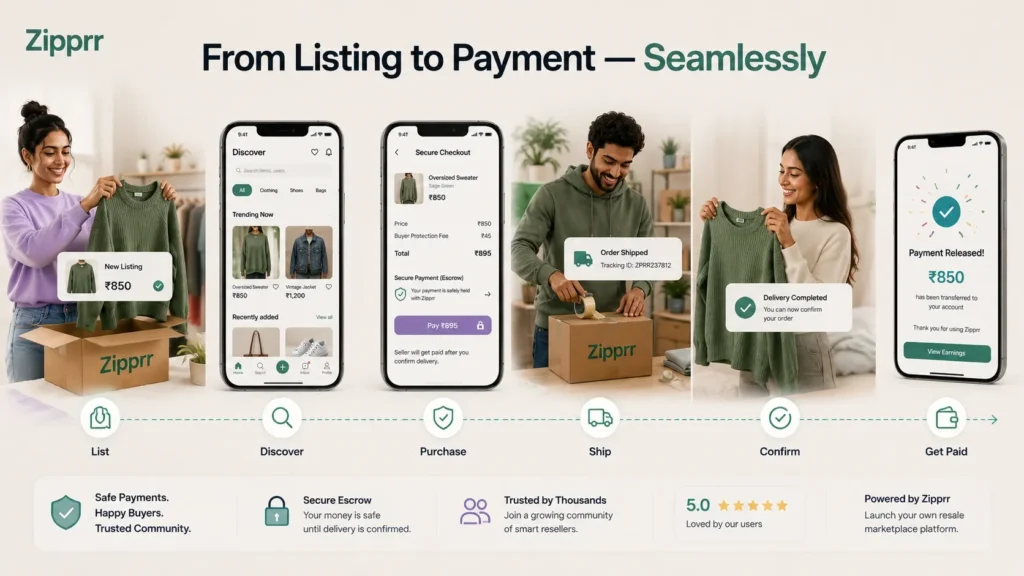
A Vinted-style second-hand marketplace app runs on a closed, accountable transaction loop that builds trust on every side:
1

Seller Lists an Item

Uploads photos, sets a price, and describes the condition honestly.

2

Buyer Discovers the Item

Through search, curated recommendations, or by following seller profiles.

3

Buyer Purchases

Payment is captured and held in escrow on the platform.

4

Seller Ships

Generates a pre-paid shipping label inside the app and dispatches the item.

5

Buyer Confirms Receipt

Inspects the item, confirms delivery, and leaves a review.

6

Platform Releases Funds

Seller receives payment; platform earns its fee.

This loop creates accountability at every step. Sellers ship because payment is already captured. Buyers trust the process because funds are protected until they are satisfied. Platforms earn consistently because every transaction is processed through the system.

Benefits of Launching a Letgo Clone with Zipprr

One of the most overlooked strengths of the Vinted clone business model is how elegantly it monetizes without alienating the users who make the platform run.

Buyer Protection Fee:

Charge buyers a small percentage, typically 3–8%, on each transaction as a buyer protection fee. It covers dispute resolution costs and is almost universally accepted because buyers receive genuine peace of mind in return.

Promoted Listings:

Let sellers pay to push their items to the top of search results or category pages. This is a high-margin, naturally scalable revenue stream as your seller base grows; competition for visibility grows with it.

Wardrobe Spotlight:

Sellers pay for featured placement of their entire profile page, driving sustained traffic to their listings rather than a single item.

Premium Seller Subscriptions:

Build monthly subscription tiers with benefits like unlimited promoted listings, detailed analytics, or priority access to customer support.

Brand Partnerships:

As your audience scales, fashion brands, eco labels, and authentication services will approach you for placement, co-marketing, and data partnerships.

Authentication Services:

Offer paid verification for luxury or high-value items, such as handbags, sneakers, and vintage pieces, where buyers are willing to pay a premium for confidence.
“

A well-run Vinted clone marketplace with 50,000 monthly active users can realistically generate six-figure monthly revenue when these streams are layered thoughtfully.

Revenue Model Analysis · Vinted Clone Business Guide

Why Entrepreneurs Are Choosing the Vinted Clone Model in 2026

Here is something worth understanding about who actually builds successful resale marketplaces: they are rarely technology people. They are market people.
They know a specific community, a specific city, or a specific product category deeply, and they build the platform that community actually deserves. The technology is a means, not the mission.
Entrepreneurs choosing to launch a Vinted clone app today tend to fall into a few clear profiles:

Founders Entering Fast-Growing Markets

Emerging Markets In Southeast Asia, the Middle East, or Latin America, where Vinted has zero presence and the resale culture is rising fast.

Regional Builders

Local-First Who want a localized buy and sell clothes app with local payment methods, local languages, and local logistics baked in from day one.

Niche Operators

Category Focus Laser-focused on specific categories such as luxury fashion, designer kids’ clothing, and premium sportswear, where a generalist platform leaves real value unclaimed.

E-Commerce Veterans

Industry Veterans Who see the broader shift from new-goods retail toward resale and want to own the infrastructure on the right side of that trend.

The marketplace clone script model lowers the technical barrier to entry sharply, freeing these founders to do what they are actually good at. If you want to understand how the most successful operators in this space structure their platforms before launch, this guide on how to build a successful secondhand marketplace using clone apps is worth reading before you finalize your feature set.

Vinted Clone App Scalability and Future-Readiness

A good Vinted clone is not built just for the day you launch it is architected for the day you hit a million users.
When evaluating a fashion resale app development partner and their clone script solution, look carefully for:
The businesses that scale from a local launch to a regional or global marketplace share one quiet advantage: they did not have to rebuild their foundation halfway through. They chose the right starting point.

Future Trends Shaping the Second-Hand Marketplace App Industry

The resale marketplace space is evolving fast. The Vinted clone platforms that thrive in 2027 and beyond will be the ones that stay ahead of these shifts:
Platforms built on flexible, well-engineered foundations can add each of these capabilities as they mature without rebuilding from scratch each time.

Launch Your Own Vinted Clone App with Zipprr Today

The resale fashion market is at a genuine inflection point. The founders who move now will build the audiences, the trust, and the brand recognition that latecomers will find nearly impossible to overcome.
Zipprr offers a ready-to-launch Vinted clone app built specifically for 2026, fully customizable, completely white-labeled, and backed by a team that has deployed marketplace clone scripts across multiple markets and industries.
What you get with Zipprr’s Vinted Clone:
Whether you are entering a new geography, building for a specific fashion niche, or scaling an existing resale community, this buy and sell clothes app foundation gives you everything you need to move fast without cutting corners.

Ready to build your second-hand marketplace app?

to explore the Vinted Clone App and speak directly with our product team.

Frequently Asked Questions About Vinted Clone App Development

1. What is a Vinted clone app?

A Vinted clone app is a pre-built marketplace software solution that replicates the proven features and business model of the Vinted platform. It allows entrepreneurs to launch a fully functional second-hand marketplace app without starting from scratch. The solution includes everything from user registration and product listings to secure payments, in-app messaging, and seller tools, all customizable to match your brand identity and target market.
With a mature marketplace clone script solution like Zipprr’s, most founders go from purchase to live launch within four to eight weeks. That window covers branding customization, payment gateway setup, shipping provider integration, and initial quality testing. Building the same product from scratch typically takes twelve to eighteen months and costs significantly more.
The primary revenue streams include buyer protection fees on each transaction, promoted listing fees from sellers seeking better visibility, wardrobe spotlight placements, premium seller subscription tiers, and brand or retail partnerships. Authentication services for luxury items add another high-margin stream. A healthy platform with a growing user base can generate six-figure monthly revenue from these channels combined.
Absolutely. A well-built fashion resale app development solution is designed to be fully moldable. You can apply your own branding entirely, configure the platform in multiple languages and currencies, adjust or remove features to match your niche, and integrate local payment providers that your audience already trusts. The clone gives you the engine you define the destination.
Modern Vinted clone solutions typically use React Native or Flutter for cross-platform mobile apps, with Node.js or Laravel powering the backend API. Cloud infrastructure is compatible with AWS or Google Cloud, and the architecture is API-first, making it straightforward to integrate new tools, analytics platforms, or third-party services as your second-hand marketplace app grows.
Yes, and the fundamentals are strong. The global resale fashion market is on track to reach $350 billion by 2027, driven by sustainability awareness, inflation-sensitive shopping behavior, and a generational shift in how people think about ownership. Large markets across Southeast Asia, Latin America, and the Middle East remain largely unserved by the dominant European and American platforms, making regional entry particularly attractive right now.
Trust is built systematically, not accidentally. The core mechanisms are: verified user profiles, a mutual ratings and review system after every transaction, buyer protection escrow that holds funds until delivery is confirmed, secure integrated payments, seller verification badges, and a responsive and fair dispute resolution process. Platforms that invest in all of these consistently see higher repeat transaction rates and lower churn on both sides of the marketplace.
Building from scratch means full technical control, but it requires twelve to eighteen months of development time, a dedicated engineering team, and a budget that often runs from $150,000 to $500,000 or more before a single user signs up. A marketplace clone script compresses that timeline to weeks at a fraction of the cost with a proven feature set already tested in production. Most experienced founders choose the clone script route to validate their market and build their user base first, then invest in deeper customization as revenue grows.

Book Your Meeting

Let’s Talk! Book Your Meeting