

Almost everyone who knows something useful now has a way to teach it online. Coaches, chartered accountants, fitness trainers, coding bootcamps, language tutors and corporate trainers are all packaging what they know into courses. The people who profit most reliably, though, are often not the individual creators. They are the owners of the marketplace where thousands of creators sell and millions of learners search.
That is why “Udemy clone” is such a common search among founders. This guide explains what a Udemy clone really is, how course marketplaces make money, which features matter, where AI changes the game, what it costs, whether to build or buy, and how to avoid the mistakes that sink most new edtech marketplaces. This guide is aimed at founders and business owners, so it keeps the focus on business decisions and skips the technical detail.
What is a Udemy clone?
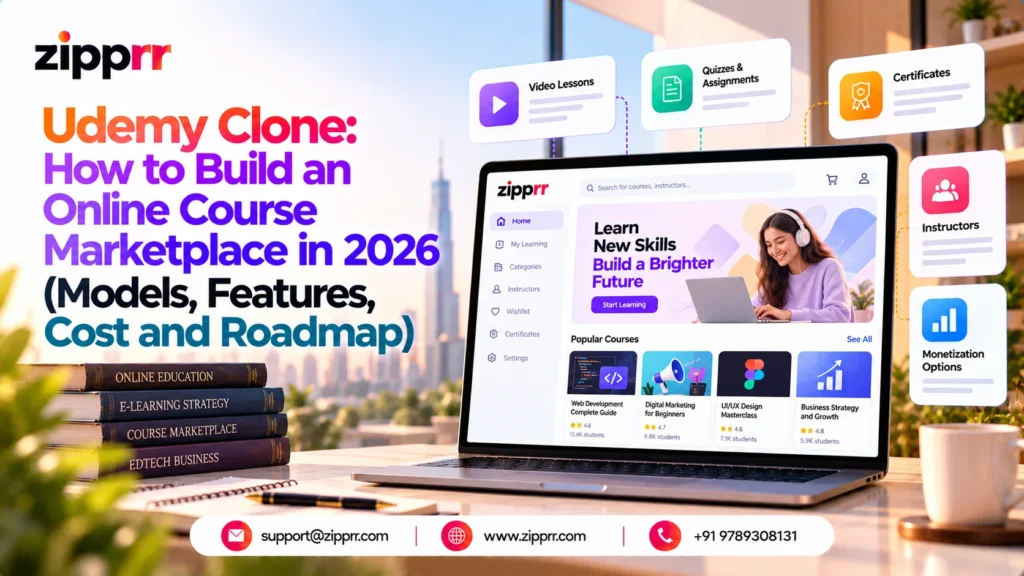
A Udemy clone is an online course marketplace platform modelled on the core mechanics of Udemy: independent instructors create and sell video-based courses, learners browse, buy and learn, and the platform earns a share of every sale. “Clone” describes the functional blueprint, not copying a brand. A sensible launch uses your own name, niche, design, pricing and policies.
In practice, a Udemy clone script is a ready-made or custom-built software product with a learner website and mobile apps, an instructor studio for uploading and managing courses, an admin panel to run the business, and payment and payout systems connecting them.
Why the course marketplace opportunity still exists
Online learning is no longer a pandemic-era spike. Professionals reskill continuously, employers fund training, and learners expect to learn on a phone at their own pace. Market research firm Mordor Intelligence sizes the global e-learning market at roughly USD 275.9 billion in 2026 and forecasts it to reach about USD 461.9 billion by 2031, a compound annual growth rate of around 10.9%. The same research points to rising smartphone and internet access, corporate upskilling and cost advantages over classroom training as the main growth drivers, and names mobile e-learning as one of the fastest-growing segments.
The same analysis also flags the real constraints: low course completion rates, the digital divide in lower-income and rural areas, content localisation barriers and data-privacy rules. Those constraints are exactly where a focused, locally relevant marketplace can win. (Figures are Mordor Intelligence estimates and forecasts; check the latest release before quoting them in investor material.)
The large global platforms cover broad, English-language, generic topics. That leaves room for focused marketplaces:
- Niche verticals: medical exam prep, aviation, Islamic studies, design software, trades and compliance training.
- Regional and language markets: courses in local languages, priced for local incomes, with local payment methods.
- Institution and brand-led marketplaces: a training company that wants to bring in outside instructors, or an association that certifies its members.
- Corporate academies: private marketplaces where employees take internal and curated external courses.
The honest takeaway: you will not beat the giants at being the giants. You win by being the best place to learn one thing, or to learn in one place.
Key trends shaping online course platforms
- AI-assisted learning: tutors, summaries, quizzes and personalised paths are becoming expected, not novel.
- Short, skills-first content: learners want outcomes and credentials they can show an employer.
- Cohorts and community: self-paced video dominates today, but live and instructor-led formats are growing, because completion improves with interaction, discussion and mentoring.
- Mobile-first and offline: in many markets, learning happens on phones with patchy connectivity, which is why a good Udemy clone app matters as much as the website.
- Cloud delivery: cloud-based platforms now lead deployment, making it practical for a new entrant to launch without owning infrastructure.
- Subscription access: bundles and memberships increasingly sit alongside single-course purchases.
- Content protection and trust: piracy, fake reviews and low-quality courses are real threats to marketplace credibility.
How an online course marketplace works (the two-sided model)
A marketplace has two customers, and both must be satisfied.
- Instructors sign up, pass any quality checks, build courses (video, documents, quizzes, assignments), set prices and publish.
- Learners search or browse, preview, buy or subscribe, learn across devices, track progress, take quizzes and earn certificates.
- The platform processes payment, takes its commission, pays instructors on a schedule, handles refunds and support, and moderates quality.
The flywheel: better courses attract learners, learners generate revenue and reviews, revenue and reviews attract better instructors. Starting that flywheel is the hardest part, which is why a later section covers it in detail. Founders who have studied other two-sided models, such as hyperlocal delivery marketplaces, will recognise the same supply-and-demand balancing act, only with courses instead of couriers.
Business and revenue models
Most successful platforms combine two or three of these rather than relying on one.
- Commission per sale: the classic model. The platform keeps a percentage, often higher for sales it drives (organic traffic, promotions) and lower for sales the instructor brings via their own link.
- Subscription / membership: learners pay monthly or annually for catalogue access, with revenue shared with instructors by watch time or completion.
- Instructor plans: instructors pay for premium tooling, lower commission, branding or analytics.
- Featured placement and promotion: paid visibility in search and category pages (introduce carefully so quality does not suffer).
- Certification fees: paid, verifiable certificates or exam proctoring.
- B2B and enterprise licences: seats for companies, schools or governments, with admin reporting.
- Live classes and coaching: take a cut of paid live sessions or one-to-one mentoring booked through the platform.
A practical starting mix: commission on course sales, plus a subscription tier once the catalogue has enough depth to justify it, plus B2B licences if you have a corporate or institutional audience.
Who should build a Udemy-style platform?
- Edtech startups targeting a vertical or language that big platforms serve poorly.
- Training institutes and academies that want to scale beyond their own faculty by onboarding external instructors.
- Corporate L&D teams building an internal learning marketplace.
- Creator collectives and associations that want a shared, branded storefront rather than renting space on a giant.
- Investors assessing digital education businesses, who should look hard at supply quality and customer acquisition cost, not just feature lists.
Use cases
- A medical-exam coaching brand curates expert-led courses with question banks and mock tests.
- A regional language platform sells vocational courses to learners who prefer their mother tongue, accepting local wallets and UPI-style payments.
- A manufacturer certifies distributors through a private course catalogue with completion tracking.
- A university extension runs paid short courses from several faculties under one storefront.
Essential features, and the business value behind each
Instead of a spec sheet, here is what each capability does for the business. A complete online course marketplace software package should cover all three sides: learner, instructor and admin.
Learner side
- Search, filters and recommendations: discovery drives conversion. If learners cannot find the right course quickly, they leave.
- Course previews, ratings and reviews: social proof is the main purchase driver in a marketplace.
- Responsive video player: adjustable speed, resume, captions, and offline download on apps for retention.
- Progress tracking, quizzes, certificates: completion and credentials raise perceived value and refunds drop.
- Wishlist, cart, coupons and gifting: standard commerce levers for conversion and campaigns.
- Multi-language and multi-currency: essential for regional or cross-border reach.
Instructor side
- Course builder: sections, lectures, resources, quizzes and assignments that a non-technical expert can use unaided.
- Earnings dashboard and payout settings: transparency builds supply-side trust.
- Q&A and messaging: keeps learners engaged and improves ratings.
- Analytics: drop-off points, revenue by course, student geography.
Admin side
- Course review and approval workflow: your quality control gate.
- Commission, tax and payout management: flexible rules per instructor, category or plan.
- Refund, dispute and support tools.
- CMS, SEO controls and marketing tools: landing pages, banners, coupons, email triggers.
- Reports: GMV, conversion, instructor performance, cohort retention.
Often overlooked, but critical
- Content protection: signed video URLs, DRM or watermarking options, restrictions on sharing.
- Live classes (integrations with video conferencing) and assignments with grading.
- Affiliate programme so partners and instructors can promote courses for a share.
- Security and compliance: secure payments, role-based access, data protection, GDPR-style consent where relevant.
AI opportunities for course marketplaces
AI is where a new platform can leapfrog older products, provided it is applied to real problems rather than used as decoration.
- Personalised recommendations and learning paths: suggest the next course based on goals, history and skills gaps, lifting conversion and completion.
- AI tutor or study assistant: answers learner questions grounded in the course material, available around the clock.
- Course creation assistance: instructors get help with outlines, quiz questions, captions, translations and summaries, lowering the effort of publishing and widening your supply.
- Automatic transcription and translation: makes content accessible and searchable across languages, which directly addresses the localisation barrier.
- Smarter search: understand intent (“become a data analyst in six months”) rather than only keywords.
- Moderation and quality scoring: flag plagiarised, low-quality or policy-violating courses and fake reviews for human review.
- Churn and dropout prediction: trigger reminders or offers to learners likely to disengage, tackling the low-completion problem.
- Support automation: handle routine refund, access and billing questions.
- Dynamic pricing and promotion insight: test discounts and bundles with data instead of guesswork.
Caveat: AI tutors can be wrong. Ground them in approved content, label them clearly, and keep humans in the loop for grading, certification and moderation.
Technology considerations
- Architecture: modular web backend with APIs serving the website and iOS/Android apps; cloud hosting that scales with traffic spikes during launches and promotions.
- Video infrastructure: upload, transcoding to adaptive bitrate, CDN delivery. Video is usually the largest recurring cost, so design for it early.
- Payments: gateways for cards and local methods, split payments or manual payout workflows, tax handling, refund automation.
- Search: a dedicated search engine for fast, relevant course discovery as the catalogue grows.
- Integrations: email and CRM, analytics, live-class tools, SMS/WhatsApp, and AI services via APIs.
- SEO foundations: server-rendered or crawlable course pages, schema markup for courses, clean URLs. Organic search is a major long-term acquisition channel for marketplaces.
How much does it cost to build a platform like Udemy?
Costs to budget beyond development: video hosting and bandwidth, payment fees, cloud infrastructure, app store accounts, security and maintenance (commonly planned as a recurring share of the build cost each year), content seeding, and above all marketing. Founders routinely underbudget growth: the software is rarely what runs out of money first.
| Approach | Typical scope | Indicative budget | Typical time to launch |
|---|---|---|---|
| Ready-made script, customised | Web + apps, core marketplace, branding, selected custom features | Lowest upfront; often a fraction of custom cost | Weeks |
| Custom MVP | Core marketplace built from scratch | Mid-range | 4 to 8 months |
| Full custom platform | Advanced AI, live classes, enterprise features, multiple apps | Highest | 9 to 18 months |
Cost depends on scope, not the label. The ranges below are indicative planning figures, since vendor quotes vary widely by region and team; treat them as a way to frame questions rather than as a quote. For e-learning app development cost specifically, the biggest swing factors are native vs cross-platform apps, live-class features, AI modules and how much is customised.
Build vs buy, and custom vs ready-made
Build from scratch makes sense if your product itself is a differentiated technology (a novel learning engine, for example), you have strong technical leadership in-house, and you have the runway for a long build before learning whether the market wants it.
Start with a ready-made solution and customise makes sense for most business-model-led founders: your edge is niche, brand, community, instructors or distribution, not rewriting video players and payout logic that already exist. A ready-made Udemy clone solution lets you validate faster, spend less before proof, and invest in the parts that make you different.
A useful rule: buy the commodity, build the differentiator. Commodity parts include accounts, course builder, checkout, video delivery, reviews and admin. Differentiators might be your curriculum, certification, AI learning paths, or a community layer.
Questions to settle before committing to ready-made software: Do you get full source code? Can the design and workflows be customised? What does upgrading look like once you have customised it? Is the stack mainstream enough that you can hire developers for it later?
Solving the cold start: getting instructors and learners
Marketplace failures are usually demand and supply failures, not software failures.
Supply: instructors and content
- Seed the catalogue yourself. Commission or partner for 20 to 50 strong courses in one niche before opening to the public. A marketplace with thin content looks abandoned.
- Recruit established experts who already have an audience (YouTubers, trainers, practising professionals) and offer better terms early: lower commission for a launch period, onboarding help, free production guidance.
- Make publishing easy: templates, outline help, AI assistance and a human success manager for the first cohort.
- Show them the money: transparent dashboards and prompt, predictable payouts matter more than headline commission rates.
Demand: learners
- Own one niche’s search results. Create helpful content (guides, free mini-courses, tools) around the exact skills your learners search for.
- Free and low-priced entry points: free lessons or previews to build trust and email lists.
- Instructor-led acquisition: instructors with audiences bring learners; give them affiliate or referral links.
- Partnerships: colleges, employers, communities and associations that bulk-enrol members.
- Paid acquisition, carefully: test small, track payback per channel, and watch refund rates.
- Retention: email journeys, progress nudges, certificates and next-course recommendations increase lifetime value.
Risks and challenges
- Content quality: one bad experience damages trust. Review gates and rating thresholds matter.
- Low completion rates: a recognised industry-wide problem. Design for engagement with quizzes, cohorts, reminders and certificates.
- Piracy and content leakage: use technical protection and clear terms, and accept that it can be reduced but not eliminated.
- Refunds and chargebacks: clear policies, previews and good course descriptions reduce them.
- Instructor concentration: relying on a few top creators who may leave. Spread supply and build the brand around the platform, not individuals.
- Customer acquisition cost: competing for broad keywords with large incumbents is expensive; niche focus is the defence.
- Legal and tax: intellectual property ownership, instructor contracts, VAT/GST on digital goods, data protection, and rules for certificates in regulated fields.
- Video costs scaling faster than revenue, which needs early monitoring.
Common mistakes to avoid
- Launching broad (“all topics”) instead of owning a niche.
- Spending the budget on features and nothing on instructor and learner acquisition.
- Opening publishing to everyone with no quality control.
- Copying another platform’s brand, pricing and policies instead of designing your own proposition.
- Ignoring mobile, where many learners actually are.
- Treating AI as a headline feature rather than solving a concrete learner or instructor problem.
- Not measuring completion, which drives reviews, referrals and renewals.
- Choosing a vendor on price alone, then discovering missing source code, poor support or locked-in architecture.
Launch roadmap
- Weeks 0 to 2, validate and define: pick the niche, audience, and revenue model; talk to 20 target learners and 10 potential instructors; define your quality standards.
- Weeks 2 to 6, set up and customise: choose build or ready-made path; configure branding, commission rules, payments, taxes and policies; connect video hosting.
- Weeks 4 to 10, seed supply: onboard founding instructors, publish the first catalogue, test the learner journey end to end.
- Weeks 8 to 12, soft launch: invite a limited learner group, watch conversion, completion, support tickets and refunds, and fix what breaks.
- Month 3 onward, public launch: SEO content, partnerships, instructor affiliate programme, targeted paid tests.
- Months 6 to 12, deepen: add subscriptions, certification, live classes, AI tutoring and B2B plans based on observed demand.
Scaling the platform
- Expand into adjacent categories only after the first niche shows healthy repeat purchase and completion.
- Introduce subscription bundles and enterprise licences once the catalogue is deep.
- Localise language, currency and payments for new regions.
- Invest in analytics: course-level conversion, cohort retention, instructor health, and CAC payback.
- Strengthen infrastructure: CDN, caching, search and background jobs before big campaigns.
- Some founders eventually widen from one vertical into a broader services ecosystem, the way multi-service super app platforms expand from one core service. That is a later-stage option, not a day-one plan.
Buyer objections, answered honestly
“The big platforms already dominate. Why bother?” Dominating the general market is not the same as serving every niche, language or institution well. Focused platforms win on relevance and community.
“A ready-made script feels generic.” It is the foundation, not the finished brand. Design, curriculum, policies, pricing and instructors are what make it yours.
“Will it scale?” A well-architected platform on cloud infrastructure can grow with demand; confirm this with the vendor by asking about architecture, caching, video delivery and load experience.
“What if I can’t attract instructors?” That is the real risk. Plan your supply strategy before you spend on software, and consider launching as a curated academy first.
“Is it safe to rely on someone else’s software?” Ask about source-code ownership, documentation, update policy and support terms in writing.
How to choose a Udemy clone development company
- Relevant experience: have they delivered learning or multi-vendor marketplace platforms, and can you speak to those clients?
- Scope clarity: a written feature list, what is included versus extra, and what customisation costs.
- Code and data ownership, hosting options and exit terms.
- Architecture: mainstream tech stack, API availability, and mobile app approach (native or cross-platform).
- Security practices: payment handling, access control, backups, vulnerability testing.
- Support and roadmap: response times, maintenance packages, and a credible plan for AI and ongoing updates.
- Business understanding: a good partner challenges your plan and asks about instructors and demand, not only features.
- Transparent pricing, with no vague “unlimited” promises.
Comparison considerations
When comparing options, evaluate along the same axes: a ready-made Udemy clone script, a custom build, a SaaS course platform (fast to start, but you rent the product and often cannot run a true multi-instructor marketplace under your own terms), and a website plugin (fine for a single creator, limited for a marketplace). Compare on time to launch, total cost over three years, control and ownership, marketplace features (multi-instructor payouts, commissions), customisation depth, and scalability.
Where Zipprr fits
Zipprr is a technology partner that helps entrepreneurs launch marketplace, on-demand, booking and service platforms without building everything from zero. For e-learning founders, Zipprr’s e-learning marketplace platform provides a ready-made course marketplace foundation that can be customised to your niche, branding and revenue model, along with scalable architecture and technology support. The aim is to shorten the path from idea to a live platform so your time and money go to what actually decides success: instructors, learners and content quality.
If you are comparing options, look at a working Udemy clone app and web demo against your requirement list and ask how each item would be customised.
1. What is a Udemy clone?
2. How does a Udemy clone work?
Instructors upload and price courses, admins approve them, learners discover and purchase them, the platform processes payment and splits revenue between itself and the instructor, and learners study through a video player with progress tracking, quizzes and certificates.
3. Is building a Udemy clone legal?
4. How big is the e-learning market?
5. How much does it cost to build a platform like Udemy?
6. How long does it take to launch an online course marketplace?
7. Can I customise a Udemy clone script?
8. Is a ready-made Udemy clone solution scalable?
9. How do Udemy-style platforms make money?
10. How can entrepreneurs make money from an online course marketplace?
11. How can AI improve an online course platform?
12. What features does a Udemy clone need?
13. How do I get instructors for a new course marketplace?
14. How do I get my first learners?
15. Should I build from scratch or buy a Udemy clone?
16. What should I look for in a Udemy clone development company?
17. How do I protect my courses from piracy?
18. Who is Zipprr and how can it help?
19. How can I see a demo before deciding?
Ready to launch your own course marketplace? Talk to Zipprr
If you are weighing up an e-learning marketplace, start by writing down your niche, your first 20 instructors and your acquisition plan. Then see how a customisable foundation fits. The Zipprr team can walk you through the platform and map it to your requirements.
- Schedule a Free Demo: book your free Udemy clone demo here
- WhatsApp: +91 97893 08131 (tap to chat)
- Email: [email protected]
Prefer to explore first? Browse the Udemy clone script details and send us your questions on WhatsApp or email. No obligation.