

For many homeowners, finding a reliable handyman is still frustrating. You ask a neighbor for a name, call three numbers that go to voicemail, wait two days for a callback, and then negotiate a price over the phone with someone whose work you’ve never seen. On the other side of that transaction, independent handymen and small repair businesses are just as underserved: juggling phone calls, paper job lists, cash payments, and word-of-mouth marketing because there’s no simple digital storefront built for their trade.
“Uber for Handyman” is the shorthand the industry uses for the software category that fixes both sides of that problem: an on-demand marketplace platform, modeled loosely on the ride-hailing app experience, that lets customers book a verified handyman from their phone and lets handymen receive, manage, and get paid for jobs without ever picking up a landline. It’s worth being clear up front that this is a business model description, not a product built or endorsed by Uber Technologies; the term describes a category of on-demand service marketplace software, not a specific company’s app.
For entrepreneurs and existing home-services businesses looking at 2026 as the year to move online, understanding exactly how this kind of platform works, and what separates a genuinely usable solution such as Zipprr’s Uber for Handyman script from a feature checklist, is the difference between a smooth launch and a costly rebuild six months in.
What Is an Uber for Handyman App?
An Uber for Handyman app is a three-sided software platform (a customer-facing app, a provider app, and an admin dashboard) that connects people who need home repair or maintenance work with local, vetted service providers, and manages the entire job lifecycle from discovery to payment inside one system.
Instead of a customer searching for “electrician near me,” calling around, and hoping someone answers, they open an app, pick a service category, describe the job, see available providers or request a match, agree on a price or estimate, and pay digitally once the work is done. The handyman, meanwhile, gets job requests pushed to their phone, can accept or decline based on their schedule, navigate to the job site, log the work, and receive payment automatically, all without a dispatcher in the middle.
This is fundamentally different from a simple business directory or listings site. A directory helps a customer find a phone number. A marketplace platform manages the booking, the communication, the payment, and the trust signals (ratings, verification, job history) that make a stranger feel safe letting someone into their home.
Zipprr is one example of a company that packages this three-sided structure (customer app, provider app, admin dashboard) as a single, ready-to-brand Uber for Handyman script, aimed at founders who want to launch a home-services marketplace under their own name rather than build the underlying system from zero.
Why On-Demand Handyman Platforms Are Gaining Traction
Several structural trends are pushing more of the home-services industry toward app-based booking, even if exact market-size figures vary by source and shouldn’t be taken as precise:
- Homeowners increasingly expect the same instant-booking convenience from home services that they already get from ride-hailing, food delivery, and hotel apps: a “call and wait” experience feels dated by comparison.
- Aging housing stock in many markets means a steady, non-seasonal stream of repair and maintenance demand: plumbing, electrical, appliance, and general handyman work doesn’t disappear in a downturn the way discretionary spending does.
- Independent tradespeople and small repair businesses are actively looking for lower-cost customer acquisition channels than traditional advertising, which makes them receptive to joining a marketplace that brings them job requests directly.
- Dual-income households have less time to manage repairs themselves or to vet providers manually, which increases willingness to pay a small premium for a vetted, bookable service.
None of this guarantees demand in any specific city or niche, since local competition, provider supply, and consumer habits still vary widely, but it explains why the category has attracted steady founder interest rather than being a one-off trend.
How the Uber for Handyman Business Model Works
At its core, the model is a three-sided marketplace built around one recurring loop: a customer requests a service, the platform connects them with a qualified provider, the job happens,The platform also takes a percentage from each transaction. Understanding each side separately makes it easier to evaluate any specific software solution against your own business plan.
The Customer Side
The customer app is the demand-generation engine. Its job is to make booking a repair faster and less stressful than calling around. That means clear service categories, transparent pricing expectations, visible provider ratings, and a booking flow that doesn’t require a phone call at any point.
The Provider Side
The provider app is the supply-and-retention engine. Handymen and repair businesses will only stay active on a platform if it reliably sends them relevant job requests, pays them promptly, and doesn’t bury them in unnecessary admin work. A provider app that’s clunky or unreliable leads to providers going inactive, which starves the customer side of good options, a failure mode that kills marketplace platforms faster than almost anything else.
The Admin Side
The admin dashboard is where the business owner actually runs the operation: approving new providers, managing service categories and pricing rules, monitoring bookings in real time, handling disputes, tracking commission revenue, and pulling the reporting needed to make decisions. A platform that looks polished on the customer and provider side but has a thin or rigid admin panel will frustrate the person actually operating the business.
Core Features of a Handyman Marketplace App
The exact feature list varies by vendor, but a credible handyman app script, Zipprr’s included, generally organizes its capabilities into the same three buckets: what the customer sees, what the provider sees, and what the business owner controls from the admin side.
Customer App Features
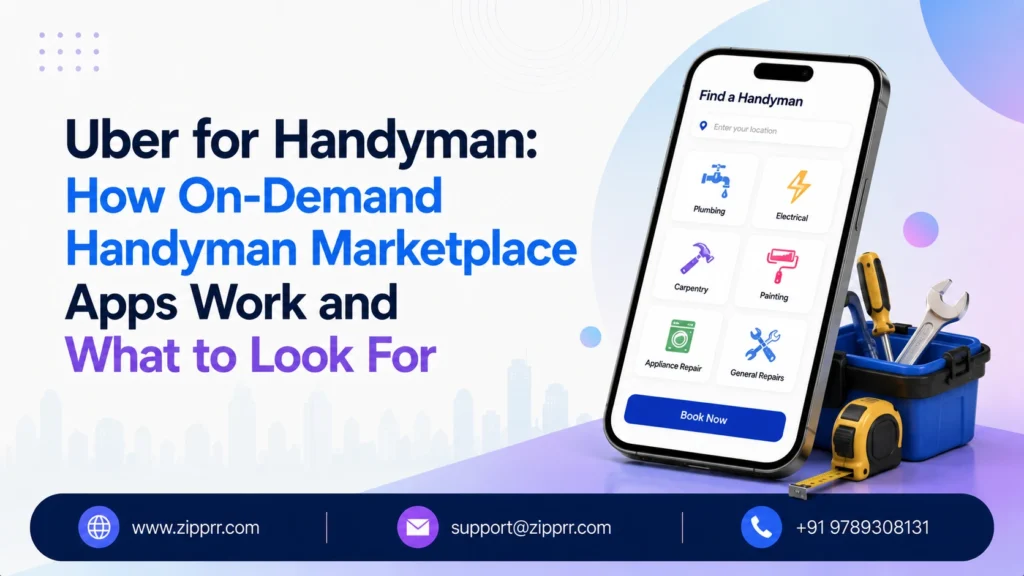
- Service discovery and categories: plumbing, electrical, carpentry, painting, appliance repair, furniture assembly, general handyman tasks, and similar categories, organized so a customer can find the right service in a couple of taps rather than typing a free-text search and hoping.
- Instant or scheduled booking: some jobs are urgent (a burst pipe), others can wait for a convenient time slot; a well-designed app supports both booking modes rather than forcing every request into an “ASAP” model.
- Provider profiles: photos, service history, ratings, and specialties, so the customer isn’t booking a stranger blind.
- Upfront quotes or estimate ranges: reducing the anxiety of not knowing what a job will cost before agreeing to it.
- In-app messaging: so job details, access instructions, or scope changes don’t require exchanging personal phone numbers.
- Live job tracking: knowing when the provider is en route removes a common source of no-show anxiety.
- Digital payments: card, wallet, or other supported methods processed inside the app rather than as a cash handoff.
- Ratings and reviews: the trust layer that lets future customers make an informed choice and gives providers an incentive to do consistent, quality work.
- Rebooking and favorites: letting a customer request the same provider again for a job well done, which drives repeat usage without any extra marketing spend.
Provider (Handyman) App Features
- Job request feed: new bookings or open job requests relevant to the provider’s category, location, and availability.
- Accept/decline controls: providers manage their own schedule rather than being auto-assigned work they can’t take.
- Navigation and job details: address, access notes, and job scope available before arrival.
- Quote submission: for jobs that need an on-site or pre-visit estimate rather than a fixed price.
- Earnings dashboard: a clear, real-time view of completed jobs, pending payouts, and commission deducted, which matters enormously for provider trust and retention.
- Availability and calendar management: so providers can set working hours, block time off, and avoid being pinged for jobs they can’t take.
- In-app communication and support: a direct channel to resolve customer questions or platform issues without leaving the app.
Admin Dashboard Features
- Provider onboarding and verification workflow: reviewing applications, documents, and approving or rejecting new providers before they go live.
- Category and service management: adding, editing, or retiring service types and associated pricing rules as the business evolves.
- Booking oversight: a real-time view of every job in the system, from requested through completed or cancelled.
- Commission and payout configuration: setting how the platform earns revenue from each transaction.
- Dispute and refund handling: a structured process for the inevitable cases where a customer or provider isn’t satisfied.
- Analytics and reporting: booking volume, revenue, top-performing providers and categories, and retention metrics needed to run the business like a business rather than guess at what’s working.
- Multi-location or multi-city configuration: relevant once a platform expands beyond its first launch market.
Booking, Scheduling, and Provider Matching in Practice
The booking flow is where most of the customer experience lives or dies. A customer selects a service category, describes the job (often with photo upload for context), chooses instant or scheduled timing, and either browses available providers directly or lets the system match them automatically.
Automated matching typically weighs a combination of factors: proximity to the job location, provider availability in the requested window, category-specific skill or certification match, current rating, and sometimes historical acceptance rate or responsiveness. The goal is to surface a provider who can realistically do the job well and show up, not just whoever is geographically closest. Getting this matching logic right is genuinely one of the harder parts of running this kind of marketplace, because it has to balance customer satisfaction against fairly distributing job volume across the provider base so no single provider is overloaded while others sit idle.
Scheduling also needs to account for job duration estimates, buffer time between jobs, and the reality that home-repair work often runs longer than planned, and a platform that doesn’t build in some flexibility here creates friction for providers trying to manage a realistic day.
Quotes, Pricing, and Payments
Handyman work doesn’t price as cleanly as, say, a fixed-distance ride. Some jobs (furniture assembly, a standard appliance install) can carry a reasonably fixed price. Others (electrical troubleshooting, structural repair) genuinely need an on-site assessment before an accurate quote is possible. A platform built for this category should support both: fixed or estimated pricing for standardized tasks, and a request-quote flow for anything that needs inspection first.
Payment handling is where trust and operational reliability intersect. Digital, in-app payment (rather than cash changing hands at the door) protects both sides: the customer has a receipt and dispute trail, and the provider doesn’t have to chase payment or handle cash logistics. Depending on the market, this can include card payments, digital wallets, or region-specific payment methods, and any platform should be evaluated on which payment gateways and currencies it actually supports for your target market rather than assumed to cover everything by default.
Revenue and Commission Models
There isn’t one universal way an Uber-for-handyman business makes money; most platforms combine two or more of the following, and the right mix depends on your market and provider base:
- Commission per booking: the platform takes a percentage of each completed job’s value; this is the most common core revenue stream because it scales directly with platform activity.
- Subscription or membership fees for providers: a flat monthly fee for providers to access job leads, sometimes tiered by how many leads or which categories they can access.
- Featured listing or priority placement fees: providers pay to appear higher in search or matching results, similar to promoted listings in other marketplace categories.
- Service or convenience fees charged to customers: a small fixed or percentage fee added at checkout, separate from what the provider earns.
- Lead-generation fees: charging providers per qualified job request rather than per completed transaction, common in categories where jobs are quoted rather than instantly priced.
Whichever combination you choose, the commission structure needs to stay low enough that providers don’t feel squeezed into leaving for a competing platform or reverting to direct, off-platform bookings, a real risk in any two-sided marketplace once trust between customer and provider is established and either side realizes they could transact without the middleman.
Trust, Safety, and Quality Control
Because handyman work happens inside a customer’s home, trust signals matter more here than in most on-demand categories. Ratings and reviews are the baseline, but they’re a lagging indicator: they only reflect quality after a job is done. Verification at onboarding (identity checks, licensing or certification where the trade requires it, and reference or portfolio review) is the layer that reduces risk before a provider ever accepts a job.
It’s worth being direct about a real limitation here: no marketplace platform, however well-built the software, can fully guarantee the quality or conduct of independent contractors it doesn’t directly employ. Background-check depth, licensing verification requirements, and insurance obligations vary significantly by region and by trade: electrical and plumbing work is regulated differently across jurisdictions, and a platform operator is responsible for understanding and complying with those local requirements rather than assuming the software handles it
automatically. Any credible platform provider should be transparent that verification tooling is a feature, not a substitute for the operator’s own compliance diligence.
Build vs. Buy: Custom Development vs. a Ready-Made Script
Founders generally choose between three paths: build from scratch with an in-house or agency development team, use a ready-made white-label script and customize it, or attempt a no-code/low-code assembly of existing tools.
Custom development offers maximum control but comes with the longest timeline and highest upfront cost: typically many months and a substantial budget before a usable product exists, with ongoing engineering overhead afterward. Zipprr’s white-label Uber for Handyman script, by contrast, starts from a working three-sided platform (customer app, provider app, admin dashboard) that’s already been built and tested, and focuses the remaining work on branding, configuration, and market-specific customization, which can compress launch timelines considerably, though the exact timeline depends on how much customization your market actually requires.
The trade-off to evaluate honestly: a ready-made script accelerates time to market and lowers initial cost, but you should confirm exactly what you’re getting: full source code ownership versus a locked license, how customizable the codebase actually is for your specific service categories and region, what happens to support and updates after the initial period, and whether the underlying technology stack is something your team (or a future hire) can actually maintain long-term.
What to Check Before Choosing a Handyman App Solution
Before committing to any Zipprr’s handyman marketplace platform, custom-built or off-the-shelf, it’s worth running through a short evaluation checklist:
- Does the solution include all three apps (customer, provider, admin) as a genuinely integrated system, or are they loosely connected pieces?
- Is source code ownership included, or are you licensing a hosted product you don’t control long-term?
- Can service categories, pricing logic, and commission structure be configured to match your specific market rather than a fixed template?
- What payment gateways are actually supported in the countries you plan to launch in?
- Is the technology stack (and its documentation) something a developer outside the original vendor could maintain if needed?
- What does post-launch support look like, and is it time-limited?
- Can the platform scale to multiple cities or regions without a rebuild, or is multi-location support a bolt-on afterthought?
- Are there real, checkable references or a working demo, rather than only marketing claims?
Asking these questions before signing anything is the single highest-leverage thing a founder can do to avoid a costly platform switch a year into operating the business.
Scalability and Multi-City Expansion
A handyman marketplace that works well in one city doesn’t automatically work in five. Expansion introduces new variables: local provider supply has to be built up market by market, pricing may need regional adjustment for cost-of-living differences, and category demand can vary (a market with older housing stock may see more plumbing and electrical requests; a newer-construction market may skew toward furniture assembly and general maintenance).
From a platform standpoint, scalability means the admin dashboard can manage multiple service areas independently: separate provider pools, potentially separate pricing rules, and reporting that can be filtered by location, without requiring a separate installation or a development project for each new market. This is worth confirming specifically during evaluation, since “scalable” is claimed by nearly every vendor but genuinely supported by fewer than the marketing copy suggests.
Estimating ROI and Realistic Expectations
Return on investment in an on-demand handyman marketplace depends on variables that are specific to each launch: local provider supply, marketing spend and channel effectiveness, commission rate, average job value, and how quickly the platform reaches enough two-sided liquidity (enough providers to serve demand, and enough demand to keep providers engaged) to sustain itself without heavy subsidization.
It’s genuinely not possible to give a universal payback timeline or revenue projection that applies across markets: any number presented without qualification should be treated skeptically. What’s more useful is understanding the levers that actually move ROI: keeping commission rates sustainable for providers so retention stays high, prioritizing a tight initial service area over spreading thin across a wide one, and investing early in the onboarding experience for providers, since supply-side liquidity is usually the harder side of a two-sided marketplace to solve first.
Conclusion
An Uber for Handyman platform succeeds or fails on the same three fundamentals covered throughout this guide: a booking experience customers trust, a job feed providers actually want to work from, and an admin dashboard the business owner can run without friction. Whether you build that three-sided system from scratch or start from a proven, white-label foundation like Zipprr’s Uber for Handyman script, the goal stays the same: turning the frustration of finding a reliable handyman into a fast, transparent, digitally managed booking experience. For founders evaluating an on-demand handyman app or a broader handyman marketplace script for their market, weighing the checklist covered above against what Zipprr’s Uber for Handyman offering provides is a practical next step before committing to any vendor.
Ready to see how a ready-made Zipprr's Uber for Handyman platform could fit your market?
Explore the full feature set and request a walkthrough to evaluate whether a white-label solution or custom build is the right starting point for your handyman marketplace business.
Conclusion
An Uber for Handyman platform succeeds or fails on the same three fundamentals covered throughout this guide: a booking experience customers trust, a job feed providers actually want to work from, and an admin dashboard the business owner can run without friction. Whether you build that three-sided system from scratch or start from a proven, white-label foundation like Zipprr’s Uber for Handyman script, the goal stays the same: turning the frustration of finding a reliable handyman into a fast, transparent, digitally managed booking experience. For founders evaluating an on-demand handyman app or a broader handyman marketplace script for their market, weighing the checklist covered above against what Zipprr’s Uber for Handyman offering provides is a practical next step before committing to any vendor.