

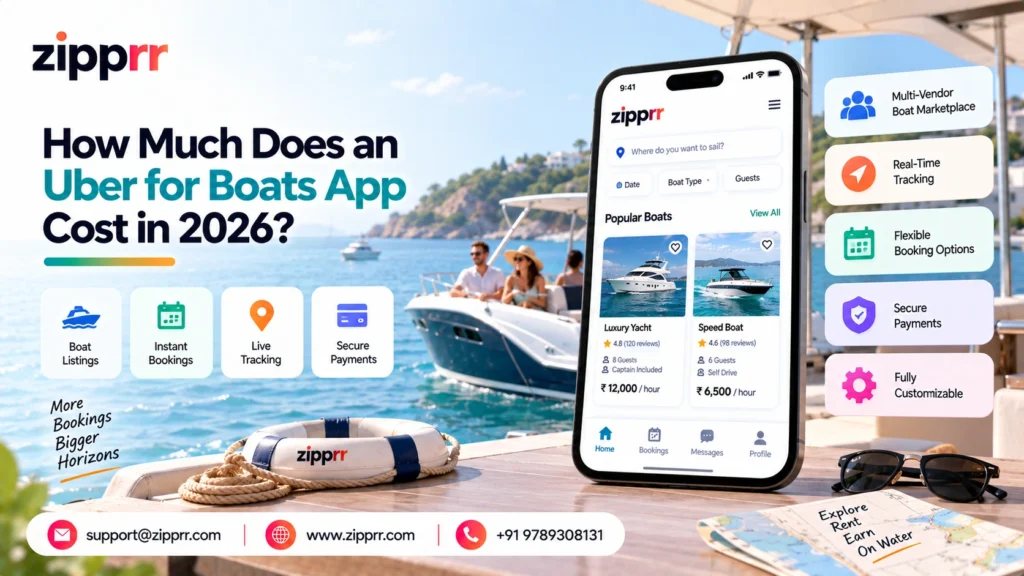
An Uber for boats app typically costs $490 to $890 as a one-time purchase with a ready-made script, or $20,000 to $80,000 and up if you build it from scratch with a development agency. A SaaS subscription model sits in between, usually running $21 to $1,000 or more per month depending on the provider and feature set. This question matters because boat and yacht rental is one of the few travel niches where demand keeps climbing while the number of serious digital platforms serving it stays small. Entrepreneurs asking this question are usually trying to figure out whether it is worth building a marine rental marketplace at all, and if so, which path gets them to market fastest without burning through their runway. We will walk through the real numbers, the features that actually matter, and how to launch without the guesswork.
What Is an Uber for Boats Business Model?
An “Uber for boats” model is an on-demand marketplace that connects people who own boats, yachts, jet skis, or pontoons with renters who want to use them for a few hours, a day, or a full charter. Think of it as the same playbook that made ride-hailing and short-term home rentals mainstream, applied to the water.
Owners list their vessels with photos, pricing, and availability. Renters search by location, dates, and boat type, then book and pay through the platform. The operator, that is you, takes a commission on every booking without ever owning a single boat.
This is important to clarify upfront: Zipprr’s Boat Rental Script is an independently developed software product. It is not affiliated with, endorsed by, or connected to Uber, Boatsetter, GetMyBoat, or any other brand referenced in this article for comparison purposes. Any resemblance in business model is purely functional, not a partnership.
The model works because it removes the two biggest barriers to boat ownership, the upfront cost and the maintenance headache, while still letting people enjoy time on the water. For owners, it turns an expensive, mostly-idle asset into a source of recurring income.
Why Are Entrepreneurs Investing in Boat and Yacht Rental Marketplaces?
The global boat rental market was valued at USD 25.52 billion in 2026 and is projected to reach USD 39.10 billion by 2034, growing at a CAGR of 5.48%, according to Fortune Business Insights. That is a steady, multi-year growth curve, not a short-term spike.
A few forces are driving this. Experiential travel keeps gaining ground over traditional package holidays, and a day on a boat is exactly the kind of shareable, memorable experience travelers now prioritize, which is part of why the Airbnb for boats model has become its own recognized category online. At the same time, boat ownership costs (storage, insurance, maintenance) keep rising, which pushes casual boaters toward renting instead of buying.
There is also a supply-side opportunity most entrepreneurs overlook. A huge percentage of privately owned boats sit unused for most of the year. Marina operators, boat clubs, and individual owners are increasingly open to listing their vessels on a rental platform because it turns a depreciating asset into an income stream.
Here is why this specific window matters for a new entrant:
- Coastal and lake-adjacent markets are underserved compared to how saturated ride-hailing and food delivery already are.
- Existing global platforms like Boatsetter and GetMyBoat cover major markets but leave regional and local operators with almost no dedicated software.
- A white-label script lets a local operator launch a branded platform for their specific region, marina network, or boat type instead of competing head-on with global apps.
For an entrepreneur or investor evaluating where to put capital, boat rental sits in a rare position: proven demand, real market data, and a supply side that is genuinely underserved by dedicated technology.
How Does an Uber for Boats Platform Actually Work?
A boat rental marketplace runs on three connected experiences: the renter app, the owner or vendor dashboard, and the admin panel. Each plays a distinct role in keeping bookings smooth and disputes rare.
For renters: they open the app, search boats near a location or marina, filter by boat type, capacity, price, and dates, then view a listing with photos, pricing, and owner reviews. Booking triggers a payment authorization, often with a security deposit hold, and a confirmation goes to both sides.
For boat owners: they list their vessel with pricing rules (hourly, daily, or seasonal), set availability on a calendar, and choose whether the rental includes a captain or is bareboat (self-operated by the renter, usually requiring license verification). Once a booking comes in, they accept, coordinate pickup or delivery, and get paid automatically after the rental period closes.
For the admin: you approve new vendor listings, manage commission rates, oversee dispute resolution, track payouts, and monitor platform-wide analytics from a single dashboard. This is also where you configure category rules, since a jet ski listing and a 40-foot yacht charter need very different pricing and verification logic.
The entire loop, search, book, pay, ride, review, is what makes this model scale. Every booking generates data (peak seasons, popular boat types, repeat renters) that feeds back into smarter pricing and marketing decisions.
Essential Features Every Boat Rental Marketplace Needs
Before comparing build-vs-buy costs, it helps to know exactly what a functioning platform requires. Skipping any of these usually means an expensive round of rebuilding later.
- GPS-based search and location filtering so renters can find boats near a specific marina, beach, or lake.
- Multi-vendor dashboards that let boat owners manage their own listings, pricing, and calendars independently.
- Availability calendar management to prevent double bookings across hourly, daily, and multi-day rentals.
- Secure payment processing with deposit holds so owners are protected against damage and no-shows.
- Captain and bareboat charter options, since some rentals need a licensed skipper and others do not.
- In-app messaging between renters and owners to confirm pickup details, marina access, and special requests.
- Ratings and reviews on both sides, which build the trust that any peer-to-peer marketplace depends on.
- Multi-gateway payment support (Stripe, PayPal, Razorpay, and regional processors) so you are not limited to one country or currency.
These are not “nice to have” additions. They are the baseline expectation renters and owners bring from using Airbnb, Turo, or Uber, and a platform missing any of them will feel unfinished by comparison. Deposit holds and multi-vendor dashboards are standard across Zipprr’s wider rental lineup too, including the P2P rental script, since peer-to-peer marketplaces share the same trust fundamentals regardless of category.
Advanced Features That Set Winning Platforms Apart
Once the essentials are covered, a handful of advanced features separate a platform that merely works from one that actually competes for bookings and repeat customers.
- Dynamic and seasonal pricing engines that automatically adjust rates for weekends, holidays, and high-demand months.
- Skipper and license verification workflows that confirm a renter is qualified before approving a bareboat charter.
- Loyalty points and coupon engines to reward repeat renters and drive referral bookings.
- Built-in CMS for landing pages and blog content, useful for local SEO around specific marinas or regions.
- Reseller and white-label rights, which matter if you plan to license the platform to other operators or marinas under your own brand.
- Analytics dashboards that break down revenue by boat category, season, and location.
The gap between essential and advanced features is usually where custom-built platforms blow past their original budget. Each of these sounds simple in a feature list, but building verification workflows or dynamic pricing logic from scratch is genuinely complex engineering work.
How Do Boat Rental Marketplaces Make Money?
A boat rental platform is not limited to a single revenue stream. Most successful operators layer two or three of the following:
- Commission per booking. The most common model, typically a percentage cut on every completed rental, charged to the boat owner, the renter, or split between both.
- Featured listings. Owners pay extra to have their boats appear higher in search results, similar to how Airbnb Plus works.
- Subscription or membership tiers. Frequent renters pay a monthly fee for discounted rates or priority booking access.
- Add-on services. Captain hire, fuel packages, catering, or watersport equipment rental bundled into the booking.
- Insurance and damage protection fees. A small charge added to every booking that covers a protection plan, which can also be a partner revenue share.
- Advertising. Local marinas, boat dealers, or watersport brands paying for visibility inside the app.
The right mix depends on your market. A platform focused on luxury yacht charters might lean heavily on commission plus add-on services, while a jet ski and pontoon rental app in a lake town might do better with volume-driven commission and featured listings.
What Technology Do You Need to Build This Platform?
At a technical level, an Uber for boats platform needs a web application, an admin panel, and native mobile apps for both renters and owners, all built on an architecture that can handle real-time availability updates without double-booking a vessel.
Common technology choices include PHP and Laravel for the backend (a stable, widely supported combination), Google Maps API for location search and GPS filtering, and native iOS and Android development for the mobile apps. Payment infrastructure needs to support multiple gateways since renters and owners may be in different countries.
Security matters more here than in many other marketplace types, because you are processing security deposits, sometimes verifying boating licenses, and handling higher-value transactions than a typical rideshare or delivery order. Card authorization holds, encrypted data storage, and role-based admin access are not optional extras.
This is exactly where the build-vs-buy decision becomes concrete. Every one of these technical requirements is something a development team has to design, build, and test from zero, or something you can get pre-built and already tested inside a ready-made script.
Custom Development vs. SaaS Subscription vs. Ready-Made Script: The Real Cost Comparison
This is the comparison most entrepreneurs actually need before deciding how to move forward. Here is how the three main paths stack up.
| Factor | Custom Development | SaaS Subscription | Zipprr Boat Rental Script |
|---|---|---|---|
| Cost | $20,000 to $80,000+ (one-time build) | $21 to $1,000+ per month, ongoing forever | $490 (Startup) or $890 (Pro), one-time payment |
| Timeline to launch | 3 to 12 months | Days, but limited customization | 7 business days |
| Source code ownership | Yes, if contracted correctly | No, you rent access | Yes, 100% unencrypted source code |
| Mobile apps included | Extra cost, separate project | Sometimes, often limited | Native Android and iOS with app store submission included |
| Customization freedom | Full control, full cost | Minimal, vendor-dependent | Full control over owned source code |
| Ongoing fees | Hosting and maintenance only | Recurring subscription forever | None beyond hosting; 90 days included support |
| Best for | Well-funded teams with a long runway and unique architecture needs | Testing an idea with minimal upfront risk | Founders who want to launch fast, own their platform, and control costs |
Custom development makes sense if you have a genuinely unique business model that no existing script can support, and the budget and patience for a 6 to 12 month build. SaaS subscriptions make sense for testing an idea for a few months before committing capital. For most entrepreneurs who have already validated demand in their region and want to launch and start generating revenue quickly, a one-time script purchase like the Boat Rental Script removes both the multi-month wait and the recurring subscription drag.
Business Benefits of Launching with a Ready-Made Script
Speed to market is the most obvious benefit, but it is not the only one. A 7-day launch means you can start collecting real user data and bookings while a custom-built competitor is still in wireframing.
Cost predictability is the second major benefit. A one-time payment of $490 or $890 means your total software cost is fixed from day one, with no surprise invoices or subscription creep eating into margins as you scale.
Owning the source code outright also means you are not locked into a vendor’s roadmap. If you want to add a feature, change the commission structure, or rebrand entirely, you control that timeline instead of waiting on a SaaS provider’s backlog.
Finally, a script built specifically for rental marketplaces already includes the features renters and owners expect (deposit holds, availability calendars, in-app messaging) instead of you having to specify, test, and debug each one from a blank page. The same one-time-purchase logic applies across Zipprr’s other rental verticals, from a self-drive car rental script to boat and yacht platforms.
Challenges in Boat Rental Marketplaces and How to Solve Them
Every rental marketplace faces friction points that are worth planning for before launch rather than discovering after your first bad booking.
Trust between strangers. Renters are handing over money to use someone else’s expensive asset, and owners are handing their boat to a stranger. Verified reviews, ID verification, and clear cancellation policies solve most of this over time.
Damage and liability disputes. A security deposit authorization hold, combined with a clear photo documentation step before and after each rental, prevents the majority of “who caused this damage” arguments.
Seasonality. Boat rentals spike in summer and drop sharply in colder months in most regions. Diversifying into year-round categories (covered boats, indoor storage rentals, or expanding to warmer secondary markets) smooths out revenue. If storage and off-season logistics interest you more than live rentals, starting an RV and boat storage business is worth exploring as a complementary or standalone model.
Licensing and safety compliance. Bareboat charters may require the renter to hold a boating license depending on the region and boat size. Building license verification into the booking flow, rather than handling it manually, keeps this from becoming a bottleneck.
Cold start problem. Like any two-sided marketplace, you need boat owners before you have listings, and listings before you have renters. Recruiting your first 20 to 30 boat owners directly, often with a reduced or waived commission for early adopters, is the fastest way through this stage.
None of these challenges are unique to boat rental. They are the same trust and liquidity problems every peer-to-peer marketplace solves, just with higher-value assets on the line.
Future Growth Opportunities in the Boat and Yacht Rental Industry
The category has room to expand well beyond simple day rentals. A few directions worth watching as you plan your roadmap.
Subscription-based boat access, where renters pay a monthly fee for a set number of outings, is gaining traction as an alternative to both ownership and one-off rentals. Corporate and event bookings (team outings, weddings, private parties) represent a higher-ticket segment that most boat rental apps currently underserve.
Bundling adjacent experiences, fishing charters, sunset cruises, watersport equipment, dive trips, turns a single-purpose rental app into a broader marine leisure marketplace. And as electric boats become more common, a platform that supports charging-station location data and electric-specific listings will have an early advantage in that segment. Operators already running Zipprr’s vacation rental script for stays often add boat rentals as a natural extension for coastal and lakefront properties.
Given that the market is still growing at a steady 5.48% CAGR through 2034 per Fortune Business Insights, there is a multi-year runway for operators who establish a strong regional presence now rather than waiting for the space to get more crowded.
How to Launch Your Uber for Boats Platform Successfully
A successful launch comes down to sequencing. Trying to do everything at once is the most common reason new marketplace platforms stall.
- Pick a focused launch region. One city, coastline, or lake district, not “nationwide,” gives you enough density to make the marketplace feel active from week one.
- Recruit your first boat owners before advertising to renters. A marketplace with renters and no boats fails immediately. Reach out directly to marinas, boat clubs, and individual owners.
- Choose your platform path. Decide between custom development, SaaS, or a ready-made script based on your budget and timeline, using the comparison table above.
- Set your commission and pricing structure before launch, not after your first disputes force the issue.
- Launch with a waived or reduced commission for your first cohort of owners to build listing density quickly.
- Market to renters once you have real listings, using local SEO, social proof from early bookings, and partnerships with tourism boards or hotels in your launch region.
- Track the metrics that matter early, booking completion rate, repeat renter rate, and average listing utilization, and adjust pricing or commission based on what you see.
Following this order, supply first, then demand, then optimization, is what separates marketplaces that reach sustainable booking volume from ones that quietly fade after a promising launch week.
What to Check Before You Buy a Boat Rental Script
A little diligence before you pay saves a lot of frustration after. These are the specific things worth confirming with any vendor, Zipprr included.
- Confirm exactly what ships in each plan (source code, native apps, license count) directly on the live product page, since packages and pricing change.
- Ask whether the source code is fully unencrypted and yours to modify, rather than a locked white-label shell you cannot touch.
- Check the payment gateway list against the countries you actually plan to launch in.
- Confirm the deposit-hold and cancellation logic before committing, since this is where most rental disputes start.
- Ask about the refund window and what happens if the platform does not fit your use case.
- Get support and update terms in writing, including duration, scope, and expected response time.
Key Takeaways
- A ready-made boat rental script costs a fraction of custom development and can launch in about a week instead of months.
- Commission, featured listings, and add-on services combine for the strongest revenue mix in this category.
- Trust, deposit disputes, and seasonality are the main operational challenges, and all three are solvable with the right platform features.
- Supply (boat owners) always needs to come before demand (renters) in a successful launch sequence.
- Owning the source code outright keeps you off a vendor’s roadmap and in control of your own timeline as you grow.
Ready to launch your boat or yacht rental marketplace?
Zipprr’s Boat Rental Script gets you a fully owned, source-code-included platform live in about 7 business days, without the six-figure price tag of custom development.